
Beyond the Panic: Why Software License Audit Preparation is a Continuous Discipline
For many C-suite executives, the term “software license audit” triggers a familiar sense of dread—an unscheduled, high-stakes examination of technology usage that often results in multi-million Rand true-up demands. The instinct is to react, assembling teams to firefight the immediate threat. Yet, this reactive stance is precisely what exposes an organisation to financial risk. The real problem isn’t the audit itself; it’s the absence of a continuous governance discipline that makes the audit feel like a crisis.
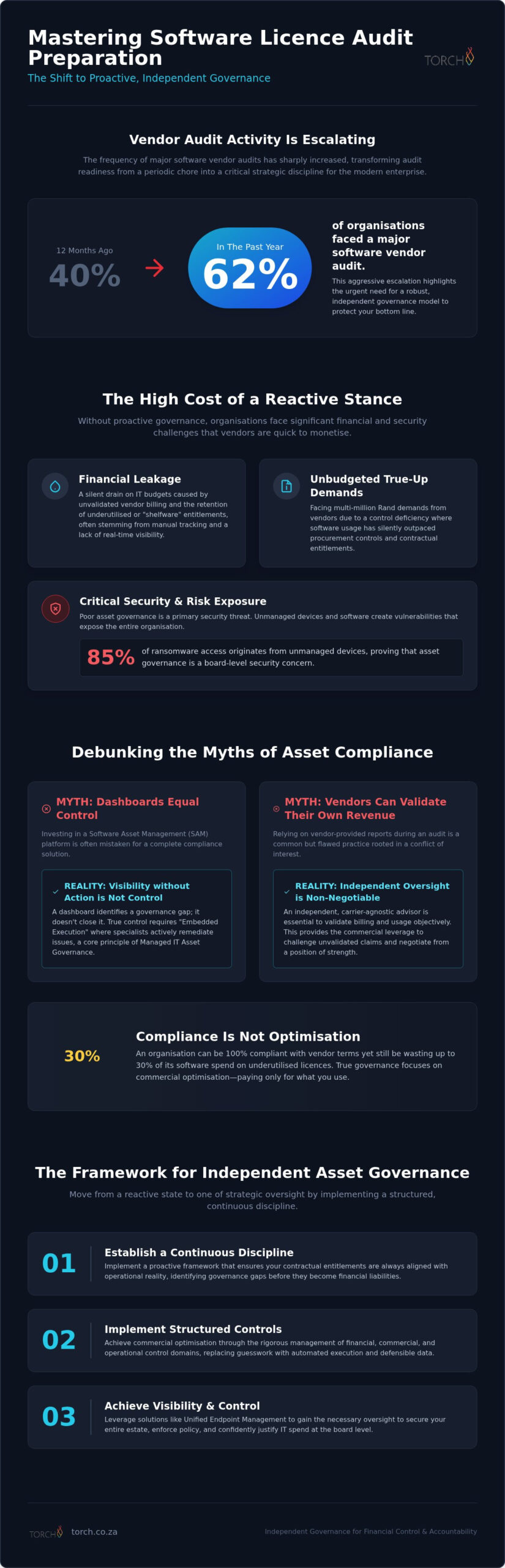
Recent industry data paints a stark picture of the audit landscape. According to Flexera’s 2025 State of ITAM Report, 50% of organisations were audited by Microsoft alone in the past three years. The financial consequences are significant: 45% of enterprises paid over $1 million in audit true-up costs during that same period, and the number paying over $10 million has nearly doubled since 2023. These figures underscore a critical reality: without a proactive strategy, audits are not a matter of if, but when—and at what cost.
Effective software license audit preparation is the proactive and continuous alignment of contractual entitlements with the operational reality of software consumption. It is not a one-time project but a sustained discipline. Reactive “fire-fighting” invariably leads to defensible data gaps, weak negotiating positions, and unnecessary financial exposure. The only sustainable way to manage vendor accountability and protect the bottom line is through a framework of Independent Governance—a shift from manual spreadsheets and panicked data collection to automated, governance-led execution that provides constant visibility and control.
The High Cost of Reactive Compliance
Over time, most large enterprises experience “operational drift,” a phenomenon where software usage organically outpaces procurement controls and contractual terms. New employees are onboarded, roles change, and projects scale, all leading to a software estate that no longer reflects its documented entitlements. This gap between reality and record-keeping is where significant risks accumulate. Unmanaged, unpatched, or unauthorised software installations not only create compliance liabilities but also serve as primary entry points for cyber threats. In fact, an estimated 85% of ransomware risks stem from unmanaged devices and assets within the corporate environment.
This lack of oversight also creates a significant financial drain. Financial leakage is the silent drain on IT budgets caused by unvalidated vendor billing and unoptimised license consumption. Without an independent, evidence-based view of what is actually being used, organisations are left to trust vendor-supplied data, which often leads to over-provisioning and over-payment. The costs are real, even if they are hidden within complex invoices and sprawling spreadsheets.
Reframing the Audit: From Threat to Governance Opportunity
An impending audit should not be viewed as a threat but as a catalyst for establishing robust financial and operational governance. A well-prepared software estate, backed by defensible data, restores board-level confidence in IT financial reporting. It transforms the IT department from a perceived cost centre into a strategically managed function with transparent, predictable spending. This is a core principle of IT FinOps, which seeks to create a culture of financial accountability and transparent cost centre allocation across the technology landscape.
By embracing a governance-led approach, the objective shifts from merely “surviving an audit” to “optimising the estate.” The goal becomes achieving a state of perpetual readiness, where vendor queries can be answered with confidence and contractual negotiations are driven by data, not defensiveness. This strategic reframing turns a moment of external pressure into an opportunity for internal strengthening, ensuring the organisation is not just compliant, but commercially optimised.
Debunking the Myths of Technology Asset Compliance
In the quest for audit readiness, many organisations fall victim to persistent myths that offer a false sense of security. These misconceptions often lead to investments in tools without the necessary governance framework, leaving them just as exposed as before. True compliance requires a clear-eyed understanding of what technology can and cannot do on its own.
- The misconception that software tools alone guarantee compliance. A dashboard can show you a problem, but it cannot solve it. Technology provides visibility; governance provides resolution.
- The idea that vendors are “partners” during an audit process. A software audit is a revenue-generating activity for the vendor. Their objective is to validate their billing and identify shortfalls, not to help you optimise your spend.
- The fallacy that “we have a SAM tool, so we are safe.” A Software Asset Management (SAM) tool is only as effective as the data it contains and the expert-led processes that govern it. Without active management, it becomes another underutilised, expensive piece of software.
- The belief that “compliance” equals “optimisation.” Being compliant simply means you are paying for everything you use. It does not mean you are only paying for what you need. Optimisation is the strategic next step that eliminates waste and aligns spend with business value.
Myth 1: Dashboards Equal Control
A common pitfall is equating visibility with control. Dashboards and reporting platforms are excellent at identifying discrepancies—such as unused licenses or unauthorised software—but they are passive observers. They highlight problems but rely on an already overburdened internal team to investigate, validate, and remediate them. This is the critical “governance gap” where most platform-only solutions fail.
True control comes from “Embedded Execution,” where a dedicated team of specialists is tasked not just with reporting issues but with resolving them. This approach, central to Torch’s Managed IT Asset Governance, ensures that insights from a platform are translated into concrete actions. Whether it is decommissioning “zombie licenses” for former employees or renegotiating a contract based on actual usage data, the focus is on driving outcomes, not just generating reports.
Myth 2: Vendors Should Validate Their Own Revenue
Relying on vendor-provided reports or allowing a software publisher to conduct its own audit is a fundamental conflict of interest. It is akin to letting a supplier write their own performance review. Vendors have a vested interest in maximising their revenue, and their data will naturally reflect that bias. To achieve a truly defensible position, organisations need an independent, carrier-agnostic advisor to validate billing, usage, and contractual adherence.
This independent validation provides the necessary commercial leverage during contract renegotiations. By using independent benchmarking data, an organisation can challenge assumptions, correct billing errors, and negotiate from a position of strength. This ensures that financial decisions are based on verified, objective reality, not on a vendor’s interpretation of it.
The Torch Framework for Independent Asset Governance
Regaining control over a complex software estate requires a structured, methodical approach. It cannot be achieved through ad-hoc efforts or last-minute scrambling. At Torch, we employ a proven 6-week framework designed to establish lasting governance by focusing on three critical control domains: Financial, Commercial, and Operational. This process systematically stress-tests procurement data against real-world usage, integrating inputs from Finance, HR, and IT to create a single, unified view of user-level consumption.
Step 1: Establishing Contractual and Commercial Control
The foundation of any defensible software estate is a deep understanding of its contractual and commercial obligations. This phase moves beyond a simple inventory to a rigorous financial audit.
- Contractual Analysis: We perform a meticulous review of all existing software license agreements, comparing them against market benchmarks using proprietary tools like TorchLight. This identifies non-standard terms, unfavourable clauses, and opportunities for commercial optimisation.
- Financial Leakage Detection: Before a vendor audit even begins, we proactively identify and quantify “silent financial leakage” in historical invoices. This process of validating billing against contractual rates and entitlements often uncovers significant discrepancies that can be reclaimed. This discipline is a direct parallel to our work in Telecom Expense Management, where independent invoice validation is key to spend control.
Step 2: Operational Visibility and Risk Mitigation
With a firm grasp of the commercial landscape, the next step is to align it with the operational reality on the ground. This requires real-time, granular visibility into what software is deployed, where it is running, and who is using it.
- Real-Time Governance: Using our SpotLight platform, we establish real-time governance visibility across every endpoint in the estate. This provides a continuous, accurate inventory of all installed software, replacing outdated spreadsheets with a dynamic, trustworthy data source.
- User-Level Mapping: We map software assets and licenses to specific user roles and cost centres. This crucial step helps eliminate “zombie licenses”—active subscriptions assigned to former employees or dormant accounts—which represent pure financial waste and a potential security vulnerability.
- Security Posture Enhancement: By identifying every asset, we can also pinpoint unmanaged and unpatched devices—the entry point for 85% of ransomware attacks. Integrating asset governance with security protocols creates a more resilient and defensible environment.
Securing the Estate: Restoring Confidence in IT Spend
The ultimate goal of software license audit preparation is not just to pass an audit but to establish a permanent state of control that reduces operational risk, eliminates financial leakage, and restores executive confidence in technology spend. Independent governance transforms IT from a reactive cost centre into a predictable, strategically managed business function whose financial data is both defensible and transparent.
A secure, governed environment is built on a foundation of complete asset visibility. By integrating software asset management with a robust Unified Endpoint Management (UEM) strategy, organisations can ensure that every device is known, managed, and compliant with both security and licensing policies. This unified approach closes the gaps that attackers and auditors alike seek to exploit, creating a stronger, more resilient enterprise. It provides the “defensible financial data” that is essential for accurate, confident board-level reporting, positioning Torch as the strategic partner that bridges the gap between Finance and IT.
Achieving Board-Level Spending Visibility
For a CFO, confidence in financial numbers is paramount. A governance-led approach provides this certainty through clear, consistent, and verifiable reporting. Monthly IT finance packs, backed by independently validated data, replace ambiguity with clarity, allowing for accurate forecasting and strategic planning. This enables powerful “scenario modelling,” allowing leadership to understand the financial impact of major license renewals or technology platform shifts before committing capital.
By transforming raw usage data into financial intelligence, organisations can build a more predictable and optimised technology budget. For those looking to extend this discipline beyond software, our guide to Automated IT Asset Tracking offers further strategies for enterprise-wide cost savings and governance.
Next Steps: Establishing Your Control Doctrine
The time to prepare for a software audit is now, not when the notification letter arrives. By shifting from a reactive audit posture to a proactive “managed risk” stance, organisations can retake control of their technology estate and their vendor relationships. This requires an operationally embedded team capable of managing the environment continuously and handling vendor disputes with data-driven confidence.
This is the essence of the Hero archetype: rescuing budgets and restoring order through rigorous accountability and expert execution. By establishing a robust, independent governance framework, your organisation can move beyond the cycle of audit panic and unlock the full commercial value of its technology investments.
Ready to move from reactive audit defence to proactive estate governance?
Book a 30-minute governance review with Derek King — no obligation, no sales pitch.
Frequently Asked Questions (FAQs)
What is the most common mistake in software license audit preparation?
The most common mistake is treating audit preparation as a one-time, reactive project. Organisations that scramble to collect data only after receiving an audit notice are already at a disadvantage. They lack the historical usage data and contractual clarity needed to challenge vendor findings effectively. The most effective approach is to maintain a state of continuous, proactive governance where compliance is a managed discipline, not an emergency response.
How does independent governance differ from standard Software Asset Management (SAM)?
Standard SAM often focuses on the technical task of inventory and reconciliation, frequently relying on a software tool. Independent governance is a broader strategic discipline that encompasses the financial, commercial, and operational domains. It includes not only technical discovery but also independent contract benchmarking, invoice validation, and the embedded execution needed to resolve discrepancies. It prioritises commercial optimisation and financial accountability, ensuring an organisation is not just compliant but is also achieving the best possible value from its technology spend.
Can a platform-only solution protect us from audit true-ups?
A platform or tool alone is rarely sufficient. While dashboards can provide valuable visibility into your software estate, they only identify problems; they do not solve them. Without an expert-led governance process to interpret the data, manage remediation, and engage with vendors, the insights from a platform often go unactioned. True protection comes from combining a powerful platform with embedded execution by specialists who can turn data into financial outcomes.
Why is it risky to let vendors conduct their own software audits?
Allowing a vendor to audit your organisation creates a significant conflict of interest. A software audit is a revenue-generating activity for the vendor, and their primary goal is to identify non-compliance that results in a true-up fee. Relying on their findings means accepting their data and their interpretation of complex licensing rules without independent validation. An independent advisor works solely for you, ensuring that any findings are verified and that your position is defended with objective, defensible data.
How does unmanaged software affect South African ransomware risk?
Unmanaged software and devices are a primary vector for cyberattacks. Industry data indicates that 85% of ransomware gains access through unmanaged endpoints. In the South African context, where enterprises are frequent targets, any unauthorised or unpatched software represents a significant security vulnerability. A robust asset governance programme that identifies and manages every piece of software on the network is therefore a critical component of a modern cybersecurity strategy, directly reducing the attack surface available to threat actors.
What are the benefits of a risk-share savings model for license optimisation?
A risk-share savings model aligns the incentives of the organisation and its governance partner. In this model, the partner’s compensation is tied directly to the measurable financial savings they deliver through license optimisation, contract renegotiation, or the recovery of over-payments. This performance-based approach ensures the partner is fully invested in achieving tangible financial outcomes, moving beyond simple reporting to deliver real, quantifiable value to the bottom line.