
In the current South African economic climate, Chief Financial Officers are under immense pressure to fortify the bottom line. Margin compression, driven by inflation and operational challenges like load-shedding, has made every line item on the budget a target for scrutiny. Amongst these, the enterprise IT and telecommunications estate often represents one of the largest and most opaque operational expenditures. Traditional approaches to cost-cutting, however, frequently fall short. Generic mandates to “reduce spend” often lead to operational drift, compromise security, and fail to address the root cause of financial leakage.
The fundamental challenge is not one of expense, but of governance. Without a framework of independent oversight, large organisations lose control of their technology spend, allowing billing errors, redundant assets, and misaligned contracts to drain budgets silently. This article moves beyond generic tips to provide a strategic framework for IT cost reduction in South Africa. It presents a governance-led checklist designed for financial leadership, demonstrating how visibility and control are the only sustainable forms of optimisation.
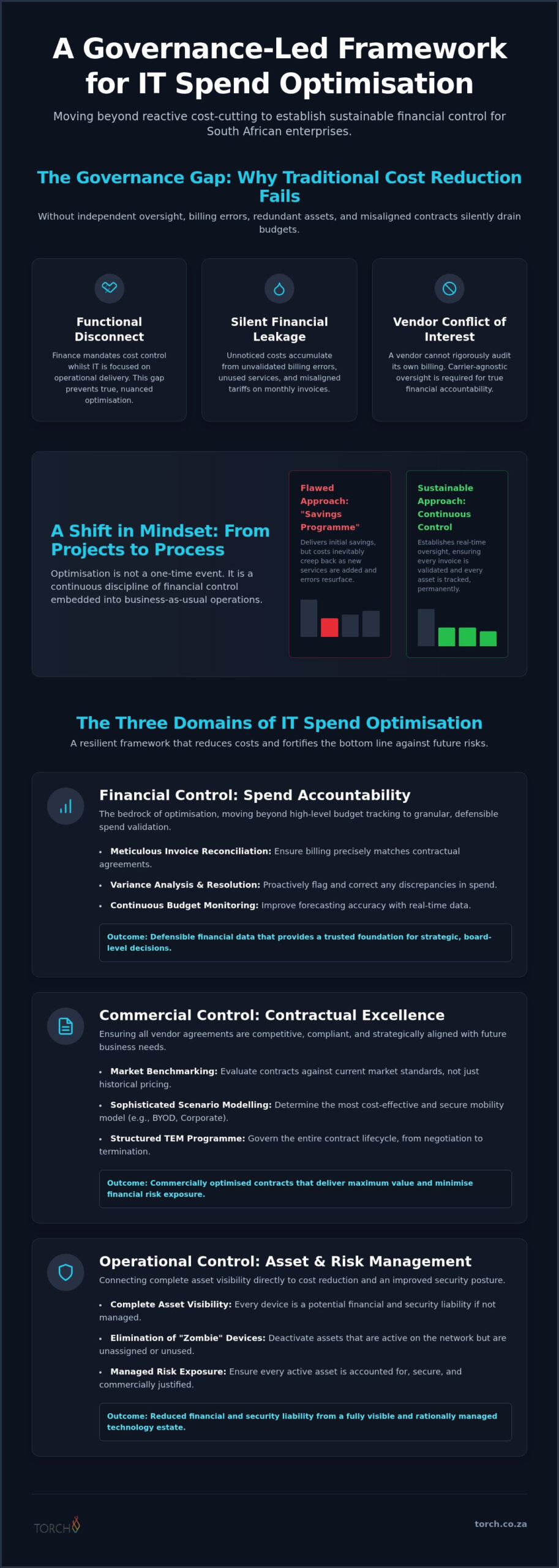
The Governance Gap: Why Traditional IT Cost Reduction Fails in South Africa
For many South African enterprises, a significant “Governance Gap” exists between the Finance and IT functions. Finance mandates cost control, whilst IT is responsible for operational delivery and stability. Without a specialist mandate bridging these two functions, attempts at cost reduction often fail. Generic cost-cutting measures, such as blanket freezes on new projects or arbitrary budget reductions, can inadvertently increase operational risk and disrupt business-critical services. True optimisation requires a more nuanced approach.
This gap is most apparent in complex technology estates, particularly in telecommunications, where “silent financial leakage” is common. This leakage is the accumulated cost of unvalidated billing errors, unused services, and misaligned tariffs that go unnoticed in monthly invoices. The first and most critical step in any defensible cost reduction strategy is therefore not cutting, but clarifying. Establishing comprehensive visibility across every asset, contract, and invoice is the non-negotiable prerequisite for taking control.
The Conflict of Interest in Carrier-Led Management
Many organisations rely on their network carriers to provide management platforms and reporting tools. Whilst these platforms can offer a degree of visibility, they present a fundamental conflict of interest: a vendor cannot be expected to rigorously audit its own billing or proactively identify revenue streams it stands to lose. In the complex South African market, with major players like MTN, Vodacom, and Telkom, achieving true financial accountability requires carrier-agnostic oversight.
An independent governance partner works exclusively for the client, not the carrier. Their sole objective is to validate expenditure, correct inaccuracies, and optimise service levels against market-best benchmarks. This separation of duties is crucial for enforcing contractual terms and ensuring that the organisation only pays for what it has agreed to and actively uses. As a guiding principle: Independent governance ensures vendor accountability that internal teams often lack the specialist data to enforce.
From One-Time Savings to Continuous Financial Control
The mindset of a “savings programme” is inherently flawed because it treats cost reduction as a one-time event. An initial audit may deliver significant savings, but without a permanent change in governance, those costs inevitably “creep” back over time as new services are added, contracts auto-renew, and billing errors resurface. A more sustainable approach is the “Torch Control Doctrine,” which reframes optimisation as a continuous discipline of financial control.
This doctrine involves embedding financial and operational governance directly into the management of the technology estate. Instead of periodic audits, it establishes real-time oversight, ensuring that every invoice is validated, every asset is tracked, and every contract is optimised on an ongoing basis. This is the core principle behind managed financial operations, or IT FinOps, which transforms cost reduction from a reactive project into a proactive, embedded business function.
The Three Domains of IT Spend Optimisation
To establish lasting control, IT spend must be governed across three interconnected domains: Financial, Commercial, and Operational. When these three pillars work in concert, they create a resilient framework that not only reduces costs but also fortifies the bottom line against future risks and inefficiencies. Effective executive decision-making depends on receiving data-backed recommendations that synthesise insights from all three areas. This is achieved by leveraging proprietary intelligence tools, such as TorchLight, which provide market benchmarking and predictive analytics to guide strategic choices.
Financial Control: Spend Accountability
Financial control is the bedrock of any optimisation strategy. It moves beyond high-level budget tracking to focus on granular spend accountability. This involves meticulous invoice reconciliation to ensure billing matches contractual agreements, variance analysis to flag and resolve discrepancies, and continuous budget monitoring to improve forecasting accuracy. For already over-extended finance teams, the manual workload of this process can be prohibitive. FinOps-as-a-Service provides the specialist resources and automated platforms to manage this function, delivering “defensible financial data” that stands up to scrutiny in board-level reporting and provides a trusted foundation for strategic decisions.
Commercial Control: Contractual Excellence
Commercial control focuses on ensuring that all vendor agreements are not only competitive but also strategically aligned with the organisation’s future needs. This requires benchmarking corporate mobile contracts against 2026 market standards, not just historical pricing. Furthermore, it involves sophisticated scenario modelling to determine the most cost-effective and secure mobility model—whether it be company-owned devices, Bring Your Own Device (BYOD), or a hybrid approach. The vehicle for achieving this is a structured Telecoms Expense Management (TEM) programme that governs the entire lifecycle of a contract, from negotiation to renewal and termination.
Operational Control: Asset and Risk Management
Operational control connects asset visibility directly to both cost reduction and security posture. Every unmanaged or untracked device is a potential financial and security liability. “Zombie” devices—assets that are still active on the network but assigned to no user—and unused software licences drain budgets silently month after month. Establishing complete endpoint visibility is therefore a dual-purpose strategy. It allows an organisation to eliminate wasteful spend on unused assets whilst simultaneously closing the security gaps that these unmanaged endpoints create. A Unified Endpoint Management (UEM) framework is the mechanism for securing, governing, and optimising these assets at scale; for enterprises exploring more tailored technology environments, Cornerstone Business Solutions provides an example of how bespoke IT services can enhance operational efficiency.
2026 Checklist: IT Cost Reduction Strategies for South African Enterprises
For CFOs and CIOs seeking to close the governance gap, a structured approach is essential. This high-level checklist is designed to identify specific control deficiencies within your IT estate. Each point represents an opportunity to reclaim control, reduce financial leakage, and improve operational resilience. By systematically addressing these areas, South African enterprises can unlock significant efficiencies, with actively governed estates delivering up to 47.2% in total savings based on our client data.
Audit and Validation Checklist
- Validate Invoices Against Contracts: Scrutinise the last three months of telecom invoices line-by-line against your master service agreements. Identify and dispute any discrepancies in rates, fees, or service charges.
- Identify “Zombie” Assets: Conduct a full audit of your mobile fleet to identify “zombie” SIMs and zero-usage data lines. Deactivate these services to stop immediate financial leakage across your national estate.
- Reconcile Software Licences: Verify active software licence counts (e.g., Microsoft 365, Salesforce) against current employee directories and usage data. Re-harvest or terminate unused licences to cut recurring costs.
- Define and Measure Silent Leakage: Establish a clear definition of “silent leakage” as the accumulated cost of unvalidated billing errors and unused services, and begin tracking it as a key financial metric.
Contractual and Strategic Checklist
- Benchmark Mobile Data Rates: Analyse your current mobile data rates against the projected average South African corporate usage trend of 24.0 GB per user per year for 2026. Use this data to renegotiate more favourable terms with your carriers.
- Review BYOD and Hybrid Policies: Assess your HR and IT policies for Bring Your Own Device (BYOD) to ensure no unmanaged or unsecured personal devices are accessing corporate data, creating both security and cost risks.
- Model the “Two-Phone Problem”: Quantify the costs associated with employees carrying separate personal and work devices. Model the potential savings and security benefits of consolidating to a secured, single-device hybrid model.
Risk and Security Alignment
- Audit High-Risk Endpoints: Recognise that up to 85% of endpoints can serve as primary ransomware entry points. Conduct a thorough audit to ensure every device accessing your network is known, managed, and secured under a single governance framework.
- Calculate the Cost of Inaction: Calculate the potential financial impact of a breach, where average recovery costs in South Africa can reach R24 million (excluding the ransom itself), versus the investment in managed governance to prevent it.
- Govern All Connected Devices: Ensure your governance framework extends beyond laptops and smartphones to include all IoT and remote operational devices, bringing them under a single UEM policy to minimise your attack surface.
Implementing Independent Governance: The Torch Approach
In a complex and often opaque technological environment, independent governance provides the steady hand needed to navigate financial and operational challenges. Torch acts not as a vendor, but as an embedded partner responsible for execution. Our model is not to simply report issues in a dashboard, but to have our specialist staff actively resolve them—correcting billing errors with carriers, decommissioning unused assets, and optimising contracts. This hands-on approach compresses timelines, moving from the identification of a challenge to a final procurement decision in as little as six weeks. The ultimate outcome of our engagement is the restoration of two critical business assets: visibility and control.
The Torch Control Architecture
Our methodology is powered by a proprietary control architecture. SpotLight, our real-time visibility platform, provides financial leadership with a single source of truth for budget versus actual spend oversight. It replaces disparate spreadsheets and carrier portals with a unified, validated data environment. Complementing this is TorchLight, our competitive intelligence engine, which detects silent financial leakage by benchmarking your costs against the wider market. It is crucial to understand that the platform is the tool, but our embedded expertise and execution deliver the governance.
Next Steps for Financial Leadership
The journey from an overloaded, reactive cost centre to an optimised, controlled technology function begins with a single step. By embracing independent governance, your organisation can transition from a state of financial uncertainty to one of clarity and accountability. Our carrier-agnostic advantage ensures that our recommendations are guided solely by your best interests, providing the leverage needed to drive meaningful change within the South African business landscape. If you are ready to close the governance gap and establish lasting financial control, we invite you to take the next step.
Book a 30-minute governance review with Derek King — no obligation, no sales pitch.
Frequently Asked Questions (FAQs)
Why should we not use our telecom carrier’s management platform for cost reduction?
Whilst carrier-provided platforms can be useful for basic usage monitoring, they present a clear conflict of interest in the context of cost reduction. A carrier’s primary objective is to protect and grow its revenue. Their platforms are not designed to proactively identify their own billing errors, highlight more competitive tariffs available elsewhere, or recommend strategies that would reduce your spend with them. Independent governance provides an essential layer of third-party validation, ensuring that all billing is accurate, all contractual terms are met, and your commercial strategy is aligned with your interests, not your vendor’s.
How much can a South African enterprise realistically save through IT cost reduction?
The potential savings vary based on the size and complexity of the IT estate and the maturity of existing governance processes. However, based on our analysis of client estates across South Africa, we have found that actively governed environments can achieve up to 47.2% in total savings. These savings are not derived from compromising service quality but from eliminating waste—correcting billing errors, decommissioning unused assets, optimising contracts, and right-sizing service plans.
What is the difference between IT FinOps and traditional accounting?
Traditional accounting is typically retrospective, focusing on recording and reporting historical spend. IT FinOps, by contrast, is a proactive and continuous management discipline. It integrates financial accountability directly into the operational management of technology. Instead of just tracking what was spent last quarter, FinOps focuses on real-time visibility, predictive forecasting, and ongoing optimisation to ensure that every rand spent on technology delivers maximum business value. It is a cultural and operational shift that aligns technology decision-making with financial objectives.
Is cost reduction in IT separate from cybersecurity strategy?
No, they are fundamentally linked. A lack of visibility and control over IT assets—a primary source of financial waste—is also a primary source of security risk. Every unmanaged device, unused software licence, or “zombie” SIM is a potential entry point for a cyberattack. Our data shows 85% of ransomware attacks originate from such endpoints. By implementing a governance framework to track and manage every asset, you simultaneously eliminate wasteful spending and reduce your organisation’s attack surface. The financial case is compelling: the median ransom demand in South Africa is R18 million, whilst the average cost to recover from a breach can reach R24 million, even before any ransom is paid. Investing in governance is a direct investment in risk mitigation.
How long does it take to see results from an IT expense management programme?
An effective, execution-led programme can deliver results remarkably quickly. Whilst deep contractual changes may take longer, initial savings from correcting billing errors and deactivating unused assets can often be realised within the first billing cycle. Our “embedded execution” model is designed for speed, with a typical timeframe of six weeks to move from initial analysis to a final, data-backed procurement decision, ensuring that value is delivered swiftly.
Can we implement these strategies without hiring more internal staff?
Yes. The goal of a managed governance service, such as FinOps-as-a-Service, is to provide the specialist expertise and operational capacity that internal teams often lack, without increasing your headcount. The service is designed to augment your existing Finance and IT teams, taking on the time-consuming, specialised work of invoice reconciliation, asset auditing, and vendor management. This frees up your internal resources to focus on their core strategic responsibilities; click here to learn more about ZANGAARD and their specialised IT delivery models.