
The Governance Gap: Why Traditional Telecom Negotiation Fails
For most large South African enterprises, the term “telecom contract negotiation strategies” evokes a cyclical, often adversarial, procurement event. It is seen as a time-bound project to secure better rates before the pressure of a renewal deadline forces a decision. This perspective, however, is precisely why so many organisations leave significant value on the table. A truly effective strategy reframes negotiation not as a one-time bargaining session, but as a continuous governance discipline—a systematic process of aligning commercial agreements with operational reality.
The primary challenge lies in a structural governance gap. Internal procurement and IT teams, despite their best efforts, often lack the carrier-agnostic benchmarking data needed to challenge proposals from major providers confidently. They are negotiating from an information disadvantage, leading to what we term “silent financial leakage.” This is not an overt billing error but a slow, persistent drain caused by misaligned subscriptions, unchallenged rate escalations, and the quiet impact of auto-renewal clauses. As a Sage archetype in this complex environment, an independent advisor provides the crucial clarity and deep industry knowledge needed to bridge this gap, transforming negotiation from a defensive tactic into a strategic financial control.
The Problem of “Silent Financial Leakage”
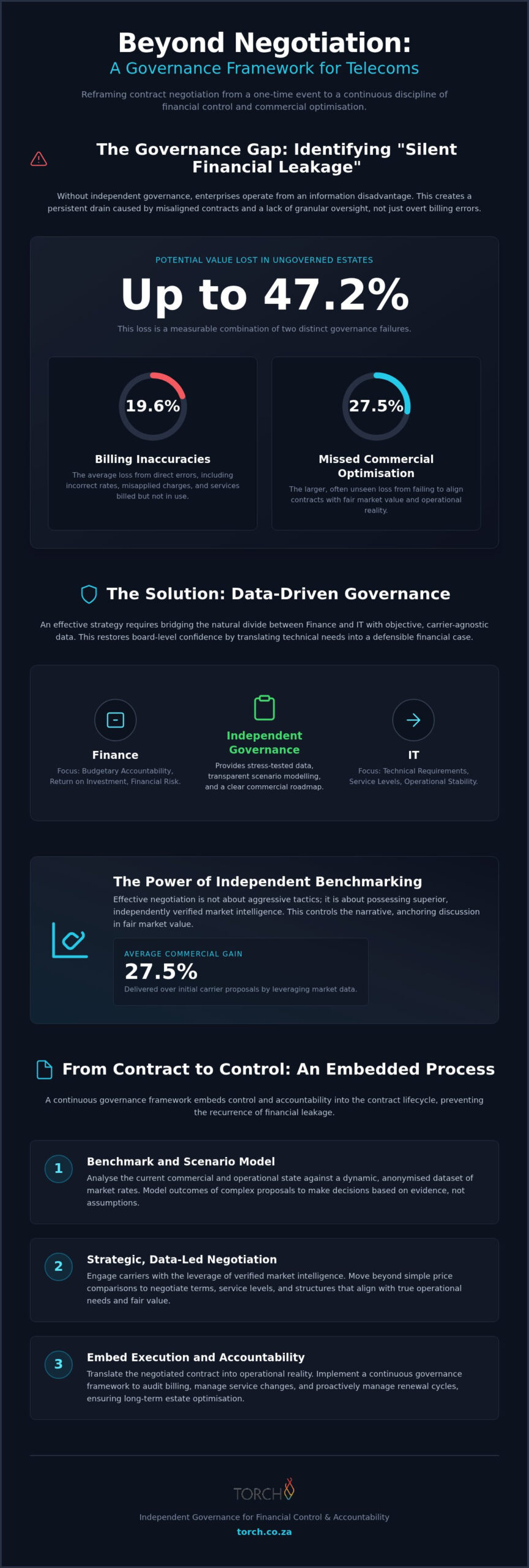
Financial leakage in a telecom estate is rarely the result of a single catastrophic failure. Instead, it is the cumulative effect of administrative drift and a lack of granular oversight. Our data-driven analysis of enterprise estates reveals a startling reality: unmanaged or poorly governed telecom environments can lose up to 47.2% of their potential value. This loss is not theoretical; it is a measurable combination of billing inaccuracies (averaging 19.6%) and, more significantly, missed commercial optimisation opportunities (averaging 27.5%).
- The danger of “auto-renewal traps”: A common feature in South African enterprise contracts, automatic renewal clauses can lock organisations into outdated terms and pricing models. Without a proactive governance framework to manage renewal timelines, enterprises forfeit their primary point of leverage and accept legacy rates as the new baseline.
- “Savings programme” vs. “governance framework”: A one-off “savings programme” might deliver a temporary reduction in costs, but it fails to address the underlying causes of overspending. A continuous governance framework, by contrast, embeds control and accountability into the lifecycle of the contract, preventing the recurrence of financial leakage and ensuring the estate remains optimised over the long term.
Bridging the Finance and IT Divide
The governance gap is often widened by a natural tension between Finance and IT departments. IT leaders are rightly focused on technical requirements, service levels, and operational stability. CFOs and financial teams are driven by budgetary accountability, return on investment, and mitigating financial risk. This can create a conflict where technical decisions are made without a full appreciation of their commercial implications, and financial targets are set without understanding the operational nuances.
- The conflict of interest in carrier-led audits: Allowing a carrier to validate its own billing or audit its own contract is a fundamental control deficiency. Carriers are not incentivised to find errors in their favour or to proactively recommend more cost-effective configurations that would lower their revenue. True financial control requires independent, objective verification.
- Restoring board-level confidence: An independent advisor acts as a crucial bridge between these two functions. By providing stress-tested data, transparent scenario modelling, and a clear commercial roadmap, they translate technical needs into a defensible financial case. This restores board-level confidence that IT spend is not just a cost centre, but a well-managed and strategically optimised investment.
Data-Driven Leverage: Benchmarking and Scenario Modelling
Effective negotiation is not about aggressive tactics; it is about possessing superior data. The most significant advantage an enterprise can bring to a renewal discussion with carriers like Vodacom, MTN, or Telkom is independently verified market intelligence. Without it, you are negotiating based on the carrier’s view of the market. With it, you control the narrative, anchoring the discussion in fair market value and proven operational models.
This data-driven approach moves the process beyond simple price comparisons. It involves stress-testing commercial proposals against the complex realities of your operational environment—from specific user profiles to diverse property requirements. Our procurement modelling engine, TorchLight, was developed for this exact purpose. It provides the analytical horsepower to model outcomes, compare complex proposals on a like-for-like basis, and make decisions based on evidence, not assumptions.
Case Study Insight: When Tsogo Group faced this challenge across four major providers, our governance-led approach used this combination of benchmarking and modelling to move them from a complex, multi-vendor challenge to a clear, defensible decision in just six weeks. This demonstrates that with the right data, even the most intricate negotiations can be executed with speed and confidence.
The Power of Independent Benchmarking
Internal teams are typically limited to their own historical spending data and the proposals presented to them by carriers. This creates an echo chamber where “market rates” are defined by the very entities you are negotiating with. Independent benchmarking breaks this cycle by providing access to competitive intelligence that is otherwise invisible.
- Accessing real-world competitive intelligence: An independent advisor maintains a dynamic, anonymised dataset of current commercial agreements, rate structures, and service level agreements (SLAs) across various industries, including the highly competitive South African financial sector.
- Comparing proposals against market reality: This allows you to compare a carrier’s “best and final offer” not just against their competitors’ proposals, but against what other enterprises of a similar scale are actually paying for comparable services right now.
- Unlocking significant commercial gains: Our analysis consistently shows that leveraging independent market benchmarking in telecom contract negotiations delivers an average commercial gain of 27.5% over initial carrier proposals.
Scenario Modelling: COPE vs. BYOD vs. Hybrid
One of the most complex decisions facing enterprises is their mobility model: Company-Owned, Personally Enabled (COPE), Bring Your Own Device (BYOD), or a hybrid approach. The right choice has significant implications for cost, security, and administrative overhead. A generic proposal from a carrier will rarely account for the specific nuances of your workforce.
- Mapping mobility models to user profiles: Scenario modelling allows you to map different mobility strategies to specific user personas within your organisation. A field technician has different needs from a C-suite executive or a call centre agent. A data-backed model ensures the solution fits the user, not the other way around.
- Stress-testing for “hybrid nuances”: A hybrid model is often the most effective but also the most complex to manage. Before signing a contract, it is critical to stress-test how the proposed commercial terms will apply to different user groups, data usage patterns, and security policies to avoid unforeseen costs or administrative burdens.
- Reducing administrative burdens: By making these decisions with clear data, you can significantly reduce the subsequent administrative load on IT and HR teams, ensuring a smoother implementation and a more sustainable long-term model.
Strategic Negotiation Tactics for Commercial Optimisation
Armed with independent data, the focus of negotiation shifts from haggling over a few percentage points to architecting a commercially optimised contract that provides long-term control. This involves embedding specific clauses and frameworks that protect your interests and ensure the agreement remains competitive throughout its lifecycle. The goal is to build a “governed estate” rather than achieve a one-time cost reduction.
One of the most common objections we encounter is, “We have a procurement team; we can handle this internally.” Whilst a skilled procurement team is invaluable, they are often tasked with managing dozens of spend categories. They cannot be expected to possess the same level of specialised, carrier-specific market intelligence as a dedicated firm that lives and breathes telecom governance. The value of an independent advisor is to augment that internal expertise with unparalleled market depth, turning a good outcome into an exceptional one. A key part of this is integrating the principles of Telecom Expense Management (TEM) directly into the contractual language from day one.
Essential Clauses for Enterprise Control
The standard-form contracts provided by major carriers are written to favour the provider. Strategic negotiation involves modifying this boilerplate language to restore a balance of power and embed mechanisms for enterprise control. Three areas are non-negotiable:
- Eliminating or modifying Automatic Renewal Clauses: The default clause should be changed to a requirement for mutual written consent for any extension. At a minimum, the notification period for termination should be reduced to a reasonable timeframe (e.g., 90 days) to preserve your agility.
- Defining and limiting Minimum Annual Revenue Commitments (MARC): If a MARC is unavoidable, it must be clearly defined, reasonable, and flexible. The contract should specify exactly which services contribute to the commitment and include provisions for downward adjustment in the event of significant changes to your business, such as divestitures or workforce reductions.
- Securing audit and reconciliation rights: The contract must explicitly grant your organisation, or a designated third party, the right to audit carrier billing and service records. This clause should detail the process for raising disputes and the carrier’s obligation to provide credits for any verified overcharges within a specified timeframe.
Usage Optimisation and Real-Time Governance
A contract sets the commercial foundation, but value is realised through ongoing management. The agreement must be flexible enough to adapt to changing user behaviour and market conditions.
- Calibrating subscriptions to actual behaviour: User needs evolve. An employee who once required a high volume of voice minutes may now be a heavy data user. The contract should allow for the frictionless recalibration of plans and subscriptions to align with these real-world trends, preventing waste on unused allowances.
- Negotiating for future data growth: According to the 2025 GetMetrix report, average enterprise data usage is climbing to 24.0 GB per user per year. Your contract should anticipate this growth, securing competitive data rates not just for today’s usage but for the projected needs over the next 24-36 months.
- Including “Market Review Clauses”: To protect against being locked into uncompetitive pricing, a Market Review Clause is essential. This contractual right allows you to request a pricing review if market rates for comparable services fall significantly during the contract term, ensuring your agreement remains fair and competitive.
From Contract to Control: Embedding Execution and Accountability
Signing a well-negotiated contract is a critical milestone, but it is not the final destination. The most carefully constructed agreement will fail to deliver its full value if it is not supported by rigorous execution and continuous accountability. A software platform alone is not enough; it can report on problems, but it cannot solve them. True control comes from embedding governance into your operational fabric.
This is the core principle of a modern IT FinOps approach: restoring absolute confidence in IT spend by creating a direct, transparent link between financial data and technical operations. Tools like our SpotLight platform provide the real-time visibility needed for budget-versus-actual oversight, but their power is magnified when coupled with an expert team dedicated to acting on those insights. This is where the Hero archetype comes to the fore, actively rescuing budgets through meticulous auditing and holding vendors accountable to their contractual commitments.
Managed Risk Exposure and Security
In today’s environment, telecom governance cannot be separated from security and compliance. Unmanaged mobile devices represent a significant vector for cyber threats and data breaches. Effective contract negotiation must position endpoint security within the broader framework of IT governance, ensuring the commercial agreement supports, rather than hinders, your security posture.
- Managing financial and operational risk: The stakes are high. Beyond the direct costs, an incident can cause severe reputational damage and operational disruption. It is crucial to manage the risk associated with unmanaged devices, where the average recovery cost from a single incident in South Africa can reach R24 million, excluding the ransom demand itself.
- Ensuring POPIA compliance: The Protection of Personal Information Act (POPIA) places strict requirements on how organisations handle personal data. A governed mobility estate, supported by automated reporting and clear policies, is fundamental to demonstrating and maintaining compliance.
The Torch Control Doctrine
At Torch, we operate under a core doctrine: sustainable optimisation is built on a foundation of commercial control. This philosophy shapes our entire approach, moving beyond the limited scope of a one-time negotiation to deliver a continuously managed and secure technology estate.
- Why control is the foundation of sustainable optimisation: Cost savings achieved without underlying control are temporary and illusory. They are quickly eroded by billing errors, administrative drift, and unmanaged usage. By establishing robust governance first, the resulting optimisations are structural, defensible, and lasting.
- Embedded staff resolve issues, not just report them: Our model goes beyond passive monitoring. Our embedded governance experts act as an extension of your team, tasked with not only identifying discrepancies but actively resolving them with carriers. This frees your internal teams to focus on strategic initiatives rather than chasing billing disputes.
- Transitioning to a well-secured and managed estate: The ultimate goal of a governance-led negotiation is a seamless transition from a reactive, unpredictable cost centre to a proactive, well-managed technology estate where costs are predictable, risks are managed, and performance is aligned with strategic business objectives.
Ultimately, a successful telecom negotiation strategy is one that looks beyond the renewal date. It establishes a framework for visibility, accountability, and control that delivers value for the entire life of the agreement and positions your organisation for even greater success in the future.
Take the first step towards commercial control. Let us run a no-cost telecom billing audit against your last three months of invoices.