
In South Africa, there are now over 127 million mobile connections—more than double the country’s population. For CFOs and CIOs, this explosion in connectivity represents a significant governance challenge. Each device connecting to your corporate network is a potential entry point for ransomware, a source of hidden financial leakage, or a compliance risk under the Protection of Personal Information Act (POPIA).
Choosing the right enterprise mobility model—Corporate-Owned, Personally-Enabled (COPE), Bring Your Own Device (BYOD), or Choose Your Own Device (CYOD)—is no longer a simple IT policy decision. It is a foundational choice that dictates your organisation’s financial control, security posture, and operational efficiency for years to come. Making the wrong choice, or having no formal policy at all, creates governance gaps that can lead to significant financial and reputational damage.
This guide provides a strategic framework for comparing COPE, BYOD, and CYOD, moving beyond surface-level pros and cons to focus on what matters most to enterprise leadership: commercial optimisation, risk mitigation, and sustainable cost control.
Navigating the Enterprise Mobility Landscape: Why Policy Choice Matters in 2026
For years, many organisations adopted a “laissez-faire” approach to mobile devices, allowing employees to connect personal phones to corporate resources with minimal oversight. This approach, often mistaken for a cost-saving measure, has created a landscape of unmanaged endpoints that represent a severe governance gap. In 2026, with hybrid work now standard practice, these gaps are no longer acceptable.
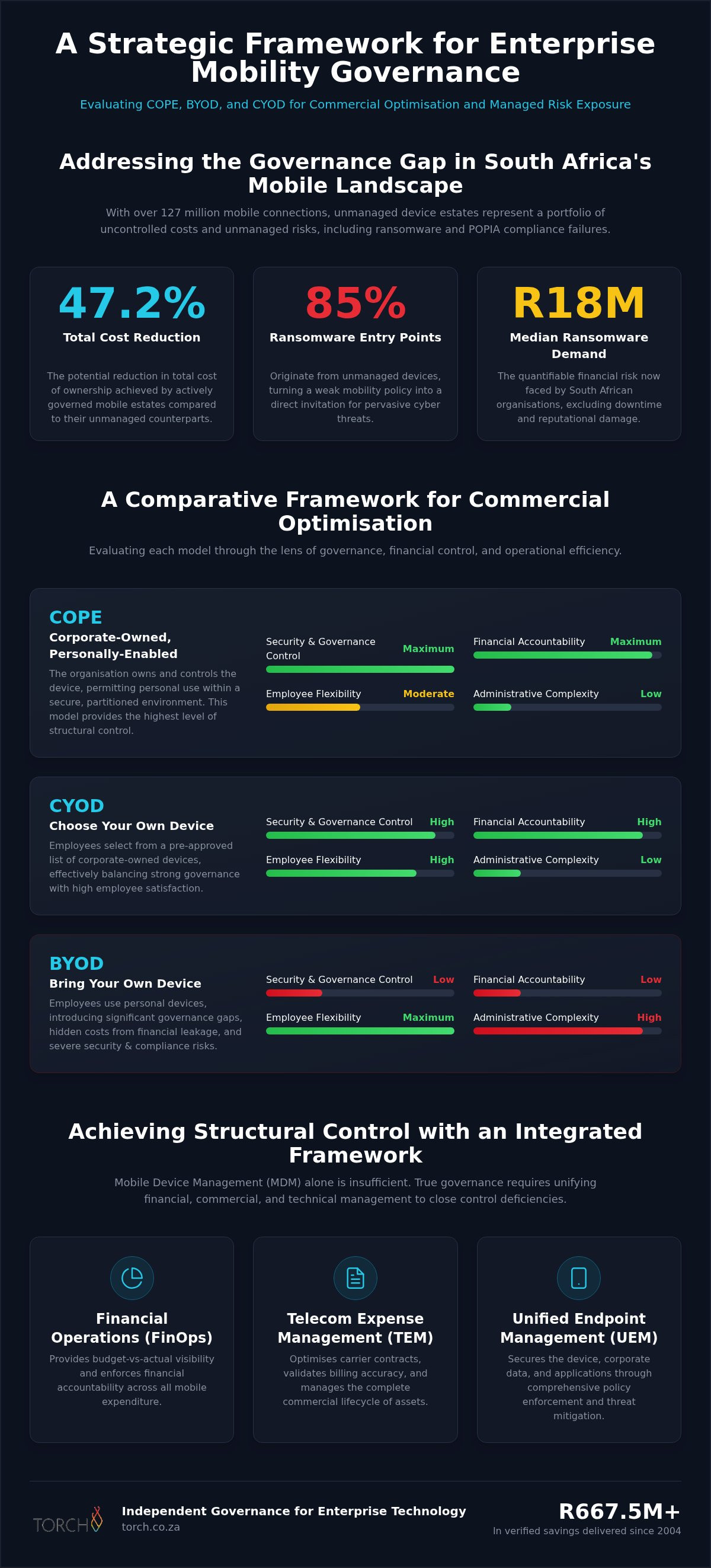
An unmanaged mobile estate is not just a collection of devices; it is a portfolio of unmanaged risks and uncontrolled costs. Our analysis shows that actively governed estates achieve up to 47.2% in total cost reduction compared to their unmanaged counterparts. The choice between COPE, BYOD, and CYOD is therefore a strategic decision about how your organisation will close these gaps and assert control over its technology spend and security.
- COPE (Corporate-Owned, Personally-Enabled): The organisation owns and controls the device, but allows for personal use within a secure, partitioned environment.
- BYOD (Bring Your Own Device): Employees use their personal devices for work, with the organisation managing a secure container for corporate data.
- CYOD (Choose Your Own Device): Employees choose from a pre-approved list of corporate-owned devices, balancing choice with standardisation.
The Financial and Security Imperative
The stakes of inaction are clear and quantifiable. With 85% of ransomware entry points originating from unmanaged devices, a weak mobility policy is a direct invitation for cyber threats. The median ransomware demand South African organisations now face is approximately R18 million, a figure that does not include the costs of downtime, reputational damage, or regulatory fines.
Beyond security, financial leakage is a silent drain on enterprise budgets. Without a carrier-agnostic partner to benchmark contracts and validate invoices, organisations are exposed to billing errors, suboptimal tariffs, and services that are paid for but never used. This lack of oversight creates a significant gap between perceived IT spend and the actual total cost of ownership (TCO).
Moving Beyond Basic Device Management
Simply deploying Mobile Device Management (MDM) software is not enough to address these complex challenges. MDM manages the device, but it does not manage the cost, the contract, or the commercial lifecycle. True governance requires an integrated approach.
At Torch, we deliver this through our Three-Pillar framework, which unifies:
- Financial Operations (FinOps): Providing budget-vs-actual visibility and financial accountability.
- Telecom Expense Management (TEM): Optimising contracts, validating billing, and managing the commercial lifecycle.
- Unified Endpoint Management (UEM): Securing the device, data, and applications through comprehensive policy enforcement.
This model moves beyond basic management to establish structural control, restoring confidence that every Rand spent on mobility is visible, justified, and optimised. For a deeper understanding of the technical layer, explore our guide to Unified Endpoint Management.
COPE vs BYOD vs CYOD: A Comparative Framework for Commercial Optimisation
Selecting a mobility model is a balancing act between security, cost, and employee satisfaction. However, the most common myths—such as “BYOD is always cheaper”—often fall apart under the scrutiny of a Total Cost of Ownership analysis. The key is to evaluate each model through the lens of commercial optimisation, which accounts for both direct hardware costs and the indirect costs of management, security, and risk.
Critically, the term “Personally-Enabled” in a COPE model does not mean “unmanaged.” It refers to allowing personal use on a corporate-owned device within a secure, managed framework. This distinction is vital for maintaining governance whilst offering the flexibility modern employees expect.
BYOD (Bring Your Own Device): Flexibility vs Financial Leakage
BYOD is often positioned as the low-cost, high-flexibility option. The organisation avoids hardware procurement costs, and employees can use the devices they are most comfortable with. Whilst appealing on the surface, this model introduces significant complexity and hidden costs for large South African enterprises.
- Perceived vs. Real Cost: The absence of an initial hardware outlay is often offset by higher administrative overhead, complex employee reimbursement schemes, and increased IT support tickets for a wide array of non-standard devices.
- The Governance Gap: Securing corporate data on a personal device is a technical and legal minefield. Enforcing policies like selective wiping can conflict with employee privacy expectations and POPIA requirements, creating a compliance grey area. This is a primary driver of the BYOD governance gap that exposes organisations to data loss and ransomware.
- Financial Inefficiency: Without centralised procurement, the organisation loses its bulk purchasing power with mobile carriers. Reconciling and reimbursing individual employee data plans is administratively burdensome and lacks the financial control of a centralised corporate contract.
COPE (Corporate-Owned, Personally-Enabled): The Governance Gold Standard
COPE provides the highest level of structural control, security, and financial visibility. By owning the asset, the organisation can enforce comprehensive security policies, manage the entire device lifecycle, and optimise costs at scale. It is the preferred model for organisations in highly regulated industries or those with a low tolerance for risk.
- Structural Control and Visibility: The organisation has full control over the device, from security configurations and application deployment to remote wiping in case of loss or theft. This eliminates the compliance ambiguity inherent in BYOD.
- Cradle-to-Grave Asset Governance: Owning the hardware enables a managed lifecycle, including procurement, deployment, repairs, and secure disposal. This prevents the accumulation of “shadow IT” and ensures assets are properly tracked and accounted for.
- Commercial Optimisation: A COPE model allows for centralised negotiation with carriers, leading to preferential rates. Furthermore, active management of these corporate plans enables 19.6% in savings through continuous subscription adjustment, ensuring you only pay for what is actually needed.
CYOD (Choose Your Own Device): The Middle Ground
CYOD offers a compromise between the rigid control of COPE and the unmanaged nature of BYOD. Employees are given a choice of devices from a curated, pre-approved list procured and owned by the company. This approach maintains a degree of employee satisfaction whilst simplifying management and support.
- Standardised Procurement: By limiting the number of supported device models, organisations can streamline procurement, reduce support complexity, and negotiate better pricing with hardware vendors.
- Simplified IT Support: IT teams are not required to support an endless variety of personal devices. A standardised fleet means faster issue resolution, fewer compatibility problems, and more efficient device management.
- Procurement Modelling Benefits: A limited device list allows for more accurate demand forecasting and lifecycle planning. This data-driven approach strengthens procurement modelling and leads to better long-term financial decisions.
Strategic Selection: A Decision Framework for CFOs and CIOs
The optimal mobility strategy is rarely a one-size-fits-all solution. Often, a hybrid approach is required, with different user groups assigned different models based on their roles, risk profiles, and access to sensitive data. For example, senior executives might be on a strict COPE model, whilst field sales staff could use a CYOD policy.
This five-step framework helps leadership teams make an informed decision grounded in financial control and accountability.
Ready to apply this framework to your organisation? Book a 30-minute governance review with Derek King to get an independent, expert perspective on your current mobility strategy.
Step 1: Audit Your Current Risk Exposure
Begin by understanding your current state. How many unmanaged or personal devices are currently accessing corporate email, data, and applications? To help identify these vulnerabilities, FaultLine Cyber & Security Ltd provides exposure assessments that reveal hidden cyber and operational risks. Is there a formal process for validating mobile carrier invoices, or are they paid without scrutiny? Use a platform like our proprietary TorchLight™ engine to benchmark your existing mobile contracts against the market to identify areas of silent financial leakage.
Step 2: Define Your Security and Compliance Baseline
Align your mobility policy with your organisation’s broader security standards and regulatory obligations, particularly POPIA. Determine the level of data separation and selective wiping required. For example, can you confidently wipe only corporate data from a personal device if an employee leaves? A robust policy must also integrate with your ransomware mitigation strategy for the entire hybrid workforce.
Step 3: Calculate the Total Cost of Ownership (TCO)
Move beyond the sticker price of the hardware. A true TCO calculation includes hardware procurement, airtime, data, IT support overhead, management software licences, and the administrative cost of processing stipends or reimbursements. Contrast this against a risk-share TEM model, where a partner handles the optimisation and is compensated from a share of the verified savings, ensuring aligned incentives. Carrier-agnostic benchmarking alone can yield negotiation gains of up to 27.5%.
Step 4: Map Models to User Personas
Segment your workforce into logical groups based on their roles. A C-level executive handling sensitive board materials has a different risk profile from a warehouse employee who only needs access to a logistics app. Map the most appropriate mobility model (COPE, CYOD, or BYOD) to each persona, creating a hybrid policy that balances security with operational need.
Step 5: Plan for Implementation and Change Management
A policy is only a document until it is implemented. Develop a clear communication plan to explain the new model(s) to employees, outlining the benefits and responsibilities. Ensure your IT team has the resources and tools required to deploy, manage, and support the chosen devices and policies effectively. A phased rollout, starting with a pilot group, can help identify and resolve issues before a full-scale deployment.
Implementing Structural Control: From Policy Choice to Sustainable Optimisation
Choosing a mobility model is the first step. Sustaining the financial and security benefits of that choice requires ongoing governance. A policy without enforcement is ineffective, and dashboards without action are just data. We believe structural control is the most reliable path to sustainable savings, embedding financial discipline and security compliance into your daily operations.
This is achieved by integrating policy with technology and expert oversight. Our SpotLight™ platform provides real-time visibility into your entire mobile estate, allowing you to track spend against budget and monitor consumption at a user level. This data-driven insight, combined with our “FinOps-as-a-Service” offering, transforms visibility into action, ensuring that optimisation is not a one-time project but a continuous business discipline.
Integrating UEM and TEM for Total Visibility
The true power of a governed mobility strategy comes from integrating Unified Endpoint Management (UEM) with Telecom Expense Management (TEM). This unified approach protects both the data on the device and the budget that pays for it. UEM enforces security policies and manages the “cradle-to-grave” lifecycle of corporate assets, whilst TEM ensures the commercial agreements underpinning that lifecycle are fully optimised. To learn more about the operational details, see our overview of Telecom Expense Management.
The Torch Approach: Independent Governance and Managed Risk
As a carrier-agnostic advisor, Torch does not sell hardware or connectivity. Our sole focus is on delivering governance, visibility, and control. With over 100 years of combined industry experience and more than R667.5M saved for clients since 2004 across 12 African countries, our track record is built on independent expertise and measurable results.
For organisations requiring reliable operational and security support in other challenging geographies beyond the continent, you can discover Tactical Troop and their specialist risk management services across Latin America.
Our analysts are embedded execution partners who resolve issues rather than just reporting them. This governance-led approach delivers tangible, audited results, such as the R38.4M in savings verified for a single client by PwC. We provide the structural control needed to turn your mobility policy into a sustainable competitive advantage.
To identify the governance gaps in your current mobile estate, request the Torch FinOps Readiness Assessment—a 20-minute diagnostic designed for CFOs and CIOs.
Frequently Asked Questions
- What is the main difference between COPE and BYOD in terms of security?
- The primary difference is control. In a COPE model, the organisation owns the device and has full authority to enforce security policies, install management software, and wipe the device if necessary. With BYOD, the organisation’s control is limited to a secure container on a personal device, creating challenges around privacy and policy enforcement.
- Is a COPE model more expensive than BYOD for a large enterprise?
- Not necessarily. While COPE involves an initial hardware cost, it often leads to a lower Total Cost of Ownership (TCO). This is due to savings from bulk carrier negotiations, reduced IT support overhead, and the elimination of complex employee reimbursement schemes. A full TCO analysis is required to determine the most cost-effective model for your specific organisation.
- How does a Choose Your Own Device (CYOD) policy help with IT support?
- CYOD simplifies IT support by standardising the hardware fleet. Instead of supporting hundreds of different personal device models, the IT team only needs to be proficient in a small, pre-approved selection. This leads to faster problem resolution, easier management, and fewer compatibility issues.
- Can Torch help negotiate better rates with South African mobile carriers?
- Yes. As an independent, carrier-agnostic advisor, we use our proprietary TorchLight™ market intelligence to benchmark your current contracts against best-in-market rates. We then manage the negotiation process on your behalf to secure optimal commercial terms, achieving average savings of 27.5% for our clients.
- What security benefits does Unified Endpoint Management (UEM) provide for BYOD?
- For BYOD, UEM creates a secure, encrypted container on the employee’s personal device. This isolates corporate data and applications from personal ones. It allows the company to enforce policies (like strong passwords) within the container and perform a “selective wipe” of only the corporate data if the employee leaves, protecting company information whilst respecting employee privacy.
- How do billing errors occur in corporate mobile accounts, and how are they detected?
- Billing errors are common and can result from incorrect tariff application, charges for ceased services, or misaligned contract terms. Torch detects these by using our SpotLight™ platform to validate every line item on an invoice against the master contract and real-time usage data. Our dedicated analysts then manage the dispute and recovery process with the carrier on your behalf.