
For many South African enterprises, corporate device lifecycle management is treated as a logistical exercise: buy the hardware, deploy it, and replace it when it breaks. This approach, however, overlooks the discipline’s true strategic value. When viewed through the lens of financial governance, it becomes a powerful mechanism for eliminating budget leakage, strengthening endpoint security, and enforcing commercial accountability across the entire technology estate.
An unmanaged device lifecycle creates significant governance gaps. These gaps manifest as “silent leakage”—a steady drain on IT budgets caused by ghost assets, billing errors, and misaligned contracts. More critically, they expose the organisation to substantial security risks. This guide provides a governance-led framework for mastering the corporate device lifecycle, transforming it from a cost centre into a source of sustained financial control and operational resilience.
The Governance Gap in Corporate Device Lifecycle Management
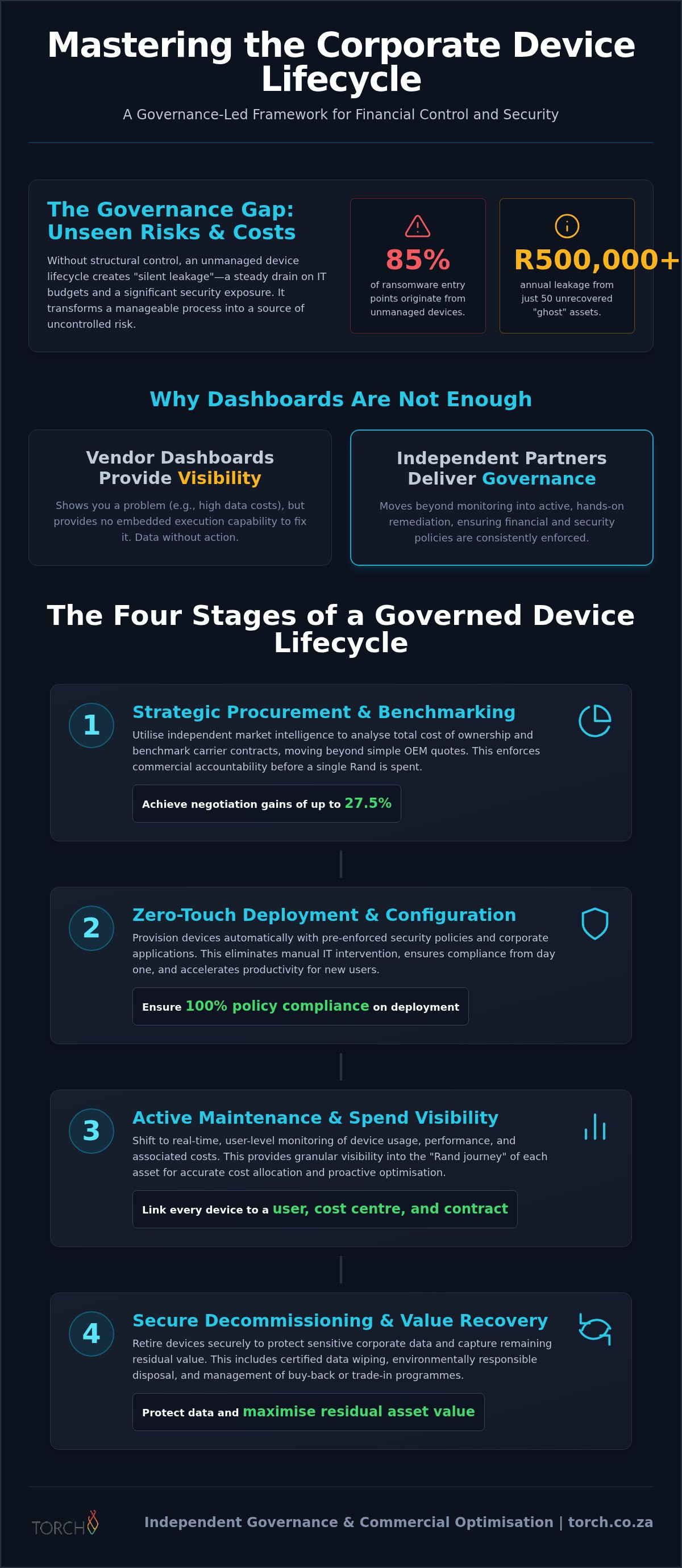
Effective corporate device lifecycle management is a strategic governance discipline, not merely a set of logistical tasks. It encompasses every stage from procurement and deployment to active maintenance and secure decommissioning, all governed by principles of financial accountability and security. Without this structural control, organisations face “silent leakage,” where unmanaged endpoints quietly drain IT budgets through unrecovered assets, inaccurate billing, and contracts that no longer reflect business needs.
The security imperative is even more pressing. Research consistently shows that a significant majority of ransomware entry points—as high as 85%—originate from unmanaged or poorly secured devices. Each laptop, tablet, or smartphone operating outside a governed framework is a potential foothold for cyber threats. The antidote to this financial and security exposure is not more data, but a system of structural control that embeds governance into every process.
Why Dashboards Aren’t Enough for IT Spend
Many organisations believe that a vendor-supplied dashboard provides sufficient oversight of their device estate. This confuses “visibility” with “governance.” A dashboard can show you a problem—such as escalating data costs or a fleet of outdated devices—but it cannot fix it. It provides data without the embedded execution needed to act on it.
Internal teams often struggle to bridge this gap. They may see the insights but lack the specialised market intelligence, negotiation leverage, or administrative capacity to translate those insights into procurement decisions or vendor disputes. For small and medium-sized businesses looking to bridge this gap through expert support, you can discover JOB Technologies and their range of outsourced IT services. True governance requires an independent, hands-on approach that moves beyond monitoring and into active remediation, ensuring that financial and security policies are not just documented but consistently enforced.
The Financial Stakes of Unmanaged Endpoints
The financial consequences of a poorly managed device lifecycle extend far beyond the initial hardware purchase. Inaccurate asset inventories make effective budgeting and forecasting impossible, leading to reactive spending and missed opportunities for optimisation. Without a single source of truth linking each device to a user, cost centre, and contract, finance teams cannot perform meaningful variance analysis or hold departments accountable for their consumption.
Consider a scenario where a mid-sized enterprise pays for 50 devices assigned to employees who left the company months ago. At an average cost of R850 per user per month, this single oversight creates a silent financial drain of over R500,000 annually. A governed lifecycle, integrated with ERP and HRM data, prevents this by ensuring assets are immediately recovered or reassigned. Enforcing device policies—from data usage limits to application controls—directly reduces financial risk and prevents budget overruns before they occur.
The Four Stages of a Governed Device Lifecycle
A mature corporate device lifecycle management framework is built on four distinct, interconnected stages. Each phase requires a combination of market intelligence, process automation, and rigorous financial oversight to deliver maximum value and security. Moving through these stages systematically transforms device management from a reactive operational burden into a proactive strategic asset.
- Strategic Procurement & Benchmarking: This initial stage focuses on using independent market intelligence to ensure the organisation pays the right price for the right technology. It involves moving beyond OEM quotes to analyse total cost of ownership and benchmark carrier contracts against the market to avoid overpaying.
- Deployment & Configuration: Once procured, devices must be deployed efficiently and securely. This stage marks the transition to zero-touch deployment, where devices are provisioned automatically with pre-enforced security policies, eliminating manual IT intervention and ensuring compliance from day one.
- Active Maintenance & Spend Visibility: In this stage, the focus shifts to real-time monitoring of device usage, performance, and associated costs. It requires tools that provide granular visibility into the “Rand journey” of each asset, allowing for accurate cost allocation and proactive optimisation.
- Secure Decommissioning: The final stage involves retiring devices in a way that protects sensitive corporate data and captures any remaining residual value. This includes certified data wiping, environmentally responsible disposal, and managing device buy-back or trade-in programmes.
Procurement: Beyond the OEM Quote
Most internal procurement teams rely on quotes from their incumbent mobile carriers or hardware vendors, leaving them with limited negotiating power. A carrier-agnostic benchmarking process, however, introduces competitive tension and data-backed insights that can secure negotiation gains of up to 27.5%. By leveraging proprietary models like Torch’s TorchLight™, organisations can evaluate complex contract scenarios and model the financial impact of different choices before committing.
This strategic approach also helps avoid auto-renewal traps, where outdated contracts are rolled over without scrutiny. Aligning procurement cycles with actual business needs—not the carrier’s revenue targets—ensures that agreements remain commercially optimised and flexible enough to adapt to changing requirements.
For organisations with operations in the United Kingdom looking to fund these strategic technology investments, TMS Finance provides specialist commercial brokerage to help source tailored funding solutions.
Maintenance: Monitoring the “Rand Journey”
Effective maintenance is about more than just managing hardware repairs; it is about monitoring the entire financial journey of each device. Real-time governance platforms like SpotLight™ provide user-level consumption monitoring, enabling finance teams to see precisely how and where the IT budget is being spent. This level of granularity is essential for allocating costs accurately to specific cost centres, which in turn drives departmental accountability.
To maintain a single source of truth, this consumption data must be integrated with the organisation’s ERP and HRM systems. This ensures that the asset inventory is always up-to-date, reflecting changes in personnel and departmental structures, and preventing the accumulation of “ghost assets” that inflate costs and security risks.
Implementing Zero-Touch Deployment for Corporate Devices
Zero-touch deployment is the automated configuration and provisioning of corporate devices without requiring physical intervention from the IT department. In this model, devices are shipped directly from the manufacturer or reseller to the end-user. Upon being powered on and connected to the internet, the device automatically enrols in the company’s management system, downloads the necessary applications, and enforces pre-defined security policies.
This automation dramatically reduces the administrative burden on overburdened IT teams, freeing them from the time-consuming manual setup of each device. It ensures a consistent, secure, and compliant user experience from the moment an employee unboxes their new hardware. This process is a cornerstone of a modern unified endpoint management (UEM) framework, which centralises control over all devices, regardless of platform or location.
Policy Enforcement and Compliance
A key advantage of zero-touch deployment is that it guarantees every device is compliant from “day zero.” Security policies, application whitelists, and network configurations are enforced before the user can even access the home screen. This proactive stance is critical for mitigating security risks, especially in remote or hybrid work environments.
The UEM platform allows for nuanced policy enforcement, such as setting up selective wiping for BYOD devices (removing only corporate data) versus a full remote wipe for corporate-owned assets in the event of loss or theft. For South African enterprises, this automated control is also vital for ensuring POPIA compliance, as it provides auditable reports on endpoint security posture and data protection measures.
Automating User Support and Onboarding
The benefits of automation extend beyond initial deployment. By integrating self-service bots like Boost™, organisations can empower users to resolve common issues 24/7 without logging a helpdesk ticket. Simple but frequent requests, such as data top-ups, international roaming activation, or SIM suspensions, can be handled instantly via SMS-based commands.
This automation significantly reduces the volume of low-level support tickets, allowing the IT helpdesk to focus on more complex, high-value strategic initiatives. To ensure vendor performance aligns with these efficiency goals, it is essential to establish clear expectations. Using a comprehensive guide like The IT Vendor Service Level Agreement Template can help structure these relationships for success.
Sustaining Optimisation through Independent Advisory
Mobile carriers and hardware vendors cannot effectively audit their own revenue streams or provide the independent oversight required for true financial governance. Their primary objective is to sell services, creating an inherent conflict of interest when it comes to identifying billing errors or recommending more cost-effective solutions. Sustainable optimisation can only be achieved through a carrier-agnostic advisor whose incentives are aligned with the client’s success.
A risk-share model, where the advisor is compensated based on a percentage of verified savings, ensures this alignment. With over 100 years of combined industry experience and a track record of saving clients more than R667.5M since 2004 across 12 African countries, Torch has proven that this model delivers results. Our embedded staff operate as an extension of the client’s team, bridging the execution gap between identifying a problem and resolving it. This high-touch approach is why actively governed estates consistently achieve up to 47.2% in total cost reduction compared to their unmanaged counterparts.
Carrier-Agnostic Governance vs. Vendor Dashboards
For a CFO to have confidence in reported savings, the validation must be objective and transparent. Vendor-supplied dashboards lack this independence. An independent advisor provides rigorous financial validation of every invoice against contracts, usage, and market benchmarks, delivering the assurance required for board-level reporting.
Furthermore, resolving complex billing disputes or contract variances requires more than just data; it requires “high-touch” execution. This involves persistent, expert-led engagement with carriers to correct errors and claim credits. This disciplined process is a core component of telecom expense management (TEM), a foundational pillar for establishing long-term financial control.
The Path Forward: From Challenge to Decision
One of the biggest obstacles to optimisation is organisational inertia. The process of building a business case, aligning stakeholders, and making a final procurement decision can take months. An independent advisor accelerates this timeline by providing a unified, data-backed view that bridges the typical divide between IT, Finance, and Procurement.
This is not a theoretical timeline. In a six-week engagement with Tsogo Group (including Southern Sun Hotels and Tsogo Gaming), Torch delivered a data-backed procurement decision that defined a hybrid mobility model, reduced administrative burden, and satisfied CFO scrutiny. By framing the challenge in terms of governance and financial control, organisations can move from analysis to action with speed and confidence. This focused approach is a key tenet of a broader IT FinOps strategy for managing technology spend.
To achieve sustainable control over your corporate device lifecycle, you need more than a dashboard; you need an independent governance partner. Book a 30-minute governance review to discover how Torch can help you eliminate silent leakage and secure your device estate.
Frequently Asked Questions (FAQs)
What is the primary difference between MDM and corporate device lifecycle management?
Mobile Device Management (MDM) is a technology focused on securing and controlling devices, primarily during their active use. Corporate device lifecycle management is a broader strategic discipline that includes MDM but also covers the financial and logistical governance of the entire lifecycle, from procurement and benchmarking to secure decommissioning and value recovery.
How does zero-touch deployment for corporate devices improve security?
Zero-touch deployment improves security by ensuring that every device is automatically enrolled and configured with the company’s security policies before the user gains access. This eliminates human error and inconsistent setups, guaranteeing that all devices are compliant with security standards from their very first use.
Why should we use an independent advisor instead of our mobile carrier?
A mobile carrier has a vested interest in maximising its own revenue and cannot provide objective, independent oversight of your spend. An independent advisor is carrier-agnostic, meaning their sole focus is on optimising your costs, validating invoices for accuracy, and ensuring your contracts are benchmarked against the best market rates.
Can corporate device lifecycle management help with POPIA compliance?
Yes. A governed lifecycle management programme is essential for POPIA compliance. It ensures that all devices handling personal information have the required security controls, such as encryption and remote wipe capabilities. It also provides a clear audit trail for how devices are provisioned, managed, and securely decommissioned, demonstrating due diligence in protecting sensitive data.
What are the hidden costs typically found in unmanaged device estates?
The most common hidden costs include paying for “ghost assets” (devices of former employees), incorrect tariff plans, automatic contract renewals at uncompetitive rates, unmanaged data-roaming charges, and billing errors that go unnoticed. These small leaks accumulate over time, leading to significant financial waste.
How does Torch measure the ROI of its lifecycle management services?
Torch measures ROI through verified, documented savings. For many services, we operate on a risk-share model where our fee is a percentage of the actual savings we deliver and that you approve. This ensures our incentives are directly aligned with your financial outcomes, providing a clear and measurable return on investment based on reduced costs and eliminated financial leakage.