
Beyond the Purchase Order: Why IT Procurement Fails Without Governance
In enterprise IT, the signing of a purchase order is often mistaken for the finish line. Procurement teams negotiate favourable terms, secure a contract, and hand over responsibility to an already overburdened IT department. This marks the beginning of a critical disconnect: the distinction between acquiring a service and governing its entire lifecycle. Without a structured governance framework, the financial discipline achieved during procurement quickly erodes.
Once the contract is signed, the real ‘Rand journey’ begins. Traditional procurement teams, focused on the initial transaction, often lose visibility into monthly billing, usage patterns, and service level agreement (SLA) adherence. This creates a governance gap where value is promised but not consistently delivered, leading to a phenomenon we call ‘Silent Leakage’.
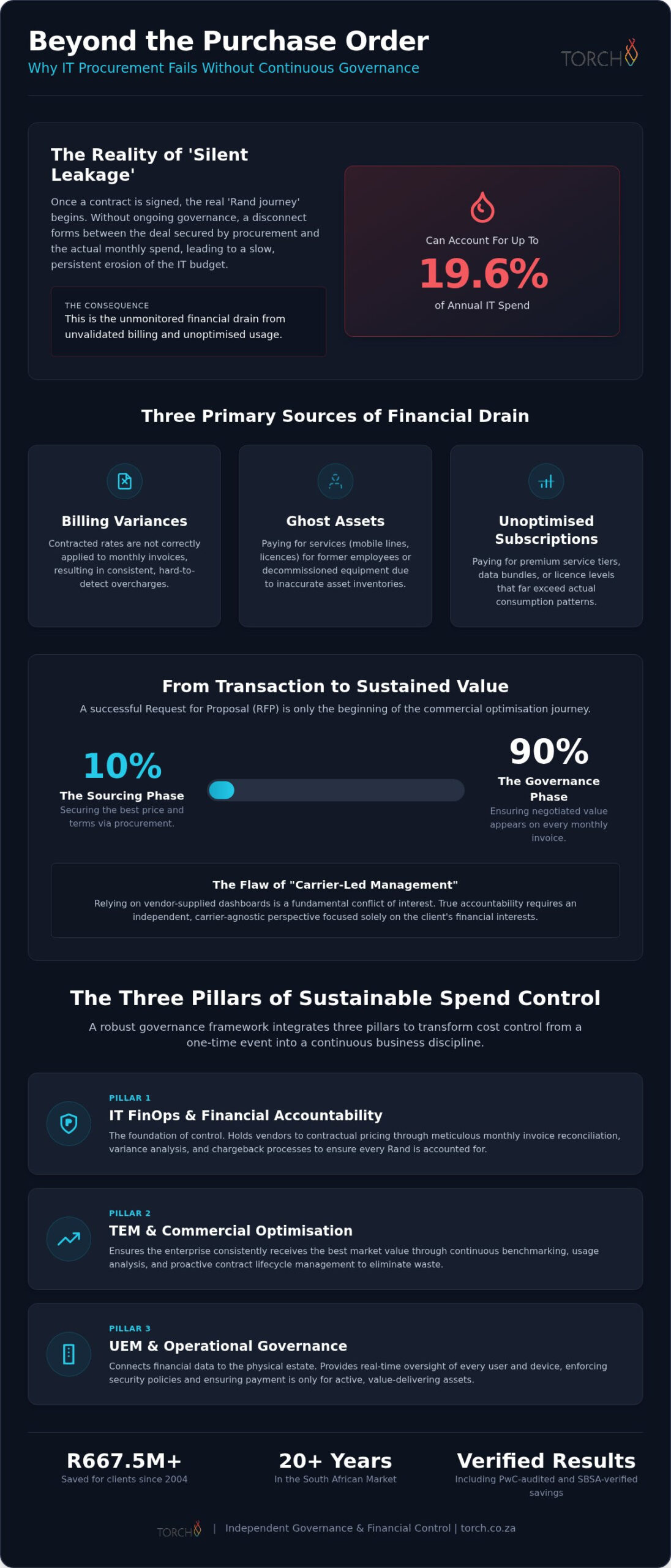
Silent Leakage is the unmonitored erosion of an IT budget through unvalidated billing and unoptimised usage. This financial drain, which can account for up to 19.6% of annual IT spend, is not the result of a single catastrophic failure but a slow, persistent bleed caused by billing errors, ghost assets, and mismatched subscriptions. Many organisations attempt to solve this by relying on vendor-supplied dashboards, a practice known as ‘Carrier-Led Management’. This approach is a fundamental conflict of interest; no supplier can be expected to rigorously audit its own revenue stream.
The Reality of Silent Leakage in Enterprise Estates
Silent Leakage manifests through three primary sources. The first is billing variances, where contracted rates are not correctly applied to monthly invoices, leading to consistent overcharges. The second is ghost assets, a direct consequence of inaccurate asset inventories. Companies end up paying for mobile lines, software licences, or hardware maintenance for employees who have left the business or for equipment that is no longer in use. Finally, unoptimised subscriptions contribute significantly, with organisations paying for premium service tiers or data bundles that far exceed actual consumption.
An incomplete or outdated asset inventory is a direct enabler of this waste. Without a single source of truth that maps every device and service to a specific user and cost centre, it becomes impossible to identify and decommission services that are no longer providing value. This lack of visibility is where financial control is lost.
Why Internal Audits Often Fall Short
Many organisations believe their internal audit and IT teams can manage this process. However, they often face a significant ‘Governance Gap’. Overburdened IT teams rarely have the time or specialised tools required for the deep-dive, line-by-line invoice reconciliation needed to uncover complex billing errors. Their primary focus is on operational uptime and strategic projects, not forensic accounting.
Furthermore, internal teams lack access to proprietary, carrier-agnostic benchmarking data. They may know what they are paying, but they cannot know if it represents the best possible market rate. Without this intelligence, they enter contract renegotiations at a significant disadvantage. True vendor accountability can only be achieved through an independent, carrier-agnostic perspective that prioritises the client’s financial interests above all else.
Defining Vendor Management in the IT FinOps Era
Effective vendor management in IT procurement is more than just checking boxes; it is the continuous governance of supplier performance, commercial optimisation, and financial accountability throughout the contract lifecycle. This represents a strategic shift from reactive ‘cost cutting’ exercises to proactive ‘financial governance’ built on a foundation of structural control.
This modern approach integrates seamlessly with IT FinOps, creating a single source of truth that connects technical infrastructure with financial outcomes. It bridges the communication gap that often exists between the IT department, which manages the technology, and the Finance department, which pays for it. An independent advisor is crucial to this process, translating technical performance into clear, board-level financial reporting.
Procurement vs. Vendor Management: The Accountability Loop
The distinction between these two functions is critical. Procurement focuses on the transaction (The Sourcing Phase), securing the best possible price and terms at a single point in time. Vendor Management, however, focuses on delivering sustained value (The Governance Phase) over the entire life of the agreement. A successful Request for Proposal (RFP) is only the first 10% of the cost-optimisation journey.
The remaining 90% involves ensuring that the ‘negotiated savings’ actually appear on the monthly invoice. This requires a rigorous, ongoing validation process that compares every line item against the master service agreement. Without this accountability loop, the value secured during procurement is quickly lost to billing errors and unmanaged spend.
The Three Pillars of Sustainable Spend Control
A robust vendor governance framework is built on three integrated pillars that align with a modern, FinOps-led approach to technology management. These pillars ensure that cost control is not a one-time event but a continuous business discipline.
- Pillar 1: IT FinOps & Financial Accountability — This is the foundation of control. It involves holding vendors to contractual pricing through meticulous monthly invoice reconciliation, variance analysis, and chargeback processes. It ensures every Rand is accounted for and aligned with the budget.
- Pillar 2: Telecom Expense Management (TEM) & Commercial Optimisation — This pillar focuses on ensuring the enterprise consistently receives the best possible market value. Through continuous benchmarking, usage analysis, and proactive contract lifecycle management, services are adjusted to match actual consumption, eliminating waste and leveraging market intelligence for renegotiations.
- Pillar 3: Unified Endpoint Management (UEM) & Operational Governance — This pillar connects financial data to the physical estate. It provides real-time oversight of every user and device, enforcing security policies and ensuring that the organisation only pays for assets that are active, secure, and delivering business value.
A Strategic Framework for Managing Technology Suppliers
Implementing a strategic governance framework for vendor management in IT procurement follows a clear, methodical process designed to establish control and deliver measurable results. This five-step approach moves an organisation from a state of reactive spend management to one of proactive financial governance.
- Establish a Baseline: The process begins with a comprehensive telecom billing audit of the last three to six months of invoices. This diagnostic phase identifies historical overcharges, billing errors, and immediate optimisation opportunities, creating a clear baseline of the current state.
- Implement Carrier-Agnostic Benchmarking: Using proprietary market intelligence, existing contracts are benchmarked against current best-in-market rates. This data-driven approach identifies commercial renegotiation opportunities that can yield average savings of 27.5%.
- Centralise Device and Asset Control: A unified platform for endpoint management is deployed to create an accurate, real-time asset inventory. This eliminates ghost assets, closes security gaps, and ensures that financial waste from unused services is eradicated.
- Automate Reconciliation and Validation: The manual, time-consuming task of invoice reconciliation is automated. Specialised platforms and processes detect variances between invoices and contracts before payment is issued, shifting the burden of proof back to the vendor.
- Conduct Regular Board-Level Reporting: Spend, savings, and vendor performance data are translated into clear financial reports. This allows IT leaders to present the value of their department with commercial confidence, demonstrating a direct contribution to the bottom line.
Benchmarking Leverage and Commercial Optimisation
Internal teams often lack the tools to model complex contract scenarios or access up-to-the-minute market pricing. Using proprietary intelligence engines like TorchLight™, an independent governance partner can analyse thousands of data points to identify the optimal commercial structure for your specific usage profile. This data-driven leverage is critical for successful negotiations.
A key aspect of this optimisation is proactive contract lifecycle management, which is designed to end auto-renewal traps. By tracking expiry dates and notice periods, the organisation is positioned to renegotiate from a position of strength, avoiding unfavourable terms that lock in uncompetitive rates. This structured approach can move an organisation from identifying a challenge to reaching a final, data-backed procurement decision in as little as six weeks.
Performance Metrics and SLA Accountability
Effective vendor management moves beyond tracking simple metrics like ‘uptime’. It focuses on the metrics that directly impact the bottom line, such as billing accuracy, dispute resolution times, and adherence to agreed-upon service levels. When a vendor consistently fails to meet these standards, a governance framework provides the data needed to enforce contractual penalties.
This accountability extends to security. With unmanaged endpoints being a primary entry point for ransomware, enforcing security policies through a UEM solution is a critical governance function. This mitigates the average R18 million risk associated with a successful breach. Furthermore, automated reporting ensures that device and data management practices remain compliant with regulatory frameworks like POPIA.
Restoring Confidence: Transitioning to Managed Governance
Whilst software dashboards provide visibility, they are often insufficient for resolving the complex billing disputes and service issues common in enterprise IT. This is why a transition to a managed governance service is a highly effective method for ensuring long-term commercial optimisation. A managed service provides not only the tools but also the specialised expertise and execution capability to turn data into action.
The impact of this ‘High-Touch’ model is significant. It involves embedding experienced staff within the organisation to actively manage vendors and remediate issues, freeing internal teams to focus on strategic initiatives. When combined with a risk-share pricing model, where the partner’s incentives are directly aligned with the client’s savings, it creates a powerful partnership for financial control. A fully governed estate can achieve up to a 47.2% total cost reduction after just 12 months of active management.
The Value of Independent Advisory
The most objective and effective financial oversight comes from an advisor who does not sell connectivity. An independent, carrier-agnostic partner has no vested interest in maintaining a specific vendor relationship and can therefore provide unbiased recommendations focused solely on achieving the best commercial and operational outcome for your business. Leveraging over 20 years of experience in the South African market provides an unparalleled ability to navigate local carrier complexities.
For example, when the Tsogo Group needed to redefine its mobility strategy, it engaged an independent advisor. A six-week engagement produced a data-backed procurement decision for a hybrid model that reduced administrative burden and satisfied rigorous CFO scrutiny, demonstrating the power of strategic, independent governance.
Next Steps for the CFO: The Governance Review
The first step towards restoring financial control is acknowledging that a governance gap likely exists within your current IT and telecom estate. Years of decentralised procurement, complex carrier contracts, and a lack of integrated visibility mean that most large enterprises are leaking budget unnecessarily. A 20-minute diagnostic can often uncover more potential savings than a year of manual internal auditing.
To understand the health of your current framework and identify immediate opportunities for optimisation, we encourage you to book a 30-minute governance review with Derek King to explore your FinOps readiness.
Frequently Asked Questions (FAQs)
Why shouldn’t I let my telecom carrier manage my spend?
Relying on a carrier to manage your spend is a conflict of interest. Carriers cannot be expected to independently audit their own revenue or proactively identify billing errors in your favour. An independent governance partner provides objective validation and ensures vendors are held accountable to their contractual agreements, acting solely on your behalf.
How does vendor management in IT differ from general procurement?
General procurement typically focuses on the ‘Sourcing Phase’—the initial transaction of negotiating and signing a contract. Vendor management in IT is the ‘Governance Phase’, which covers the entire lifecycle of the service. It ensures the value negotiated during procurement is actually delivered and sustained month after month through rigorous performance tracking, invoice validation, and continuous optimisation.
What are the most common billing errors in enterprise IT contracts?
The most common errors include incorrect tariff plans being applied, failure to apply negotiated discounts, charges for ‘ghost assets’ (services for former employees or decommissioned hardware), and delayed deactivation of services. These errors often go unnoticed without a dedicated, line-by-line reconciliation process.
How can vendor management help reduce ransomware risks?
A significant portion of ransomware attacks originate from unmanaged or poorly secured endpoints. A core component of IT vendor governance is Unified Endpoint Management (UEM), which enforces security policies, ensures software is patched, and provides the ability to remotely secure or wipe a compromised device. This dramatically reduces the attack surface available to threat actors.
Is a dashboard enough to control my IT and telecom costs?
A dashboard is a tool for visibility; it can show you that a problem exists, but it cannot solve it. True cost control requires a governance framework that includes the execution and expertise to act on the data. This means having a team dedicated to disputing incorrect invoices, renegotiating contracts based on usage data, and decommissioning unused assets—tasks that a dashboard alone cannot perform.
What is the expected ROI of a managed vendor governance programme?
The return on investment is multi-faceted. Financially, actively governed estates can achieve up to 47.2% in total cost reduction through a combination of commercial renegotiation (averaging 27.5%) and continuous optimisation (averaging 19.6%). Beyond direct savings, the ROI includes mitigated security risks, improved operational efficiency for IT teams, and enhanced budget certainty for board-level reporting.