
For many CIOs and Heads of Infrastructure, presenting the annual IT budget to the board feels less like a strategic discussion and more like a defence. The board often perceives IT as a “black hole” of expenditure—a necessary but ever-increasing cost centre where financial accountability is opaque. This perception forces technology leaders into a reactive cycle of justifying rising costs rather than demonstrating strategic value.
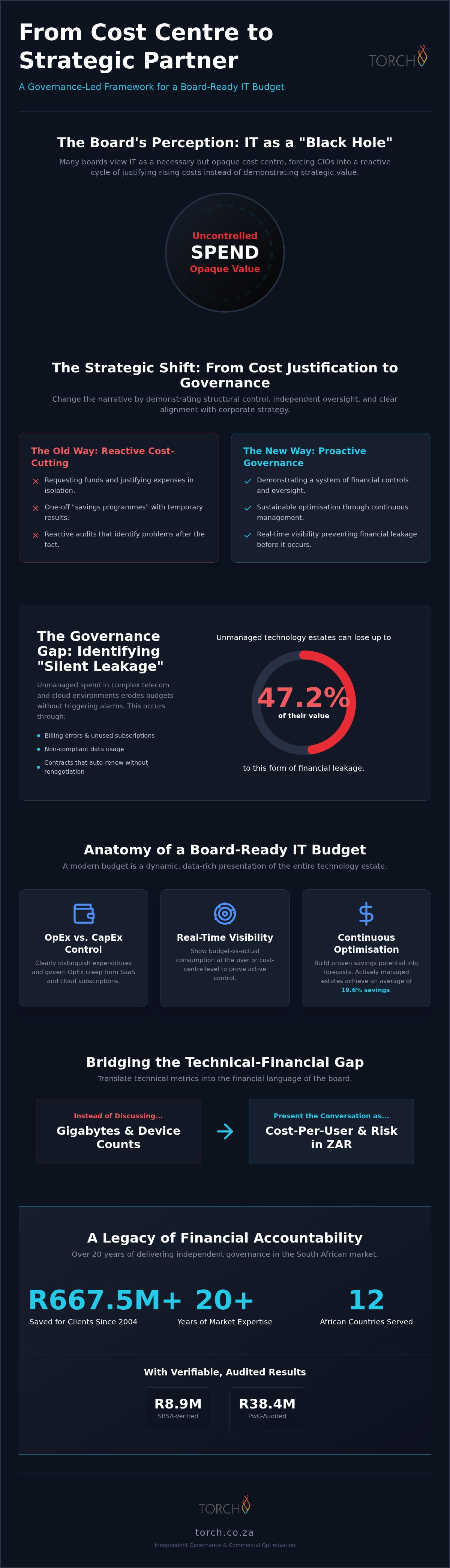
The fundamental challenge is not the budget itself, but the narrative surrounding it. A successful IT budget presentation for 2026 is not a request for funds; it is a demonstration of existing structural control, independent financial oversight, and a clear alignment with corporate strategy. By shifting the conversation from cost-justification to governance, you can reframe IT from a petitioner into a strategic partner that drives commercial optimisation and mitigates financial risk.
This guide provides a governance-led framework for building and presenting a board-ready IT budget. We will explore how to quantify financial leakage, overcome common objections with data, and secure approval by proving that every Rand is governed, visible, and aligned with the organisation’s most critical objectives.
The Strategic Shift: From Cost Centre to Value Driver
The board’s view of IT as a bottomless expense pit stems from a lack of visibility and a history of reactive “savings programmes” that fail to deliver sustainable results. To change this perception, the focus must shift from simple cost reduction to sustainable commercial optimisation, underpinned by a robust governance framework. This approach moves IT from a reactive department that simply cuts costs to a proactive one that manages the entire technology estate with financial discipline.
- Reframing Perception Through Financial Control: Instead of presenting a list of expenses, present a system of controls. Show the board how IT FinOps, Telecom Expense Management (TEM), and Unified Endpoint Management (UEM) work together to provide complete oversight of technology spend.
- Sustainable Optimisation vs. Cost Reduction: A one-off negotiation with a carrier is a temporary fix. Sustainable optimisation involves continuous benchmarking, contract governance, and usage management to prevent the return of wasteful spending.
- Proactive Governance Frameworks: Move beyond reactive audits. A proactive framework provides real-time visibility into budget-vs-actual spend, enabling continuous adjustments and preventing financial leakage before it occurs.
- Building Confidence with Independent Oversight: Board-level confidence is built on objective, verifiable data. An independent, carrier-agnostic advisor provides the validation that vendor-supplied reports cannot, ensuring procurement decisions are based on market reality, not sales pitches.
Defining the Governance Gap in Your Current Estate
Before you can demonstrate control, you must first identify where it is lacking. For most large enterprises, significant governance gaps exist within complex telecom and cloud environments, leading to “silent leakage”—unmanaged spend that erodes budgets without triggering alarms. Internal audits often miss this leakage because they lack the specialised tools and market intelligence to identify it.
- Unmanaged Spend in Telecom and Cloud: This occurs through billing errors, unused subscriptions, non-compliant data usage, and contracts that auto-renew without renegotiation. Without a centralised governance platform, these costs accumulate unnoticed.
- The Cost of “Silent Leakage”: Our analysis shows that unmanaged technology estates can lose up to 47.2% of their value to this form of financial leakage. Quantifying this figure for your own organisation provides a powerful business case for investing in governance.
- The Need for Carrier-Agnostic Benchmarking: To ensure vendor accountability, you need to compare your contracts against the broader market. Carrier-agnostic benchmarking provides objective proof of whether your rates are competitive, giving you the leverage needed for effective negotiations.
Aligning IT Spend with Corporate Strategy
A governance-led budget connects every line item to a strategic business outcome. Instead of asking for Rands to fund a server upgrade, you are requesting an investment to improve operational efficiency by 15%. This shift in language frames IT as a direct enabler of corporate goals, from enhancing business agility to securing the remote workforce.
- Linking Infrastructure to Business Outcomes: Map technology investments to specific objectives. For example, a UEM programme is not just a security tool; it is a strategic enabler for a secure and productive hybrid work model.
- Presenting IT FinOps as a Strategic Discipline: Explain to the board that IT financial management best practices are about embedding financial accountability into the fabric of technology operations. It is a strategic discipline that ensures technology value is measured and optimised, not just a clerical task of processing invoices.
- Bridging the Technical-Financial Gap: Use governance frameworks to translate technical metrics into financial language the CFO and board understand. Instead of discussing gigabytes and device counts, talk about cost-per-user, risk exposure in ZAR, and return on investment.
The Anatomy of a Board-Ready IT Budget
A modern IT budget must transcend static spreadsheets. It should be a dynamic, data-rich presentation that provides a clear, defensible view of the entire technology estate. This requires a granular understanding of spend, real-time visibility, and a focus on performance metrics that matter to the board.
- OpEx vs. CapEx in a Hybrid World: Clearly distinguish between operational and capital expenditures, explaining how the shift to cloud services and hybrid work models impacts this balance. Show how SaaS and subscription-based services require continuous governance to control OpEx creep.
- The Role of Real-Time Visibility: Present your budget using data from a real-time governance platform. This allows you to show budget-vs-actual consumption at the cost-centre or even user level, proving that you have active control over expenditure.
- Factoring in Continuous Optimisation: Build proven savings potential into your forecasts. For instance, actively managed estates achieve an average of 19.6% savings through continuous subscription adjustment. Including this demonstrates a commitment to ongoing financial discipline.
- Vendor Performance and Compliance Metrics: A board-ready budget must include metrics on vendor performance. Are they meeting their SLAs? Are their invoices accurate? This holds suppliers accountable and justifies the need for independent oversight.
Budgeting for the Hybrid Workforce
The rise of the hybrid workforce has created new financial complexities. Forecasting mobile data needs, managing a diverse range of devices, and securing a distributed estate all carry significant budgetary implications. Your presentation must show that you have a clear, costed strategy to manage this new reality.
- Forecasting Mobile Data Needs: With usage trends rising towards 24GB per user per month in some sectors, accurate forecasting is critical. Use historical data and predictive analytics to build a defensible mobile data budget that avoids costly out-of-bundle charges.
- Managing BYOD vs. Corporate-Owned (COPE) Models: Present a clear financial analysis of your chosen device model. Whether it is Bring-Your-Own-Device or a corporate-owned approach, you must quantify the total cost of ownership, including support, security, and management overheads.
- Allocating Rands for Endpoint Governance: Securing the remote estate is non-negotiable. Allocate a specific budget for a Unified Endpoint Management (UEM) solution, framing it as an essential investment to protect the organisation from financial and reputational risk.
Visualising Spend Through BI Models
Static spreadsheets are inadequate for conveying the complexities of modern IT spend. To gain board approval, you must present financial data in a way that is intuitive, transparent, and defensible. Purpose-built Business Intelligence (BI) models and dynamic dashboards are essential tools for achieving this clarity.
- Demonstrating Granular Control: Use BI models to visualise cost-centre allocation and user-level consumption. This moves the conversation from high-level totals to a detailed demonstration of where every Rand is going and who is accountable for it.
- Moving from Static to Dynamic Reporting: Replace quarterly spreadsheet reports with access to a dynamic dashboard that reflects real-time governance. This transparency builds immense confidence, as it shows the board that financial oversight is an ongoing activity, not a periodic exercise.
- Establishing “One Source of Truth”: A key goal of a governance-led approach is to create a single, undisputed source of truth for all IT assets and telecom invoices. This eliminates discrepancies between finance, IT, and procurement, ensuring everyone is working from the same verified data.
Overcoming Common Board Objections with Data-Backed Governance
Every CIO has faced the tough questions: “Why is this so expensive?” or “Why is our mobile spend still increasing?” A governance-led approach equips you to answer these objections not with opinions, but with objective, data-backed evidence. This is where you demonstrate financial literacy and commercial acumen.
- Answering “Why is this so expensive?”: Address this question with carrier-agnostic benchmarking data. Show the board exactly how your current rates compare to the market average for an enterprise of your scale. This reframes the discussion from cost to value.
- Justifying Managed Service Fees: Use verified proof points to justify the investment in a governance partner. Citing specific, audited savings figures, such as the R8.9M verified for Standard Bank (SBSA) or the R38.4M audited by PwC for another client, proves a clear ROI.
- Explaining the Link Between Devices and Risk: When the board questions security spend, connect it directly to financial risk. Explain that unmanaged devices are the primary entry point for ransomware, and that a security breach has a quantifiable financial impact far exceeding the cost of prevention.
- Demonstrating Sustainable Control: Assure the board that savings will be sustained. Explain how a structural control framework, embedded processes, and continuous monitoring prevent the return of wasteful spending, ensuring long-term financial health.
The Risk of Doing Nothing: Quantifying Financial Leakage
One of the most powerful tools for securing budget approval is to quantify the cost of inaction. By illustrating the financial leakage that is already occurring within the estate, you create a compelling business case for investing in a governance framework to stop it.
- Illustrating the Cost of Inaction in ZAR: Calculate the potential financial impact of auto-renewal traps, persistent billing errors, and unused licences. Presenting this as a concrete Rand value makes the problem tangible and urgent for a financially-minded board.
- Identifying Savings Internal Teams Miss: Explain how a specialised Telecom Expense Management (TEM) programme uses proprietary tools and market intelligence to identify hidden savings that internal finance and IT teams are not equipped to find.
- The “Silent Leakage” Case Study: Use the powerful statistic that unmanaged estates can lose up to 47.2% of their value. This highlights the significant financial risk of maintaining the status quo and underscores the need for proactive, independent oversight.
Securing the Estate: Budgeting for Risk Mitigation
Cybersecurity is often viewed as a grudge purchase or a form of insurance. To secure the necessary budget, you must reframe security spend as “budget protection.” A single security incident can derail an entire year’s financial plan, making proactive risk mitigation one of the wisest investments an organisation can make.
- Reframing Security as “Budget Protection”: Position your security budget not as a cost, but as a measure to protect all other corporate budgets from the catastrophic financial impact of a data breach, ransomware attack, or regulatory fine.
- Quantifying the Financial Impact of Unmanaged Endpoints: Use the verified statistic that 85% of ransomware entry points originate from unmanaged devices. This creates a direct, undeniable link between endpoint governance and the protection of the company’s financial assets. For a deeper dive, our guide on endpoint security challenges provides further context.
- Proving the ROI of Endpoint Governance: Demonstrate the return on investment for UEM by comparing its annual cost to the potential cost of a single ransomware event, including downtime, data recovery, and reputational damage. The financial case is almost always overwhelmingly positive.
Securing Approval through Independent Oversight and FinOps
The final step in your presentation is to propose a clear, credible path forward. The board values objectivity and accountability above all else. By recommending a model built on independent oversight and supported by a FinOps-as-a-Service discipline, you align your proposal with the core principles of sound corporate governance.
- The Value of an Independent Advisor: Emphasise why the board should trust reports from an independent, carrier-agnostic advisor over those provided by your vendors. An independent partner has no conflict of interest; their sole objective is to ensure your organisation achieves maximum value and control.
- The “Risk-Share” Model: Propose engagement models that align incentives with outcomes. A risk-share model, where the partner is compensated based on a percentage of verified savings, provides the board with a low-risk, high-reward path to financial optimisation.
- Presenting a Proven Roadmap: Showcase a clear, data-backed roadmap that demonstrates how a procurement challenge can move to a final decision, often in as little as six weeks, based on a proven methodology that avoids months of internal debate.
- Closing with a Call for Accountability: Conclude your presentation not with a request for money, but with a call for a new standard of financial accountability and structural control for the entire technology estate.
The FinOps-as-a-Service Advantage
For already overburdened IT and finance teams, implementing a new governance framework can seem daunting. A FinOps-as-a-Service model provides the expertise and resources needed to execute this strategy without adding to internal headcount. It allows your team to focus on high-value strategic initiatives while experts handle the complex, time-consuming tasks of financial governance.
- Outsourcing Low-Value Tasks: Delegate tasks like invoice reconciliation, variance analysis, and contract audits to a dedicated team, freeing your internal staff to focus on innovation and business alignment.
- Maintaining Expert Board-Level Reporting: Ensure that monthly IT finance reporting is delivered with expert precision, providing the board with consistent, credible, and actionable insights into technology spend.
–Ensuring Sustainable Optimisation: A true FinOps partner provides embedded execution, not just dashboards. They work within your organisation to resolve issues, manage vendors, and ensure that optimisation is a continuous, sustainable process.
Next Steps for the CIO: The Path to Approval
To translate your presentation into action, conclude with a clear, low-friction call to action that provides immediate value and demonstrates the principles of governance you have just presented. Rather than asking for a large, upfront commitment, offer a diagnostic first step to build confidence and provide tangible proof of concept.
- Conduct a No-Cost Telecom Billing Audit: Offer to initiate a no-cost audit of your last three months of telecom invoices. This is a powerful way to provide immediate, tangible proof of the financial leakage present in your estate.
- Use the Torch FinOps Readiness Assessment: Propose using a specialised diagnostic tool to identify and benchmark your organisation’s current governance gaps against industry best practices.
- Final Call to Action: The most effective next step is a direct engagement with an expert. Book a 30-minute governance review to prepare your estate for board scrutiny and build a data-driven case for your 2026 budget. Or, for a comprehensive overview, request a 20-minute Torch FinOps Readiness Assessment designed for CFOs and CIOs.
Frequently Asked Questions (FAQs)
How do I explain IT FinOps to a non-technical board member?
Explain IT FinOps as the practice of bringing financial accountability and discipline to every aspect of technology spending, much like financial operations exist for the rest of the business. It is not a software tool, but a cultural and operational shift that ensures every Rand spent on technology is visible, controlled, and directly linked to business value. Its goal is to make IT a predictable and optimised financial partner.
What are the most important metrics for IT financial performance in 2026?
The most critical metrics are those that link technology spend to business outcomes and risk. Key metrics include:
- Total Cost of Ownership (TCO) per user for hybrid work.
- Percentage of IT spend under active governance.
- Verified savings from vendor renegotiations and optimisation.
- Financial risk exposure from unmanaged endpoints (quantified in ZAR).
- Vendor performance against contractual SLAs.
Why should we use an independent advisor instead of our telecom carrier?
A telecom carrier has an inherent conflict of interest: their primary goal is to protect and grow their revenue. They cannot be expected to proactively identify their own billing errors or recommend switching to a more cost-effective competitor. An independent, carrier-agnostic advisor works only for you. Their objective is to provide transparent market benchmarking, enforce vendor accountability, and ensure you pay the fairest possible price for the services you need.
How does endpoint management reduce our financial risk exposure?
Unified Endpoint Management (UEM) reduces financial risk in several ways. Firstly, it helps prevent costly data breaches by enforcing security policies on all devices, including personal ones used for work (BYOD). Given that 85% of ransomware attacks originate from unmanaged endpoints, a UEM solution directly closes the single biggest security gap. Secondly, it protects against device loss or theft through remote wipe capabilities. Finally, it ensures software licence compliance, avoiding expensive audit penalties.
What is the typical ROI for a Telecom Expense Management programme in South Africa?
While ROI varies by the initial state of the estate, it is typically significant and rapid. A comprehensive TEM programme delivers returns through multiple avenues. Carrier-agnostic benchmarking and expert negotiation typically yield 27.5% in contract savings. Furthermore, continuous optimisation of subscriptions and usage patterns delivers an additional 19.6% in ongoing savings. Many TEM services operate on a risk-share model, meaning you only pay a percentage of the verified savings, guaranteeing a positive ROI.
How can we avoid auto-renewal traps in our technology contracts?
Avoiding auto-renewal traps requires a proactive governance process supported by a centralised contract management system. This involves:
- Creating a single repository for all technology and telecom contracts with key dates (notification, termination) clearly flagged.
- Establishing automated alerts for contract renewal deadlines, providing procurement teams with at least 90-120 days to review, benchmark, and renegotiate terms.
- Implementing a policy that prohibits any contract from auto-renewing without a formal performance review and market price comparison.