
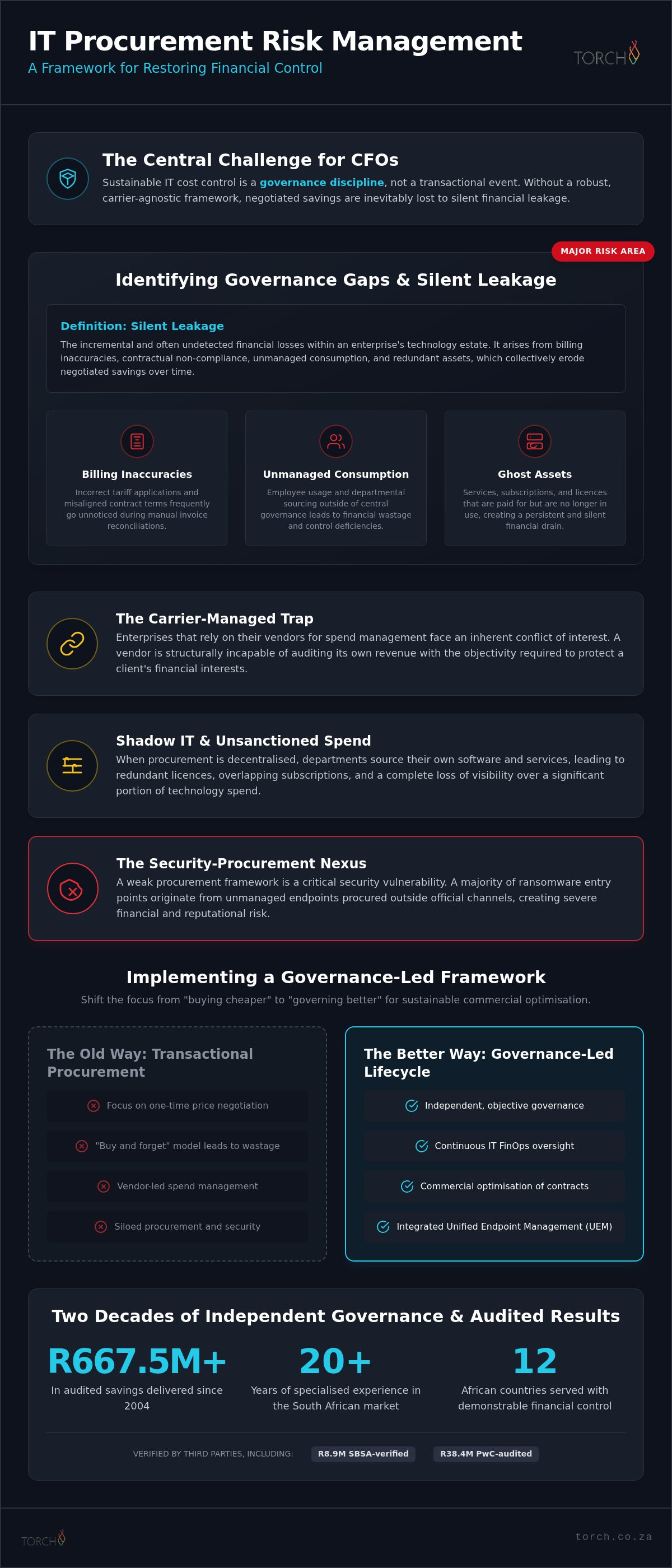
For Chief Financial Officers and procurement leaders in 2026, the central challenge is no longer just negotiating better rates for IT and telecom services. The real test lies in preserving those savings against a constant, invisible drain on the budget. Despite securing favourable terms with primary carriers, many enterprises see their technology costs inexplicably rise. This paradox stems from a fundamental misunderstanding: sustainable IT cost control is a governance discipline, not a transactional event. Without a robust, carrier-agnostic IT procurement risk management framework, negotiated savings are inevitably lost to silent leakage.
This framework is designed to help you identify critical governance gaps and eliminate the silent financial leakage eroding your enterprise IT and telecom estates. By shifting the focus from “buying cheaper” to “governing better,” organisations can restore financial visibility, achieve structural control, and mitigate the significant security risks tied to unmanaged procurement.
The Evolving Landscape of IT Procurement and Sourcing Challenges
The procurement landscape has fundamentally shifted. The era of centralised hardware purchasing has given way to fragmented, consumption-based models for Software-as-a-Service (SaaS), cloud infrastructure, and mobile estates. This decentralisation creates significant challenges for financial governance, as traditional procurement workflows were not designed to manage the fluid nature of “as-a-service” consumption. Amidst economic volatility across Africa, the pressure on CFOs to demonstrate structural control over this sprawling digital estate has never been greater. This elevates procurement from a back-office function to a strategic financial imperative.
- The transition from centralised hardware purchasing to fragmented, consumption-based SaaS and mobile estates.
- Why traditional procurement workflows fail to capture the nuances of modern “as-a-service” models.
- The rising pressure on CFOs to demonstrate structural control amidst economic volatility.
- Defining procurement as a strategic financial imperative rather than a back-office function.
Managing Multi-Vendor Hybrid Estates
Large African enterprises often operate across multiple jurisdictions, managing a complex web of contracts with diverse vendors. This complexity makes it exceedingly difficult to maintain a single source of truth for all IT and telecom assets, leading to inefficiencies and a lack of clear oversight. The primary goal must be to achieve commercial optimisation, which is the continuous alignment of contractual terms with actual, real-world consumption patterns across the entire technology estate.
The Shift from Transactional to Lifecycle Procurement
The traditional “buy and forget” model is a direct path to financial wastage. In a lifecycle approach, the procurement event is merely the beginning. True financial control requires integrating procurement with IT FinOps for continuous budget oversight throughout an asset’s operational life. This is where independent governance becomes essential. By providing objective oversight, an independent partner ensures vendors are held accountable to their contractual obligations, preventing the value negotiated at purchase from eroding during the “run” phase.
Identifying Governance Gaps: Where IT Budgets Suffer Silent Leakage
Silent Leakage is the invisible financial drain on an IT budget caused by a combination of systemic billing errors, unmanaged employee usage, and the persistence of “ghost assets” — services and subscriptions that are paid for but no longer in use. This issue is compounded by the “Carrier-Managed Trap,” where enterprises rely on their vendors for spend management. A vendor is structurally incapable of auditing its own revenue with the objectivity required to protect its client’s financial interests. As a result, common billing discrepancies, such as incorrect tariff applications or misaligned contract terms, are frequently overlooked by internal teams performing manual invoice reconciliations.
Definition: Silent Leakage
Silent Leakage refers to the incremental and often undetected financial losses within an enterprise’s technology estate. It arises from billing inaccuracies, contractual non-compliance, unmanaged consumption, and redundant or unused assets, which collectively erode negotiated savings over time.
Shadow IT and Unsanctioned Spend
When procurement is decentralised, individual departments or employees often source their own software and services, a practice known as Shadow IT. This leads to redundant software licences, overlapping subscriptions, and a complete loss of visibility over a significant portion of technology spend. Discovering these hidden costs requires a systematic approach. Automated Business Intelligence (BI) models, such as our proprietary SpotLight™ platform, can analyse spend data across the organisation to identify and flag unsanctioned expenditure, providing the evidence needed to bring it back under central governance. For a deeper understanding of this discipline, explore our IT FinOps services.
The Security-Procurement Nexus
A weak IT procurement risk management framework is not just a financial issue; it is a critical security vulnerability. Poor governance over device procurement directly increases an organisation’s exposure to cyber threats. Research indicates that a significant majority of ransomware entry points originate from unmanaged or poorly secured endpoints. When a device is procured outside of official channels, it often misses essential security configurations, patching schedules, and policy enforcements, creating an open door for malicious actors. The potential financial and reputational cost of a single data breach originating from an unmanaged endpoint is severe. Therefore, integrating a robust Unified Endpoint Management (UEM) strategy into the broader sourcing framework is no longer optional—it is a cornerstone of corporate risk management.
Navigating Market Benchmarking and Contractual Complexity
One of the greatest disadvantages internal procurement teams face is a critical lack of objective, carrier-agnostic data. Negotiations are often conducted in an information vacuum, where the vendor holds all the cards regarding market rates and contract structures. This asymmetry allows for the proliferation of auto-renewal traps and a “loyalty tax,” where long-term clients inadvertently pay more than new customers for equivalent services. By leveraging data-backed benchmarking, however, organisations can level the playing field. Our experience shows that this approach consistently achieves negotiation gains of up to 27.5%. Before committing to any long-term Request for Proposal (RFP), it is vital to conduct thorough scenario modelling to understand the full financial implications of different contract structures.
- The critical lack of objective, carrier-agnostic data in standard contract negotiations.
- Identifying auto-renewal traps and the “loyalty tax” prevalent in enterprise telecom agreements.
- How to achieve up to 27.5% negotiation gains through data-backed benchmarking.
- The importance of scenario modelling before committing to long-term RFPs.
Utilising Competitive Intelligence
Proprietary competitive intelligence engines like TorchLight™ provide the market benchmarking that internal teams simply cannot access. This technology analyses thousands of anonymised data points from across the market to model ideal contract terms and pricing based on an organisation’s specific consumption profile. This allows procurement leaders to move beyond accepting “standard” rates and instead secure best-in-market gains. This is why independent governance, backed by objective data, must be the cornerstone of vendor accountability.
Ending the Cycle of Auto-Renewals
Evergreen clauses, which trigger automatic contract renewals unless notice is given within a specific window, are a significant financial danger in IT and telecom agreements. They create commercial stagnation, locking enterprises into outdated technology and uncompetitive rates. The antidote is a proactive renewal roadmap. By systematically tracking every contract end date and initiating a review process well in advance, organisations can avoid these traps and ensure their technology estate does not accumulate commercial or technical debt. This is a core discipline within a structured Telecoms Expense Management (TEM) programme.
Implementing a Governance-Led Framework for Sustainable Optimisation
True cost optimisation is not achieved through a one-time negotiation or the implementation of a new software platform. It is the result of a cultural shift from fragmented processes to an integrated governance ecosystem. Software dashboards can report on problems, but they cannot resolve them. Sustainable results require embedded, high-touch execution where an independent partner works within the organisation to enforce accountability and remediate issues as they arise. This is the Hero function of governance: rescuing budgets from the silent leakage that erodes them, through rigorous and relentless financial accountability.
Instead of a narrow focus, a successful framework integrates multiple disciplines. Torch’s model is built upon Six Integrated Service Lines, harmonising FinOps, Telecom Expense Management (TEM), Unified Endpoint Management (UEM), Strategic Advisory, and Proprietary Technology to establish total estate control.
The 20-Minute FinOps Readiness Assessment
For CFOs and procurement directors seeking to identify immediate control deficiencies, a diagnostic approach is the most effective first step. Our 20-Minute FinOps Readiness Assessment is a structured framework designed to pinpoint governance gaps and quantify their financial impact. This process provides a clear, data-backed business case for change. As demonstrated in our work with clients like the Tsogo Group, this focused approach can accelerate procurement decisions, moving from an initial challenge to a final, board-approved decision in a concentrated timeframe. This ability to deliver clarity and direction is built on a foundation of over 20 years of experience and more than R667.5M in verified savings delivered to enterprises across the African market.
Building Vendor Accountability
The final pillar of a robust IT procurement risk management framework is structural vendor accountability. This is achieved by embedding clear performance metrics, service level agreements (SLAs), and financial penalties directly into IT contracts. An independent advisor plays a crucial role here, not as an antagonist, but as an objective mediator responsible for monitoring compliance, managing disputes, and ensuring that the terms of the agreement are consistently met. This transforms the client-vendor relationship from a transactional one into a true partnership based on transparency and mutual accountability.
Ready to establish a governance framework that protects your IT budget? Book a 30-minute governance review with Derek King to diagnose your organisation’s exposure to silent leakage.
Frequently Asked Questions
-
What are the most common challenges in IT procurement and sourcing for 2026?
The primary challenges include managing fragmented spend across decentralised SaaS and cloud services, a lack of visibility into actual consumption patterns, the security risks posed by unmanaged “Shadow IT” procurement, and the difficulty of negotiating effectively without access to independent, carrier-agnostic market benchmarks.
-
How does silent leakage affect my enterprise IT budget?
Silent leakage systematically erodes your budget through small, often invisible, financial drains. These include systemic billing errors, paying for unused “ghost” assets, suboptimal tariff plans, and failing to claim service credits. Cumulatively, these can negate the savings achieved during contract negotiations, causing costs to rise unexpectedly.
-
Why should we use an independent advisor instead of our telecom carrier for spend management?
A carrier’s primary objective is to protect its own revenue, making it impossible for them to be truly objective when auditing your spend. An independent, carrier-agnostic advisor works exclusively for you, with the sole purpose of ensuring you pay the lowest possible amount for the services you actually need and use. Their role is to provide accountability and enforce contract compliance.
-
What is the difference between IT procurement and IT financial governance?
IT procurement is the transactional event of acquiring technology goods and services. IT financial governance is the continuous, lifecycle-based discipline of managing, monitoring, and optimising that technology to ensure it delivers its intended value without financial wastage or unnecessary risk. Procurement is the “buy” phase; governance covers the entire “run” phase.
-
How can active management capture 19.6% in immediate Rand savings?
This figure, drawn from our client data, represents the average savings achieved through continuous, active management of the technology estate. It comes from activities like optimising mobile data pools, downgrading underutilised subscriptions, identifying and terminating unused services, and correcting billing errors on a monthly basis—actions that are impossible in a “buy and forget” model.
-
What security risks are associated with poor IT asset procurement governance?
Poor procurement governance leads to unmanaged endpoints (laptops, mobile devices) that are not enrolled in security protocols. These devices often lack critical patches, security software, and policy enforcement, making them primary entry points for ransomware and other cyberattacks. This creates significant risk of data breaches, financial loss, and reputational damage.