
For Chief Financial and Information Officers in South Africa, the challenge is no longer simply managing mobile devices; it is mastering the financial and security governance of the entire mobile estate. Manual compliance processes, once considered adequate, now represent a significant source of risk and financial leakage. Clerical errors, inconsistent policy enforcement, and delayed security patches create vulnerabilities that are easily exploited.
Automating mobile device security compliance is the strategic response to this challenge. It is not about adding another dashboard but about embedding a continuous, proactive governance framework into the fabric of your IT and finance operations. This framework shifts the organisation from a state of reactive “firefighting” to one of sustained control, ensuring every endpoint is secure, accounted for, and commercially optimised from procurement to retirement.
The Governance Gap: Why Manual Compliance Fails the Modern Enterprise
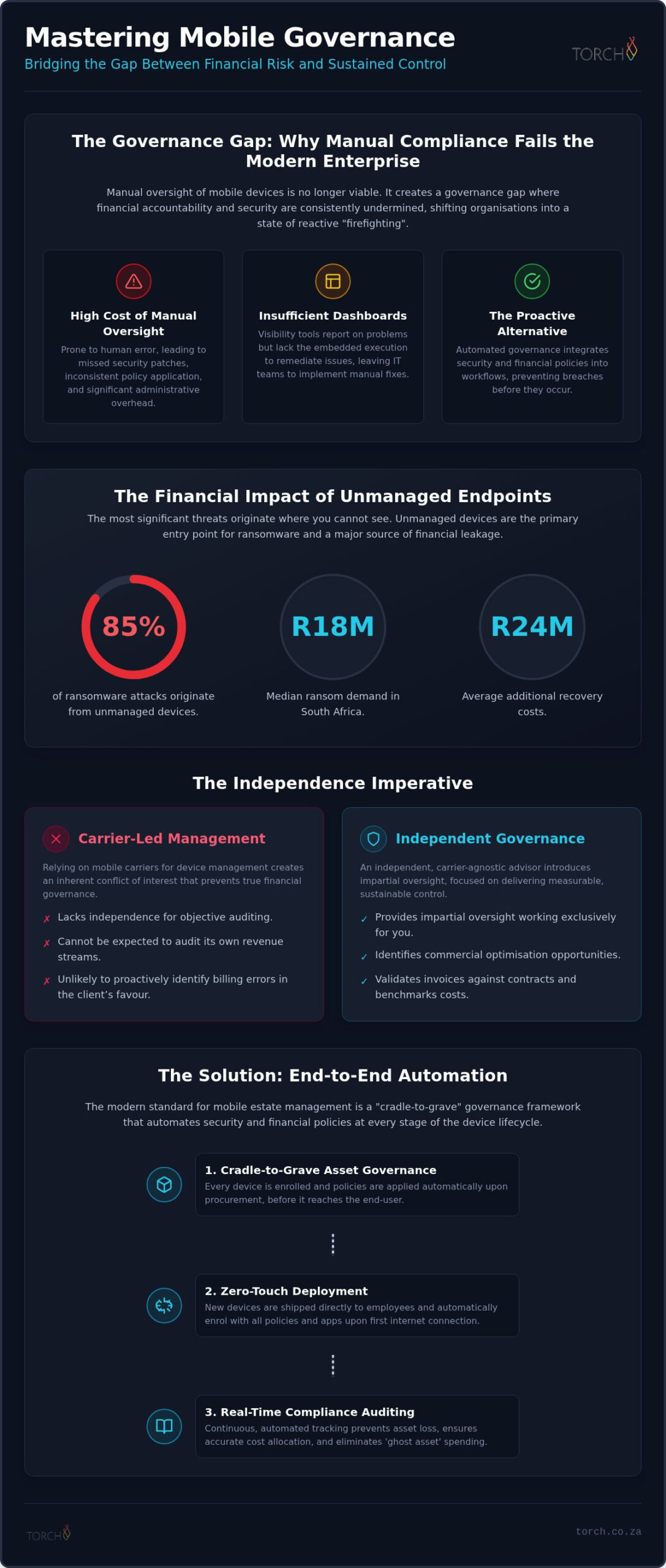
In an environment of dispersed workforces and increasingly sophisticated cyber threats, manual approaches to mobile security are no longer viable. The sheer volume of devices, coupled with the complexity of usage policies and regulatory requirements, makes manual oversight a high-risk, low-reward activity. This reliance on manual checks and balances creates a governance gap, where financial accountability and security posture are consistently undermined.
- The high cost of manual oversight: Manual processes are prone to human error, leading to missed security patches, inconsistent policy application, and significant administrative overhead. These small oversights accumulate, creating systemic weaknesses across the mobile estate.
- Why dashboards alone are insufficient: While visibility tools and standard Mobile Device Management (MDM) dashboards can report on problems, they rarely solve them. They lack the embedded execution needed to remediate issues, leaving already overstretched IT teams to manually interpret data and implement fixes.
- The shift to proactive governance: True control comes from moving beyond reactive problem-solving. Automated governance integrates security and financial policies directly into workflows, preventing compliance breaches before they occur and ensuring that every device aligns with organisational standards from day one.
The Invisible Risks of Unmanaged Endpoints
The most significant threats to an enterprise often originate from the places it cannot see. Unmanaged and improperly secured endpoints—including both corporate-owned and employee-owned (BYOD) devices—are the primary entry points for ransomware and a major source of financial leakage. With 85% of ransomware attacks originating from unmanaged devices, the failure to enforce consistent security policies has direct and severe financial consequences.
The financial impact is not trivial. In South Africa, the median ransom demand has reached R18 million, with recovery costs averaging an additional R24 million. This figure does not account for reputational damage or regulatory penalties. Unmanaged personal devices also contribute to silent budget leakage, as unmonitored data usage and non-compliant application subscriptions inflate telecom expenses without oversight. This clear correlation between compliance failure and financial overspending highlights the need for a unified governance model.
Establishing Independent Oversight
Many organisations default to their mobile carriers for device management, assuming it is the most straightforward solution. However, carrier-led management inherently lacks the independence required for objective auditing and commercial optimisation. A carrier cannot be expected to audit its own revenue streams or proactively identify billing errors in the client’s favour. This creates a conflict of interest that prevents true financial governance.
Engaging an independent, carrier-agnostic advisor introduces the impartial oversight needed to bridge this gap. An independent partner works exclusively for the client, focusing on identifying commercial optimisation opportunities, validating invoices against contracts, and benchmarking costs against the market. This approach moves the conversation beyond generic management to a professional, financially literate governance discipline focused on delivering measurable, sustainable control over the entire telecom estate.
Mechanics of Automation: From Zero-Touch to Real-Time Auditing
The 2026 standard for mobile estate management is built on end-to-end automation. This means establishing a cradle-to-grave governance framework that tracks every asset from the moment of procurement until its secure retirement. By integrating security and financial policies directly into automated workflows, enterprises can eliminate manual friction, prevent wasteful spending on “ghost assets”—devices that are paid for but not in use—and ensure a consistent security posture across the organisation.
- Cradle-to-grave asset governance: Every device is enrolled in a central management system upon procurement, with policies applied automatically before it ever reaches the end-user.
- Real-time visibility: Continuous, automated tracking prevents assets from disappearing from inventory, ensuring accurate cost allocation and eliminating expenditure on lost or unused devices.
- Integrated procurement workflows: Security and compliance requirements are built into the procurement process, ensuring that no device can be activated on the network unless it meets pre-defined governance standards.
Zero-Touch Deployment and Policy Enforcement
One of the most significant drains on IT resources is the manual configuration of new devices. Zero-touch deployment automates this entire process. A new device can be shipped directly to an employee, and upon its first connection to the internet, it automatically enrols in the organisation’s Unified Endpoint Management (UEM) platform. From there, all necessary applications, security settings, and usage policies are installed without any intervention from the IT department.
This automation ensures immediate and consistent policy enforcement. Password protocols, application controls, data encryption, and network access rights are applied uniformly, whether the employee is in the office, at home, or travelling. For hybrid and remote workforces, this capability is essential for maintaining a standardised security and compliance posture across thousands of disparate endpoints.
Real-Time Compliance Auditing
The era of the annual, manual compliance audit is over. Modern governance demands continuous, automated monitoring that provides real-time insight into the health of the mobile estate. Instead of relying on periodic spot-checks, automated systems use purpose-built Business Intelligence (BI) models to constantly analyse device data, identify variances in usage or security posture, and flag anomalies for immediate attention.
This shift to real-time auditing provides board-level confidence that is impossible to achieve with manual methods. Automated reports can instantly verify compliance with internal policies and external regulations like the Protection of Personal Information Act (POPIA). This data-driven approach allows leadership to make strategic decisions based on accurate, up-to-the-minute information about IT spend, risk exposure, and operational efficiency.
Regulatory and Financial Imperatives: POPIA and Ransomware Protection
In South Africa, automating mobile device security compliance is not just an operational enhancement; it is a regulatory and financial necessity. The legal landscape, particularly concerning data protection under POPIA, requires organisations to demonstrate auditable control over any device that accesses personal information. Simultaneously, the pervasive threat of ransomware demands a robust defence strategy centred on securing every potential entry point.
Automated governance directly addresses both imperatives. By enforcing security policies on all endpoints—including corporate-owned and BYOD devices—a UEM framework drastically reduces the attack surface available to cybercriminals. The financial argument is compelling: the investment in an automated governance system is a fraction of the potential cost of a single data breach, which encompasses regulatory fines, recovery expenses, and long-term reputational harm.
Automating POPIA Compliance for Mobile Estates
Meeting POPIA requirements is impossible without a systematic way to manage and protect data on mobile devices. Automation provides the necessary tools to maintain compliance at scale. For regulatory audits, automated reporting generates the evidence needed to prove that appropriate technical and organisational measures are in place to protect personal information.
For BYOD environments, this is particularly critical. Automated systems can create a secure, encrypted container on an employee’s personal device, segregating corporate data from personal data. This allows for selective wiping, where only corporate information is removed if the employee leaves the company or the device is lost, leaving personal data untouched. By maintaining a single source of truth for all asset and user data, automation ensures that your organisation can confidently demonstrate its adherence to data protection principles.
Commercial Optimisation Through Risk Mitigation
Strong security compliance is intrinsically linked to financial performance. A well-governed mobile estate prevents the financial leakage that occurs when lost or stolen devices remain active on the network, accumulating charges without any oversight. Automated policies can immediately lock or wipe a missing device, preventing unauthorised use and stopping unnecessary expenditure.
The financial benefits are significant. Our analysis shows that actively governed estates achieve up to a 47.2% total cost reduction compared to their unmanaged equivalents. This figure is a direct result of integrating security discipline with financial oversight. By mitigating risks like data breaches and device loss, organisations not only protect their data but also fortify their bottom line. A robust security posture is one of the most effective commercial optimisation strategies an enterprise can deploy.
Beyond the Dashboard: Sustaining Control Through Managed Services
Implementing powerful automation software is only part of the solution. Without dedicated resources to manage the platform, interpret its outputs, and execute on its findings, even the most advanced dashboard becomes another underutilised tool. For already overstretched IT and finance teams, the answer lies in a managed governance service that combines technology with expert human oversight and execution.
This model provides more than just a platform; it delivers a partnership that blends strategic guidance with hands-on accountability to resolve issues and a steady, supportive presence to simplify complexity for your internal teams. This approach ensures that the insights generated by the technology are translated into tangible outcomes, such as the 19.6% savings consistently achieved through continuous subscription adjustment and policy optimisation. A managed service handles the low-value manual tasks, freeing your internal experts to focus on core strategic initiatives.
Managed IT FinOps and Security Integration
The most effective governance frameworks integrate financial discipline with security management. Combining IT FinOps-as-a-Service with unified endpoint security provides a holistic view of estate health, where every technical decision is weighed against its commercial impact. This unified approach ensures that security policies are not implemented in a vacuum but are aligned with budgetary goals and financial controls.
A key component of this integrated service is carrier-agnostic benchmarking. An independent partner can leverage market intelligence to assess whether your carrier contracts are commercially competitive, providing the data-backed evidence needed to strengthen your position during renegotiations. This level of precision and oversight is a powerful way to ensure that your security investments are protected by a commercially sound financial framework.
Next Steps for Enterprise Leaders
Transitioning from manual oversight to automated governance does not need to be a lengthy or disruptive process. The journey begins with understanding your organisation’s current state of readiness. A focused diagnostic can quickly assess your existing processes, identify critical governance gaps, and map out a clear, actionable path forward.
With a proven methodology, it is possible to move from identifying a challenge to making a final, data-backed procurement decision in as little as six weeks. To understand how automated governance can secure your mobile estate and deliver sustainable financial control, the first step is a conversation.
Book a 30-minute governance review to assess your current framework and explore a clear path to secure, automated compliance.
Frequently Asked Questions (FAQs)
How does automating mobile security compliance reduce my IT budget?
Automation reduces costs by eliminating manual, time-consuming tasks for IT staff, preventing financial leakage from lost or unused devices (“ghost assets”), and optimising mobile subscription usage. It also mitigates the high cost of data breaches by enforcing consistent security policies that reduce your organisation’s risk exposure.
Is automated compliance enough to meet POPIA requirements in South Africa?
Automation is a critical component for meeting POPIA requirements. It provides the technical measures needed to protect personal information, such as data encryption, access controls, and selective wiping for BYOD devices. Crucially, it also generates the audit-ready reports required to demonstrate compliance to the Information Regulator.
Can automation help manage security on employee-owned (BYOD) devices?
Yes. Automated UEM platforms can create a secure, containerised environment on personal devices to separate corporate data from personal data. This allows the organisation to enforce security policies on its own data and applications without infringing on employee privacy, providing a secure and manageable solution for BYOD.
What is the difference between a standard MDM dashboard and automated governance?
A standard MDM dashboard provides visibility—it reports on the status of your devices. An automated governance framework adds execution. It integrates policies directly into workflows (like procurement and onboarding), automates remediation of compliance issues, and combines security control with financial oversight for a complete management solution.
How long does it take to implement an automated compliance framework?
While every organisation is different, a focused diagnostic and strategic planning process can move an enterprise from initial assessment to a final procurement decision in approximately six weeks. The technical implementation is often rapid, particularly with zero-touch deployment capabilities that automate device enrolment.
Why should we use an independent advisor rather than our mobile carrier?
A mobile carrier has an inherent conflict of interest, as it cannot objectively audit its own billing or recommend solutions that may reduce its revenue. An independent, carrier-agnostic advisor works solely on your behalf to provide impartial oversight, validate costs, benchmark contracts against the market, and ensure your governance strategy serves your financial and security interests.