
Understanding the COPE Model: Beyond Basic Device Management
Enterprise mobility has evolved past the point where hardware procurement can be treated as a detached administrative task. For Chief Financial Officers (CFOs) and Chief Information Officers (CIOs) managing dispersed workforces across South Africa, mobile estates represent a critical intersection of operational productivity, regulatory risk, and continuous fiscal exposure. This corporate-owned personally-enabled (COPE) policy guide provides a structural framework for enterprises seeking to transition from informal, high-risk mobility models into an actively governed endpoint estate.
At its foundation, Corporate-Owned Personally-Enabled (COPE) is an operational strategy in which an enterprise retains full ownership, procurement authority, and architectural control over mobile endpoints, whilst permitting employees to use those devices for approved personal activities. Unlike legacy corporate models that locked down devices into single-purpose utility, COPE acknowledges the operational reality of modern work patterns without surrendering governance, asset tracking, or perimeter integrity.
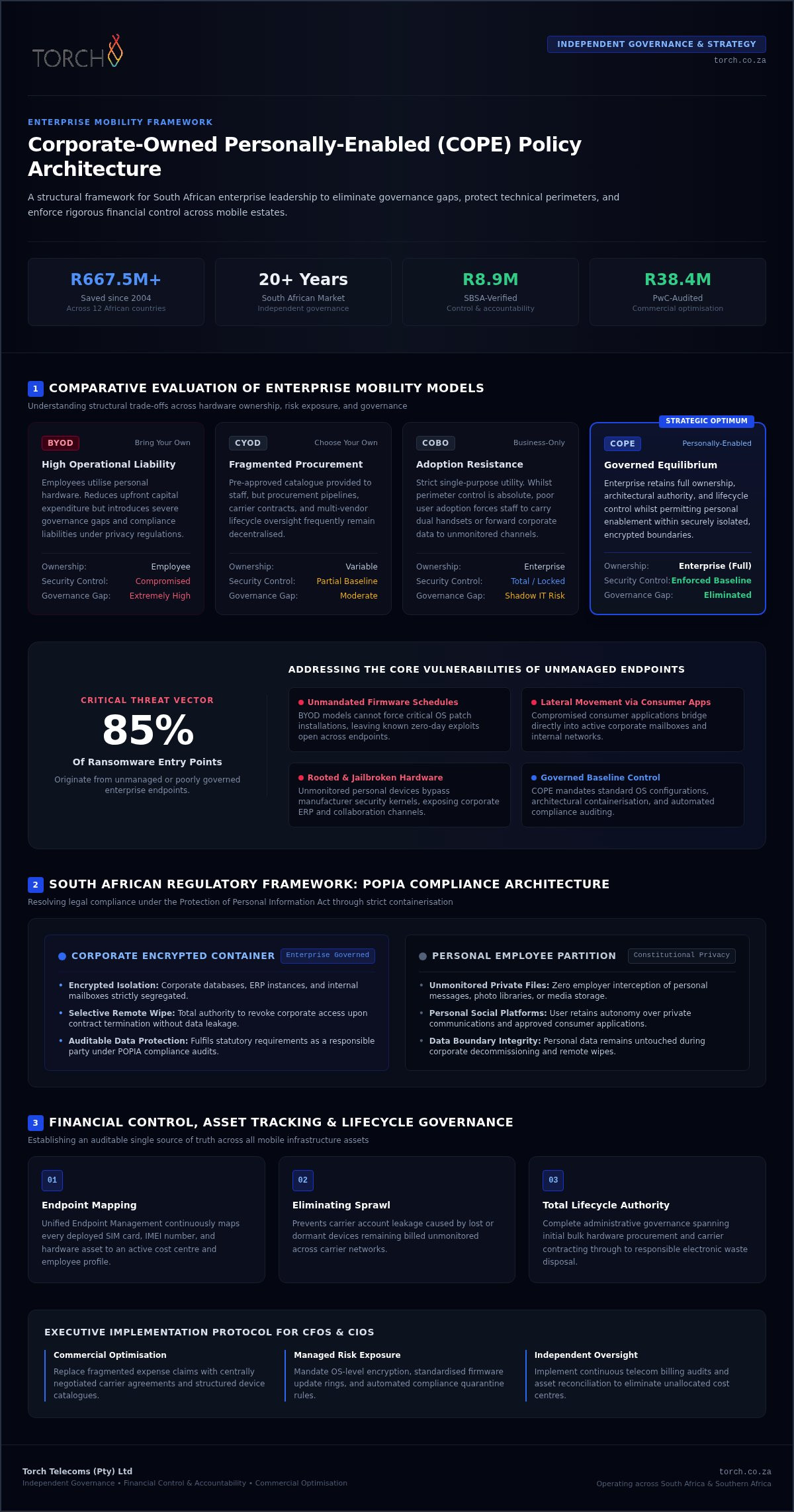
To understand the strategic position of COPE, enterprise leaders must evaluate it alongside alternative mobility frameworks:
- Bring Your Own Device (BYOD): Employees utilise personal hardware for corporate tasks. Whilst BYOD reduces initial capital expenditure, it introduces severe governance gaps. IT teams cannot enforce uniform security baselines, device health monitoring is compromised, and the enterprise faces significant legal liability under data privacy regulations when monitoring or wiping endpoints. Furthermore, hidden operational costs emerge through fragmented reimbursement processing and support overheads.
- Choose Your Own Device (CYOD): The organisation provides a pre-approved catalogue of devices from which the employee selects, but procurement, carrier contracting, and asset lifecycles often remain fragmented. For a detailed strategic breakdown of these models, consult our comparison on COPE vs BYOD vs CYOD.
- Corporate-Owned Business-Only (COBO): The enterprise issues hardware strictly reserved for corporate use. Whilst security control is absolute, employee adoption is notoriously low, frequently driving staff to carry two handsets or circumvent policies by forwarding corporate correspondence to personal channels, creating unmonitored shadow IT.
The primary driver behind the enterprise migration toward COPE is the elimination of the “Governance Gap”—the operational void that occurs when corporate digital assets reside on hardware over which IT has negligible administrative oversight. When hardware is corporate-owned, the enterprise maintains unambiguous authority to deploy management profiles, audit configurations, enforce encryption, and decommission the asset at end-of-life. By permitting personal enablement within strictly governed boundaries, organisations secure user compliance whilst defending their technical and financial perimeter.
The Evolution of Mobility Deployment Models
The rapid expansion of hybrid working models across southern Africa initially accelerated the adoption of BYOD programmes. However, enterprise balance sheets and risk committees are now confronting the hidden consequences of unmanaged mobility. The apparent hardware savings of BYOD have been systematically offset by administrative drag, escalating support tickets for non-standardised hardware, and critical exposures in endpoint defence.
Industry analyses indicate that approximately 85% of ransomware entry points originate from unmanaged or poorly governed endpoints. In a BYOD environment, an enterprise cannot mandate firmware update schedules, restrict lateral movement from compromised consumer applications, or verify whether a mobile device has been jailbroken or rooted. A compromised personal device with access to corporate mailboxes, enterprise resource planning (ERP) instances, or internal collaboration channels provides threat actors with immediate network access.
Consequently, enterprise executive committees are moving toward COPE as a measured, governed framework. COPE reconciles the modern requirement for employee flexibility with the non-negotiable obligation to enforce enterprise-grade security controls. It allows the enterprise to standardise hardware builds, streamline support through predictable operating system baselines, and maintain total lifecycle authority from initial procurement to responsible electronic waste disposal.
The Strategic Imperative for COPE in South Africa
Operating a mobile estate within South Africa introduces specific regulatory and market complexities that demand active governance rather than passive administration. Central to this is the Protection of Personal Information Act (POPIA). Under POPIA, organisations act as responsible parties obliged to protect personal data from unlawful access, loss, or unauthorised destruction. When employees process customer or corporate information on unmanaged personal handsets, maintaining compliance audits becomes extraordinarily difficult.
COPE resolves this regulatory tension through architectural separation. By leveraging enterprise mobility tools, IT divisions establish secure, encrypted containers that isolate corporate databases and productivity applications from the user’s personal files, social platforms, and media. The organisation enforces rigorous security policies across the corporate container—including remote wiping of business data upon contract termination—without intercepting or infringing upon the employee’s personal messages, photos, or private applications. This dual-persona structure protects both enterprise assets and employee constitutional privacy rights.
Furthermore, COPE establishes an auditable single source of truth for enterprise asset management. Without central ownership, organisations experience hardware sprawl, where lost or dormant devices remain unaccounted for on mobile carrier accounts. Implementing a structured COPE framework supported by dedicated Unified Endpoint Management ensures that every deployed SIM card, IMEI number, and hardware asset is continuously mapped to an active cost centre and employee profile.
—
The Pillars of a Governed COPE Strategy: Security and Finance
An enterprise-grade COPE strategy cannot function solely as an IT policy or an operational HR guideline. To be sustainable, it must be constructed upon two interconnected pillars: technical endpoint security and commercial financial governance. Treating mobility purely as an infrastructure rollout inevitably leads to unchecked expenditure, whereas viewing it purely as a procurement cost-cutting exercise exposes the enterprise to severe operational vulnerabilities.
When mobile endpoints are actively managed, the risk profile of the business declines, and billing structures can be optimised against actual consumption profiles. Conversely, uncontrolled estates suffer from “silent leakage”—the systematic drain of corporate capital resulting from unallocated data packages, obsolete contracts, unapplied commercial discounts, out-of-bundle penalties, and recurring fees paid for decommissioned hardware. Bridging this operational divide requires integrating active security controls with structured IT FinOps practices.
Endpoint Security and Ransomware Mitigation
Mobile devices are no longer merely communication tools; they are powerful computational endpoints holding cryptographic keys, access tokens, and administrative credentials. A modern COPE deployment must incorporate cradle-to-grave lifecycle management, ensuring that every asset is secured before it leaves procurement and remains governed until complete sanitisation.
Through Unified Endpoint Management (UEM) managed services, IT teams implement zero-touch provisioning. When a device is unboxed, enterprise enrolment profiles automatically configure corporate firewalls, push essential line-of-business applications, enforce multi-factor authentication, and apply strict compliance rules. If an employee attempts to disable system encryption or install applications from unverified third-party repositories, the device can be quarantined automatically from the corporate network.
The operational cost of failing to secure mobile endpoints is substantial. According to the Sophos State of Ransomware 2025 report, the median ransomware demand in South Africa reached R18 million. When considering broader business disruption, operational downtime, forensic investigations, and regulatory notifications, overall enterprise recovery costs routinely escalate well beyond R24 million. Mobile devices represent an increasingly common ingress vector for these catastrophic attacks. By enforcing policy compliance, containerised application structures, and immediate selective-wipe capabilities, an enterprise systematically reduces its attack surface, transforming vulnerable endpoints into fortified network perimeter extensions.
Commercial Optimisation and Spend Visibility
While security controls neutralise technical risk, financial governance ensures that the estate remains commercially viable. Managing hundreds or thousands of mobile contracts across South African telecommunications networks presents immense billing reconciliation complexity. Invoices regularly span tens of thousands of line items, fraught with complex tariff structures, variable data pools, value-added services, and split-billing anomalies.
Without specialised Telecom Expense Management (TEM), corporate finance teams lack the capability to validate these charges against contracted rates. As a result, enterprises routinely overpay for enterprise mobile voice and data services. Sustained financial governance requires independent contract auditing, continuous tariff rationalisation, and carrier-agnostic benchmarking to ensure billing integrity.
Torch integrates dedicated analytical platforms to solve this challenge. By utilising SpotLight™, enterprises gain continuous, real-time visibility across user-level consumption, budget-versus-actual allocations, and cross-departmental cost centres. Concurrently, TorchLight™ serves as a proprietary competitive-intelligence engine, benchmarking carrier contract structures against broader market realities to eliminate hidden margins and silent leakage during contract renewals. This financial discipline ensures the enterprise pays exclusively for active, optimised, and policy-compliant services.
—
Building Your COPE Policy: A Practical Implementation Framework
Drafting a successful corporate-owned personally-enabled policy requires a balanced approach that pairs administrative clarity with operational enforceability. A policy that is overly restrictive leads to low employee satisfaction and the emergence of shadow IT; a policy that is too permissive creates security liabilities and unpredictable carrier bills. Enterprise leaders should execute policy deployment across four core phases:
- Scope of Use and Acceptable Behaviour: Define unequivocally what personal enablement entails. The policy must clearly outline permitted personal applications (such as banking or navigation) versus banned application classes (such as peer-to-peer file sharing, unapproved cloud storage, or gambling services) that jeopardise device integrity.
- The Financial Rand Journey: Map the entire financial lifecycle of the device. Establish baseline corporate data allowances, define how out-of-bundle costs are restricted or capped, and determine the exact mechanism by which personal data usage is managed or funded by the user.
- Mutual Legal and Operational Responsibilities: Delineate the boundary between enterprise administration and personal privacy. Clarify that the hardware remains corporate property, subject to auditing, remote remediation, and asset recovery upon separation of employment.
- End-of-Life and Decommissioning: Detail the physical return, certified cryptographic wiping, and retirement protocols for hardware at the end of its useful economic life. For deeper guidance on managing the hardware asset cycle, see our framework on the corporate device lifecycle.
Drafting the Usage and Privacy Guidelines
A policy document must be written in unambiguous, accessible terms to avoid operational misunderstandings between business divisions. When establishing personal enablement rules, precision prevents friction:
Data Allocation and Personal Consumption: Enterprises should avoid open-ended data contracts that leave the organisation exposed to unmanaged out-of-bundle rates. A governed policy defines a tiered allowance model aligned with employee role profiles. If an employee exhausts their business data allocation through personal streaming or large downloads, automated tools must manage the threshold. Solutions like Boost™—Torch’s SMS-based automation bot—allow employees to self-manage personal top-ups or request temporary business limit extensions without submitting manual IT helpdesk tickets or burdening the finance department.
Application Governance and Security Baselines: The policy must explicitly establish containerisation principles. Explain to employees that IT administrators have zero visibility into their personal photo galleries, private messages, personal email accounts, or financial transactions. However, clarify that IT maintains administrative control over the business container, including enterprise email, ERP clients, and corporate repositories. The policy must clearly forbid side-loading applications from outside official application marketplaces, disabling biometrics, or using hardware for unlawful purposes.
POPIA Compliance and Transparency: Include explicit operational disclosures regarding telemetry. Detail precisely what technical metadata the enterprise logs (such as operating system version, patch status, network connection type, and physical asset location for theft recovery) to eliminate misunderstandings regarding employee surveillance. Transparency ensures compliance with South African privacy legislation and fosters enterprise-wide trust.
Operationalising the Procurement Cycle
Once governance guidelines are drafted, the operational procurement workflow must be automated. Manual procurement models dependent on disparate spreadsheets, fragmented carrier interactions, and ad-hoc managerial emails introduce delays and administrative error. Integrating procurement directly into an asset management framework creates a closed-loop environment:
| Lifecycle Stage | Operational Action | Governance Mechanism |
|---|---|---|
| 1. Request & Approval | Automated requisition triggered via HR onboarding or hardware refresh criteria. | Validation against cost-centre budgets, job grade matrices, and policy eligibility rules. |
| 2. Zero-Touch Enrolment | Direct carrier or distributor shipping of standardised hardware to the end user. | Automated enrolment into corporate UEM profiles upon device boot; mandatory cryptographic encryption applied. |
| 3. Active Management | Real-time consumption tracking, automated tariff optimisation, and ongoing user support. | Variance detection, split-billing validation, and automated SIM reallocations via Torch technology solutions. |
| 4. Offboarding & Sanitisation | Immediate selective wipe of business container upon employee departure; physical asset recovery. | De-registration from carrier networks, cancellation or reallocation of SIM accounts, and auditable data sanitisation. |
—
Sustaining Governance: Why Independent Oversight is Essential
Drafting an exceptional policy and implementing modern software does not inherently ensure sustained operational control. Over time, enterprise mobile estates suffer from operational decay: employees change roles without hardware reassignment, telecom carriers adjust billing line items without notification, and internal teams become overwhelmed by monthly administrative burdens. Sustained governance demands ongoing, independent oversight.
Many enterprises assume their telecom service providers will flag billing errors or suggest optimal tariff structures. This expectation ignores a fundamental structural reality: carriers operate with an inherent commercial conflict of interest. A service provider cannot objectively audit its own revenue streams. Tariff adjustments that reduce enterprise spend directly reduce the carrier’s top-line billing. Relying on vendor self-auditing leaves silent billing leakage unchecked.
Similarly, internal corporate audit divisions rarely possess the specialised tooling or commercial market telemetry required to validate high-volume, multi-carrier invoices down to individual usage parameters. According to an independent analysis conducted by GetMetrix, actively governed enterprise estates achieve up to a 47.2% total cost reduction compared to unmanaged equivalents. This magnitude of fiscal efficiency is not achieved through simple software dashboards; it requires embedded, continuous operational execution that reconciles contracts against consumption and holds service providers accountable.
The Torch Governance-Led Model
Torch operates as an independent, carrier-agnostic partner delivering strategic oversight and hands-on operational management to mid- and large-scale enterprises. With over 20 years of continuous operation in the South African market and more than 100 years of combined telecommunications expertise, Torch provides the governance structures enterprises need to eliminate billing leakage and mitigate operational exposure.
Rather than simply supplying static reporting dashboards that notify internal teams of existing overspend, Torch provides embedded execution. Our specialists operate within client environments to actively remediate billing errors, enforce compliance profiles, execute vendor negotiations, and resolve daily operational challenges. Since 2004, Torch has delivered over R667.5 million in verified savings for enterprises across 12 African countries. Our methodology was demonstrated in a major insurance-sector engagement, where our governance interventions yielded R38.4 million in savings, fully audited and verified by PwC.
Through our proprietary analytical platforms, Torch eliminates the friction between IT requirements and CFO balance-sheet controls. SpotLight™ delivers unified visibility into user-level consumption and budget alignment, whilst TorchLight™ models competitive carrier pricing to support complex procurement decisions in weeks rather than months.
Measuring Success and ROI
A corporate-owned personally-enabled deployment should demonstrate measurable financial and operational returns across several core indicators:
- Active Management Savings: Continuous, monthly subscription adjustments and data pool rationalisations consistently deliver a 19.6% reduction in ongoing operational expenditure by cutting out dormant lines and unneeded bundles.
- Negotiation Gains: Utilizing carrier-agnostic market benchmarking during contract renewal intervals captures up to 27.5% in commercial savings, establishing terms reflecting actual market value rather than standard vendor proposals.
- Asset Accountability: Achieving near-total asset reconciliation across the estate, ensuring every procured device corresponds directly to an active employee, a verified cost centre, and an enforced UEM profile.
- Reduced Threat Exposure: Minimising mobile-related security incidents, verified through zero critical data breaches originating from containerised corporate applications.
The Torch FinOps Readiness Assessment is a 20-minute diagnostic for CFOs designed to benchmark your current mobile governance baseline, identify structural financial leakage, and quantify immediate cost-recovery opportunities across your endpoint estate.
—
Frequently Asked Questions
What is the primary difference between COPE and BYOD for security?
The fundamental difference lies in hardware ownership and administrative authority. In a BYOD model, the employee owns the physical asset, restricting the organisation’s legal and technical right to enforce operating system updates, block unverified application installations, or monitor underlying firmware health. Under a COPE model, the enterprise owns the device, enabling IT to enforce mandatory encryption, zero-touch security configurations, real-time threat prevention, and immediate remote data wiping, fully protecting corporate assets without infringing on user privacy.
Does a COPE policy increase the corporate telecom budget?
While COPE requires upfront capital expenditure or structured device leasing, it frequently reduces the total cost of ownership (TCO) compared to an unmanaged estate. BYOD environments conceal significant expenses through inefficient expense claim processing, unstructured stipends, and elevated IT support overheads for disparate devices. COPE introduces bulk hardware purchasing power, standardised maintenance lifecycles, and centralised Telecom Expense Management, which can yield up to a 47.2% total cost reduction across actively governed estates.
How does COPE affect employee privacy under POPIA?
COPE supports POPIA compliance by separating corporate data from personal information through operating-system-level containerisation. IT administrators maintain complete governance over the corporate workspace—enforcing security parameters and retaining the capability to wipe business records—whilst remaining architecturally locked out of personal communications, photo libraries, browsing histories, and personal applications. This provides robust enterprise data protection whilst honouring personal privacy protections.
Can we implement COPE without a UEM platform?
Implementing COPE without a Unified Endpoint Management (UEM) solution is not recommended for enterprise organisations. Without UEM, IT divisions cannot automate device provisioning, enforce mandatory encryption baselines, separate corporate data from personal applications, or execute selective wipes when an asset is lost or an employee leaves the company. UEM provides the essential technical control plane that allows a COPE policy to function practically and securely.
What are the most common billing errors in South African mobile contracts?
The most pervasive billing issues include continuing recurring subscription charges for lines that have been cancelled, incorrect application of negotiated contract discounts, out-of-bundle data penalties triggered by misconfigured tariff tiers, billing for unauthorised third-party content services, and inaccurate SIM split-billing calculations. Because enterprise telecom invoices frequently comprise thousands of detailed line items, these systematic errors routinely pass internal approvals unnoticed without automated audit tools.
How often should a corporate mobile policy be audited for commercial optimisation?
Operational billing and usage trends must be audited monthly to catch silent leakage, terminate dormant subscriptions, and adjust data allocations against real-world consumption patterns. High-level commercial benchmarking and contract terms should undergo an independent review at least once every 12 to 18 months, or well ahead of formal network contract renewals, ensuring the enterprise leverages competitive market intelligence during vendor renegotiations.
—
Take Control of Your Enterprise Mobile Estate
Adopting a corporate-owned personally-enabled framework provides your enterprise with a disciplined path toward endpoint security, predictable operational expenditure, and complete regulatory compliance. Transitioning from unstructured mobility to an actively governed model protects corporate balance sheets from telecom leakage whilst securing your digital perimeter.
To evaluate your current mobility spend, identify control deficiencies, and review your carrier contract structures against independent market benchmarks, partner with South Africa’s dedicated governance specialists.
Book a 30-minute governance review with Derek King to evaluate your COPE strategy
This consultation is an objective, consultative review of your mobile governance framework. There is no cost, no sales pitch, and no obligation.