
What is a Single Source of Truth for IT Assets?
Creating a single source of truth for IT assets involves establishing a centralised, verified repository that encompasses all hardware and software within an organisation. This approach mitigates the risks associated with fragmented data, which can lead to what is known as “silent leakage” in IT procurement.
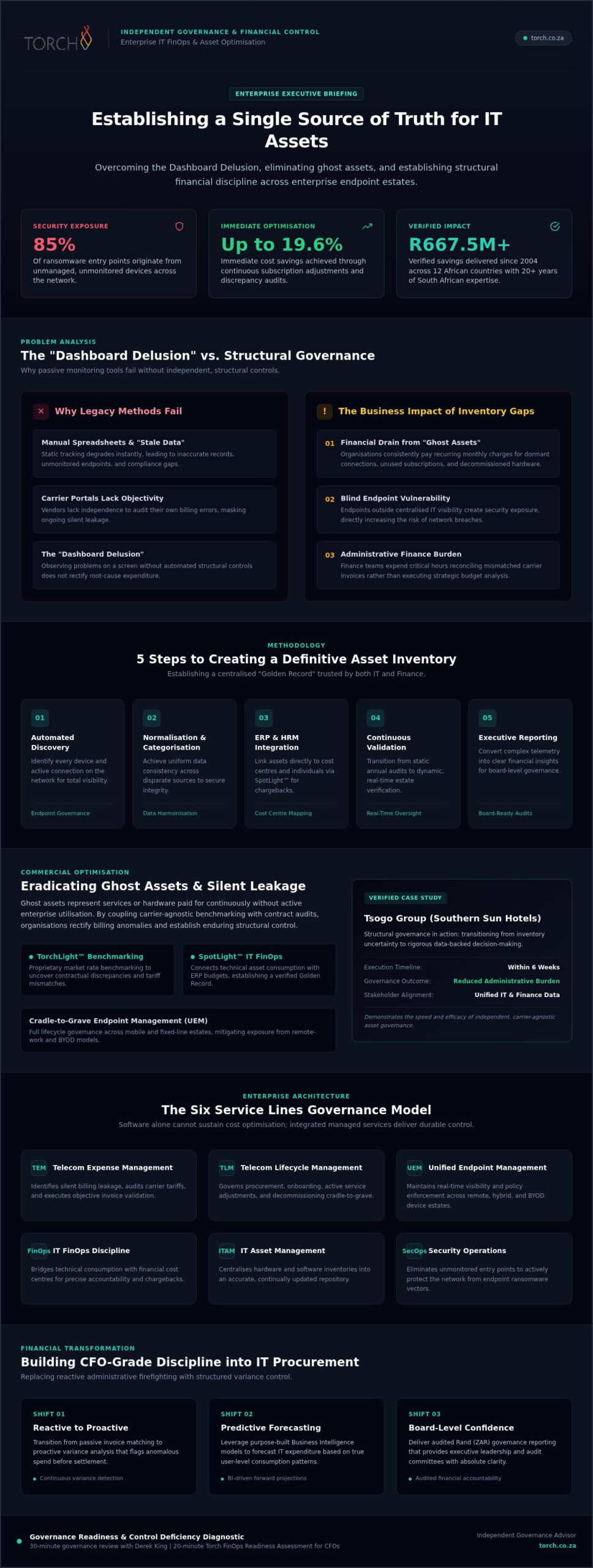
Many enterprises fall into the trap of the “Dashboard Delusion,” where they perceive they are addressing issues simply by observing them on a dashboard, rather than implementing structural controls that rectify the underlying problems. The security imperative is stark: a staggering 85% of ransomware entry points originate from unmanaged devices, making it essential for companies to maintain visibility and control over their IT assets.
The Consequences of Inaccurate IT Asset Inventory
- Financial implications arise when organisations pay for “ghost assets” or unused subscriptions, wasting valuable resources.
- Security risks grow as endpoints remain invisible to the centralised IT team, increasing vulnerability to cyber threats.
- Administrative burdens are placed on Finance teams tasked with reconciling mismatched carrier invoices, diverting focus from strategic activities.
Why Spreadsheets and Carrier Portals Fail
- Manual tracking methods, such as spreadsheets, often result in “stale data,” rendering them ineffective for accurate governance.
- Carrier portals lack the independence required for objective audits of their own revenue, resulting in potential biases.
- Utilising a carrier-agnostic, independent governance partner is critical to achieving effective oversight and accountability.
5 Steps to Creating a Definitive Asset Inventory
- Automated Discovery – Identify every device and connection on the network, ensuring complete visibility.
- Normalisation and Categorisation – Achieve data consistency across disparate sources to maintain integrity.
- ERP and HRM Integration – Connect assets to cost centres and individual users for enhanced tracking and accountability.
- Continuous Validation – Transition from annual audits to real-time governance, ensuring up-to-date accuracy.
- Executive Reporting – Translate complex technical data into clear financial insights suitable for board-level discussions.
Automating Discovery and Endpoint Governance
Implementing Unified Endpoint Management solutions can provide real-time visibility of all IT assets. This approach promotes a “cradle-to-grave” lifecycle management strategy for both mobile and fixed-line assets, effectively addressing the complexities introduced by BYOD and remote-work scenarios.
Integrating Financial and Operational Data
Using SpotLight™ can bridge the gap between IT usage and ERP budget allocation. It is crucial to monitor user-level consumption for effective chargeback models and to establish a “Golden Record” that both Finance and IT can trust.
Addressing the Ghost Asset Challenge and Silent Leakage
Ghost Assets refer to services or hardware for which payments are made but that are not being utilised. Such inefficiencies can be rectified by employing carrier-agnostic benchmarking to detect discrepancies and through contract audits that uncover hidden billing errors. Continuous subscription adjustments can yield immediate savings of up to 19.6%.
The Role of Independent Governance
Objective validation is necessary to hold vendors accountable and to ensure an unbiased review of asset use. Telecom Expense Management (TEM) plays a pivotal role in identifying “silent leakage” that dashboards often miss, further enhanced by market benchmarking using proprietary tools like TorchLight™.
Case Study: Structural Control in Action
The engagement with the Tsogo Group (Southern Sun Hotels) exemplifies the effectiveness of a governance-led approach. Within six weeks, the transition from challenge to data-backed decision-making significantly reduced administrative burdens for both IT and Finance leaders, demonstrating the value of independent oversight.
Sustaining the Truth: From Dashboards to Managed Services
It is essential to recognise that software alone cannot ensure long-term cost optimisation. A comprehensive approach that integrates the Six Service Lines model—Telecom Expense Management (TEM), Telecom Lifecycle Management (TLM), Unified Endpoint Management (UEM), IT FinOps, IT Asset Management (ITAM), and Security Operations (SecOps)—is necessary for effective governance.
Building Financial Discipline into IT Procurement
- Shift from reactive invoice matching to proactive variance analysis to optimise financial oversight.
- Leverage purpose-built BI models for predictive budget forecasting, ensuring informed decision-making.
- Establish “Board-Level Confidence” backed by audited Rand savings to secure stakeholder buy-in.
Next Steps: Your Governance Readiness
Identifying the “Governance Gaps” in your current endpoint estate is crucial. Choose a partner with extensive experience in the South African market to ensure effective implementation. Call to Action: Book a 30-minute governance review with Derek King to diagnose your current control deficiencies.