
Commercial leverage at renewal time stems from unassailable usage telemetry, not eleventh-hour pleas for discounts. When software providers enforce automatic price escalations or repackage existing features into costlier tiers, traditional procurement pushback rarely succeeds. Regaining structural control demands rigorous SaaS license negotiation tactics backed by empirical internal baselines rather than supplier goodwill.
You’re likely all too familiar with the creeping financial leakage across your software estate: paying for unassigned or inactive seats, confronting opaque tier structures, and navigating restrictive auto-renewal clauses. It’s a persistent governance gap that quietly erodes operating margin while locking your organisation into multi-year commitments that offer little downward flexibility.
This guide provides proven negotiation playbooks and independent governance strategies to secure favourable SaaS contract terms and eliminate licensing waste. We’ll examine how to establish indisputable utilisation baselines, negotiate capped renewal terms, and introduce proactive oversight cadences that return commercial leverage to your balance sheet.
Key Takeaways
- Ground procurement discussions in unassailable internal consumption telemetry rather than vendor-reported metrics to resolve governance gaps and eliminate licence sprawl.
- Fortify contractual agreements by embedding downward flexibility, renewal price caps, and robust data protections to ensure managed risk exposure.
- Deploy structured SaaS license negotiation tactics at least six months prior to contract expiry to neutralise vendor lock-in and counteract artificial switching friction.
- Shift from reactive annual procurement cycles to continuous commercial optimisation through independent FinOps governance, securing permanent financial control and accountability.
Establishing Procurement Leverage: Internal Telemetry and Licence Auditing
True bargaining power never originates in a vendor’s administrative portal. Relying on supplier-reported active user metrics concedes commercial ground before discussions even commence. To deploy effective SaaS license negotiation tactics, enterprise procurement leads must anchor every renewal proposal in empirical consumption data gathered independently across the corporate digital estate.
Unmanaged subscription growth routinely drives financial leakage across decentralised business units. Departmental leaders purchase siloed tools on corporate charge cards, resulting in duplicate capabilities and unassigned licences that compound month after month. Resolving these control deficiencies requires establishing a single source of truth through rigorous internal telemetry.
Uncovering Ghost Licences and Underutilised Tiers
Licence bloat hides in plain sight. Standard offboarding gaps often leave seats active months after employees depart, whilst shifted roles create orphaned accounts that incur full monthly retainers. Structured Software asset management (SAM) disciplines expose these imbalances by matching provisioned access rights directly against productive consumption patterns.
Auditing software estates systematically uncovers recurring financial exposure:
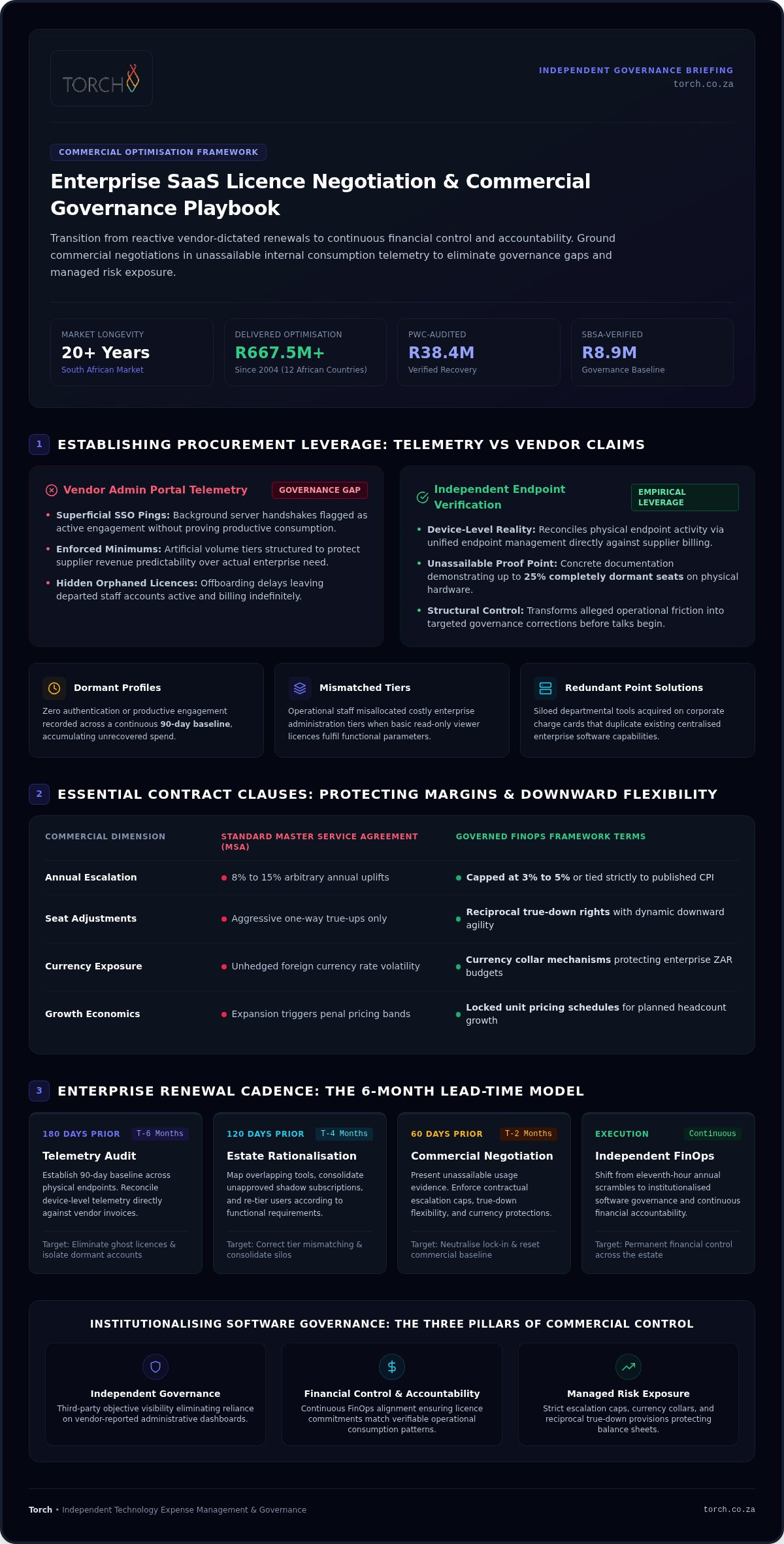
- Dormant profiles: User accounts showing zero authentication activity across a continuous 90-day baseline.
- Mismatched tiers: Operational staff assigned expensive enterprise administration tiers when a read-only viewer licence satisfies functional requirements.
- Redundant point solutions: Overlapping productivity and collaboration applications procured outside central oversight that duplicate existing enterprise investments.
Identifying these discrepancies across large productivity environments like Microsoft 365 often provides the fastest route to recovering capital. Organisations looking to analyse utilisation data and eliminate wasted seat allocations can learn more about LicenseIQ to see how automated intelligence uncovers underused subscriptions.
Reconciling Endpoint Telemetry Against Vendor Invoices
Superficial single sign-on (SSO) pings do not equal real engagement. A background process authenticating against a server provides no evidence of operational value. Advanced SaaS license negotiation tactics demand marrying financial invoices directly with device-level data via unified endpoint management to prove actual application interactions. This endpoint telemetry also strengthens the security case: unmanaged devices account for 85% of ransomware entry points, so visibility across managed and unmanaged endpoints supports both a defensible renewal position and a more complete security risk assessment.
Telemetry-backed usage audits establish the unassailable baseline required for commercial renegotiation. As an illustrative example, not a measured Torch benchmark, if 25% of provisioned seats sit completely dormant on physical hardware, vendor representatives cannot justify contractual minimums or mandatory volume tier escalations. Surplus licences stop being accepted as normal operational friction; instead, they become identified governance gaps targeted for structural removal.
Essential SaaS Contract Clauses: Protecting Margins and Flexibility
Standard vendor Master Service Agreements (MSAs) are deliberately engineered to protect vendor revenue predictability at the expense of enterprise agility. Accepting off-the-shelf contract schedules transfers structural commercial risk entirely onto your balance sheet. Achieving genuine commercial optimisation requires embedding non-negotiable legal protections into contract terms well before signature.
Capping Annual Price Increases and Escalation Clauses
Uncapped renewal terms represent compounding managed risk exposure. Vendor boilerplate clauses can permit annual price uplifts, although the percentage varies by agreement and should not be assumed to follow a standard 8% to 15% range. Countering this requires clear contractual boundaries:
- Inflation-linked caps: Insist on escalation caps tied directly to published consumer price indices or fixed limits of 3% to 5%.
- Predictable growth schedules: Lock established unit pricing for prospective seat expansions so future headcount additions don’t trigger penal tier pricing.
- Currency collar mechanisms: Structure exchange boundaries for offshore subscriptions billed in foreign currencies, protecting enterprise budgets against sharp ZAR fluctuations.
Aligning commercial terms with recognised FinOps Governance, Policy & Risk frameworks ensures procurement guidelines actively uphold long-term financial control and accountability.
Securing Downward Flexibility and True-Down Rights
Most enterprise software contracts enforce aggressive true-up reconciliations whenever headcount expands, yet remain completely silent on downward adjustments. Highly effective SaaS license negotiation tactics demand reciprocal true-down rights that grant your organisation the legal right to reduce provisioned commitments at scheduled quarterly intervals.
Without downward flexibility, organisational restructuring or operational shifts leave you funding unused shelfware until contract expiration. Alongside true-down terms, eliminate auto-renewal traps by replacing standard 30-day rollover windows with strict 90-day written notification requirements. Contract terms must also guarantee comprehensive data portability at agreement conclusion without punitive extraction levies. If you’re evaluating expiring enterprise agreements, scheduling a 30-minute governance review with Derek King provides objective insight into where structural terms can be fortified.
Tactical Negotiation Playbooks for Enterprise Renewal Cycles
Enterprise software vendors routinely rely on perceived switching friction to force acceptance of unfavourable renewal terms. When organisations delay contract reviews until the final month of an agreement, leverage evaporates entirely. Executing structured SaaS license negotiation tactics requires building a disciplined, cross-functional front between finance, procurement, and technology teams well ahead of formal notice deadlines.
Executing the 180-Day Renewal Governance Cadence
Timing dictates commercial leverage. Setting a strict 180-day timeline prevents reactive decision-making and ensures negotiations are rooted in empirical operational requirements rather than vendor deadlines:
- Day 180 to 120: Finalise internal utilisation audits, deprovision dormant profiles, and document business-critical feature dependencies across departments.
- Day 120 to 90: Formulate a unified negotiating position between finance and IT, establishing non-negotiable contract caps while assessing credible commercial alternatives.
- Day 90 to 60: Initiate formal dialogue with the incumbent vendor, submitting unassailable utilisation baselines before standard cancellation windows close.
Countering Tier Bundling and Feature Packaging
SaaS vendors increasingly attempt account expansion by packaging unwanted capabilities, new functionality, or artificial seat thresholds into mandatory higher tiers. Procurement teams must counter this pressure by demanding functional modularity. Insisting on unbundled agreements ensures your organisation pays strictly for verified, productive utilisation rather than subsidising unrequested product roadmaps.
Carrier-agnostic benchmarking confirms that vendors yield on tier constraints when faced with independent consumption proof. Maintaining modular contract terms preserves operational agility and reinforces long-term financial control and accountability.
Institutionalising Software Governance with an Independent FinOps Model
Isolated annual renegotiations fail to halt creeping mid-term financial leakage. Point-in-time procurement interventions provide momentary relief, but unmonitored licence provisioning inevitably resumes without continuous operational controls. Achieving sustainable commercial optimisation requires shifting from reactive renewal cycles to an embedded operating model that reconciles everyday technical consumption against strict executive budget parameters.
Moving from Periodic Audits to Continuous Oversight
Passive software dashboards merely report financial leakage after invoices arrive; they do not resolve the underlying governance gaps. True operational oversight links employee lifecycle adjustments, departmental transfers, and device-level activity directly to subscription states. For organisations and bureaus seeking to modernise these core workflows, durasuite.co.uk offers a dedicated HR and payroll transformation platform that streamlines employee lifecycle and workforce data management.
Engaging dedicated IT FinOps services bridges the divide between daily technical provisioning and executive oversight through regular variance analysis. This structured discipline ensures that enterprise SaaS license negotiation tactics remain grounded in verified telemetry, producing audit-ready documentation that maintains financial control and accountability across all business units.
Unlocking Value Through Objective Strategic Advisory
Software vendors rely on vast datasets to forecast enterprise expenditure, placing internal buyers at an information disadvantage during contractual renewals. Partnering with an independent advisory team neutralises this asymmetry through objective market intelligence. Carrier-agnostic benchmarking delivers an average of 27.5% in negotiation gains across enterprise portfolios by validating supplier proposals against real transactional baselines.
Rather than placing administrative reconciliation burdens on procurement personnel, forward-thinking organisations can engage Torch as an independent advisory partner to provide hands-on governance advisory services. Drawing on over 20 years of operational experience in the South African corporate market and R667.5M+ saved across enterprise estates since 2004, an active management framework delivers up to 47.2% total cost reduction across actively governed estates. This disciplined approach converts software procurement from an uncontrolled operational overhead into an actively managed risk exposure.
Securing Long-Term Commercial Agility and Financial Control
Enterprise software contracts do not have to compromise your operating margin. By replacing passive vendor dashboards with verified endpoint telemetry, enforcing a disciplined 180-day renewal cadence, and embedding reciprocal true-down provisions into master agreements, organisations can permanently eliminate wasteful shelfware. Executing structured SaaS license negotiation tactics restores genuine commercial leverage to enterprise buyers.
Operating as an independent, carrier-agnostic governance advisor across South Africa, Torch has delivered R667.5M+ saved across enterprise estates since 2004. Our market benchmarking consistently yields an average of 27.5% in commercial negotiation gains, bridging governance gaps and establishing continuous financial control and accountability across complex software estates.
Taking control of your software estate begins with clarity. Partnering with seasoned governance specialists ensures your upcoming renewal cycles actively protect capital and support sustainable operational growth.
Frequently Asked Questions
How early should an enterprise start preparing for a major SaaS renewal?
Preparation should begin at least six months (180 days) before contract expiry. Starting this early allows sufficient time to audit dormant accounts, gather unassailable endpoint utilisation telemetry, and reconcile actual user requirements across business units. It also prevents vendors from exploiting impending cancellation deadlines or auto-renewal notice windows, ensuring your team has the empirical leverage needed to execute effective SaaS license negotiation tactics without operational disruption.
What is the difference between a software true-up and a true-down clause?
A true-up clause requires the customer to pay retroactively for any licences provisioned beyond the contracted threshold during an agreed period. Conversely, a true-down clause grants the enterprise the contractual right to reduce committed licence counts and associated subscription costs if user numbers drop. While vendors standardly mandate annual true-ups, negotiating reciprocal quarterly true-downs ensures you don’t stay financially committed to inactive shelfware after restructuring or workforce changes.
How do enterprise teams benchmark SaaS pricing without public vendor rate cards?
Enterprise teams secure market pricing visibility by partnering with independent advisory specialists who maintain extensive cross-client transaction databases. Relying on peer anecdotes or list prices creates blind spots, whereas carrier-agnostic benchmarking reveals verified net-effective price points across comparable licence tiers and volumes. This empirical intelligence neutralises vendor information asymmetry, empowering procurement to challenge artificial tier structures and secure commercial terms aligned with prevailing fair-market rates.
Can an organisation reduce software licence quantities during an active contract term?
Yes, provided the underlying master agreement contains explicit midterm adjustment provisions such as scheduled true-down rights or modular licence structures. Without these embedded terms, vendors typically hold customers to initial minimum commitments until the contract term expires. Effective SaaS license negotiation tactics introduce flexibility clauses during initial signing or formal renewals, giving organisations the legal mechanism to deprovision surplus seats at quarterly intervals without incurring financial penalties.
Why do software dashboards alone fail to control enterprise SaaS expenditure?
Dashboards provide passive visibility, merely reporting spend and provisioned logins after the financial commitment is made. They don’t actively decommission dormant accounts, enforce contractual compliance, or renegotiate terms with software suppliers. Eliminating financial leakage requires hands-on governance and structured operational workflows that link identity changes directly to licence entitlement. Without embedded human accountability and ongoing intervention, identified governance gaps remain unaddressed, allowing subscription waste to compound across fiscal quarters.
How does an independent FinOps approach improve vendor negotiation outcomes?
An independent FinOps approach introduces continuous operational discipline, connecting daily endpoint consumption with executive budgeting. Operating free from vendor or carrier bias, independent advisors validate invoices against verified technical telemetry rather than vendor portal claims. In South Africa, this objective governance model uncovers latent control deficiencies, models future contract scenarios accurately, and delivers an average of 27.5% in commercial negotiation gains through verified, data-backed procurement positions.