
An auto-renewal clause can turn a missed notice window into another contract term. The underlying issue is often governance, not the calendar. For South African businesses, Section 14 of the Consumer Protection Act (CPA) generally excludes juristic persons whose asset value or annual turnover exceeds R2 million; this means the exclusion applies to most enterprise-scale agreements, but not necessarily every business-to-business contract. Consumer renewal protections should therefore not be assumed to apply, and businesses should seek legal advice on the specific agreement. That makes avoiding telco contract auto-renewal traps a matter of financial control and accountability.
If renewal dates are scattered across contracts, invoices and team inboxes, a reminder alone cannot provide a reliable view of obligations, notice windows and accountable owners. Even when a date is tracked, the service and commercial commitment may no longer fit current users or business needs. A structured review helps Finance and IT assess those commitments before a new contract period begins.
This checklist explains how to consolidate renewal information, examine service use and commercial terms, and assign clear ownership for each decision. It also shows how independent governance can connect contract review, invoice validation and usage oversight with endpoint and ransomware security: connectivity, endpoint-management and security-related services should remain current, owned and supported as part of the same review cycle. Torch Services’ TorchLight™ and SpotLight™ references can help anchor this governance approach in the organisation’s wider technology oversight, supporting managed risk exposure and informed commercial optimisation across the telecom lifecycle.
Key Takeaways
- Check how renewal wording, notice conditions and service scope work together. Each contract needs to be reviewed on its own terms.
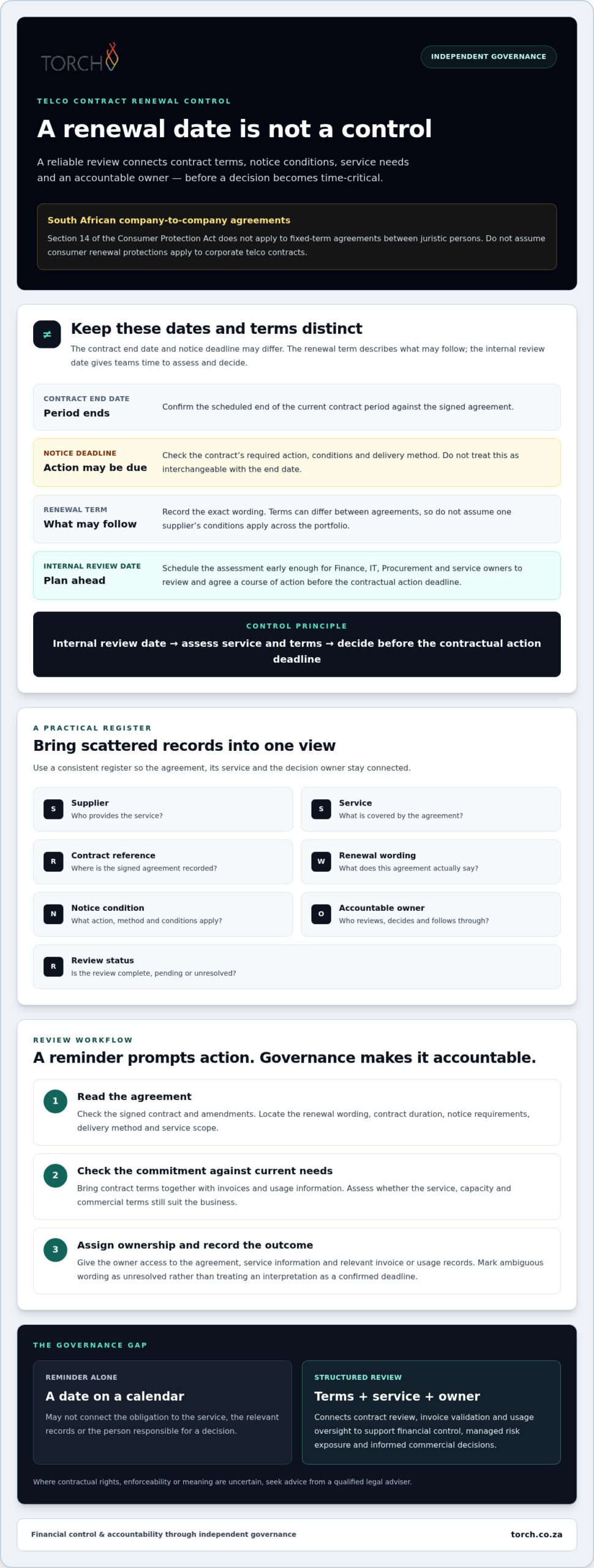
- Record the contract end date, notice deadline, renewal term and internal review date separately so teams can act before options narrow.
- Use a consistent register for supplier, service, contract reference, renewal wording, notice condition, owner and review status to support avoiding telco contract auto-renewal traps.
- Bring contract terms, invoices and usage into recurring reviews to maintain visibility and inform commercial decisions.
Why telco contract auto-renewal needs more than a diary reminder
An auto-renewal clause is a contract term that may extend a service unless a party takes specified action within the stated conditions. An automatic renewal clause can therefore affect what happens at the end of an agreement, but the outcome depends on the wording of that contract.
A renewal date marks when a contract period ends; the notice deadline marks the latest date for giving notice under the agreement. These dates may differ. Confusing them can leave a business with less time to assess its options, although the effect of a missed review or notice window varies by contract.
For South African enterprises, this is a governance issue as well as a scheduling one. Section 14 of the Consumer Protection Act (CPA) generally excludes juristic persons whose asset value or annual turnover exceeds R2 million. That exclusion applies to most enterprise-scale agreements, but businesses should not assume it applies to every company-to-company telco contract or that consumer renewal protections are irrelevant without checking the parties’ status and the specific agreement. Clear records and ownership support financial control and accountability, helping teams assess risk before a decision becomes time-critical; seek legal advice where the application or effect is uncertain.
Which contract details create renewal exposure?
Start with the signed agreement and any amendments. Locate the renewal wording, contract duration and notice requirements, including how and where notice must be given. Terms can differ between agreements, so do not assume one supplier’s conditions apply across the portfolio. An automatic extension also does not show, by itself, whether the service, capacity or commercial terms still suit the business.
Why do renewal dates get missed across an enterprise?
Records often sit in different places. Procurement may hold signed agreements, Finance may see invoices, IT may track services, and an individual service owner may understand day-to-day requirements. Staff changes or unclear responsibility can break the link between those records and a renewal decision.
A reminder prompts someone to act; governance makes clear who must review, decide and follow through. Assign an accountable owner and make sure they can access the contract, current service information and relevant invoice or usage records. That creates a practical basis for assessing ongoing need and commercial options, rather than treating a calendar alert as the control itself.
In practice, avoiding telco contract auto-renewal traps starts with connecting each agreement to its service, notice conditions and responsible decision-maker. Without that connection, even a correctly recorded date may not lead to a meaningful review.
How renewal clauses, notice windows and service commitments interact
A renewal decision depends on more than the contract’s end date. Read the renewal wording alongside the notice conditions and service scope. The clause sets out what may happen, the notice terms specify any action required, and the service description shows what the business is committed to receiving. Reviewing only one element can leave obligations or operational requirements out of view.
Set the internal review date early enough to complete the assessment and decision before the contractual action deadline. Finance, IT, Procurement and service owners need time to examine the agreement, check the service against current requirements and agree a course of action. A reminder is a prompt, not the decision itself.
| Date or term | What it means | What to do |
|---|---|---|
| Contract end date | The scheduled end of the current contract period. | Confirm it against the signed agreement. |
| Notice deadline | The date by which the contract’s specified action must be taken, if applicable. | Check the clause for conditions and delivery method. |
| Renewal term | The period or arrangement that may follow if renewal conditions are met. | Record the exact wording; do not assume it matches another agreement. |
| Internal review date | The organisation’s planned date to assess the service and decide what to do. | Schedule it sufficiently ahead of the contractual deadline. |
What should teams check in renewal and notice wording?
Review the precise clause, required action, delivery method and any conditions stated in the signed agreement. Record the document and clause reference alongside your notes. If wording is ambiguous, mark it as unresolved rather than treating an interpretation as a confirmed deadline. Where contractual rights, enforceability or meaning are uncertain, seek advice from a qualified legal adviser.
Do the existing services still fit business needs?
Compare the contracted scope with active users, current usage records and documented business requirements. A service that appears inactive or has changed may need validation, but do not assume it can be removed without checking the agreement and relevant conditions. Telecom Expense Management can bring contract audits, invoice validation and usage oversight together as part of lifecycle governance.
Once the terms and service needs are clear, record open questions, assign an owner to resolve them and document the decision before the applicable contractual deadline. This creates a traceable basis for renewal planning without presuming which commercial outcome is right.
A practical checklist for preventing overlooked telco renewals
A repeatable process turns avoiding telco contract auto-renewal traps from a one-off calendar task into a governance control. Gather signed agreements and amendments, then match each document to the service it governs. Verify deadlines against the contract, assign an accountable owner and make unresolved details visible rather than relying on informal knowledge.
A contract register is a control record of obligations, evidence, ownership and decisions, not merely a list of dates. Keep it in a controlled location that Finance, Procurement and IT can access. For each material agreement, name a business owner and a backup contact so that a staff change does not leave the review without an accountable lead.
How should a contract register support renewal decisions?
Use consistent fields so teams can compare agreements and identify what needs attention. At a minimum, capture:
- Supplier and service, plus the contract reference.
- Renewal wording and notice condition, with the source document and clause location.
- Contract end date, verified notice deadline and internal review date.
- Named owner, backup contact, review status and next action.
Set reminders against the verified terms in each agreement, with an escalation route if an owner has not confirmed the review or decision. The timing should reflect the contract’s actual notice conditions, not a universal lead time. Update the register when agreements change, decisions are approved or ownership moves.
What should the pre-renewal review cover?
Compare contracted scope with current users, usage records, billing and documented business requirements. For example, if a service appears inactive or its users have changed, validate the records with the relevant owner before deciding what that means for the agreement. Do not assume an apparently unused service can be removed automatically.
Log billing discrepancies and service questions for investigation. Then document the options considered, approvals, decision and next actions, including who is responsible and by when. This gives Finance, Procurement and IT a shared evidence trail without presuming that renewal, amendment or another outcome is right for every agreement.
Review the register at regular intervals and whenever a contract or service changes. That keeps renewal information current and makes ownership and follow-through part of routine financial control.
Build ongoing renewal governance with independent oversight
A renewal review should be part of an ongoing control cycle, not an isolated exercise before a deadline. Regularly compare contract terms with invoices and usage records to identify changes, outstanding questions and upcoming decisions while there is still time to assess them. This gives Finance and IT a shared basis for financial control and accountability across services and suppliers.
For enterprises managing multiple telecom vendors, services or user groups, carrier-agnostic oversight can add an objective view. It is not about taking an adversarial position towards providers. It is about checking obligations, charges and service use against business requirements, then making informed decisions with the relevant parties. For solution providers and organisations managing cellular data or IoT fleets through services like choiceiot.com, reviewing active endpoints alongside contract terms ensures commitments stay aligned with real operational demand. This supports managed risk exposure and commercial optimisation throughout the contract lifecycle.
When can an independent TEM review help?
A review may help when contract records, invoices and usage information are held by different teams, or when leaders need a clearer picture before renewal decisions. Contract audits, invoice validation and usage optimisation can help assess whether recorded services and charges align with the agreement and current business use. Torch Services provides Telecom Expense Management for this type of lifecycle oversight. Explore Telecom Expense Management for details.
What should leaders expect from a governance review?
Expect a structured discussion about which contracts are visible, who owns each service, how reviews are managed and where control gaps or unresolved questions remain. Torch Services is an independent, carrier-agnostic advisor, so its role is to provide financial oversight and vendor accountability, not to sell connectivity. The purpose of a review is to help leaders understand their position and consider next steps, not to prescribe a single renewal decision or guarantee a commercial result. Where wider technology-spend accountability is in scope, IT FinOps can inform the broader financial governance approach.
Use the findings to clarify accountabilities, prioritise unresolved issues and strengthen review processes across future renewal cycles. This helps embed independent governance into routine oversight while supporting constructive, evidence-based engagement with telecom providers.
Make renewal oversight part of financial control
A dependable renewal process needs more than a diary entry. Keep contract wording, notice conditions, service commitments and accountable owners visible in one controlled record, then review them before the contractual action deadline. This gives Finance, IT and Procurement time to assess current requirements, validate usage and billing, and document a decision.
A reminder prompts action; clear ownership and recurring contract, invoice and usage reviews create accountability beyond a single renewal cycle. That is the practical foundation for avoiding telco contract auto-renewal traps and supporting informed commercial optimisation. Independent governance can help clarify obligations without taking an adversarial stance towards telecom providers.
Torch Services provides Telecom Expense Management, including billing validation, contract audits and usage optimisation. Bringing these checks into a recurring review can help teams maintain visibility and identify questions to resolve before a renewal decision is due. Each organisation’s contracts and circumstances differ, so the review should support a considered decision rather than promise a particular saving or outcome.
With clear records, defined ownership and a repeatable review process, your teams can approach renewal decisions with greater visibility and confidence.
Frequently Asked Questions
Can a telco contract renew automatically without a new signature?
Yes. A contract may extend automatically if its signed terms provide for renewal when specified conditions are met, even if the parties do not sign a new agreement at that point. The effect depends on the clause and the agreement. For South African company-to-company contracts, do not assume the Consumer Protection Act’s fixed-term renewal provisions apply: the Section 14 juristic-person exclusion generally applies where the entity’s asset value or annual turnover exceeds R2 million, although the specific circumstances should be checked. Review the signed terms and seek qualified legal advice if the clause, the parties’ status or its effect is unclear.
What should we check before a telecom contract renews?
Check the signed agreement’s renewal clause, contract duration, notice deadline, required action and method for giving notice. Confirm the contracted service scope, then compare it with current users, usage records, billing and documented business requirements. Record the source document and flag unclear terms for review rather than treating an assumption as fact. This gives decision-makers a stronger basis for assessing renewal readiness and resolving outstanding questions.
How can an enterprise keep track of telco contract renewal dates?
Maintain a controlled contract register that records each supplier, service, agreement reference, renewal wording, verified notice condition, accountable owner and review status. Include the contract’s document location and an internal review date set ahead of the contractual action deadline. Use reminders as prompts, with a named owner and escalation route to support follow-through. This shared record helps Finance, IT and Procurement coordinate and supports avoiding telco contract auto-renewal traps.
Is a renewal date the same as a notice deadline?
No. The renewal date usually refers to when a contract period ends or a further period may begin. The notice deadline is the date by which the agreement requires a specified action, if applicable. They may differ, and the contract wording determines the relevant dates and conditions. Record both separately, verify them against the signed agreement and schedule the internal review early enough for teams to assess the service and decide what to do.
What happens if we miss a telco contract notice deadline?
The result depends on the signed contract. Missing a deadline may affect the available options or trigger an extension under the agreement, but not every contract works the same way. Check the renewal clause, notice requirements and relevant correspondence, then ask a qualified legal adviser if the consequences or your rights are uncertain. Do not assume that a missed deadline automatically means the same outcome across different suppliers or services.
Can telecom expense management help prevent auto-renewal issues?
Yes. Telecom Expense Management can support renewal readiness by bringing contract audits, invoice validation and usage optimisation into a joined-up review process. This can help teams compare recorded services and charges with contract terms and current usage, while clarifying obligations and unresolved questions. It does not replace checking the signed agreement or seeking legal advice where needed, but it can strengthen ongoing visibility, financial control and accountability across the telecom lifecycle.