
What if the endpoint missing from your audit records is also the device creating a governance gap? For many IT and finance teams, endpoint compliance reporting for audits still means manually reconciling invoices, asset lists and security records. That work can take weeks, while unmanaged or “ghost” devices remain out of view.
When records are incomplete or out of date, it is harder to establish a reliable picture of your IT estate. In South Africa, POPIA non-compliance can attract administrative fines of up to R10 million (Protection of Personal Information Act 4 of 2013, section 100), making clear records and appropriate safeguards important parts of risk management. Audit preparation should support financial control and accountability, rather than rely on spreadsheets that are difficult to keep current.
This guide explains how to improve endpoint reporting by connecting device oversight with asset and financial governance. You’ll learn how to set a practical compliance baseline, identify gaps that manual processes can miss and make evidence easier to review. The aim is clearer reporting and more confident decisions when auditors ask how controls are monitored and exceptions are handled.
Key Takeaways
- Learn why manual endpoint records can create governance gaps, and how automated reporting can improve visibility across your IT estate.
- See how asset discovery, policy enforcement and business intelligence contribute to a more joined-up reporting approach.
- Understand how endpoint compliance reporting for audits can bring asset, security and financial information into clearer view.
- Explore practical steps for setting a compliance baseline and improving oversight of devices across your organisation.
- Consider how a governance-led approach can help teams assign responsibility and address findings, rather than leaving them with reports but no clear path to action.
Understanding Endpoint Compliance Reporting for Modern Audits
Endpoint compliance reporting for audits is the process of checking whether devices meet an organisation’s policies and relevant external requirements, then recording the results for review. Automation can bring device status and supporting evidence into a consistent view, rather than requiring staff to assemble records manually. For a high-level overview of the security concepts involved, see Endpoint security.
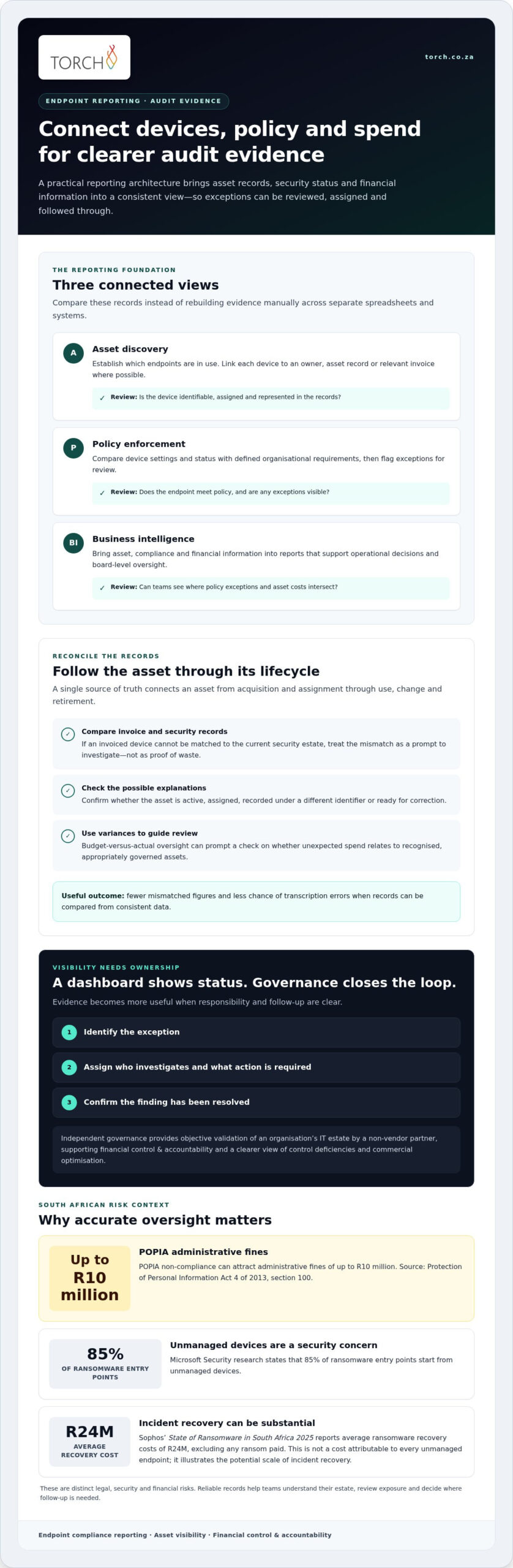
Manual reporting creates a governance gap when records become incomplete or out of date between reviews. A laptop missing from an asset register, for example, may still incur costs while its security status remains unclear. That makes it harder to confirm ownership, financial accountability and whether the device meets policy. Automated reporting can shift effort from assembling evidence for a point-in-time audit to maintaining regular visibility, so teams can investigate exceptions sooner. Microsoft Security research states that 85% of ransomware entry points start from unmanaged devices, reinforcing the importance of identifying ghost devices.
The High Cost of Non-Compliance in South Africa
POPIA non-compliance can carry administrative fines of up to R10 million (Protection of Personal Information Act 4 of 2013, section 100), while a data breach can also damage trust and reputation. These are distinct risks, but both underline the value of reliable oversight and records. Unmanaged devices can also contribute to silent IT budget leakage when assets remain in use or incur costs without clear ownership or review.
Sophos (State of Ransomware in South Africa 2025) reports average ransomware recovery costs of R24M, excluding any ransom paid. This is not a cost attributable to every unmanaged endpoint, but it illustrates the potential scale of incident recovery. Knowing which devices are in the estate and whether they meet policy helps organisations assess exposure and decide where follow-up is needed.
Why Dashboards Are Not Enough
A dashboard can show a device or service status. Governance adds the next steps: who investigates an exception, what action is required and how the team confirms it has been resolved. Carrier-provided tools can offer useful information about the services they cover, but may not independently reconcile the wider endpoint estate, associated costs and organisational controls. Audit evidence is more useful when it is consistent across these areas, rather than scattered across separate screens.
Independent governance is the objective validation of an organisation’s IT estate by a non-vendor partner. It can provide a more impartial view of control deficiencies and commercial optimisation. Visibility is only the starting point. A dependable process also assigns responsibility and tracks findings through to action.
The Architecture of an Automated Compliance Reporting System
Reliable endpoint reporting connects three views that are often managed separately: which devices the organisation owns or uses, whether they meet security policies, and what they cost. When these records can be compared, teams can produce evidence from consistent data instead of re-entering details into spreadsheets. This reduces the chance of transcription errors and mismatched figures.
A practical architecture has three pillars:
- Asset discovery: Establish which endpoints are in use and link each one to an owner, asset record or relevant invoice where possible.
- Policy enforcement: Compare device settings and status with defined organisational requirements, then flag exceptions for review.
- Business intelligence: Present asset, compliance and financial information in reports that support operational decisions and board-level oversight.
Unified Endpoint Management (UEM) helps centralise device oversight, giving teams a consistent way to manage and review endpoints. Automated collection can make supporting evidence more repeatable, but it still depends on clear policies, accurate source records and accountable review. For further technical context, explore Unified Endpoint Management.
Creating a Single Source of Truth
A single source of truth connects an asset’s lifecycle, from acquisition and assignment through use, change and retirement. This “cradle-to-grave” view helps teams reconcile records that might otherwise sit in separate asset, security and finance systems. For example, an invoice may list a device that cannot be matched to the current security estate. Treat that mismatch as a prompt to investigate: check whether the asset is active, assigned, recorded under a different identifier or ready for correction. This can surface potential ghost assets without assuming every discrepancy represents waste.
Purpose-Built BI Models for Spend and Security
Purpose-built BI models turn operational records into reports that can support decisions. Rather than showing a device count alone, reporting can help teams see where policy exceptions and asset costs intersect, then prioritise review. Budget-versus-actual oversight adds another useful check: an unexpected variance can prompt a review of whether the spend relates to recognised, appropriately governed assets.
Torch Services’ SpotLight™ platform provides real-time governance visibility, bringing relevant information into view for review. Its value depends on connecting insight to ownership and follow-up, rather than treating a dashboard as proof that a control is working. This governance-led approach aligns with the NIST Cybersecurity Framework (CSF) 2.0, which includes a Govern function.
To discuss how these reporting components could fit your environment, book a 30-minute governance review with Derek King.
How to Build an Audit-Ready Endpoint Reporting Framework
A useful framework turns governance expectations into checks that can be evidenced and reviewed. For endpoint compliance reporting for audits, define the baseline first. Then make sure your data and reporting process show which controls are met, which exceptions remain and who is responsible for follow-up.
- Set the baseline. Identify relevant POPIA considerations and applicable industry standards, then document the organisation’s policies and the devices they cover. Treat this as an organisational control baseline, not a substitute for legal advice.
- Automate asset discovery. Compare discovered devices with asset and finance records. Aim for complete estate visibility, but track unmatched or offline devices as exceptions rather than assuming any inventory is automatically 100% complete.
- Map policies to measurable checks. Translate requirements into defined reporting fields, such as encryption status, patch level, operating system version and local administrator access.
- Monitor for change. Use recurring checks to identify configuration drift, such as a device falling behind the organisation’s patch policy after an update cycle.
- Share reports with accountable stakeholders. Set a schedule and clear reporting responsibilities for relevant leaders, such as the CFO, CISO and audit team. Include exceptions, evidence dates and remediation status.
Mapping Policies to Endpoint Controls
High-level requirements become auditable when they are translated into specific checks with defined pass, fail or review outcomes. For example, an encryption policy can map to a recorded encryption status, a patching policy to update status, and access controls to a record of local administrator rights. An Endpoint Security Standard offers an example of how an organisation documents controls such as encryption, access and patching. Use it as a reference, then set requirements that suit your own environment.
Link evidence to the device identifier and the date it was collected. For a related approach to commercial governance, see The Enterprise Guide to Telecom Contract Benchmarking.
Automating POPIA Compliance Reporting
For endpoint controls that support POPIA-related assurance, retain documented evidence of how personal data is protected at rest and in transit. For mobile devices, reports might record whether relevant safeguards are enabled and flag devices that fall outside policy. In BYOD environments, remote wipe or selective wiping may be considered as controls, provided their use is defined in organisational policy and aligned with privacy and operational requirements. Confirm the appropriate approach with your legal and privacy advisers. A reporting template is not a statement of legal obligations.
Sustaining Governance with Unified Endpoint Security Management
An audit-ready report is a starting point, not a control in itself. Governance must continue after findings are delivered: exceptions need owners, agreed next steps and follow-up. A governance-led approach connects endpoint oversight with financial accountability, helping organisations review security gaps and possible spend leakage over time. In highly regulated sectors such as consumer finance, specialist consultancies like versapien.com demonstrate how connecting risk management and compliance with digital transformation helps maintain continuous audit readiness.
Unified Endpoint Security & Management is a logical part of this approach because it brings endpoint governance and security into a wider control framework. Technology can support visibility, but sustained optimisation also depends on people and process. In a managed-services model, responsibilities should be clear: teams need to investigate reported issues, coordinate resolution with relevant client stakeholders and confirm that actions are completed. Reporting should show progress and outstanding exceptions, rather than leave leaders with a list of unresolved findings.
Bridging the Gap Between IT and Finance
Endpoint information is more useful to decision-makers when considered alongside financial data. IT FinOps supports this connection by bringing financial discipline to technology oversight, so leaders can review endpoint controls and related expenditure together. For example, an asset that appears in financial records but cannot be reconciled with the managed estate may warrant investigation before the next audit cycle.
Carrier-agnostic benchmarking can provide an independent reference point for commercial reviews. It helps organisations assess whether costs and terms align with their requirements, rather than relying on a single provider’s view. The purpose is not to presume that a supplier’s dashboard is incorrect, but to strengthen independent governance, commercial optimisation and oversight of risk across the wider environment.
Next Steps: Establishing Structural Control
A governance review can help identify where reporting, ownership or follow-up may need attention. It is a practical way to discuss the move from a reactive audit posture, where evidence is assembled when requested, towards recurring oversight with clear accountability. Bring questions about how endpoint records are reconciled, how exceptions are escalated and how resolution is tracked. The goal is a clearer view of governance gaps, not another dashboard without action.
Build Lasting Control Across Your Endpoint Estate
Effective endpoint compliance reporting for audits connects asset records, security controls and financial data, giving decision-makers a clearer basis for evidence and oversight. Automating collection can reduce reliance on manual spreadsheets, but lasting audit readiness also requires defined policies, regular monitoring and accountable follow-up when exceptions arise.
A governance-led approach turns reports into action. It helps IT and finance teams assess device status alongside spend, investigate mismatches and maintain control beyond the audit itself. Independent, carrier-agnostic governance can add an impartial view across complex environments. Torch Services brings over 20 years of experience in the South African market and has helped clients save R667.5M+ since 2004 across 12 African countries through structural control and managed services.
With clearer ownership and ongoing review, organisations can move from assembling evidence under pressure to building more consistent oversight. Practical, steady improvements can make endpoint governance clearer and audit preparation more manageable.
For a practical discussion about your reporting and governance needs, book a 30-minute governance review with Derek King.
Frequently Asked Questions
What is the difference between endpoint management and endpoint compliance?
Endpoint management is the work of overseeing and controlling devices, such as configuring settings, applying updates and managing applications. Endpoint compliance is the assessment of whether those devices meet defined organisational policies and relevant requirements. Management provides the means to apply controls; compliance reporting records their status and highlights exceptions. A device can be managed but still fall short of policy, so both operational control and evidence of compliance matter.
How does automated reporting help with POPIA audits in South Africa?
Automated reporting can help organise evidence about endpoint safeguards, such as device status, encryption settings and policy exceptions. This gives teams a more consistent basis for showing how controls are monitored and where follow-up is needed. Endpoint compliance reporting for audits can support POPIA-related assurance, but a report alone doesn’t establish compliance. Organisations should confirm that their safeguards, processes and evidence suit their circumstances, seeking legal or privacy advice where appropriate.
Can I use automated reporting for employee-owned (BYOD) devices?
Yes, automated reporting can include employee-owned devices if the organisation’s tools and policies support BYOD oversight. Before implementation, define which device information is collected, what security controls apply and how personal and work data are separated. Selective wiping may remove organisational data without erasing an employee’s personal information, where the chosen management capability supports it. Explain these arrangements clearly to staff and have privacy and legal advisers review the policy.
What are the most common endpoint compliance failures found in audits?
Examples of issues an audit may uncover include devices with outdated operating systems or security updates, encryption that is disabled, excessive local administrator access, and assets missing from the security inventory. These are practical checks to consider, not a ranked list of the most frequent findings across organisations. Unmatched invoice and device records can also warrant investigation. Define what counts as an exception in your own policy, then record evidence and assign follow-up.
How often should endpoint compliance reports be generated?
Set reporting frequency according to your organisation’s risk, policy requirements, audit timetable and rate of endpoint change. Continuous or regular checks can help teams identify configuration drift between formal reviews, while scheduled summaries give stakeholders a consistent view of exceptions and remediation. A monthly report may suit some governance routines, but it isn’t a universal requirement. Agree who receives each report, what decisions it supports and how urgent exceptions are escalated.
Do I need to replace my existing antivirus to implement automated reporting?
Not necessarily. Automated reporting may be able to collect information from existing endpoint security tools, depending on their capabilities and how they integrate with your reporting system. First establish what evidence you need, such as protection status or update currency, then confirm whether your current tools can provide it reliably. If there are gaps, assess them against your policy before deciding whether to adjust configurations, add reporting capability or consider a different tool.