
What if the biggest opportunity to control IT spend lies not in cutting services, but in governing them more effectively? For South African enterprises asking how to reduce enterprise IT costs, the challenge is often seeing where money goes across suppliers, cost centres and business units, and whether that spend still reflects actual use and business need.
Cost pressure is real, but blunt reductions can shift expenditure elsewhere or leave security and service delivery exposed. Without reliable records of contracts, usage and assets, leaders may struggle to distinguish avoidable spend from investment that protects operations.
This practical 2026 guide explains how to identify cost leakage and build a measured optimisation plan. It covers how to validate spend and usage, prioritise actions by impact, feasibility and risk, and establish ongoing financial control and accountability. The goal is sustainable commercial optimisation supported by independent governance, not a one-off cost-cutting exercise.
Key Takeaways
- Learn how to reduce enterprise IT costs by identifying avoidable or poorly governed spend before considering service or technology cuts.
- Use four cost levers to assess where governance gaps may exist, including telecom invoices, contracts and usage.
- Build a measurable optimisation plan from a reliable baseline of approved budgets, invoices, contracts, usage and asset records.
- Prioritise actions by impact, feasibility and risk to protect security and service delivery.
- Compare internal ownership, point tools and managed governance to determine what best supports independent oversight, implementation and accountability.
How to reduce enterprise IT costs: find the governance gaps first
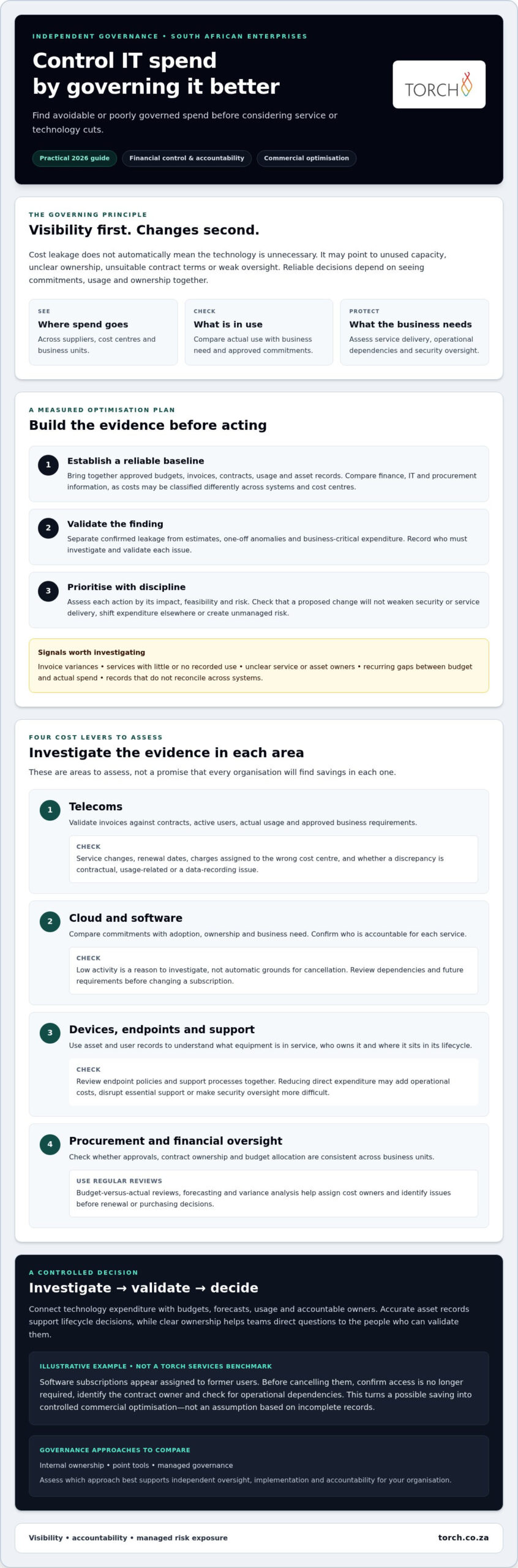
Sustainable optimisation is not indiscriminate budget cutting. Start by identifying spend that is avoidable or poorly governed, then check whether a proposed change preserves the technology and services the business needs. Cost leakage does not automatically mean the technology is unnecessary. It may point to unused capacity, unclear ownership, unsuitable contract terms or weak oversight.
To understand how to reduce enterprise IT costs, map expenditure across telecoms, cloud and software, devices, support and procurement. Compare records from finance, IT and procurement, as costs may be classified differently across systems or cost centres. An IT governance framework can help teams connect technology decisions with business accountability.
Reliable cost decisions depend on visibility of commitments, usage and ownership. Without all three, an apparent saving may simply move expenditure to another team or create unmanaged risk.
Which signals indicate weak IT cost control?
Look for invoice variances, services with little or no recorded use, unclear service or asset owners, and recurring gaps between budget and actual spend. Then check whether device, user, contract and cost-centre records reconcile across the systems that hold them.
Classify findings before acting. Separate confirmed leakage from estimates, one-off anomalies and business-critical expenditure. This shows which issues are evidenced, which need further investigation and who is responsible for validating them.
Why can blunt cost-cutting create new exposure?
Removing support or controls without assessing their role can interrupt operations or shift costs elsewhere. A team may need to find an alternative service or absorb extra work. Endpoint decisions need similar care: devices without clear ownership or consistent management can make security oversight more difficult. That is a governance concern, not a prediction that an incident will occur.
Illustrative example, not a Torch Services benchmark: a business finds software subscriptions assigned to former users. Before cancelling them, it confirms the access is no longer required, identifies the contract owner and checks for any operational dependency. This turns a possible saving into controlled commercial optimisation, rather than an assumption based on incomplete records.
Four enterprise IT cost levers to assess before reducing spend
These four levers provide a prioritisation framework, not a promise that every organisation will find savings in each area. Assess the evidence, business impact and risk before deciding what to change. This makes commercial optimisation more disciplined than applying uniform cuts across an IT budget.
- Telecoms: Validate invoices against contracts, active users, actual usage and approved business requirements. Investigate service changes, renewal dates and charges allocated to the wrong cost centre. Independent billing validation can help distinguish a contractual issue from a usage or data-recording discrepancy. See how telecom expense management can support this work.
- Cloud and software: Compare commitments with adoption, ownership and business need. Confirm who is accountable for each service and whether usage information supports the current commitment. When managing hosting and cloud workloads, evaluating flexible infrastructure providers such as Snel.com can help teams match server capacity with actual requirements rather than overpaying for idle resources. Low activity is a reason to investigate, not automatic grounds for cancellation. Check dependencies and future requirements before changing a subscription.
- Devices, endpoints and support: Use asset and user records to understand what equipment is in service, who owns it and where it sits in its lifecycle. Often, maintaining and repairing existing office hardware through specialists such as ZD Computer Trading LLC provides a practical alternative to premature equipment replacement. Review endpoint policies and support processes together. A change that reduces direct expenditure but weakens management or disrupts essential support may create additional operational costs or make security oversight more difficult. Security is part of this lever: Microsoft Security research indicates that 85% of ransomware entry points originate from unmanaged devices.
- Procurement and financial oversight: Check whether approvals, contract ownership and budget allocation are consistent across business units. Regular budget-versus-actual reviews, forecasting and variance analysis help assign cost owners and identify issues to investigate before renewal or purchasing decisions.
How can FinOps and endpoint governance strengthen control?
FinOps connects technology expenditure with budgets, forecasts, usage and accountable owners. It helps teams understand variances and direct questions to the people who can validate them. Accurate asset records support lifecycle decisions and help teams check whether endpoint policies are being followed. Together, these practices strengthen financial oversight without treating every variance as an instruction to cut.
To determine how to reduce enterprise IT costs responsibly, start with the lever where the data is credible and the decision is actionable. Review the evidence with finance, IT and procurement, then record the rationale, owner and follow-up measure for each approved change. This keeps cost controls connected to service needs and security oversight.
How to build an enterprise IT cost-reduction plan without weakening control
A sound plan turns findings into authorised, traceable action. It should make clear what will change, who owns the decision and how the organisation will check that financial outcomes and service controls remain on track.
A practical first 90 days
- Set scope and accountability. Agree which cost areas or business units are in scope, name an executive sponsor and assign finance and IT owners. Confirm what data they need and who can approve changes.
- Establish the baseline. Bring together approved budgets, invoices, contracts, usage records and asset data. Reconcile differences where possible, and record data gaps rather than treating incomplete information as fact.
- Validate priority findings. Check high-priority variances against source records and business requirements before changing suppliers, services, user entitlements or endpoint policies. Separate confirmed adjustments from estimates.
- Rank and sequence actions. Assess initiatives by evidence, expected business impact, implementation effort and risk. Consider renewal windows, operational dependencies and security review requirements when setting the order of work.
- Assign measures and review. Give every approved action an owner, a baseline and a review date. Record decisions, dependencies and unresolved issues to maintain accountability across finance, IT and procurement.
A useful control measure has an owner, a baseline and a review date. Measures can include budget versus actual, verified adjustments, invoice exceptions and ownership of unresolved issues. Track service and endpoint outcomes alongside financial results, so each change is assessed for its effect on operations and security as well as expenditure.
Which measures show whether changes are working?
Use a regular governance cadence to review results, assign remediation and record decisions. Keep unverified adjustments separate from confirmed outcomes. If service or endpoint indicators move in the wrong direction, investigate before extending the change. This makes the plan a repeatable control process, rather than a one-off exercise in how to reduce enterprise IT costs.
When should enterprises manage IT cost optimisation internally or with a partner?
Internal teams should retain decision-making authority, but they may not always have the capacity or cross-vendor visibility to investigate fragmented expenditure and carry through remediation. The right approach depends on the scale of the governance gap and the skills available, not on an assumption that external support is always necessary.
Compare three options against the same criteria:
- Internal ownership: Works well when finance, IT and procurement can access reliable data, agree on cost owners and dedicate capacity to regular reviews. Consider whether teams can independently validate supplier information and implement agreed changes.
- Point tools: Can help consolidate or analyse specific data, but assess whether they cover the relevant suppliers and systems. A report alone may not resolve unclear ownership, contract discrepancies or the work required to apply and verify a change.
- Managed governance: Can complement internal teams where independent analysis, cross-vendor visibility or execution capacity is limited. Clarify who investigates findings, approves decisions, carries out remediation and reports on results.
For organisations with overlapping telecom, cloud, software and endpoint controls, an integrated model including IT FinOps, Telecom Expense Management and Unified Endpoint Management is one option. Torch is an independent, carrier-agnostic advisor that does not sell connectivity. Its services bring financial oversight and vendor accountability together with practical support for implementing changes. Torch reports up to 47.2% total saving on telecom spend (GetMetrix analysis of SA financial-services billing data), covering up to 71 months of mobile billing data rather than total enterprise IT spend. The split is 19.6% from active management and 27.5% from independent negotiation. This is a reported analysis, not a guarantee; outcomes vary, and the methodology and comparison basis should be understood when assessing the result.
Audited examples give further support to the measured optimisation approach: Torch reports R8.9M in savings for a bank over 18 months (verified by SBSA) and R38.4M for an insurer over 26 months (audited by PwC). These are client-specific results, not benchmarks for every estate.
What should a governance partner demonstrate?
Look for carrier-agnostic analysis, transparent methods and recommendations tied to evidence. Ask how invoice findings, benchmarking and usage insights become approved changes, who implements them and how follow-up controls are maintained. Reporting should distinguish verified adjustments from estimates and show unresolved issues, owners and next steps. These checks help determine whether a partner strengthens independent governance and financial oversight.
What is a practical next step?
Finance and IT leaders can begin by assembling representative invoices, contracts and usage records, then confirming who currently owns each cost area. This gives internal teams a clearer basis for deciding whether they have the capacity and cross-vendor visibility to manage optimisation themselves, or whether additional governance support would address a specific control gap.
Make IT cost control a lasting discipline
To understand how to reduce enterprise IT costs, start with evidence, not blanket cuts. Map spend and ownership, validate possible leakage, then prioritise changes by business impact, effort and risk. A clear baseline and regular reviews turn individual adjustments into ongoing financial control and accountability.
Keep service and endpoint outcomes in view alongside the budget. This helps leaders pursue commercial optimisation without overlooking operational continuity or security. Independent governance can also complement internal finance, IT and procurement teams where cross-vendor visibility or implementation capacity is limited.
Torch reports more than 20 years operating in the South African market and 100+ years of combined industry experience. Torch also reports up to 47.2% total saving on telecom spend (GetMetrix analysis of SA financial-services billing data), split between 19.6% active management and 27.5% independent negotiation. These are reported results, not guarantees; outcomes vary by estate and context.
With reliable evidence and clear ownership, your organisation can strengthen cost control while continuing to support the services and safeguards its people need.
Frequently Asked Questions
How can an enterprise reduce IT costs without affecting service quality?
Reduce avoidable or poorly governed spend, rather than applying blanket cuts to technology or support. First, compare invoices, contracts, usage and asset records to confirm where a change is justified. Then assess its operational dependencies and security implications before approval. Track service outcomes alongside financial measures after implementation, so teams can identify unintended effects and adjust the action if needed.
What are the biggest sources of enterprise IT cost leakage?
Common areas to investigate include telecom services that do not match active users or agreed requirements, cloud and software commitments with unclear ownership or limited adoption, and devices or support processes with incomplete records. These are potential sources, not automatic proof of waste. Validate each finding against contracts, usage and business needs, and distinguish confirmed leakage from estimates, one-off anomalies and expenditure that supports essential operations.
Can IT cost optimisation improve security as well as reduce spend?
Yes, when cost decisions include endpoint ownership and policy oversight. Accurate asset and user records help teams identify devices that need review and support consistent endpoint governance. This can improve visibility of managed risk while informing lifecycle decisions. By contrast, removing controls or support without assessing their purpose may weaken oversight. Treat security and service outcomes as checks alongside financial results, not as assumptions.
How should a company measure enterprise IT cost reductions?
Set a baseline from approved budgets, invoices, contracts, usage and asset records, then compare it with verified adjustments after changes are made. Track budget versus actual, invoice exceptions, unresolved issues and named owners. Record the review date for each measure. Include service and endpoint outcomes too, so reporting shows whether financial changes were achieved without undermining operational continuity or security controls.
Should an enterprise manage IT cost optimisation internally or use a managed services partner?
Keep decisions and accountability with internal leaders, and consider a partner where cross-vendor visibility, specialist analysis or implementation capacity is limited. Compare options for independence, reporting quality, remediation ownership and follow-through, not dashboards alone. An external partner should explain how findings become approved actions and how results are verified. The right model depends on the organisation’s data, skills and ability to sustain financial oversight.