
What if routine employee requests could be handled simply without losing control over who owns the decision? Automated IT user support can take repeatable tasks off support teams’ hands, but not every request is suitable for automation. The distinction matters.
Employees want routine needs addressed through a straightforward process, whilst support teams need capacity for issues that require judgement. For decision-makers, the challenge is to improve convenience without weakening financial control & accountability or creating unmanaged risk exposure.
This guide explains how to identify requests that are defined and repeatable, set clear ownership and oversight, and assess automation in the context of the user experience. It also explains why automation should support, not replace, the wider service desk. Torch Services’ Boost™ provides an example: an SMS-based self-service option available 24/7 for defined telecom requests, including top-ups, limit increases and SIM suspensions, with a full audit trail of every request.
With independent governance in view, you can take a measured next step that serves employees and gives operational teams a clearer, more controlled way to manage routine support.
Key Takeaways
- Prioritise requests that are clearly defined and repeatable; retain human handling where judgement is needed.
- Structure automated IT user support around a visible request, a defined action and clear ownership.
- Assess authorisation, accountability and user clarity before automating, then track operational and financial measures separately.
- Use a measured approach that improves access to routine support whilst maintaining independent governance and financial control.
Why automated IT user support matters for repetitive enterprise requests
When straightforward employee requests arrive repeatedly through channels that require manual handling, support teams have less capacity for work that needs diagnosis or judgement. Automating selected tasks can give employees another route for routine needs and free staff to focus on more complex issues. The value depends on choosing a clear scope, not automating every interaction.
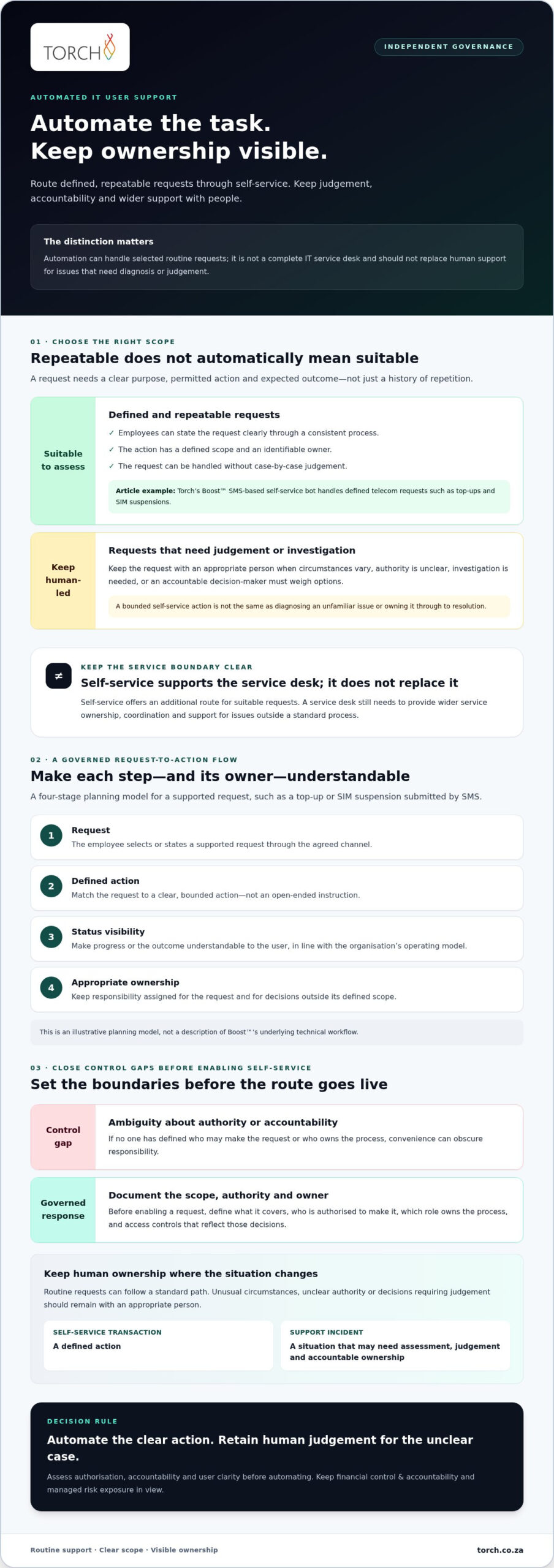
Automated IT user support uses technology to handle selected, repeatable user requests; it is not a complete IT service desk. Technical support covers a broader range of assistance, as outlined in this technical support reference. A service desk also needs to provide wider service ownership, coordination and support for issues that don’t fit a standard process.
Which employee requests are suitable for automation?
A request is easier to standardise when its purpose, permitted action and expected outcome are clearly defined. Repetition alone isn’t enough. The process also needs a controlled scope so it can be applied consistently and ownership remains clear.
For example, Torch’s Boost™ SMS-based self-service bot handles defined telecom requests such as top-ups, limit increases and SIM suspensions. Suspending a SIM also supports cost management: in a banking case study, 340 inactive SIMs were deactivated in month one. Suspending a SIM for a lost device or leaver is an operational control, not merely a convenience. These are examples of bounded requests, not complex IT incidents or every possible employee need.
When assessing a request, consider whether:
- Employees can state the request clearly using a consistent process.
- The action has a defined scope and an identifiable owner.
- The request can be handled without case-by-case judgement.
If a request needs investigation, depends on circumstances that vary, or requires an accountable decision-maker, it calls for human support rather than a standard automated route.
What automation can, and cannot, mean for the support experience
Self-service can offer an additional route for suitable requests. It shouldn’t be treated as a universal replacement for service-desk support. Completing a defined task is different from diagnosing an unfamiliar problem, weighing options or taking ownership of an issue through to resolution.
Employees should understand what the self-service route covers, whilst support teams need clarity about who is responsible when a request falls outside its scope. That distinction helps align convenience with independent governance, financial control & accountability, and managed risk exposure.
Set automation scope according to the request and the controls needed to handle it responsibly. This keeps the focus on useful, repeatable actions whilst preserving human judgement where the user’s situation calls for it.
How automated IT user support works within a governed workflow
Automation works best when each request follows a defined path and responsibility remains visible. The workflow below is illustrative. It shows how an enterprise might structure a supported request, not the technical steps or features of any particular tool. For automated IT user support, the discipline lies in setting boundaries before a routine task is made available for self-service.
A practical request-to-action flow
Consider an employee submitting a supported request by SMS. A top-up or SIM suspension is an example of a defined telecom request. A governed process can be described in four conceptual stages:
- Request: The employee selects or states a supported request through the agreed channel.
- Defined action: The request is matched to an action with a clear scope, rather than interpreted as an open-ended instruction.
- Status visibility: The process makes the request’s progress or outcome understandable to the user, according to the organisation’s operating model.
- Appropriate ownership: Responsibility for the request and any decision outside its defined scope remains assigned.
This is a planning model, not a description of Boost™’s underlying technical workflow. It helps teams consider what a user needs to know and who remains accountable, without assuming specific integrations, confirmations or ticketing functions.
Where governance and human ownership fit
Before enabling a request for self-service, document what it covers, who is authorised to make it and which role owns the process. Set access controls to reflect those decisions. Clear boundaries support financial control & accountability by reducing ambiguity about who can initiate an action and who is answerable for its governance.
Routine requests can follow a standard path. Unusual circumstances, unclear authority or decisions requiring judgement should remain with an appropriate person. A self-service transaction is a defined action; a support incident is a situation that may require assessment, judgement and accountable ownership. This distinction prevents convenience from being mistaken for complete service resolution.
For organisations refining these boundaries, a focused governance review with Derek King can provide a discussion of request scope, controls and ownership.
How to assess automated IT user support without creating control gaps
Assess automation as an operating control, not just a convenient channel. A request can be easy to process yet still need defined authority, clear ownership and review. This matters particularly when user actions have financial or security implications. Consistent boundaries support financial control & accountability and help manage risk exposure, but don’t by themselves guarantee a secure outcome.
Questions to resolve before automating a request
Use this checklist to establish whether a request is ready for self-service and how it will remain governed:
- Suitability: Is the request repeatable, sufficiently defined and appropriate for a standard self-service route?
- Authorisation: Who is permitted to make the request, and what access controls should apply?
- Ownership: Which organisational role owns the policy, and who decides how exceptions are handled?
- User clarity: Can employees understand what the route covers and what to do if their need falls outside its scope?
- Review: Who will review usage and operational outcomes, and how will that review inform changes to the process?
If ownership or authorisation is unclear, resolve the gap before introducing automation. Broader endpoint governance may also be relevant when support processes intersect with device management. Torch’s unified endpoint management brings that wider governance context into view.
Measures that show whether automation is useful
Keep operational and financial measures distinct. An operational review can consider request volumes, completion patterns where data is available, user feedback and recurring failure points. These signals help teams assess whether the process is understandable and where it needs refinement. They are not proof of a particular improvement without supporting evidence.
Financial review asks a different question: are requests being made within approved authority, and can associated activity be understood against the organisation’s financial controls? The appropriate measures depend on the request and available records. For example, an organisation might compare usage patterns with its own approval rules, then investigate discrepancies through its normal accountability processes.
Review findings with operational owners and relevant financial stakeholders. This gives the organisation a basis to refine request scope, address control deficiencies and decide whether the process remains suitable. Document decisions and the reasons for changes to help maintain consistency as responsibilities or business needs evolve.
Torch automated IT user support: a practical next step for enterprise teams
Automation is most useful when it addresses a defined operational need and sits within clear accountability. Torch’s Boost™ is an SMS-based self-service bot available 24/7 for user requests, including top-ups, limit increases and SIM suspensions. It maintains a full audit trail of every request, supporting oversight whilst handling specific telecom requests rather than replacing broader service-desk support or addressing every endpoint issue.
How Torch fits automated requests into enterprise operations
For internal teams, a self-service route for defined telecom requests can reduce the need to process each routine request manually. This creates an opportunity to organise support around clear service ownership, rather than treating automation as a standalone technology deployment. Keep the intended scope explicit, with independent governance and financial control & accountability in view.
Torch works as a managed-services partner, bringing operational involvement alongside technology. Its wider products and offerings place user support within the broader enterprise telecom and IT governance context. Automated requests can play a defined role, alongside endpoint governance and wider service-desk needs.
A measured way to explore the opportunity
Start by identifying recurring requests, defining which may suit a standard process and naming the owners of relevant policies and exceptions. Then decide how employees will understand the scope and how operational teams will review whether the approach remains useful. Torch brings 100+ years of combined industry experience and has operated in the South African market for over 20 years, providing relevant context for this measured approach.
In a PwC-audited insurance case study, the IT team spent 22% of its capacity on telecoms administration before engagement. This topic-relevant outcome illustrates the capacity that can be tied up in defined telecoms work and the value of assessing suitable requests within a governed operating model.
To discuss where defined telecom requests could fit within your operating model, use the governance review booking link.
Make your next automation decision with confidence
Turn a broad automation ambition into a focused operational decision. Choose one recurring request to examine, identify the accountable owner, and agree what evidence would show whether a self-service route is working as intended. This gives operational and financial stakeholders a practical basis for deciding whether to refine the scope, retain the current process or consider a wider role for automated IT user support.
The right approach is deliberate, not expansive by default. Clear ownership and review give employees a simpler route for suitable requests whilst helping decision-makers maintain financial control and accountability as the operating model develops.
A measured first decision can create a sound foundation for progress.
Frequently Asked Questions
Can automated IT user support work through SMS?
Yes. SMS can serve as a channel for automated IT user support when the request suits a short, clearly structured exchange. It can be convenient for employees who need to make a defined request without opening a portal. Explain which requests the channel covers and how users can access human assistance if their situation doesn’t fit the standard process.
What types of IT support requests can be automated?
Requests with predictable steps and a clear, bounded outcome are potential candidates. For example, password resets or software access requests may suit automation in some organisations, depending on policies, approval requirements and risk assessment. These are general examples, not claims about Torch’s support scope. Requests involving exceptions, unclear authority or diagnosis are better assessed by an appropriate person.
Is automated IT user support available 24/7?
Torch’s Boost™ SMS-based self-service bot supports 24/7 user requests, including top-ups, limit increases and SIM suspensions, with a full audit trail of every request. An automated route can make it possible to submit an eligible request outside staffed hours, but that doesn’t mean every request will be completed immediately or that human support is continuously available. Explain which steps are automated, when a person may need to review a request and how users can seek further help.
Does automated IT user support replace an IT service desk?
No. Automation can support selected request types, but an IT service desk handles broader needs such as investigating faults, coordinating work across teams and taking responsibility for incidents. For instance, an employee reporting an unusual device problem may need questions and assessment before the cause or next action is clear. A service desk remains important for that work and for requests that fall outside a standard process.
How can an organisation assess whether support automation is working?
Set a baseline before making changes, then review results for each request category over comparable periods. Alongside volumes and completion patterns, consider repeat attempts, abandoned requests and feedback about whether instructions were clear. Investigate recurring problems rather than treating every incomplete request as a failure of the tool. This gives operational owners evidence to refine the process and determine whether it is meeting its intended purpose.
How does automated user support relate to endpoint management?
Automated support provides a route for employees to make defined requests; endpoint management governs how devices are administered across their lifecycle. The functions can intersect, for example when a support request relates to a work device, but a self-service channel doesn’t itself manage that device. Keeping the processes distinct helps teams assign responsibility appropriately and consider whether a request also needs action under endpoint policies.