
What if a TEM report identifies billing discrepancies, but no one is accountable for resolving them? Telecom invoices, contracts and usage records can be difficult to reconcile, and internal teams may not have capacity to maintain billing and lifecycle controls. The questions to ask a TEM provider should therefore go beyond promised savings. They should reveal how the provider works, how its independence is protected and who is responsible for turning findings into action.
Before sharing business data or committing, establish what evidence supports the provider’s claims and how its commercial terms align with your interests. This article sets out practical questions to help South African organisations assess independence, service scope, delivery and accountability. It also explains what to clarify about reporting, remediation and ongoing controls, so you can distinguish a useful analysis from sustained operational improvement. The aim is to help you assess whether a provider can strengthen financial control and accountability, support commercial optimisation and manage risk exposure over time.
Key Takeaways
- Use the questions to ask a TEM provider to establish whether its oversight is independent and covers the telecom costs, contracts, usage and processes that matter to your organisation.
- Distinguish reporting from delivery by clarifying who owns invoice checks, remediation and ongoing governance.
- Assess fees and claimed outcomes against a defined baseline, calculation method, exclusions and approval process.
- Define a practical decision sequence: identify governance gaps, test the evidence, map delivery responsibilities and agree how performance will be measured.
- Consider how TEM can connect with finance, asset and endpoint controls to support consistent oversight.
Questions to Ask a TEM Provider About Independence and Scope
A fragmented telecom estate can make it hard to see who owns each service, how spend is allocated and where accountability sits. Mobile and fixed-line services may involve multiple contracts, teams and approval processes. Telecom Expense Management (TEM) brings structured oversight to telecom costs, contracts, usage and service processes, linking the records to the decisions and controls behind them.
The questions to ask a TEM provider should establish not only what it analyses, but whose interests guide its advice and who is responsible for follow-through. Independence means objective financial oversight and appropriate vendor accountability, not hostility towards carriers. Clear, evidence-based governance supports constructive commercial relationships.
How independent is the provider from telecom carriers?
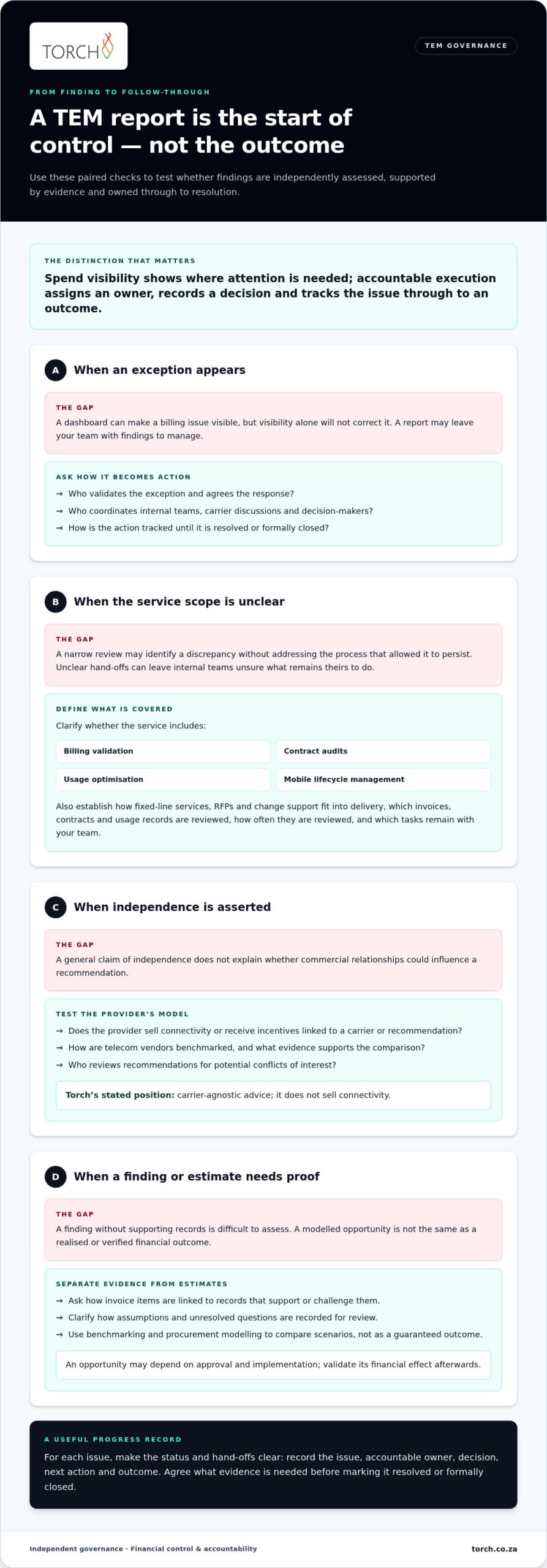
Clarify whether commercial relationships could influence recommendations. Ask:
- Does the provider sell connectivity, or receive incentives linked to a carrier or particular recommendation?
- How are telecom vendors benchmarked, and what evidence supports the comparison?
- Who reviews recommendations for potential conflicts of interest?
The answers should explain the provider’s commercial model and how it maintains impartiality, rather than relying on a general claim of independence. Torch Services is a carrier-agnostic advisor that does not sell connectivity. Its role is to support objective oversight and vendor accountability while keeping recommendations aligned with your organisation’s requirements.
What does the TEM service actually cover?
A narrow review may identify a discrepancy without addressing the process that allowed it to persist. Establish whether the scope includes billing validation, contract audits, usage optimisation and mobile lifecycle management. Ask how fixed-line services, RFPs and change support fit into delivery, and which tasks remain with your team.
- Which invoices, contracts and usage records are reviewed, and how often?
- Does the work include coordinating remediation, or does it stop at reporting findings?
- What information will your teams receive, and how will owners and actions be tracked?
These details help distinguish a one-off analysis from ongoing governance. Torch Services’s telecom expense management services cover billing validation, contract audits, benchmarking, usage optimisation, mobile lifecycle management, fixed-line services, RFP management and change support. Define the required scope and hand-offs at the outset so internal teams know how findings will become controlled operational improvements.
Questions That Reveal Whether TEM Analysis Leads to Action
A dashboard can make a billing issue visible, but visibility alone will not correct it. Ask what happens after an exception is identified: who validates it, who agrees the response, and how is the action tracked until it is resolved or formally closed? The answers show whether the service supports ongoing governance or leaves your team with a list of findings to manage.
Spend visibility shows where attention is needed; accountable execution assigns an owner, records a decision and tracks the issue through to an outcome.
How are billing variances and contract issues validated?
Ask which records analysts use to investigate an exception and how they document the evidence. Clarify how disputed items are distinguished from confirmed discrepancies, how assumptions are recorded and what information your team receives to assess a recommendation. These questions test the reasoning behind a finding, not just how it appears in a report.
- How are invoice items linked to records that support or challenge them?
- How are unresolved questions and assumptions recorded for review?
- How does market benchmarking inform procurement modelling without being presented as a guaranteed outcome?
TorchLight™ supports competitive intelligence, market benchmarking and procurement modelling. Use modelling to compare scenarios and inform commercial decisions, while treating estimates as estimates rather than realised or verified savings. An opportunity may depend on approval and implementation, and its financial effect needs to be validated afterwards.
Who owns remediation after a finding is raised?
A finding needs a clear route to action. Establish who coordinates internal teams, carrier discussions and decision-makers, and how responsibilities are agreed. Ask what a progress report records, such as the issue, accountable owner, decision, next action and outcome. This shared record makes it easier to see what is progressing and where work is waiting for input.
- Who follows up when an action is awaiting a decision or response?
- How are changes to an issue’s status or ownership reported?
- What evidence is needed to mark the matter resolved or formally closed?
Torch combines governance technology with hands-on advice and execution. Technology supports visibility, but operational control also depends on clear ownership and follow-through. Assess whether the delivery model gives your teams practical support to progress agreed actions, rather than leaving them to interpret reports and coordinate every next step themselves.
Questions to Ask About TEM Evidence, Fees and Accountability
Commercial terms should make the provider’s work and supporting evidence easy to assess. Before agreeing to a fee model, define what counts as an outcome, how it will be verified and which responsibilities sit with your team. The questions to ask a TEM provider should also reveal assumptions that could affect reported results, such as changes in service scope or usage.
How are savings measured and verified?
Start with the baseline: which invoices and services are included, and what period does it cover? Then ask how the calculation accounts for changes in users, usage, tariffs or service scope. An identified opportunity is not the same as an implemented change, and implementation does not automatically establish a verified financial outcome. Ask what evidence supports each stage and who approves the final calculation.
If fees depend on verified savings, clarify how the agreement treats disputed calculations, overlapping initiatives, exclusions and changes made by your own teams. A risk-share arrangement should specify the calculation method and review process. It should not be treated as a guarantee of savings.
What commercial terms and accountability should be explicit?
Use the comparison below to structure discussions and record agreed terms. It distinguishes a defined service from an open-ended promise and gives finance and operational teams a shared basis for review.
| Area | Clarify before committing |
|---|---|
| Fee basis | How fees relate to deliverables, verified outcomes or the agreed service scope. |
| Outcome verification | The baseline, calculation method, exclusions, evidence and approval process. |
| Reporting cadence | How often progress, open items, decisions and results are reported. |
| Responsibilities | Which work the provider leads and which approvals or actions remain with your team. |
| Controls and exit | How escalation, data access, records and transition arrangements are handled. |
External support should complement internal teams, not create parallel ownership. For example, finance may retain approval of commercial outcomes while the provider supports analysis and agreed follow-up. Define decision rights, hand-offs and escalation routes in the agreement. This gives both parties a shared reference for reviewing delivery, resolving ambiguity and maintaining financial control & accountability throughout the engagement.
How to Choose a TEM Provider That Fits Your Governance Needs
A suitable TEM model should address specific governance gaps, fit the way your teams work and make accountability clear. Use this decision sequence to turn evaluation criteria into a practical selection framework:
- Define the gaps. Identify where oversight is weakest, such as invoice review, contract ownership, usage controls or mobile lifecycle processes. Record which teams currently own each area.
- Test the evidence. Establish how analysis is supported, how assumptions are documented and how your organisation can review conclusions before decisions are made.
- Map delivery. Set out who analyses, approves, coordinates and completes each action. Make hand-offs between the provider and internal stakeholders explicit.
- Agree measures. Select reporting and performance measures that reflect your governance objectives, with clear owners and a review process.
How should you assess fit across teams and services?
Map finance, procurement, IT and user responsibilities before agreeing the operating model. Consider whether telecom controls need to connect with cloud spend oversight, asset records or endpoint management. Where telecom and cloud cost governance intersect, Torch’s IT FinOps-as-a-Service may be relevant.
Torch’s broader governance offering brings together TEM, telecom lifecycle management, unified endpoint management, FinOps and asset management. This helps enterprises consider how related controls interact while keeping each service’s scope and accountability clear. Torch has more than 20 years of operating history in South Africa and 100+ years of combined industry experience. These provide context for an evaluation, not a promise of a particular commercial outcome.
What is a practical next step after shortlisting?
Prepare a concise outline of your telecom estate, the governance challenges you want to address and the people involved in decisions. This gives internal stakeholders a shared basis for discussing priorities, operational ownership and how a proposed service should fit existing processes.
A well-defined scope helps your organisation move from provider evaluation to a considered, accountable decision.
Turn Your Evaluation into Lasting Governance
The value of your evaluation lies in what changes after a provider is selected. Before moving forward, turn your priorities into a practical governance charter: define decision rights, the evidence required for review, how unresolved issues are escalated and how progress will be assessed. This gives internal teams and the provider a shared reference point, helping keep financial control & accountability clear as services, contracts and business needs evolve.
The questions to ask a TEM provider are most useful when they lead to a decision you can explain and a working arrangement your teams can sustain. You do not need every process perfected before taking the next step. A focused conversation about your current estate and governance priorities can help clarify where to begin.
A clear starting point can make complex telecom oversight more manageable and put your organisation on a steadier path towards stronger governance.
Frequently Asked Questions
Is a TEM provider independent from telecom carriers?
A TEM provider can be independent, but its commercial relationships and methods matter. Ask whether it sells connectivity, receives carrier-linked incentives or has referral arrangements, and how it manages potential conflicts. Request an explanation of how vendor comparisons are made and what evidence supports them. The questions to ask a TEM provider should establish how objective advice is maintained, rather than relying on an independence label alone.
Can a TEM provider work alongside our internal finance and IT teams?
Yes. A TEM provider can add capacity while your finance and IT teams retain defined decision rights. For example, finance might approve how a billing adjustment is treated, while IT confirms whether a line or service is still needed. Agree how requests enter the workflow, who supplies supporting records and how actions are handed back. Clear hand-offs help external support strengthen existing controls instead of creating a competing process.
What information should we prepare before evaluating a TEM provider?
Prepare a current service and vendor inventory, recent invoices, relevant contracts, cost-centre allocations and a list of internal owners. Include known issues, such as inconsistent coding or uncertainty about who manages unused lines, alongside the decisions you want TEM to support. If records contain personal or commercially sensitive information, follow your organisation’s data-sharing and access procedures before transferring them. A defined scope helps keep early discussions focused.
How should a TEM provider handle a disputed telecom charge?
A disputed charge should be recorded and investigated, not treated as an error before the evidence is reviewed. Note the invoice reference, service or line involved, charge and reason for the query, then compare the item with relevant contract and usage or service records. Agree who submits the query, tracks correspondence and records the response. Follow your organisation’s existing payment and dispute procedures while the item is under review.
Does appointing a TEM provider change our relationship with telecom carriers?
No, appointing a TEM provider does not by itself change your organisation’s carrier relationships or existing agreements. A provider can support analysis or coordinate discussions, while authorised staff retain decision-making and contractual responsibilities. Set clear communication protocols: who may contact each carrier, what information can be shared and when your team must approve a change. This supports independent oversight alongside professional, constructive engagement with carriers.
Can TEM support forecasting as well as invoice checking?
Yes. Invoice reviews can provide a stronger basis for forecasting when considered alongside service plans and known changes, such as workforce growth, device assignments or contract renewals. Ask how assumptions are recorded, actual spend is compared with forecasts and scenarios are updated when plans change. Forecasts support decisions but are not guarantees. Their usefulness depends on reliable input data and timely review by the people responsible for budgets.