
What if your mobile security policy is clear on paper but inconsistently applied across the devices people actually use? A written standard sets expectations, but it won’t configure devices, reveal compliance gaps or resolve exceptions by itself. As employees work across different locations and travel, IT teams need controls that keep pace without disrupting access to essential work. That is the practical challenge of mobile device security policy enforcement.
Consistent enforcement is not a one-off enrolment task. It is an ongoing governance cycle: translate requirements into device controls, monitor compliance and respond to exceptions with clear accountability. This guide explains how to build that approach across a changing enterprise device estate. You’ll learn how to define enforceable requirements, improve visibility and manage remediation in a measured way, while protecting organisational information and supporting different work arrangements. The aim is practical control, not a policy that exists only in a document.
Key Takeaways
- Turn policy statements into device controls with a named owner and evidence source, so requirements can be checked in practice.
- Separate baseline safeguards from risk-based exceptions, with clear approval and review processes for each exception.
- Make mobile device security policy enforcement a continuous cycle, starting with device visibility and continuing through monitoring and remediation.
- Use compliance evidence and defined accountability to identify gaps and support consistent decisions across the device estate.
- Embed endpoint governance and managed support into ongoing operations to sustain controls as devices and work arrangements change.
Why mobile device security policy enforcement needs operational controls
Mobile device security policy enforcement is the process of applying, checking and acting on device controls that reflect an organisation’s approved security policy. It connects the organisation’s requirements with device settings, responsibility for managing those settings and evidence that they are working as intended.
A policy may state that business information must be accessed securely, but that principle alone does not show which devices can access it, which applications are permitted or how exceptions are handled. Keep the parts distinct: objectives describe what the organisation wants to achieve; technical controls put those requirements into effect; accountable owners oversee decisions and follow-up; evidence shows what has been implemented and where gaps remain. A centralised unified endpoint management approach can bring device controls, compliance auditing and remediation into a more consistent operating model.
Mobile security covers a range of considerations, from protecting information to managing how devices connect to business resources. A useful overview of the wider topic is available in Mobile security. The policy should set clear organisational expectations, while the technical configuration translates those expectations into controls suited to the device estate.
What should a mobile device security policy cover?
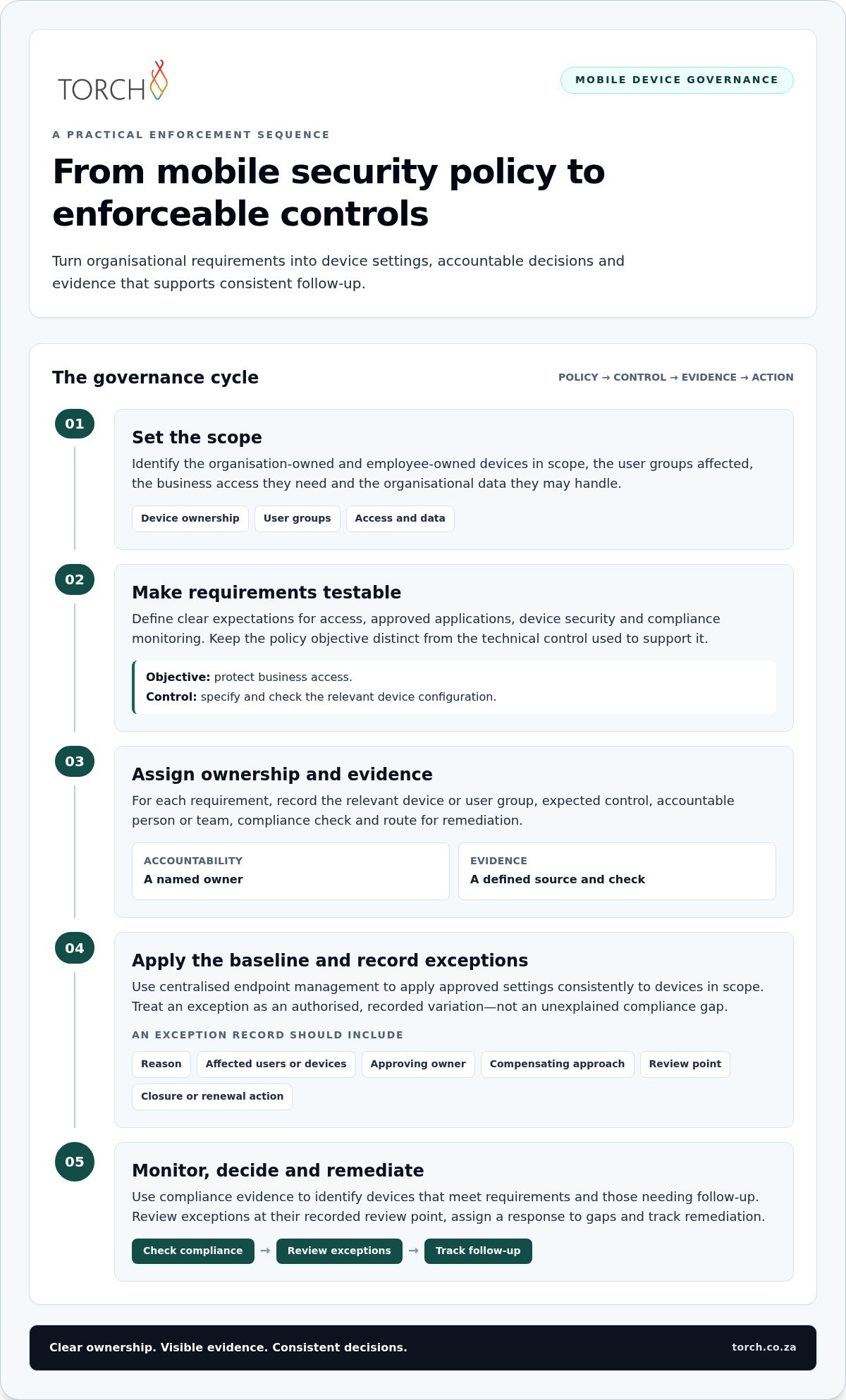
Set the scope before deciding on settings. Identify which organisation-owned and employee-owned devices are covered, which user groups are affected, what business access they need and what organisational data they may handle. Then define requirements for access, approved applications, device security and compliance monitoring. Keep each principle distinct from its implementation. For example, protecting business access is a policy objective; the specific device configuration used to support it is a technical control.
Where does policy enforcement commonly break down?
Gaps often appear between a rule and the work needed to apply it. If no owner is responsible for reviewing an exception or deciding how to address a device outside the standard, the issue can remain open without a clear decision. Incomplete visibility creates another problem: a compliance report may describe enrolled devices without giving decision-makers confidence that it represents the full estate.
For example, an employee-owned phone used for work may be absent from an organisation’s managed-device view. That does not establish that the device is insecure, but it leaves uncertainty about whether requirements apply and how compliance is assessed. Assigning ownership, recording evidence and tracking remediation gives teams a practical basis for managing that uncertainty. Without these operational disciplines, managed risk exposure is harder to assess and address consistently.
How mobile device security policies become enforceable controls
A policy requirement becomes actionable when it specifies what must happen on a device, who is responsible for the control and what evidence will show whether it is operating. This creates a traceable link between organisational intent and day-to-day device management. A control is accountable when it has a named owner, an evidence source and a defined route for remediation.
For each requirement, document the relevant device or user group, the expected control, the accountable person or team, how compliance will be checked and what happens if the control is not met. The NIST Guidelines for Mobile Device Security provide a technical reference for managing mobile devices across their lifecycle. Apply guidance in line with your organisation’s approved policies and operating needs.
Translate policy statements into device controls
Use plain, testable requirements rather than broad instructions. For example, an access principle can become a defined condition for business access, together with a process for checking whether managed devices meet it. Approved applications can be specified by role or work purpose, then deployed through centralised endpoint management. Compliance auditing provides evidence to identify devices that meet requirements and those needing follow-up.
Centralised management helps teams apply approved settings consistently across devices in scope, rather than relying on each user to interpret policy. It also helps align configuration, application deployment and endpoint security with organisational requirements. Controls should be specific enough to assess and practical enough to support work. Before rollout, consider whether a setting could block an essential application or create avoidable access barriers for a user group.
Make exceptions visible and accountable
A baseline establishes the expected control for each relevant device group. An exception is a recorded, authorised variation from that baseline, not an unexplained compliance gap. For each exception, capture the reason, affected devices or users, approving owner, any compensating approach, review point and actions needed to close or renew it.
For example, a team may need a temporary variation while a business application is being prepared for deployment. Record the decision and its accountable owner, then set a review point so the exception does not become a permanent, unexamined deviation. An unknown device or a failed check without an assigned response, by contrast, remains an unmanaged compliance gap.
This discipline strengthens financial control and accountability by making decisions, ownership and follow-up visible. It also supports independent governance: teams can distinguish approved risk decisions from unresolved control deficiencies and direct remediation accordingly. Torch Services’ unified endpoint management brings together centralised device control, application deployment and compliance auditing to support this operational approach.
A practical sequence for implementing mobile device security policy enforcement
A sound rollout is as much a change-management exercise as a technical one. Give users time to understand what will change, prepare support teams for questions and use early implementation to identify issues before extending the approach more widely. Plan each stage around operational readiness rather than an assumed fixed timeline.
Prepare the estate and define enforcement priorities
Make the rollout manageable for the teams and users affected. Group planned changes by business function or work pattern, then identify dependencies such as access to essential applications and the availability of user support. Choose an initial rollout group that can provide useful feedback without placing critical operations under unnecessary pressure. Before settings change, confirm that communications, support materials and escalation routes are ready.
- Prepare the change. Confirm the rollout stages, affected user groups and communications each group needs. Explain what users should expect and where to raise questions.
- Check operational readiness. Ensure support teams understand the changes and can guide users through common access or usability issues. Align implementation with business activity.
- Start with a controlled rollout. Introduce the changes to a representative group. Gather feedback on user experience and any unintended effect on work processes.
- Adjust before extending. Use the initial feedback to refine communications, support guidance or implementation settings, then proceed to further groups in planned stages.
- Review the rollout. Assess whether implementation is working as intended and capture lessons to inform future changes.
Prepare, introduce, learn, adjust and extend. This sequence helps teams make progress while leaving room to respond to operational feedback.
Roll out, monitor and remediate consistently
Keep communication active throughout each stage, not just at launch. Users need timely, understandable guidance, while support teams need a clear view of what has changed and how to help. Torch’s unified endpoint management supports centralised implementation across enterprise devices. A staged rollout gives teams a practical way to incorporate user feedback as controls are introduced.
After each stage, review whether the support approach and implementation plan are working for the people affected. Use what the rollout reveals to make the next stage clearer and more manageable, while keeping the overall direction aligned with organisational priorities.
Sustaining enforcement through endpoint governance and managed support
Mobile controls need attention after rollout as work patterns and operational priorities evolve. A sustainable governance model makes room for decisions about recurring issues, changing support needs and whether teams have the capacity to act on findings. This keeps enforcement connected to everyday operations rather than treating it as a technical task that ends at deployment.
Measure control health without relying on dashboards alone
Use review meetings to interpret what reporting means for the organisation. Look for patterns such as repeated user difficulties, exceptions that persist across review cycles or work groups that regularly need additional assistance. These signals can point to friction in how a requirement is applied or a need to clarify responsibilities. Agree which issues require action and who will take it, then revisit those decisions at the next review.
A dashboard can show where attention may be needed, but it cannot make the judgement or carry out the follow-up. Independent governance connects visibility to decisions, helping leaders understand whether the current approach remains workable and where managed risk exposure needs closer attention. Torch’s TorchLight™ and SpotLight™ capabilities support this operational-resilience approach by helping organisations translate governance frameworks into disciplined, practical execution while retaining clear accountability for decisions.
When managed endpoint governance can help
Internal teams may have limited capacity to keep routine endpoint governance moving alongside other priorities. Torch’s hands-on, embedded execution can support implementation and ongoing remediation, helping teams progress agreed actions rather than stopping at reporting. This is useful when an organisation needs consistent follow-through across user groups or work arrangements while retaining clear accountability for decisions.
A unified endpoint management approach can sit within broader operational governance by clarifying how endpoint-related work is managed and reviewed. The focus is on sustaining agreed controls and addressing operational issues, not extending the discussion into telecom billing.
With clear ownership and support, endpoint governance can adapt as business needs change while keeping decisions visible and follow-through part of normal operations.
Make endpoint governance part of everyday decision-making
Mobile device security policy enforcement is most effective as an ongoing management discipline, not a task that ends when a policy is approved. As devices and working arrangements change, leaders need confidence that governance remains practical: responsibilities are understood, decisions can be evidenced and teams have capacity to follow through. This helps align security oversight with operational continuity and keeps attention on the control gaps that matter most.
The next step need not be a wholesale redesign. An independent discussion can clarify where decision rights, oversight or operational capacity need attention, and identify a proportionate improvement to pursue first. A considered approach supports stronger accountability without creating unnecessary friction for users or IT teams.
With clear priorities and steady ownership, your organisation can strengthen mobile governance with confidence as its needs evolve. To discuss practical next steps, book a 30-minute governance review with Derek King, with no obligation or sales pitch.
Frequently Asked Questions
Is mobile device management the same as mobile device security policy enforcement?
No. Mobile device management is a set of capabilities for administering and controlling devices. Mobile device security policy enforcement is the governance process that ensures approved requirements are applied and followed. An organisation might use device management to configure settings, but it still needs to decide which policies apply, who reviews compliance and how exceptions are handled. The technology supports enforcement; it does not replace ownership or decision-making.
Can an organisation enforce security policies on employee-owned devices?
Yes. Where employees use their own devices for work, an organisation can set requirements for business access and the information those devices handle. Define the scope clearly: explain which work-related controls apply, what information the organisation can access and how personal use is treated. For example, policy can distinguish business applications and data from personal content. Clear boundaries help users understand expectations and support consistent decisions.
What happens when a mobile device does not meet security policy?
The response should depend on the control failure and the business access involved. A team might first notify the user and provide a route to resolve a fixable issue, such as updating a setting or removing an unapproved work application. If the gap remains, the organisation can assess whether to limit relevant business access while it is addressed. Record the decision and any approved exception.
How often should an organisation review its mobile device security policy?
Set a regular review point, then bring it forward when material changes could affect the policy. These may include introducing a new business application, changing how staff access organisational information or identifying repeated exceptions during compliance reviews. Check whether requirements still fit actual work practices, owners remain appropriate and controls produce useful evidence. Record changes and communicate them to affected users.
Does unified endpoint management replace endpoint security?
No. Unified endpoint management (UEM) helps administer devices and apply organisational controls, while endpoint security addresses protection of those endpoints. The functions are related but not identical. A UEM service may include endpoint security capabilities, as Torch’s offering does, but the organisation should still define the protections it requires and assess how its controls work together. Device administration alone should not be treated as proof that every security need is covered.
How can policy enforcement avoid disrupting employees?
Design controls around real work requirements. Before rollout, identify essential applications and user groups that rely on them, then communicate what will change and where support is available. Introducing controls to a representative group first can reveal access or workflow issues before wider implementation. Make the exception route clear, too. This gives IT a way to handle legitimate operational needs without allowing temporary variations to go unreviewed.