
What if your asset register is tidy but still doesn’t reflect the devices your people actually use? Automated IT asset auditing can help close that visibility gap, but automation alone doesn’t make the results reliable. Records and allocations can drift apart, leaving IT and finance teams to reconcile discrepancies by hand. That affects more than administrative workload: decisions about technology investment, support and oversight are harder when the underlying picture is uncertain.
For enterprise leaders, the priority is not simply to produce a larger inventory. It’s to establish whether asset information can support financial and operational decisions, and whether the right people are accountable for addressing gaps. A clear record of the evidence behind each entry gives teams a more dependable basis for oversight, without treating every mismatch as a confirmed error.
This guide explains how to use automated auditing to reconcile asset records, identify control gaps and strengthen financial control and accountability. It covers what an audit can establish, how to bring relevant information together, and how to assess findings and assign follow-up. You’ll also see how asset-management and endpoint-governance services can support a wider control model, helping your organisation build a clearer, more reviewable view of its technology estate and make better-informed lifecycle decisions.
Key Takeaways
- Automated IT asset auditing can organise recurring checks, but source records still need validation before they can be treated as reliable evidence.
- Build a practical reconciliation workflow by defining scope, bringing relevant records together, validating discrepancies and assigning follow-up actions.
- Prioritise findings by their financial, operational or security-control significance, and distinguish confirmed changes from unresolved exceptions.
- Torch Services’ asset-management service and unified endpoint management services can support a broader control model grounded in clear ownership and follow-through.
What automated IT asset auditing verifies, and why records alone are not enough
Automated IT asset auditing is the recurring comparison of asset records with relevant evidence to identify missing, conflicting or outdated information. It makes checks repeatable, but it cannot make incomplete source data reliable by itself. A well-populated register may still contain entries that no longer reflect how technology is allocated or used.
Automated reconciliation identifies where records and supporting evidence differ; physical or user validation helps establish what is actually present, who uses it and whether the recorded details are correct. An audit tests whether information can be supported. Routine inventory maintenance updates records, procurement acquires assets, and device support resolves user or technical issues. These activities can inform an audit, but they serve different purposes.
IT asset management provides the wider discipline for governing technology throughout its lifecycle. The overview of IT Asset Management (ITAM) describes its broad scope, while an audit applies a focused test to whether selected records and evidence align.
What does an IT asset audit establish?
An audit tests whether records are complete enough to support decisions about an asset’s ownership, status and lifecycle. Is the assigned person or business unit recorded? Is the device active, in storage, returned or retired? Does the available evidence support the recorded allocation and status? The aim is not simply to find populated fields. It is to establish whether the information is credible and useful for financial control and accountability.
Example: an asset register assigns a laptop to one employee, while endpoint records show activity associated with another user. The discrepancy doesn’t, by itself, prove the register is wrong. The device could have been reassigned without an updated record, or the evidence may need checking. Flag the mismatch for validation and resolution rather than silently overwriting either source.
Why automate asset-audit checks?
Repeated, structured comparisons can reduce manual collation and help teams identify exceptions consistently across review cycles. This makes it easier to see what changed, which records need investigation and whether previously identified gaps remain unresolved. Set the review frequency according to how quickly the estate changes and the organisation’s control needs. Automation does not remove the need for physical checks or confirmation from accountable users.
The practical value comes from disciplined follow-through. Treat each exception as a question to resolve, retain the basis for any correction and assign responsibility for maintaining the record. Without those steps, faster checking can produce a longer list of discrepancies rather than stronger oversight.
How automated IT asset auditing connects records, endpoints and evidence
A useful audit workflow starts with a defined question, not a data export. Automated IT asset auditing can compare relevant records, but the evidence available and the validation required will depend on the organisation’s environment. Sources may include an asset register, endpoint records, and procurement or finance data. Establish which sources are available and how current they are before relying on them.
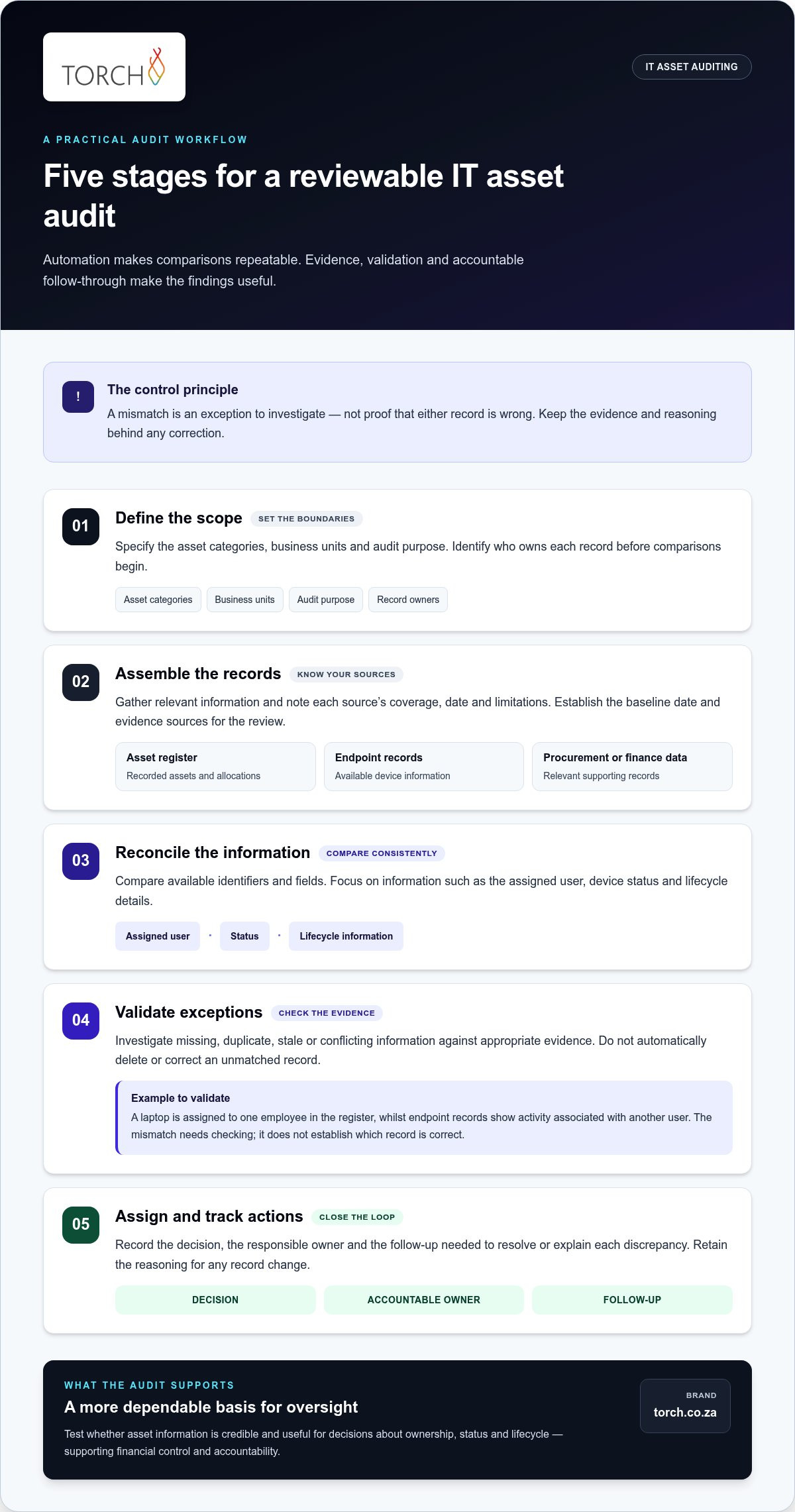
Reconciliation identifies exceptions that need supporting evidence and an accountable owner; it doesn’t decide, by itself, which record is correct. Use a consistent sequence to make the work reviewable:
- Define scope. Set the asset categories, business units and audit purpose, then identify who owns each record.
- Assemble records. Gather the relevant sources and note their coverage, date and limitations.
- Reconcile. Compare available identifiers and fields, such as assigned user, status and lifecycle information.
- Validate. Investigate exceptions against appropriate evidence rather than treating a mismatch as proof of an error.
- Assign actions. Record the decision, responsible owner and follow-up needed to resolve or explain each discrepancy.
Set audit scope and establish a baseline
Define which assets and business areas are in scope, and why they’re being reviewed. Corporate endpoints may need different checks from other IT assets, so separate categories where control needs differ. Identify record owners before comparison begins. Document the baseline date and evidence sources, too. This gives reviewers a clear reference point and helps them interpret findings against the estate as it stood at that time.
Reconcile records and validate exceptions
Compare fields only where the relevant data exists. An unmatched record, duplicate entry, stale status or conflict between an asset register and endpoint information should become an exception for review, not an automatic deletion or correction. Check the available evidence, capture the reasoning and route the issue to an owner with the authority to resolve it. Retaining both the discrepancy and its resolution supports consistent follow-up and independent governance.
Where security controls form part of the audit purpose, use relevant guidance as context, not as a substitute for evidence about your own estate. The National Institute of Standards and Technology (NIST) publishes cybersecurity and technology resources that organisations may consider alongside their internal control framework.
A governance review with Derek King can help clarify how asset-audit responsibilities and follow-up fit into your control model. View the governance review booking page.
How to act on automated IT asset audit findings
An exception list is not a control outcome. To make automated IT asset auditing useful, prioritise each discrepancy by its possible financial, operational or security-control significance, rather than by the number of records involved. Unresolved asset exceptions create both financial exposure and endpoint-security risk, so they should remain visible until an accountable owner resolves them. A device with unclear ownership may need prompt investigation if that uncertainty affects endpoint oversight; a minor data-field inconsistency may need only a routine correction.
Triage discrepancies without creating false positives
First classify what the evidence shows: a missing record, a duplicate entry, a possible ownership change or stale status information. These are different conditions and shouldn’t be bundled into one generic “asset error”. Before classifying an item as lost, retired or unauthorised, review available evidence and seek confirmation through the organisation’s established process. A mismatch is a reason to investigate, not a conclusion.
Illustrative example, not a Torch Services benchmark: an exception register might show a device identifier, discrepancy type, business impact, current status, owner, next action, due date and closure evidence. One entry could record a device with an outdated allocation, assigned to a manager to confirm its current user. Keep the original finding visible until the review is complete, and record the confirmed correction separately from exceptions that remain open.
For every material finding, document who is accountable, what action is required, when it is due and what evidence will demonstrate closure. This creates a consistent decision trail and helps teams distinguish confirmed changes from unresolved questions.
Turn audit results into ongoing control
Once a correction is validated, feed it into the organisation’s agreed record-maintenance process so that the authoritative record is updated and future reviews use the corrected information. If the same discrepancy keeps recurring, examine the process behind it: ownership may be unclear, handovers may not trigger record updates, or lifecycle steps may lack a defined control.
Endpoint findings also need context. A device with uncertain status or ownership may indicate a gap in endpoint oversight and affect managed risk exposure, but an audit finding alone doesn’t establish that a control has failed or that a security incident has occurred. Unified endpoint management can form part of broader endpoint policy oversight, alongside clear responsibilities for investigating and resolving exceptions.
Use review outcomes to refine record ownership, handover practices and follow-up responsibilities. That turns audit findings into repeatable improvements in financial control and accountability, rather than a one-off exercise.
A governance review can also help teams identify how endpoint oversight and exception handling fit into their broader control framework. See the booking details.
Building an accountable automated IT asset auditing model with Torch Services
Automation strengthens oversight only when the organisation agrees what the records mean and who must act on the results. Torch Services’ asset-management service and unified endpoint management (UEM) services can support a broader control model, while effective governance depends on reliable records, defined ownership and follow-through on findings. As an independent, carrier-agnostic advisory partner rather than a software vendor, Torch brings offerings such as TorchLight™ and SpotLight™ into a wider governance conversation focused on practical control and accountability.
What to establish before operationalising automation
Before putting a recurring review into operation, bring the relevant teams together to agree on the control model. IT, finance, procurement and business teams may each hold information or make decisions that affect an asset’s status. Define who owns each record and who can approve changes, then agree which fields, evidence and definitions make a reconciliation valid.
Set a review cadence that reflects how quickly the estate changes and which control priorities matter most. Document how unresolved or higher-impact exceptions are escalated, and ensure teams know where validated corrections should be recorded. These agreements make results easier to interpret and reduce the risk of different groups applying inconsistent definitions.
Connect asset visibility with financial and endpoint governance
Validated asset information can inform decisions about allocation, lifecycle planning and oversight. It can also help finance teams assess whether records support the organisation’s view of its technology holdings, while endpoint governance gives IT a basis for reviewing device oversight. Neither a register nor an endpoint record alone provides the full picture; governed evidence from relevant sources can support more accountable decisions and managed risk exposure.
Torch Services operates six integrated service lines, including TEM, TLM, UEM, FinOps, ITAM and SecOps. Within this wider governance context, its asset-management service and UEM services can complement clear internal responsibilities and established follow-up processes. As an independent, carrier-agnostic advisory partner, Torch connects cost and security considerations rather than treating them as separate control questions. IT financial governance connects technology oversight with disciplined financial management. This is a governance framework, not a claim that asset auditing itself produces a particular saving.
A practical model should make the path from finding to decision clear: establish ownership, assess the evidence, record the resolution and use recurring issues to refine controls. That is how automated IT asset auditing can contribute to financial control and accountability rather than simply producing another report.
Make asset assurance part of everyday governance
Automated IT asset auditing is most valuable when its findings inform decisions beyond the audit itself. Treat each review as an opportunity to strengthen how your organisation assigns accountability, assesses evidence and responds to changes across its technology estate. A consistent approach can help decision-makers build confidence in the information used for financial and operational oversight.
Torch Services brings 100+ years of combined industry experience to its work in technology governance. Consider how your current records, responsibilities and review practices fit together, and where clearer ownership could improve control. A focused discussion can help identify practical priorities without committing to a particular programme.
With clear priorities and accountable follow-through, your organisation can build a more dependable foundation for managing its technology estate.
Book a 30-minute governance review with Derek King, with no obligation or sales pitch.
Frequently Asked Questions
How often should an organisation run automated IT asset audits?
Set the cadence according to how quickly the estate changes, the organisation’s control requirements and its capacity to resolve exceptions. A major device refresh or organisational change may justify a focused review outside the regular cycle. Automated IT asset auditing can surface changes between formal reviews, but frequent comparisons won’t correct weak source records by themselves. Assign owners to review results and use additional validation where the evidence leaves an asset’s status uncertain.
Can automated IT asset auditing replace a physical asset check?
No, not in every situation. Automated comparisons can highlight inconsistencies in available records, but they can’t independently establish that a device is physically present or correctly assigned. If a device’s location matters to a decision, arrange a suitable physical check or seek confirmation from the accountable user. The right approach depends on the asset, the quality of the evidence and the control objective, rather than a blanket rule to check every item in the same way.
What information is needed to automate an IT asset audit?
Start with the records your organisation can access, then agree what fields are meaningful and who is responsible for each source. For example, an asset identifier may be compared with an assigned user, acquisition information or a recorded lifecycle status, where those details exist. Establish how teams will interpret missing or differently formatted values before comparing records. The available data varies by organisation, so don’t assume particular systems or integrations are in place.
How can teams tell whether automated asset auditing is working?
Assess whether the process supports better decisions, not simply how many records match. Set a baseline, then track measures such as the proportion of in-scope records with key fields completed, the age of open exceptions and whether agreed corrections have evidence of closure. Review these measures by asset category or business unit to reveal where control needs attention. They’re organisation-specific indicators, not universal benchmarks, and a high match rate alone doesn’t prove effective oversight.
Does automated asset auditing help identify security exposure?
It can help teams identify records that warrant security review, such as a device with uncertain ownership or outdated status. Those discrepancies are prompts for investigation, not proof of a vulnerability or security incident. Assess them alongside relevant endpoint controls and the organisation’s risk priorities. For instance, establish whether an unclear allocation affects oversight of that device, then route any confirmed policy gap through the appropriate security and governance process.