
What happens when a laptop changes hands but the asset register does not? In a large enterprise, that gap can leave teams unsure who is accountable for support, audits and retirement. Automated IT asset tracking helps keep asset records current, but visibility alone is not governance.
Manual records can lose accuracy as devices move between users and teams. When ownership, status and lifecycle information sit in disconnected places, financial control and security oversight become harder to maintain.
The answer is not simply to automate data capture. Automation supports control when asset events lead to accountable decisions, with clear ownership for updating records and acting on changes. This article explains how automated IT asset tracking can support a dependable view of assets and their status, and how to connect that view with lifecycle management, endpoint governance and financial accountability. It also sets out practical implementation principles, so asset information can inform consistent decisions about support, oversight and retirement.
Key Takeaways
- See how automated IT asset tracking differs from an inventory and the wider discipline of asset management.
- Follow the asset-information workflow from collection and record association through review and accountable action.
- Learn how to start with a defined asset group, clear ownership and data rules, then phase implementation against a measurable objective.
- Understand why data sources and tracking methods vary according to asset type and system design.
- Explore how Torch’s independent asset-governance advisory work sits alongside endpoint governance, security management and lifecycle support.
What automated IT asset tracking solves beyond a spreadsheet
An asset inventory records what an organisation holds. Tracking is the ongoing process of keeping relevant asset information current. Asset management is broader: it uses that information to guide decisions throughout an asset’s lifecycle, from assignment and support to review and retirement. IT Asset Management (ITAM) provides a useful foundation for understanding this wider discipline.
Automated tracking keeps asset information updated through defined data sources and workflows. This describes a process, not a guarantee that every record will be accurate without oversight. Automation can surface changes, but people still need to validate information, take action and remain accountable for the outcome. Without that follow-through, outdated data can accumulate in an automated record just as it can in a spreadsheet.
How automated tracking differs from an asset inventory
A spreadsheet or register captures a point-in-time view. As equipment moves between teams, changes user or reaches a new lifecycle stage, the record can quickly fall behind. Automated IT asset tracking supports ongoing updates through the data sources and workflows established for the environment. The methods used will depend on asset type and system design.
Discovery is not the same as governance. Identifying an asset does not confirm that its record is accurate, establish who owns it or decide what should happen next. Those steps require validation and assigned responsibility. A useful process states who reviews a change, who updates the record and who acts on the information.
Why asset visibility matters to finance, IT and security
Dependable records help IT teams assess support needs and prioritise work with a clearer view of equipment assignments and lifecycle status. Finance teams can use accurate asset information to strengthen procurement planning and financial control & accountability, rather than relying on incomplete records when reviewing requirements. Better IT cost visibility and control can also support security outcomes by helping teams identify which assets require security review, remediation or retirement.
Unknown ownership raises practical questions: which team should respond to a support issue, whether an existing asset can meet a new requirement, or whether a device is ready for retirement. It can also make endpoint oversight harder, because teams may not have a clear view of the assets that need review. Connecting records to named owners and decision workflows brings these questions into routine governance.
The objective is not simply a fuller inventory. It is a dependable basis for decisions, with clear responsibility for keeping information useful over time.
How automated IT asset tracking works across the asset lifecycle
Automated IT asset tracking turns asset information into a governed record and a clear next action. Its value depends on both the available data sources and the governance rules that determine how changes are checked, assigned and resolved.
Sources and methods vary by asset type and system design. A process might collect information from established records or other relevant sources, associate it with an asset record, flag changes for review and direct the right person to act. Automation can update information when a source is reliable and the rules are clear. It cannot resolve every ambiguity on its own.
From asset data to a governed record
An asset record needs enough structure to support decisions. For example, an organisation might record an asset identifier, asset type, assigned team, status and lifecycle stage. These are illustrative examples, not a statement of fields in any particular platform. ITAM principles help organise assets across their lifecycle, while a configuration management database (CMDB) can provide a structured view of configuration items and their relationships. Both are useful when definitions are agreed and maintenance is accountable.
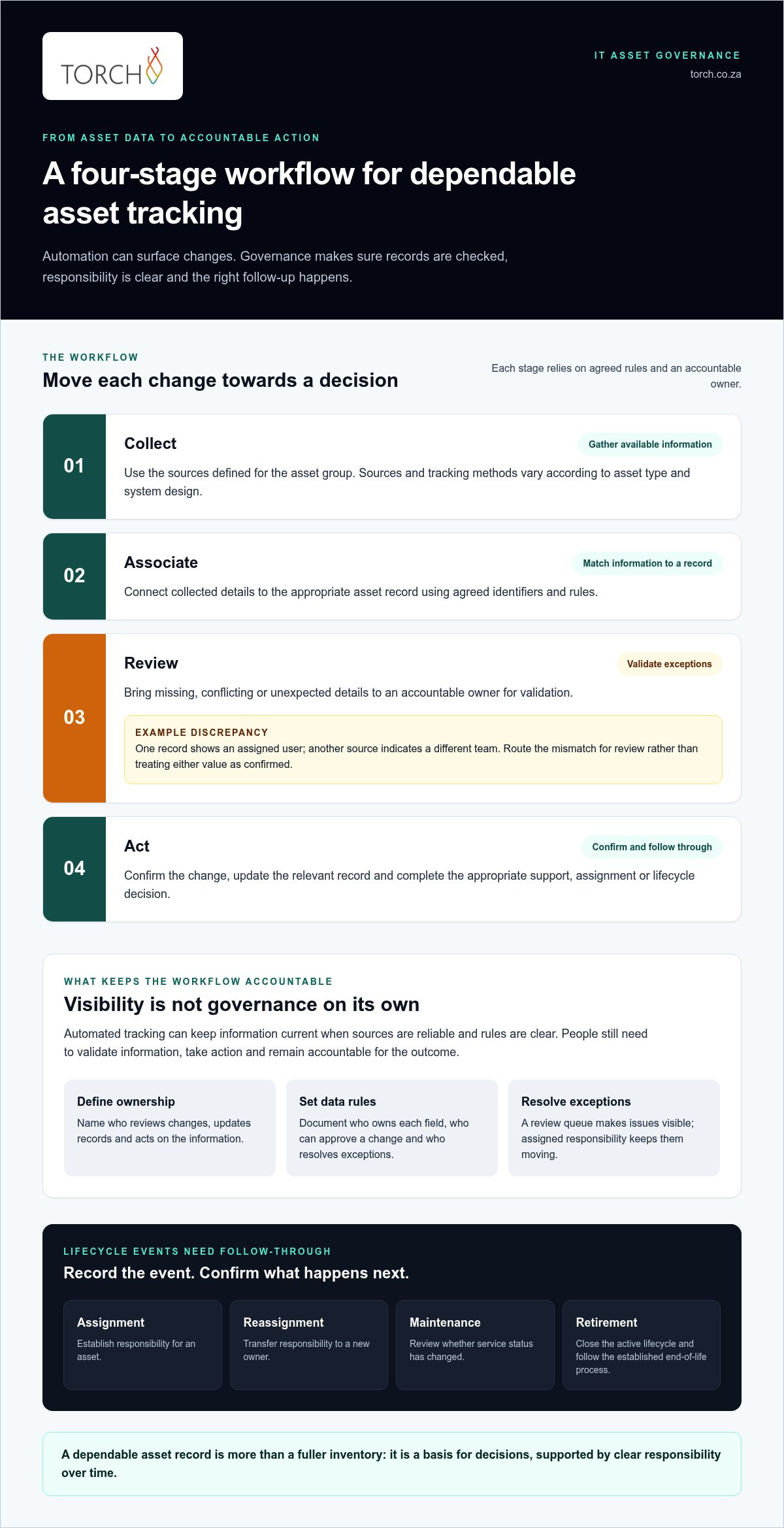
Document who owns each data field, who can approve a change and who resolves exceptions. If a record shows one assigned user while another source indicates a different team, the workflow should route that discrepancy for review rather than silently treating either value as correct.
Tracking changes through handovers and lifecycle events
Different events call for different decisions. Assignment establishes responsibility for an asset; reassignment transfers it; maintenance may change its service status; retirement closes its active lifecycle and prompts the organisation to follow its established end-of-life process. Recording the event is only the first step. An owner must verify the change and ensure the relevant record and follow-up action are addressed.
- Collect: Gather available information from the sources defined for the asset group.
- Associate: Match that information to the appropriate asset record using agreed identifiers and rules.
- Review: Surface missing, conflicting or unexpected details for validation by an accountable owner.
- Act: Confirm the change and complete the relevant support, assignment or lifecycle decision.
A review queue makes exceptions visible, but assigning responsibility for resolving them is what keeps the process moving. Torch’s governance work can help clarify ownership and lifecycle controls as part of a practical review: governance review of asset ownership and lifecycle controls.
How to implement automated IT asset tracking without creating another data silo
Successful implementation starts with the operating model, not the software. A defined scope, clear ownership and practical measures help automated IT asset tracking strengthen existing decisions instead of creating a separate record that teams must maintain.
Set scope, ownership and success measures
Begin with a defined asset group and a specific objective, such as improving record completeness or reducing the effort required to reconcile assignments. Choose the lifecycle events to include in the initial phase, then expand once responsibilities and processes are working. Involve IT, finance, procurement and security stakeholders wherever their decisions depend on asset information.
- Define scope: Select the asset group and lifecycle events for the first phase. Set boundaries so teams know which records and decisions are covered.
- Map ownership: Assign responsibility for data quality, approvals, exceptions and process changes. Make handovers between teams explicit, including who must update or review information.
- Set data rules: Agree which sources inform each record, how conflicting details are handled and what information is required for a record to be considered complete.
- Phase deployment: Introduce the process in manageable stages, testing how it supports real workflows before extending its scope.
- Review outcomes: Track measures such as record completeness, reconciliation effort and unresolved exceptions. Use the results to identify where responsibilities or rules need adjustment.
Choose measures that show whether information is useful, not merely whether it has been collected. For example, a rising number of unresolved assignment exceptions may point to unclear handover responsibilities rather than a need for more data. Endpoint records should also support security and management decisions, which is why unified endpoint management belongs in the wider governance conversation.
Integrate the process and improve it over time
Map how asset decisions relate to ITSM, ERP and HRM processes, such as support requests, procurement approvals or staff changes. This does not require assuming that systems are connected. Document where information is created, reviewed and acted on, and how hand-offs are managed. Joined-up governance helps teams work from consistent responsibilities across functions, supported by Torch’s broader technology solutions.
Schedule regular reviews of stale records, recurring exceptions and changes to business processes. If a new approval path or team structure affects asset ownership, update the rules as well as the workflow. This discipline keeps the approach manageable as its scope grows.
For organisations planning this work, Torch’s governance review can help frame the priorities and the decisions involved.
How Torch connects automated IT asset tracking with enterprise governance
Asset information is most useful when it informs operational decisions, not just a dashboard. Torch is an independent, carrier-agnostic advisory partner, not a platform vendor. Its asset-governance and endpoint-management work can sit alongside endpoint governance, security management and lifecycle support, connecting asset oversight with the responsibilities that shape how devices are managed throughout their lifecycle. TorchLight™ and SpotLight™ are examples of Torch-specific offerings that support this practical, governance-led approach.
Torch’s six integrated service lines include TEM, TLM, UEM, FinOps, ITAM and SecOps. Together, they provide a wider context for using asset information to support financial control & accountability, endpoint oversight and managed risk exposure. The focus is not simply on capturing changes, but on helping relevant teams interpret information and follow through within their areas of responsibility.
Why tracking needs operational ownership
A dashboard can display an asset’s recorded status. It cannot decide who should resolve an ownership gap, review a lifecycle change or take responsibility for a follow-up action. Those decisions need an operating process with clear roles and accountability. Without them, visibility may reveal a governance gap without resolving it.
Torch’s hands-on managed services approach supports execution as part of the wider governance environment, rather than treating tracking as a standalone reporting exercise. Accurate, accountable asset governance gives finance a stronger basis for oversight and helps endpoint and security teams understand which assets fall within their remit. The result is a more joined-up approach to financial control and security oversight, while recognising that automation does not remove the need for human judgement.
Choose a useful next step for your organisation
Start by identifying one estate or asset group, the governance gap causing the most friction and the decision that better information should support. That might mean clarifying responsibility during handovers, improving visibility of lifecycle status or connecting asset records to endpoint oversight. A focused discussion can help determine where ownership, process or information needs attention.
Include the relevant IT, finance, procurement and security perspectives where their decisions rely on asset information. The aim is to establish a practical priority and a clear next step, not to add complexity for its own sake. Torch’s asset-governance discussion is one way to structure that conversation: discuss your asset-governance priorities with Torch.
Turn asset visibility into accountable action
Automated IT asset tracking is most useful when it helps your organisation make clear decisions about ownership, oversight and lifecycle priorities. Identify the part of your estate where information is least dependable, then define which decision better asset governance should support.
Torch brings 100+ years of combined industry experience to its work with enterprise environments. A focused conversation can help clarify the governance gap, the teams involved and a manageable way forward, without adding process for its own sake.
Start with one clear priority and build a more accountable approach to asset oversight from there.
Frequently Asked Questions
Can automated IT asset tracking work when devices are offline?
It can still support oversight, but an offline device may not provide current information until an approved data source can report again. Treat its last recorded status as historical, not proof of its present condition or location. For example, if a laptop is away from the network, an asset owner can confirm its assignment through an established handover process, then update the record when appropriate.
How often should an enterprise reconcile its IT asset records?
Set reconciliation intervals according to how quickly the asset group changes and the decisions that depend on its records. A frequently reassigned device pool may need more regular checks than equipment with stable ownership. Combine scheduled reviews with checks after material events, such as a team restructure or procurement cycle. Track unresolved discrepancies so the review schedule can respond to actual record-quality issues.
Does automated IT asset tracking replace physical audits?
No. Automated IT asset tracking can help maintain records, but it cannot always establish that a device is physically present, correctly labelled or in the condition recorded. Physical verification remains useful for resolving discrepancies, checking selected assets or confirming records before a major lifecycle decision. Set its scope and timing according to risk, with extra attention to high-value, frequently moved or difficult-to-account-for equipment.
Can automated asset tracking include employee-owned devices?
It can, if the organisation has a clear policy defining which employee-owned devices are in scope and what information is appropriate to record. Keep corporate oversight distinct from personal ownership: define the business purpose, responsible team and limits on information collection before including a device. For example, an organisation may need to record that a personal device is approved for work access without treating it as company-owned equipment.
What happens to an asset record when a device is retired?
Update the record to show that the device is retired rather than removing its history as though it never existed. The entry can document the effective date, prior assignment and relevant approval or disposal references, according to the organisation’s process. This helps teams distinguish active equipment from retired items during later reviews. Keep or archive the record in line with the organisation’s information-retention and financial-control practices.