
What if the main weakness in your IT asset register is not missing information, but unclear accountability? IT asset management for enterprises brings asset records into sharper focus, but its value depends on connecting each device, licence and service to clear ownership and sound decisions.
When information is scattered across teams, systems and suppliers, finance can struggle to understand what the organisation owns and is responsible for, while IT and security teams may lack a reliable view of the endpoints they support. That makes financial control, operational planning and managed risk exposure harder to sustain. A practical governance approach helps turn fragmented records into information people can use and act on.
This guide explains how to establish clearer ownership and more reliable asset information, then connect oversight to financial accountability, operational decisions and endpoint security. It also covers how an asset management platform, endpoint governance and managed support can contribute to that work. The aim is to treat IT assets not as a static inventory, but as a shared governance responsibility.
Key Takeaways
- IT asset management for enterprises works best when asset visibility is backed by clear ownership and accountability.
- Bring finance, IT, procurement and security into a shared governance framework, with distinct responsibilities for each team.
- Strengthen oversight in a practical sequence: agree scope, assign owners, reconcile records, set controls and review outcomes.
- Connect asset information to financial control, operational decisions and endpoint governance rather than treating it as a standalone inventory.
- Torch’s asset management platform, Unified Endpoint Security & Management and IT FinOps-as-a-Service support governance. Spotlight provides real-time financial oversight, while Boost offers 24/7 automated user support.
IT asset management for enterprises: why visibility needs governance
A register can show what an organisation believes it owns. Governance determines who is responsible for keeping that information reliable and what decisions should follow from it. IT asset management for enterprises is the coordinated oversight of technology assets, their records, ownership and related decisions. It is a business process supported by systems, not simply an inventory or dashboard.
This distinction matters because visibility alone does not create control. A device record with no accountable owner may become outdated. A software entitlement that cannot be connected to a team or business need may be difficult to assess during budgeting. Reliable information gives finance, IT and security a firmer basis for decisions, supporting financial control and accountability, service continuity and managed risk exposure.
What falls within an enterprise IT asset estate?
The scope depends on the organisation’s operating model and governance needs. It might include organisational laptops and mobile devices, software entitlements, and records that identify an asset’s owner, business purpose or support responsibility. Software Asset Management (SAM) is a related discipline covering oversight of software assets. The Software Asset Management (SAM) overview offers a foundational description. Define the assets and decisions the organisation needs to govern rather than assume every enterprise has the same boundary.
Why do fragmented records create governance gaps?
Asset information often sits across systems, teams and supplier records. When those sources use different identifiers or ownership details, decision-makers may struggle to reconcile recorded information with who is accountable for it. Finance may find it harder to connect expenditure with business ownership, while IT and security teams may have an incomplete view of endpoints requiring oversight. These gaps make it harder to prioritise action consistently.
Enterprise ITAM is an accountable governance practice that connects reliable asset information to the people responsible for decisions and action. Assign responsibility for record accuracy, define who can approve changes and set a process for reviewing discrepancies. A dashboard can surface information, but it does not resolve ownership questions or assign accountability. Where telecom-related expenditure is in scope, telecom expense management can complement the wider governance picture with financial oversight of that area.
With scope and accountability established, asset information becomes more useful across business functions. The next step is to shape an enterprise framework that gives each team a clear role in maintaining and acting on it.
Build an enterprise ITAM framework around ownership and accountability
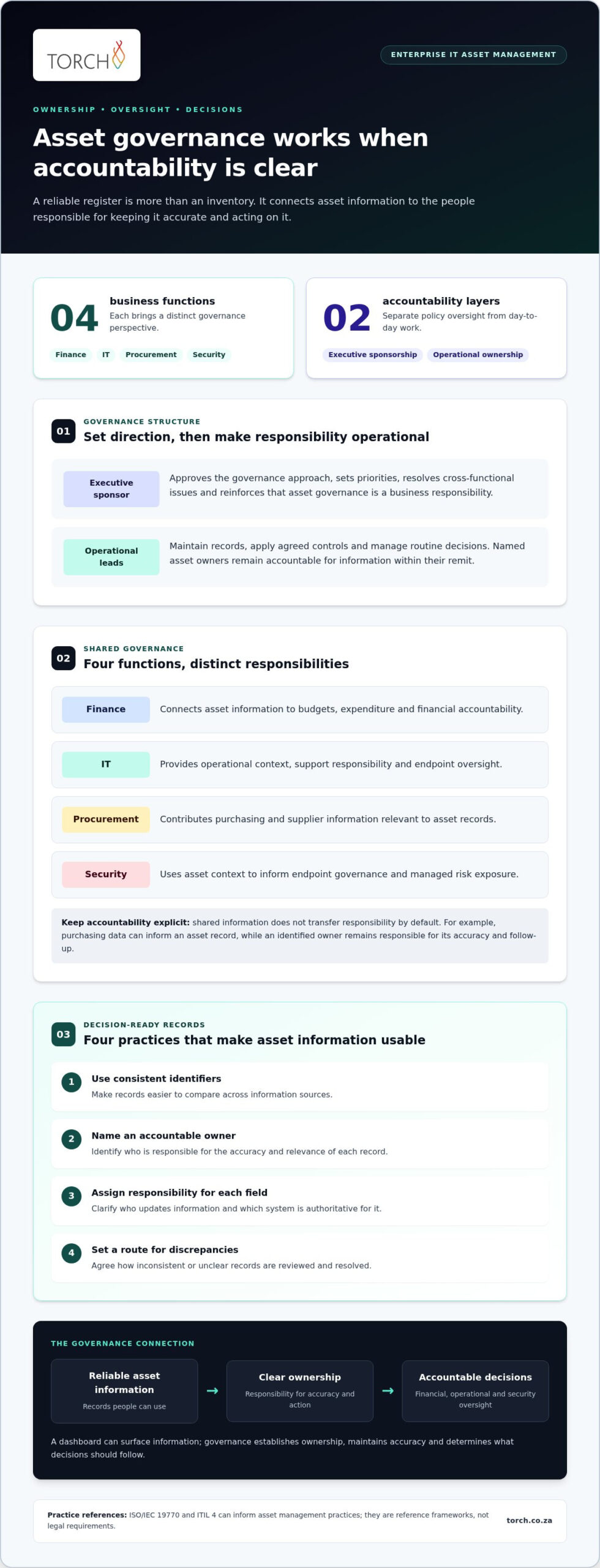
A workable framework makes decision rights clear. Executive sponsorship sets priorities, resolves cross-functional issues and reinforces that asset governance is a business responsibility, not an isolated IT task. Operational teams maintain records and apply agreed controls, while named asset owners remain accountable for the accuracy and relevance of information within their remit.
Who should own enterprise ITAM decisions?
Separate policy oversight from day-to-day work. An executive sponsor can approve the governance approach and address competing priorities. Operational leads can maintain records and manage routine decisions. Finance, IT, procurement and security each contribute a distinct perspective:
- Finance connects asset information to budgets, expenditure and financial accountability.
- IT provides operational context, support responsibility and endpoint oversight.
- Procurement contributes purchasing and supplier information relevant to asset records.
- Security uses asset context to inform endpoint governance and managed risk exposure.
Teams should share agreed information without transferring accountability by default. A procurement record, for example, can inform an asset record, but an identified owner still needs to be responsible for its accuracy and follow-up. IT asset management for enterprises is more dependable when each decision has an owner, an appropriate information source and a clear route for resolving discrepancies.
What makes asset information decision-ready?
Set common definitions and data responsibilities before expanding reporting. Use consistent identifiers, name an accountable owner, and make clear who updates each field and how discrepancies are handled. For example, define which system is authoritative for purchasing details and who is responsible for updating ownership when an employee or business unit changes. This gives decision-makers a more coherent basis for connecting financial oversight with operational and security decisions, without assuming that systems are automatically integrated.
An asset register lists information; governance is the process that keeps it accurate, assigns responsibility and turns it into accountable decisions. ISO/IEC 19770 and ITIL 4 can serve as reference frameworks for shaping practices, rather than legal requirements. The Harvard Business School discussion of ITAM and data analytics also considers how data can inform asset oversight and planning.
Torch’s PowerBI integration supplies real-time analytics for strategic decision-making. Spotlight provides real-time financial oversight. These capabilities can help present relevant information, while ownership and decision rights remain part of the organisation’s governance framework. A 30-minute governance review with Derek King is one way to discuss priorities, with no obligation or sales pitch.
Put enterprise ITAM into practice with measurable governance
Effective implementation is less about launching a new dashboard and more about establishing who makes decisions, which information those decisions rely on and how the organisation checks whether its controls are working. A measured approach helps teams address governance gaps deliberately, without imposing arbitrary targets or timelines.
How should an enterprise start an ITAM governance programme?
Begin by agreeing which assets and decisions are in scope. Map the teams that maintain relevant information, approve decisions and use the results. Then compare existing records with named responsibilities and the business processes that depend on them. This reveals where information is missing, inconsistent or disconnected from an accountable decision-maker.
Next, set priorities according to organisational needs and risk. IT asset management for enterprises should turn those priorities into a clear operating sequence:
- Agree scope: define the asset categories, information and decisions covered.
- Assign owners: identify who is accountable for records and who can approve or act on decisions.
- Reconcile records: investigate material gaps between sources and agree which information is authoritative for each purpose.
- Set controls: establish responsibilities for updates, approvals, exceptions and escalation.
- Review outcomes: assess whether the controls provide useful information and support consistent decisions.
For example, if a device appears in a procurement record but has no named business owner, record the discrepancy, assign responsibility for resolving it and define how the correction will be reflected in the relevant systems. This sequence concerns governance and decision rights, not the mechanics of acquiring, maintaining or retiring assets. The organisation can refine its approach as priorities and operating requirements change.
Which signals show whether governance is working?
Choose indicators that show whether controls are dependable, rather than simply counting records. Internal measures could include the completeness of required fields, the proportion of assets with an assigned owner, unresolved discrepancies and whether reviews happen at the agreed cadence. These are potential measures, not prescribed targets. Each organisation should define acceptable performance for its own scope and requirements.
Financial oversight can be assessed by whether asset information is clear enough to support accountable review of expenditure and related decisions. Security and compliance indicators should reflect the organisation’s own policies, risk priorities and applicable requirements. Teams might review whether assets within a defined security scope have an accountable owner, and whether exceptions are recorded and addressed through agreed processes.
ITAM measures should assess the quality of control and accountability, not record volume alone. A large register may still leave decision-makers without reliable ownership, review or follow-through.
How Torch supports enterprise IT asset management governance
Turning an agreed governance model into consistent practice takes more than a register. Torch Services supports enterprise IT asset management governance with an asset management platform, endpoint oversight, financial governance and analytical insight. Each capability has a defined purpose and can support the organisation’s approach to accountability and decision-making.
How do asset, endpoint and financial governance work together?
ITAM establishes the asset-governance context: what information is maintained, who is accountable and how it informs decisions. Unified Endpoint Security & Management addresses endpoint governance and security, complementing that context with a focus on managed risk exposure. Torch Services’ Unified Endpoint Security & Management offering supports organisations seeking a more joined-up approach to endpoint oversight. This is complementary governance, not a claim that separate systems are automatically integrated.
IT FinOps-as-a-Service supports financial oversight, helping decision-makers consider technology expenditure with greater accountability. Spotlight provides real-time financial oversight, while Boost offers 24/7 automated user support and includes a Boost SMS platform for quick user solutions. Each has a distinct role: financial visibility informs commercial decisions, user support addresses support needs, and asset governance clarifies ownership and oversight.
How can insight support strategic decisions?
Asset information is more useful when it can be interpreted in context. Torch Services’ purpose-built BI models deliver deep analytical insights, and PowerBI integration supplies real-time analytics for strategic decision-making. These capabilities can support analysis relevant to an organisation’s governance priorities, while decisions remain grounded in its own responsibilities and requirements. The aim is not to add another dashboard for its own sake, but to make information more useful to those accountable for acting on it.
A testimonial from Old Mutual Insurance recognises Torch Services’ cost savings, audit accuracy and ongoing management. This is client feedback, not a quantified ITAM-specific result, but it speaks to the importance of dependable oversight and sustained management in governance work.
When is a managed governance conversation useful?
A discussion can be useful when ownership is fragmented, financial or endpoint oversight is difficult to maintain, or teams have information but lack a clear route from insight to action. An independent governance perspective can help bring those questions into focus and identify practical priorities without treating technology as a substitute for accountability. Torch Services’ 30-minute governance review with Derek King offers a no-obligation discussion without a sales pitch.
Make accountable asset governance your next step
Stronger asset governance does not require every decision to be made centrally. It requires clear ownership, useful information and a consistent way to act on what that information reveals. For organisations in South Africa, these foundations can connect technology oversight with financial control, operational priorities and security governance.
IT asset management for enterprises is most effective when it informs how teams make and review decisions, rather than remaining a register maintained in isolation. Start by identifying where ownership is unclear, which information matters most and what decision needs better support.
Clearer accountability is achievable. Build governance around the decisions that matter, then review whether the information and controls are helping people act with confidence.
Frequently Asked Questions
What is the difference between IT asset management and enterprise asset management?
IT asset management focuses on technology assets, such as workplace devices and software, while enterprise asset management usually covers a wider range of operational assets. For example, a manufacturer might manage laptops and software entitlements through ITAM, while tracking production machinery and facilities through EAM. The functions can share governance principles, but their asset data, operational needs and accountable teams may differ.
Is IT asset management a software tool or a business process?
IT asset management is a business process that software can support. A platform can help organise records and present information, but it cannot establish decision rights or resolve competing views of ownership by itself. Before selecting or configuring a tool, define what information teams need, who maintains it and how exceptions are handled. This helps prevent the system from simply reproducing existing inconsistencies.
Can IT asset management and unified endpoint management work together?
Yes. ITAM and unified endpoint management (UEM) address different but complementary concerns. ITAM can provide context about an asset’s business owner and record, while UEM focuses on endpoint governance and security. For example, a device may be subject to endpoint controls while its assigned business owner remains responsible for confirming its organisational purpose. Teams should define how information is shared rather than assume the systems are integrated.
How should an enterprise assign ownership of its IT assets?
Assign an accountable business owner for each asset or agreed asset category, then distinguish that role from the person responsible for maintaining the record. For example, a department might be accountable for a device’s business purpose, whilst an operational team updates its status in the relevant system. Document who approves changes, who resolves discrepancies and where unresolved ownership questions are escalated.
What information should leaders use to assess IT asset governance?
Leaders need evidence that records are trustworthy and exceptions receive attention. Alongside ownership and review information, examine when key records were last validated, where the source data came from and whether unresolved discrepancies are increasing or being addressed. Consider whether reports provide enough context for a decision, rather than presenting totals without explaining gaps. Interpret these signals against the organisation’s own scope and control requirements.
How does IT asset management support financial control and accountability?
IT asset management for enterprises can help connect technology records with the people and business areas responsible for related decisions. For example, reviewing an asset’s owner alongside purchasing or renewal information can help finance ask who uses or approves the associated commitment. This supports investigation and clearer accountability, while asset and endpoint information can also inform security oversight. ITAM provides decision context; it does not replace financial approval or budget controls.