
Financial control is an operating discipline, not a month-end exercise. Managed IT financial operations bring budgeting, forecasting, spend oversight and cash-flow monitoring together so technology costs support business priorities. Automation and process improvement can also make financial workflows clearer and more accountable.
IT spending can be difficult to govern when costs, supplier commitments and operational data sit across separate processes. A structured approach helps decision-makers see what is being spent, when payments are due, and where controls or workflows need attention.
This article explains what financial operations involve and how cost control, cash-flow monitoring, automation and process improvement fit into effective management. It shows how these activities connect financial oversight to day-to-day IT decisions, helping leaders strengthen accountability and make informed choices about future investment.
Key Takeaways
- Bring budgeting, forecasting, reporting and cash-flow oversight together to give financial decisions a coherent operational foundation.
- Use spending and cash-flow visibility to identify control gaps, anticipate commitments and keep technology expenditure aligned with business priorities.
- Review invoice and approval workflows for manual hand-offs that automation could streamline while maintaining accountability.
- Connect process improvements to reliable records and clear financial reporting, so leaders can make better-informed investment decisions.
- When technology costs are difficult to govern, consider how Telecom Expense Management and IT FinOps-as-a-Service can strengthen oversight.
What Is Financial Operations?
Financial operations turn plans into controlled, day-to-day decisions. In IT, that means linking budgets, spending records and forecasts so leaders can assess costs against business priorities.
Effective oversight depends on clear ownership and usable information. For example, a finance team can compare a software invoice with its approved budget, then investigate any variance before updating the forecast.
Financial oversight and budget setting
Financial oversight means setting limits, monitoring transactions and correcting deviations from approved plans. It matters because an IT budget should guide purchasing decisions, not merely record expenditure after it occurs.
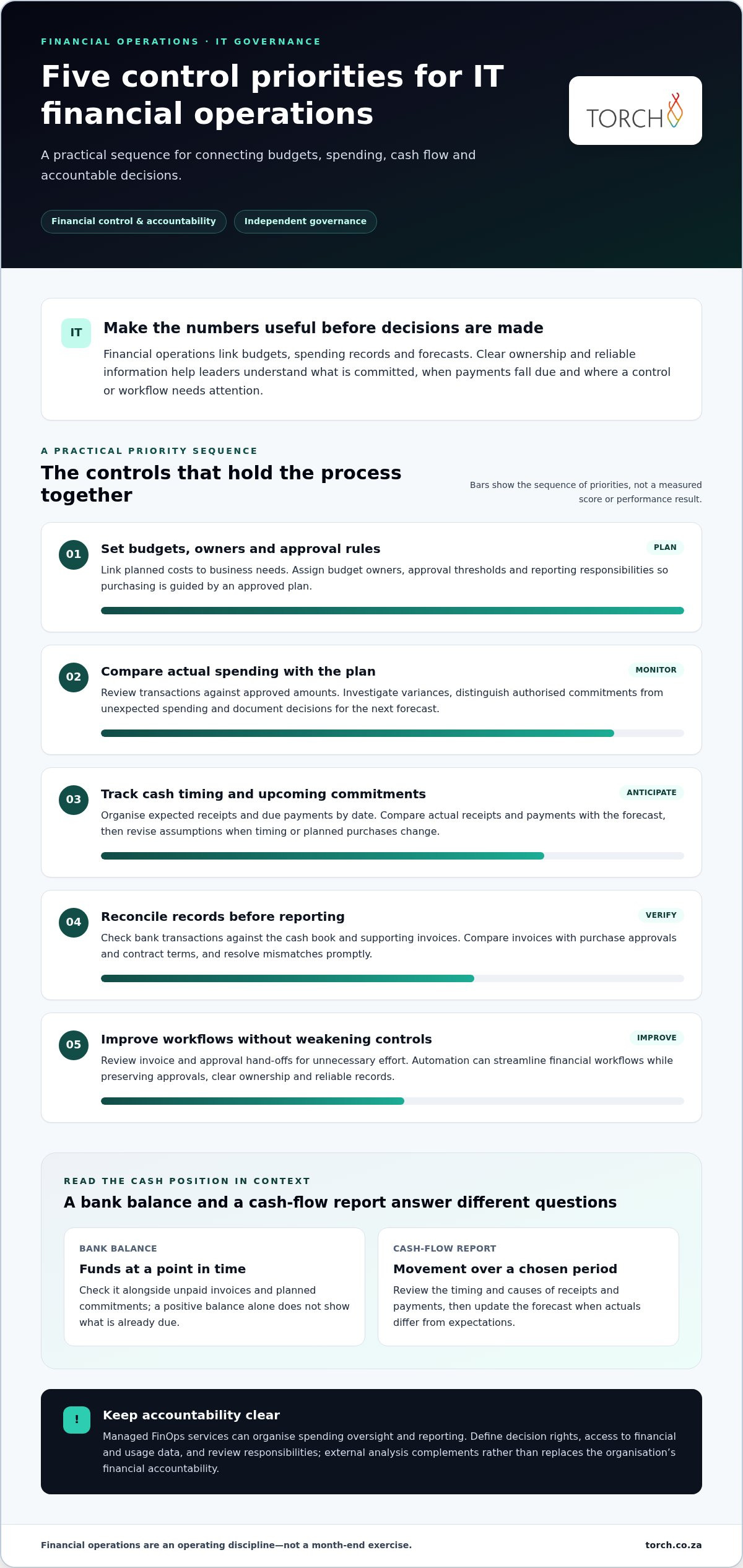
Set a budget by linking planned costs to business needs, such as software renewals, support and infrastructure changes. Assign budget owners, approval thresholds and reporting responsibilities. Compare actual transactions with approved amounts, investigate variances and document decisions. A clear workflow helps distinguish authorised commitments from unexpected spending and strengthens financial control & accountability.
Budgeting, forecasting and efficiency
Budgeting allocates resources to planned activity; forecasting updates expectations as income, expenses or business requirements change. Together, they help leaders assess whether current spending remains aligned with future needs.
For example, a team planning a software renewal can record the expected commitment in its budget, then revise its forecast if user requirements change. Financial management tools can support oversight by showing transaction amounts, timing and locations in real time. Use this information to identify duplicate processes, review recurring costs and prioritise resources. Efficiency improves when workflows remove unnecessary effort without weakening approvals or record-keeping.
Budget optimisation is not simply about lowering the total. It means directing spending towards business priorities while identifying waste and control gaps. Compare planned and actual costs, then use the variance to inform the next forecast.
Managed FinOps services and cloud spending
Managed IT financial operations, often called FinOps services, help organisations oversee technology spending through analysis, reporting and financial governance. They connect financial decisions with usage and operational information.
For AWS, Microsoft Azure and Google Cloud, spending oversight can bring usage records and charges into a shared view. Teams can assign costs to business owners, compare actual spending with budgets and forecasts, and investigate changes before making allocation decisions. The value comes from clearer accountability and timely insight, not software alone.
Outsourcing FinOps also requires clear decision rights, controlled access to financial and usage data, and an agreed process for reviewing findings. Inaccurate source data can undermine reports, while unclear ownership can delay action. Define responsibilities and approval workflows before relying on an external team’s analysis.
For organisations seeking structured support, IT FinOps-as-a-Service can organise spending oversight and financial reporting. It is especially relevant when internal teams need a consistent view of IT expenditure to support budget decisions. It complements, rather than replaces, the organisation’s own financial accountability.
Cost control and cash-flow monitoring
Cost control connects approved spending with actual commitments and payments. Cash-flow monitoring shows whether available funds can meet those commitments when due. Together, these practices help South African organisations manage expenses, protect operational continuity and review financial data before decisions become urgent.
Managed FinOps services provide specialist analysis and reporting, while in-house cloud cost management keeps that work within the organisation. The right model depends on internal capacity, cloud complexity and the level of oversight required. Either approach needs clear ownership, reliable records and timely action on variances.
Cash and bank management
Cash and bank management tracks incoming funds, outgoing payments and balances across business accounts. A practical control is to reconcile bank transactions with the cash book and supporting invoices, then investigate differences promptly. For example, if a supplier payment appears on the bank statement but not in the payable ledger, resolve the mismatch before reporting available cash.
This process distinguishes cash already committed from cash still available. Finance teams can organise expected receipts and due payments by date, then use that view to plan transfers and payment timing. Accurate records also reduce errors in month-end reporting.
Interpreting cash flow
A cash-flow report records movement over a chosen period, while a bank balance shows funds at a particular point in time. Review both alongside unpaid invoices and planned commitments. If receipts are delayed while a large supplier expense falls due, the forecast may signal pressure even when the current balance is positive.
Interpret cash-flow information by looking at timing, causes and business impact. Compare actual receipts and payments with the forecast, identify recurring variances, then revise assumptions. For instance, a change in customer payment timing may call for a revised forecast rather than an immediate spending cut.
Managing costs and cash flow
- Group expenses by supplier, service and business owner to make recurring commitments visible.
- Compare invoices with purchase approvals and contract terms before processing each payable.
- Update cash-flow forecasts when payment dates, expected receipts or planned purchases change.
- Investigate variances and assign an owner and follow-up action to each material discrepancy.
These controls make financial data more useful by connecting expense decisions with expected cash needs. Managers can prioritise essential payments and assess the timing of discretionary spending. A consistent review workflow also makes repeated errors and unplanned commitments easier to spot.
In-house teams retain direct operational context, whilst managed support can add dedicated analysis and reporting capacity. Responsibilities still need to be explicit: internal leaders set priorities and retain approval authority, while the agreed service scope determines which analysis and monitoring tasks are supported. To discuss financial oversight and cost governance, book a governance review.
Automation and process improvement
Automation can make repeatable financial workflows more consistent, but it cannot replace clear process ownership. Financial operations include transaction monitoring, monthly close and fixed-asset accounting. Each activity depends on accurate records and defined review responsibilities. Improve the workflow before automating it, so inefficient steps are not simply completed faster.
Automating financial operations
Finance automation uses software to perform structured tasks, such as transferring transaction data, checking entries and preparing recurring reports. Generative AI may help automate some business activities, though its effects will vary by task and organisation. This is a broad estimate, not a forecast for any specific finance team or process.
Consider a monthly close that draws figures from separate systems. Automation can consolidate routine data transfers while finance staff review unusual movements and confirm the resulting statements. This lets teams focus their judgement where it matters instead of treating every record as an exception. Clear review points also make the process easier to trace.
Start by documenting the process owner, information sources, decision rules and exception route. Test the redesigned workflow against representative transactions before relying on its outputs. Automation depends on reliable inputs and defined controls; otherwise, errors can enter accounting records and reports without being detected promptly.
Robotic process automation
Robotic process automation uses software to carry out rule-based actions across digital systems. For example, it can transfer approved transaction details into a reporting system or compile routine information for a close. Staff remain responsible for checking exceptions and authorising decisions that require financial judgement.
Choose tasks with stable rules and clear inputs. If a transaction needs interpretation, route it for human review rather than forcing it through an automated rule. Keep an audit trail of actions and changes so reviewers can understand how figures reached a report. This supports accountability without treating automation as a substitute for governance.
Improving processes through analytics
Process improvement examines where work stalls, duplicates effort or creates inconsistent records. Analytics can reveal patterns in close adjustments, repeated corrections or delays between data entry and reporting. Managers can use these insights to identify which process step needs redesign, then assess whether the change improves accuracy and visibility.
Centralised financial records can help coordinate income statements, expense statements and balance sheets. Consistent classifications across these reports, for example, make it easier to trace a reported movement to its underlying transaction. Review access permissions and audit trails alongside efficiency measures to keep process improvement connected to data integrity, security and financial control & accountability.
Operations management can help businesses control costs by streamlining processes, reducing waste, using automation and improving supplier collaboration. Businesses can use automation to streamline accounts payable, where teams review invoices, verify purchase orders and process payments to help ensure suppliers are paid accurately and on time. 80% of traditional finance tasks could be automated.
ERP platforms can help operations teams streamline workflows, reduce redundant effort, address production delays and minimise manual errors. In IT, operations management includes workflows and techniques that support efficient, safe operations. Together, these practices connect process design with cost control while maintaining accurate financial processing.
Financial operations management
Financial operations management coordinates financial activities so an organisation can meet obligations and make sound decisions. For IT expenditure, the strategic aim is to connect transaction-level tracking with business priorities and accountable oversight.
Choosing a managed FinOps provider
When choosing a managed FinOps provider, assess whether its scope, reporting and controls fit your organisation’s needs. Unclear responsibilities can weaken oversight, even when the analysis is detailed.
Define the decisions the provider will support, the financial data it will handle, and who retains approval authority. Assess how reports explain variances, allocate costs and flag issues requiring action. A useful report, for example, connects a cloud transaction to a business owner and budget instead of presenting an unexplained total. Agree how findings will feed into existing finance and technology workflows.
In South Africa, assess applicable tax requirements, POPIA considerations, and any contractual or sector-specific data-location conditions. Map the data involved, its purpose, storage and access locations, retention controls, and any cross-border processing against your organisation’s legal and governance requirements.
Provider services
Managed IT FinOps providers can support spending visibility, cost allocation, forecasting, reporting and analysis of technology expenditure. These activities help finance and technology teams understand how usage and commitments relate to budgets.
Useful outputs include reconciled transaction views, reports by service or business unit, and explanations of material variances. A provider may also identify spending patterns for internal review and support decisions with analytics. The organisation remains responsible for setting priorities and approving financial commitments; clear service boundaries preserve accountability.
Implementing managed FinOps
Implementation establishes the information, responsibilities and review practices needed for consistent financial operations. A defined sequence helps teams move from fragmented records to useful, decision-ready reporting.
- Set objectives, ownership and approval responsibilities across finance and technology.
- Map relevant accounts, services, transaction records and existing reporting workflows.
- Agree allocation rules, reporting measures and processes for reviewing exceptions.
- Review the resulting insights with budget owners and refine the approach as needs change.
For example, a business might begin by grouping cloud expenditure by service owner, then comparing those costs with agreed budgets. Check that classifications are accurate before using reports to optimise commitments. Ongoing tracking should connect findings to named owners and documented decisions, rather than leaving recommendations in a dashboard. This creates a repeatable management cycle.
Managed FinOps works best when external analysis complements internal context. Finance teams understand cash priorities, while technology teams explain operational requirements. Regular joint reviews help both interpret transactions appropriately. Treat provider reports as decision support, with clear access controls and internal approval processes.
An organisation’s financial operations include budgeting, forecasting, accounting, auditing, financial reporting, and managing cash flow, investments and other financial instruments. Financial management planning should prioritise long-term initiatives and reflect the business model, market conditions and organisation.
Financial management helps businesses plan for investment and opportunity and build resilience. It can also support future funding, economic stability, profitability and organisational value. Without sound financial operations, an organisation may struggle to pay bills or meet its obligations.
Torch Services: Telecom Expense Management
Torch Services provides Telecom Expense Management for organisations seeking clearer oversight of telecom expenditure and supplier charges. Its work in the South African market spans over 20 years, with R667.5M+ saved since 2004 across 12 African countries.
Where technology costs span teams and services, Torch Services’ IT FinOps-as-a-Service can support financial visibility and cost governance. Torch also offers automated user support and an asset management platform for organisations seeking joined-up operational oversight.
If you’re considering how these services fit your organisation’s priorities, contact Torch Services to discuss your requirements.
Make financial accountability part of the operating rhythm
The next step is to turn financial insight into an operating practice. For managed IT financial operations to support lasting accountability, assign clear ownership to decisions and establish when leaders will review them. A useful review links the available information to a specific action, a responsible person and a follow-up point.
Start with a governance gap that affects decision-making, such as unclear ownership of a technology expense or inconsistent reporting. Define what evidence would help resolve it, who should act and how the outcome will inform future planning. This provides a practical basis for improving oversight without treating every issue as a separate initiative.
As priorities evolve, revisit the controls and reports that inform them. Consistent ownership helps finance and technology teams make clearer decisions and keep attention on commercial priorities.
With a clear next step, your organisation can take a more deliberate, accountable approach to technology decisions.