
The most capable technology expense management option isn’t automatically the one with the longest feature list. For South African enterprises comparing similar solutions, the better fit is the service whose pricing approach, telecom procurement support, invoice management, automation and reporting match the organisation’s needs. A fragmented approach to mobility can make services and spending harder to track, so assess how each option brings devices, contracts and invoices into a governed view.
A shortlist is easier to assess when you look beyond headline features. Compare options by pricing model, telecom procurement, invoice management, automation and the control they provide over technology spend. This guide outlines where different approaches may fit, what to examine in each proposal, and how to apply consistent criteria when making a practical decision for your business.
Key Takeaways
- Compare TEM options by how they handle telecom procurement, invoice consolidation and ongoing expense governance, not by feature count alone.
- Assess pricing alongside the work included, such as invoice processing, support and reporting, to understand the operational value behind the fee.
- Use customer reviews to identify recurring strengths and limitations, then weigh them against your organisation’s service mix and requirements.
- Examine how automation supports invoice checks, approvals and reporting, and where human oversight remains important.
- Use a consistent scorecard to narrow the options and identify which capabilities matter most to your organisation.
Technology expense management
The right alternative to Tangoe for telecom expense management depends on your services, devices and finance processes. Compare Cass Information Systems, Sakon and Brightfin by their operational focus, automation and proposed scope, rather than assuming one option suits every South African enterprise.
Tangoe helps organisations manage technology expenses, including telecom services, mobile devices and related invoices. Its expense management services can provide visibility into services and spending, helping teams organise information for governance and operational decisions.
Technology expense management (TEM) brings technology-related costs into a structured process. Telecom expense management focuses on telecom services, devices, contracts, invoices and spending. For example, a business can compare a mobile invoice with its service inventory, then investigate mismatches before approving payment.
Cass Information Systems is associated with expense auditing and payment services, which may suit organisations focused on invoice review and payment administration. Sakon is a telecom expense management option to assess for telecom operations and service oversight. Brightfin focuses on IT expense management, so compare its scope with your telecom and broader technology requirements.
Feature names alone don’t show whether a service will fit. Map each option against the work your team needs done, from invoice checks to device and service records. Request like-for-like proposals based on the same service scope, invoice volumes, integrations and support requirements, as these factors shape the commercial comparison.
| Option | Primary focus | Assessment criteria | Pricing comparison |
|---|---|---|---|
| Tangoe | Technology and telecom expense management | Service, device and invoice coverage | Compare quoted scope and included services |
| Cass Information Systems | Expense auditing and payments | Invoice review and payment workflows | Compare audit and payment scope |
| Sakon | Telecom expense management | Telecom operations and service oversight | Compare managed services and features |
| Brightfin | IT expense management | Fit with telecom and wider IT costs | Compare supported processes and scope |
Choose the option whose scope covers the controls and processes your organisation needs, without paying for capabilities that aren’t relevant.
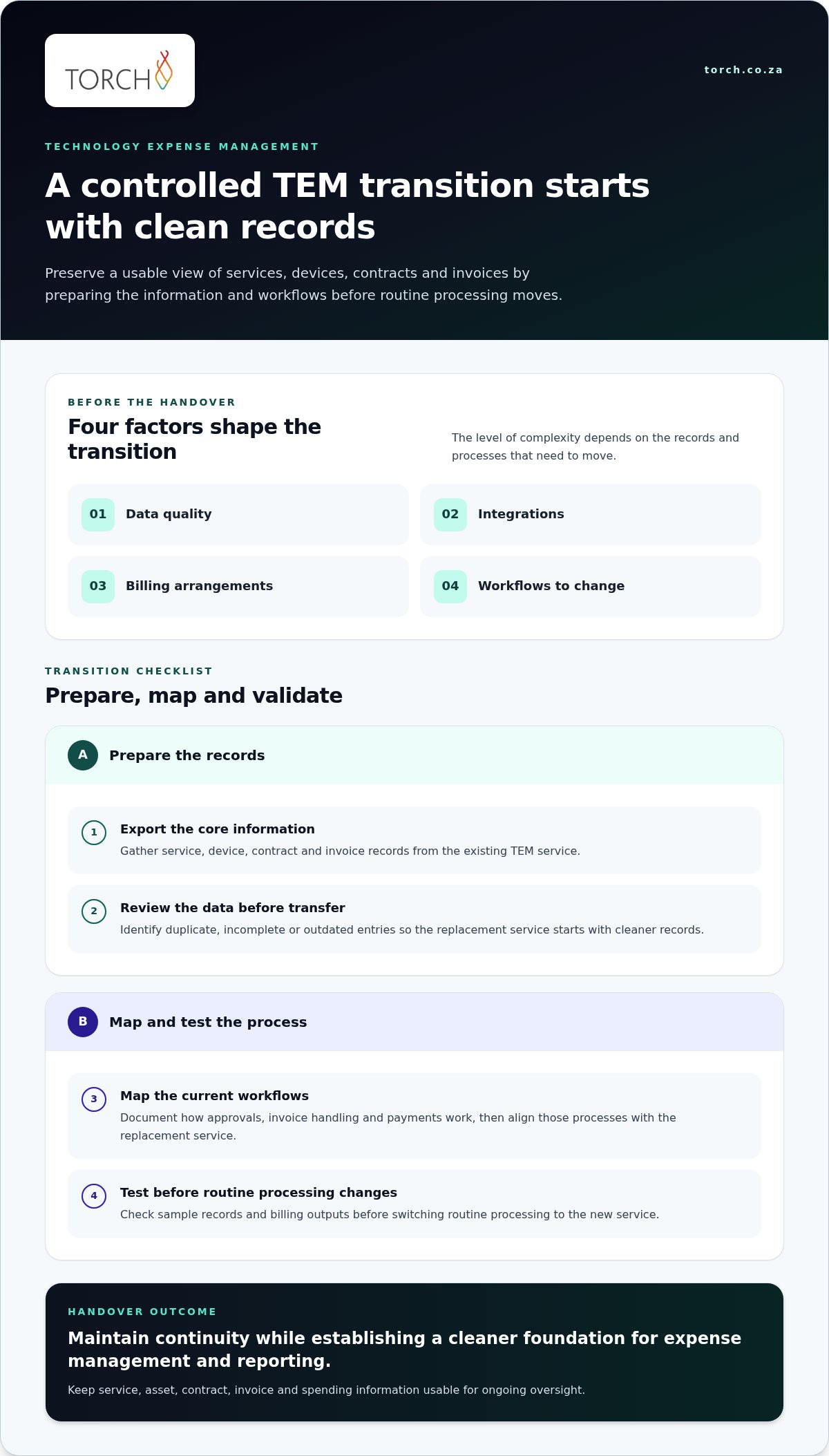
Moving from Tangoe involves more than transferring records between systems. The priority is to preserve accurate service, device, contract and invoice information, then align it with the replacement service’s processes. Complexity depends on data quality, integrations, billing arrangements and how many workflows need to change.
A practical transition starts with a clear inventory and ownership plan:
- Export service, device, contract and invoice records from Tangoe.
- Identify duplicate, incomplete or outdated entries before transfer.
- Map current approval, invoice and payment workflows to the new service.
- Test sample records and billing outputs before switching routine processing.
These steps help protect continuity while creating a cleaner foundation for expense management and reporting.
A migration plan should preserve a usable view of telecom services, assets, contracts, invoices and spending. Telecom expense management helps enterprises understand and govern these areas, so confirm that transferred records support the oversight your team needs. Review mobility alongside the wider telecom picture rather than treating each component in isolation.
That matters commercially as well: companies may leave 20-30% in savings on the table by managing mobility piecemeal. Use the transition to assess whether mobility costs are handled as part of a joined-up expense process, then compare the scope with your priorities. A clear handover can help teams maintain continuity while deciding which controls and workflows should carry forward.
Telecom procurement and bill consolidation
Procurement decisions shape telecom spending throughout the service lifecycle. Start by matching each carrier invoice to the mobile lines, devices, plans and contracts your organisation actually uses. A consolidated view helps finance and IT teams spot inconsistent charges, unused services and upcoming renewals without treating separate carrier bills as separate cost centres.
Telecom spend analytics turns invoice and asset data into decisions. For example, compare charges by carrier, service plan, department and device type, then investigate differences against the relevant contract. Reporting should show which costs recur, which services have changed and where a plan no longer matches usage. In South Africa, include each carrier’s service and billing data in the same review, whilst retaining the source invoice for traceability.
Benchmarking is useful when it compares like with like. Group similar plans, user needs and service conditions before reviewing rates; otherwise, a lower headline price may conceal a different allowance or scope. Use the findings to guide sourcing discussions, not to assume every carrier offers identical terms. Record the comparison method so procurement can explain why a plan or supplier fits.
Telecom optimisation should connect sourcing decisions to the full asset lifecycle. A review can flag devices nearing replacement, lines without an identified user and plans that no longer reflect business use. Assign an owner to investigate each exception, then record the decision and its effective date. This creates a clear trail from procurement through service changes to device retirement.
Businesses can negotiate device costs and service plans separately when carriers no longer bundle them. Separate discussions may provide more flexible terms. For example, procurement can compare device specifications independently, then assess service plans against employee needs and coverage requirements. Keep the agreed device and plan terms together in reporting, even when separate agreements apply.
When switching from Tangoe, review renewal and termination dates, exit obligations, data access, invoice-dispute processes, service levels and transition charges. Map carrier contracts and open billing issues before changing workflows, so an active dispute or renewal isn’t lost between systems.
Use a controlled review sequence:
- Build a carrier, contract, service and device inventory from current records.
- Match each invoice line to its contract, plan and accountable owner.
- Compare equivalent plans and device requirements before sourcing discussions.
- Record approvals, exceptions and effective dates in reporting.
These steps preserve the link between procurement decisions and later invoice checks. Keep supporting contract and invoice records accessible to the teams responsible for each decision, so future reviews can trace the reasoning behind plan and supplier choices.
Start with an inventory, then trace each proposed change to the relevant invoice, contract and service record. Compare devices and plans separately where bundled costs no longer apply, and document the terms considered for each. Check that the choice still fits employee needs, coverage requirements and recorded usage. Add approved changes to the consolidated view, with an owner responsible for follow-up. This connects sourcing decisions to billing and lifecycle records and preserves a basis for future review.
TEM vendor pricing and reviews
Pricing comparisons are useful only when each vendor is assessed against the same scope. For a South African organisation, include billing workflows, local carrier invoices, support and reporting requirements.
Small Business and Enterprise Suitability
Smaller organisations may prioritise straightforward invoice handling and clear workflows, while larger enterprises often need broader service coverage, integration and reporting. Cass Information Systems focuses on expense auditing and payments, Sakon on telecom expense management, and Brightfin on IT expense management. Compare these options with Tangoe against your organisation’s needs, rather than assuming size alone determines suitability.
Customer Reviews and Common Complaints
Reviews can show how users experience implementation, billing accuracy, support and everyday workflows. Don’t treat one comment as a finding about an entire vendor: look for recurring, recent feedback about the same service scope your organisation needs. For example, compare feedback on invoice handling with your billing requirements, then weigh it against reviews of reporting and support.
Published prices rarely support a reliable comparison unless the included work is clear. Ask each vendor to price the same scope: invoice processing, expense auditing, payment handling, telecom service coverage, reporting and ongoing support. Separate implementation charges from recurring service fees, and note whether the quote varies with invoice volumes, integrations or workflow complexity.
Build a like-for-like scorecard before reviewing proposals. Record which workflows are automated, which need staff intervention, and what billing data feeds each report. For example, an organisation with several carriers may value consolidated invoice handling more than a feature designed for one service category. This keeps the decision focused on operational fit, not just the quoted price.
For South African businesses, suitable services must handle invoices and service records from the local carriers in use. Compare Tangoe, Cass, Sakon and Brightfin against those carrier requirements, including invoice formats, service data and reporting needs. Assess their ability to support these workflows alongside contract scope and local operating arrangements.
Use these steps to make the review evidence-based:
- Define the required services, billing workflows and reporting outputs.
- Request comparable proposals using the same scope and assumptions.
- Read reviews for repeated themes on implementation, accuracy and support.
- Score each vendor against operational fit, price structure and local carrier needs.
Then document the trade-offs. A lower quote may exclude work your team still needs to manage, while a broader service may include workflows your organisation won’t use. Select the option whose overall scope best matches your technology expense processes.
TEM software features and automation
TEM features matter when they connect service records, invoices and approvals into useful oversight. If you’re comparing Tangoe alternatives, assess what each platform automates and what remains manual.
Mobile device management and SaaS spend management are distinct from telecom expense management. The options discussed here include Tangoe, Cass Information Systems, Sakon and Brightfin. Compare each against explicit requirements for device controls, SaaS subscription records and telecom billing. Expense visibility alone does not mean a tool manages endpoints or SaaS access.
A useful technology expense management workflow links an invoice line to a service, device, contract and accountable owner. For example, an unexpected mobile charge should be traceable to its line and plan, then sent for review before payment. This connected inventory supports clearer reporting than a spreadsheet containing invoice totals alone.
Automation is valuable when it reduces repetitive work without hiding exceptions. A workflow might capture invoice data, compare it with service records, flag a mismatch and send it to an assigned reviewer. The reviewer can record the reason and resolution, leaving a decision trail for later analysis. These steps describe a way to evaluate services, not a claim that every vendor automates every stage.
Use a feature assessment that separates capabilities into practical groups:
- Inventory: Can the system relate mobile lines, devices, services and ownership records?
- Invoice controls: Can teams identify exceptions and route them for review?
- Reporting: Can users examine spend by carrier, service, department or cost centre?
- Integration: Can relevant data move between billing, finance and asset records?
- Governance: Can administrators track approvals, changes and unresolved items?
Compare Tangoe, Cass, Sakon and Brightfin against the same scenarios. Use a sample mobile invoice, device record and SaaS subscription entry as test cases. Ask each vendor to show how its stated features handle the same input, exception and reporting need. This reveals the difference between a feature label and a workable process.
Automation should improve visibility, not lead to unchecked decisions. Keep human approval for exceptions affecting contracts, user access or disputed billing. A unified view can help enterprises identify patterns and potential savings while preserving a clear route for review and correction.
Assess your TEM workflows with a 30-minute governance review.
Torch Services: Telecom Expense Management
Torch Services provides Telecom Expense Management for organisations seeking clearer oversight of telecom services, invoices and associated costs. It is independent, carrier-agnostic and vendor-neutral, with no commissions, supporting independent governance and commercial optimisation.
“One Partner, Six Integrated Service Lines” brings connected support to technology cost governance. Verified outcomes include R38.4M saved over 26 months for a South African insurer, with PwC audit evidence; 22% of its IT team’s capacity had been spent on telecom administration. In banking, R8.9M was saved over 18 months, with SBSA verification. Torch has saved R667.5M+ since 2004 across 12 African countries.
Telecom Expense Management can be complemented by Automated User support and an asset-management service. Contact Torch Services to discuss your requirements.
Set a clear governance direction
Choosing among Tangoe alternatives is an opportunity to define what your organisation needs to control, not just which system to replace. Assign clear ownership for telecom decisions, invoice exceptions and employee requests, then connect those responsibilities to practical workflows. This makes the selection relevant to how your teams work, rather than a feature comparison in isolation.
Torch Services offers Telecom Expense Management, automated user support, an asset management platform and IT FinOps-as-a-Service. These services can help when telecom billing, user support, technology asset records and IT spending need more coordinated oversight. Start with the governance gap that matters most to your organisation, such as invoice accountability or ownership of devices and services.
Use that priority to shape a focused discussion about the processes you want to strengthen and the outcomes you need to track. A considered next step can turn a broad comparison into a practical plan for better oversight.
With clear priorities and accountable workflows, your organisation can move forward with confidence.