
The lower headline fee isn’t automatically the lower-cost choice. When evaluating Torch Services for IT management, the better fit is the provider whose specialist expertise, operating overhead and service availability align with the work your business needs covered. The decision should rest on the service scope and the demands it places on your team, not on a broad label alone.
Comparing IT management options is difficult when service descriptions do not explain who handles specialist requirements, what work remains with your team, or when support is available. These details matter: an arrangement that looks straightforward can still leave significant operational work in-house.
This overview outlines what to assess across expertise, costs and support coverage, helping you identify which model fits your organisation’s requirements and make a more informed decision.
Key Takeaways
- Compare the full operating effort behind each option, not just the headline fee; internal workload and service scope also shape cost.
- Assess availability against your business’s operating needs, including how service interruptions are handled and what resilience measures are included.
- Separate managed IT support, help desk coverage and response commitments when evaluating each provider’s support model.
- Map infrastructure, cloud, cybersecurity and backup requirements to the specific services each provider offers.
- Use the comparison to identify where specialist IT cost governance, asset management or user support could address gaps in your current arrangements.
Cost efficiency and operational overhead
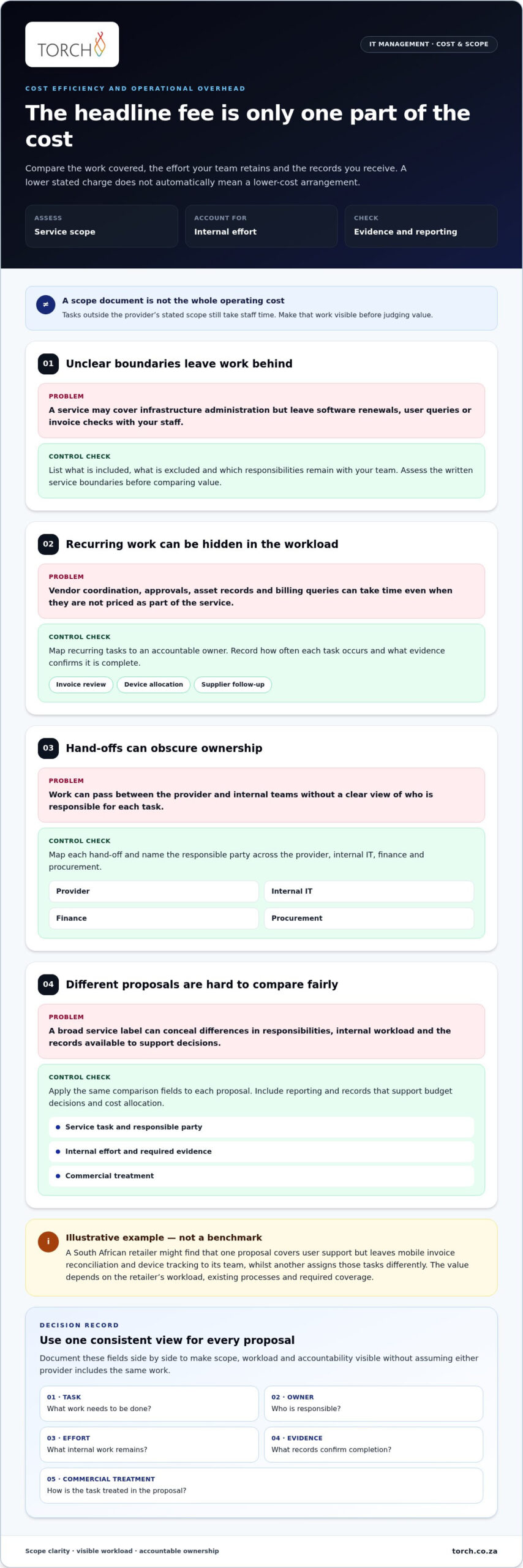
The headline fee is only one part of an IT management decision. In South Africa, compare the full scope of work with the internal effort your organisation must retain. A service might cover infrastructure administration but leave software renewals, user queries or invoice checks to your staff. Those tasks still take time, even when they fall outside the provider’s stated scope.
The risk is paying for a service that does not match the work your team needs handled. A narrow scope can leave unplanned administration in-house; a broader one may include work your business does not need. Compare written service boundaries, exclusions and responsibilities before assessing value.
Build a like-for-like comparison around identifiable cost drivers, not an assumed price advantage. Record who manages each task, how often it occurs and what evidence confirms completion. Include staff time for vendor coordination, approvals, asset records and billing queries. This makes operational overhead visible alongside stated charges, rather than treating unpriced work as cost-free.
For example, a South African retailer might find that one proposal covers user support but leaves its team to reconcile mobile invoices and track assigned devices. A second proposal might assign those tasks differently. This is an illustration, not a benchmark: value depends on the retailer’s workload, existing processes and required coverage.
Use these steps to assess each proposal consistently:
- List the services included, exclusions and responsibilities assigned to your staff.
- Map recurring work, such as invoice review, device allocation and supplier follow-up, to an accountable owner.
- Identify hand-offs between the provider, internal IT, finance and procurement.
- Compare the reporting and records available to support budget decisions and cost allocation.
Telecom billing is a practical area to examine because usage, allocations and invoice queries can create recurring administrative work. A review of telecom expense controls can help clarify which processes should sit within your operating model and which require oversight from your team.
Assess the operational trade-off, not just the scope document. If staff must repeatedly correct asset assignments or resolve supplier queries, include that work in your internal workload assessment. If a proposal centralises these processes, establish what records and reporting decision-makers will receive. These checks distinguish a lower stated charge from an arrangement that better fits your governance needs.
Document the comparison in a simple decision table: service task, responsible party, internal effort, required evidence and commercial treatment. Apply the same categories to both proposals. This gives you a clearer view of cost efficiency, workload and accountability without relying on unsupported savings estimates or assuming either provider includes the same work.
Service availability and resilience
Support availability depends on defined coverage, escalation routes and continuity arrangements. Compare these commitments with the services your South African operations rely on.
Managed support and response times
Managed support may cover help desk requests, incident triage and escalation, but proposals can divide these duties differently. Compare written support hours, contact channels, severity categories and response commitments. Distinguish acknowledgement from resolution: a quick ticket response does not necessarily restore an affected service. As a practical test, trace a staff login issue and a critical business-system outage through the stated escalation process.
Reliability and service quality
Customer reviews alone do not establish that either Nebula or Torch Services is more reliable or delivers better service. Look for repeated, dated examples of communication, issue ownership and follow-through, then weigh them against the specific services being compared. A review of one support interaction cannot establish performance across every service or customer environment.
A provider’s name alone cannot establish whether its handling of personal information meets POPIA requirements. Where personal information is processed, assess relevant contracts, access controls, retention practices, incident handling and subcontractor arrangements against your organisation’s obligations.
Resilience also depends on what happens when a supplier, system or staff member becomes unavailable. Ask each provider to explain incident escalation, how responsibilities pass between teams and what operational records are available afterwards. If a support contact cannot progress a service interruption, for example, a documented route to the next responsible team reduces uncertainty. The written process should clarify ownership, communication and recovery responsibilities instead of relying on informal assumptions.
Apply the same scenario to both providers. Choose an operationally important service, such as access to a business application, then trace the response from the initial report through escalation and service restoration. Record whether the proposal explains:
- Which support channel accepts the incident and who owns it.
- How urgency is classified and communicated to your team.
- What escalation path applies if the initial response stalls.
- How incident progress and closure are documented.
For South African organisations, include POPIA-related responsibilities in the same operational review rather than treating privacy as a separate box-ticking exercise. Identify the information a provider may access, who can authorise access and how your teams remove it when access is no longer needed. This connects service continuity with managed risk exposure.
If your organisation needs to clarify governance responsibilities across its operating environment, a governance discussion can help frame the assessment around service ownership, escalation and operational control.
How do Nebula and Torch Services compare on managed IT support, help desk, and response times?
Compare the managed support model behind each proposal, not just its service label. The Nebula vs Torch Services for IT management decision should clarify which user needs are included, how recurring work is organised and what remains with your internal team.
Start with a service catalogue. Separate routine requests, such as account access assistance, from specialist work, such as configuring a business application. Then map each request type to the proposed provider or internal role. This shows whether the arrangement covers employees’ actual needs, rather than an assumed standard help desk workload.
Next, examine how each model uses your internal IT capability. One proposal may emphasise repeatable user tasks, while another may rely on your specialists for application-specific knowledge. Treat these as questions for the scope and responsibility matrix, not claims about either provider. A useful comparison identifies who retains technical context and how internal staff contribute.
Knowledge retention is another factor. For a task such as onboarding a new employee, establish how the process captures recurring steps, relevant account dependencies and exceptions. If that knowledge rests with one individual, the organisation may need to recreate it when responsibilities change. Compare how each proposed model documents repeatable work and makes the information available to authorised staff.
Assess the boundary between user assistance and specialist support. A help desk may resolve common user issues, while complex application or infrastructure work requires different expertise. Identify when a request moves beyond routine assistance, and whether the proposal describes the skills and internal involvement needed. This clarifies the service’s practical reach without assuming every ticket receives the same treatment.
Use a compact comparison table with one row for each representative task:
- Employee onboarding and routine account assistance.
- Common software-use questions and repeatable requests.
- Application-specific troubleshooting that needs internal context.
- Work that requires a specialist outside the help desk function.
- Documentation retained for recurring tasks and future staff changes.
Finally, compare the operating model with your organisation’s existing skills and workflows. If internal specialists spend time answering recurring user questions, determine whether the proposed division of work addresses that pressure. If your team must retain application knowledge, make that responsibility explicit. A useful Nebula vs Torch Services for IT management comparison judges fit by task, expertise and internal ownership, not broad service terminology alone.
What IT infrastructure, cloud, cybersecurity, and backup services does each provider offer?
Compare Nebula and Torch across the same service categories, using each proposal’s stated scope. A provider’s name alone does not establish whether infrastructure, cloud workloads, cybersecurity controls or backup operations are included. For each category, record the service, its boundaries and who is accountable for delivery. This prevents broad labels from hiding gaps or overlap.
For infrastructure, check which environments and tasks each proposal covers. Distinguish server monitoring from operating-system maintenance, network administration and device support. Establish whether the provider manages configuration changes or advises your internal team. A useful comparison records each responsibility against the relevant system, such as a branch network, staff laptops or a business application.
Cloud scope needs the same precision. List your organisation’s cloud environments and workloads, then map each to the proposed management responsibilities. A proposal might describe cloud support without clarifying whether it includes access administration, configuration oversight, cost reporting or troubleshooting. Compare these as separate tasks, not automatic consequences of the word “cloud”.
For cybersecurity, distinguish endpoint management from wider security responsibilities. Check how device configuration, user access, threat detection and incident escalation are described. For example, establish who handles a suspected compromised laptop and who coordinates follow-up across internal IT and the provider. Where deeper vulnerability testing is required, specialist partners such as It4us Cyber Security can independently assess system resilience. These distinctions clarify operational ownership without assuming a cybersecurity heading covers every control.
Backup scope should specify the systems and data covered, along with operational responsibilities. Compare who schedules and monitors backups, investigates a failed job and carries out a restoration when required. Backup and recovery are related, but they are not interchangeable. Use a concrete scenario, such as restoring a shared business file, to identify each party’s role.
Build a side-by-side matrix with one row per task and these fields:
- System or workload covered.
- Service activity and stated exclusions.
- Responsible party and escalation route.
- Reporting or evidence provided to your team.
- Dependencies on internal staff or other suppliers.
Then test a scenario across the full service chain. Trace a staff member’s report of suspicious laptop activity through device response, access review, investigation and any required data restoration. Note which steps each proposal assigns, where responsibilities transfer and what information supports closure. This shows whether infrastructure, cloud, security and backup operate as connected responsibilities or separate service components.
Use the completed matrix to identify uncovered tasks, duplicated responsibilities and dependencies before comparing commercial terms. Keep the assessment tied to your organisation’s actual systems and workloads rather than assuming either provider delivers the same breadth under similar service labels.
Torch Services: Telecom Expense Management
Torch Services’ Telecom Expense Management helps organisations examine telecom expenditure and strengthen oversight of related costs. It is relevant when invoice review, usage visibility or internal administration makes telecom spending difficult to manage. The service can complement broader IT cost governance, helping decision-makers identify where processes need clearer ownership and control.
For businesses comparing managed IT arrangements, the distinction matters: telecom cost governance is a focused discipline, not a substitute for infrastructure, cloud or cybersecurity support. Consider it when your priority is better visibility over telecom expenses, rather than outsourcing every IT function.
To discuss whether Telecom Expense Management fits your requirements, contact Torch Services.
Turn your comparison into a clear operating decision
The right IT management arrangement should fit the work your organisation needs covered and the oversight it wants to retain. Use the Nebula versus Torch Services comparison to identify where you need broader technical support and where focused governance over telecom costs, user assistance or technology assets could address a specific operational gap.
Torch Services offers Telecom Expense Management, automated user support and an ITAM service. These capabilities are relevant when your priority is better visibility and ownership in those areas, rather than assigning every IT responsibility to one provider. Define the outcome you need, then align the next discussion with that priority.
A considered decision starts with clear scope and accountable ownership. Contact Torch Services to discuss the requirements that matter to your business and identify the right next step.