
The purchase price is only the starting point. Total cost of ownership (TCO) includes the costs of acquiring, operating, maintaining and disposing of an IT asset over its useful life, less any resale value. A sound approach to calculating total cost of ownership for IT assets also includes indirect costs, such as staff time and downtime, which are easy to overlook. The result gives you a fuller basis for comparing options than purchase price alone.
It’s easy to focus on the upfront figure, especially when budgets are under pressure. But an asset with a lower purchase price may bring higher support, operating or disruption costs over time. This guide explains TCO, the direct and hidden costs to include, and how life cycle cost analysis brings them together. You’ll also learn how to set an analysis horizon, account for end-of-life value and compare options consistently, so purchasing decisions reflect the full cost of ownership.
Key Takeaways
- Assess an IT asset across its full useful life, not just at the point of purchase.
- Include maintenance, repairs, downtime and staff time to uncover costs that a purchase-price comparison can miss.
- Use a consistent analysis horizon and subtract any expected resale or repurposing value.
- Compare alternatives on lifecycle costs, then examine which assumptions have the greatest effect on the result.
- Clear asset and cost-centre records can make ongoing IT cost governance more effective.
What is life cycle cost analysis?
Life cycle cost analysis tracks an IT asset’s financial impact from deployment to retirement, including how maintenance needs change as equipment ages. For South African TCO calculations, record VAT treatment, tax depreciation and data disposal separately. Apply the relevant treatment to each asset and its use rather than assuming one approach fits the entire register.
Acquisition and installation costs
Acquisition and installation costs cover what an organisation spends to make an asset ready for use. Record the equipment price separately from configuration, installation labour, software setup and financing charges. This makes it easier to see how much internal effort is needed before the asset delivers operational value.
For example, a storage deployment may require servers, cabling, network components and specialist installation. Track staff hours spent on design, setup and testing, as those hours take capacity away from other work. In a 5-year evaluation, keep initial expenses distinct from later operating charges, so different deployment models can be assessed on comparable terms.
Operating and upkeep costs
Operating and upkeep costs accrue while an asset is in service. Energy, consumables and insurance support day-to-day use, while maintenance and repairs help keep the asset available and functional. Separating scheduled servicing from unplanned repairs shows how upkeep costs change over the asset’s life.
Downtime, disposal and residual value
Downtime, disposal costs and residual value all affect the cost of keeping an asset until retirement. Record operational disruption and recovery effort when equipment fails. At retirement, capture removal, data handling and disposal costs. If equipment can be resold or repurposed, record its expected value separately.
Plan disposal around the information stored on the equipment and the organisation’s chosen handling process. For example, a server containing business data may need secure sanitisation before reuse or resale. Record the method and associated cost alongside the retirement decision. Keeping disposal costs and residual value visible makes end-of-life planning part of the lifecycle calculation, not an afterthought.
TCO calculation formula
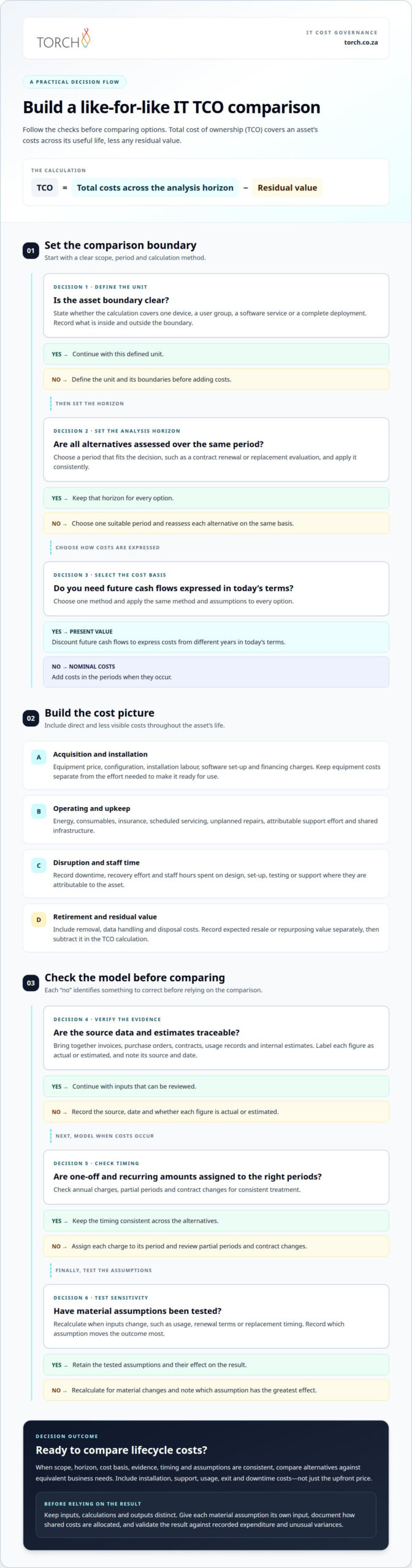
A practical TCO formula gives you a consistent calculation: TCO = total costs across the analysis horizon − residual value. Before calculating total cost of ownership for IT assets, define the period and asset boundary. This keeps the calculation focused on a specific decision and prevents options with different scopes from being compared as if they were equivalent.
Decide whether to calculate nominal costs or present value. A nominal calculation adds costs in the periods when they occur. A present-value calculation discounts future cash flows, expressing costs from different years in today’s terms. Apply the same discounting method and assumptions to every option. Otherwise, the comparison may reflect inconsistent modelling rather than meaningful differences.
Build the model around a small set of controlled inputs:
- Define the unit. Specify whether the calculation covers one device, a user group, a software service or a complete deployment. Record what is inside the boundary and what remains outside it.
- Set the horizon. Choose an analysis period that fits the decision, such as a contract renewal or replacement evaluation. Apply that period consistently to all alternatives.
- Gather source data. Bring together invoices, purchase orders, contracts, usage records and internal estimates. Label each figure as actual or estimated, and note its source and date.
- Model the timing. Assign one-off and recurring amounts to the period in which they occur. Check that annual charges, partial periods and contract changes are treated consistently.
- Test assumptions. Recalculate the result when material inputs change, such as usage, renewal terms or the timing of replacement. Record which assumption moves the outcome most.
Keep the calculation auditable. Give each material assumption its own input instead of embedding values in complex formulas. Reviewers can then trace the result and update it when contract terms or usage data change. If you allocate shared costs, document the basis and apply it consistently across alternatives.
A spreadsheet can support a transparent model if it separates inputs, calculations and outputs. A dedicated calculator may also report nominal totals, present value and sensitivity scenarios. Either way, validate the result against recorded expenditure and examine unusual variances before using it in a decision. A governance review of your TCO model can help assess whether its scope and assumptions are aligned.
What is total cost of ownership (TCO)?
TCO combines the costs of acquiring, operating, maintaining and disposing of an asset over its useful life, less its residual value. To compare vendors, cloud services and leasing options, assess equivalent business needs over the same period. Include installation, support, usage, exit and downtime costs rather than comparing upfront prices alone.
In South Africa, hardware and software costs in rand depend on specifications, licensing models, user or device numbers, support arrangements and contract terms. Build a like-for-like estimate from the required configuration and usage, and record one-off and recurring expenses separately. A generic price benchmark can mislead if it covers different infrastructure or service levels.
Consider an illustrative comparison between Widget A and Widget B. Widget A has a lower upfront price, while Widget B includes installation and support. Compare their full costs over the same analysis horizon, including repairs, operating needs and end-of-life value. A lower purchase price does not mean a lower TCO unless you assess the associated lifecycle expenses.
Industry benchmarks are useful only when their scope matches the asset, usage and service conditions being assessed. Instead of treating a broad benchmark as a target, compare internal assets with similar roles, ages and workloads. A 5-year horizon can serve as an example for IT equipment analysis, but the chosen period should reflect the expected useful life and decision being evaluated.
TCO and return on investment (ROI) answer different questions. TCO totals lifecycle costs; ROI relates an investment’s costs to its expected financial returns or benefits. For example, a cloud service may have higher recurring costs but support a business outcome that a purchase-only comparison would miss. Keep the cost view clear, then assess benefits separately using the organisation’s chosen ROI method.
A spreadsheet can track each asset’s acquisition, installation, usage, maintenance, downtime and disposal costs, with assumptions recorded alongside them. A useful template separates one-off and recurring costs, identifies the cost centre, and records the analysis period and residual value. Use a calculator to compare alternatives and test how changes to usage or repair assumptions affect the result.
Definition of total cost of ownership
The key distinction is between an asset’s recorded purchase value and the economic burden it creates for the organisation. TCO is a management tool for decision-making, not simply the figure in an asset register or accounting record. This matters when a device appears fully depreciated but still requires support and operational attention.
Define the decision boundary before interpreting a TCO result. Calculating the cost of a single laptop answers a different question from assessing a department’s device estate. State the unit being assessed, its business purpose and who owns the decision. Without that context, a per-device figure can be mistaken for the full cost of a team or service.
Ownership also has an organisational dimension. An asset assigned to the wrong user or cost centre can distort budgeting and renewal decisions. For example, if a staff member changes roles but the device record is not updated, its costs may remain assigned to the former team. Linking each asset clearly to its owner and cost centre makes the analysis more useful to managers.
Separate costs attributable to the asset from shared resources used by several teams. A support function, for example, may serve multiple systems. Allocating its time without a consistent rationale can make one asset appear artificially expensive and another less costly. Make the allocation basis visible so reviewers understand how shared resources are treated.
TCO helps frame trade-offs, but it does not make the decision on its own. A technology choice may meet a strategic need, such as improved endpoint security, that a cost total cannot fully express. Consider cost alongside operational suitability and managed risk exposure, then record why the chosen option fits the organisation’s priorities.
Use this as a decision rule: include only costs and assumptions relevant to the stated asset, purpose and period, and keep the boundary consistent when comparing options. This discipline makes results easier to interpret across procurement, IT and finance, even when each team approaches the decision from a different perspective.
A practical TCO calculation defines an analysis horizon, gathers reliable data, models recurring and one-off costs, and, where appropriate, discounts costs to present value.
Torch Services: Telecom Expense Management
Torch Services helps organisations strengthen IT cost governance through Telecom Expense Management, asset management and IT FinOps-as-a-Service. These services are relevant when invoices, asset records and cost-centre allocations are difficult to reconcile, or when lifecycle costs need clearer ownership.
Its asset-management service maintains a full asset register, attributing each asset to a cost centre and tracking its lifecycle from procurement to decommission. ITAM, UEM and FinOps share one view, with every asset tied to an owner and a cost centre. IT FinOps-as-a-Service adds invoice reconciliation and variance analysis against contracts and purchase orders, alongside accruals, journals, recharges, budgeting support and monthly IT finance packs.
For telecom expenses, Telecom Expense Management can help organisations oversee charges and usage more closely. Contact Torch Services to discuss your IT cost-governance requirements.
Make lifecycle cost part of each decision
A TCO model is most useful when teams revisit it as business needs change. Apply the same approach at procurement, renewal and replacement, and assign someone to keep assumptions and records current. This turns calculating total cost of ownership for IT assets into an ongoing governance practice rather than a one-off purchasing exercise.
For South African organisations, consistent asset and cost-centre records help decision-makers connect expenditure to the people and services it supports. Use those records to spot where actual usage differs from assumptions, then refine future forecasts and procurement choices. Clear ownership also helps teams consider costs and operational needs together.
If you’re ready to review how your IT asset costs are governed, start with the areas where records, ownership or lifecycle decisions need greater clarity.
Clearer decisions provide a stronger foundation for deliberate, accountable IT management.
Frequently Asked Questions
Why use a TCO calculator?
A TCO calculator makes assumptions visible and helps compare scenarios consistently. For example, procurement teams can model purchasing against leasing, then adjust expected usage, support needs or replacement timing to see which inputs have the greatest effect. Much like specialised estimation tools in other fields—such as truckaccidentcalculator.com for assessing vehicle collision claims—purpose-built calculators turn complex variables into structured financial estimates. It can also help prevent a recurring charge from being counted twice, such as in a spreadsheet and a separate budget. Use the result to inform a decision, not to replace a review of the inputs.
Still have some questions about TCO?
Start by identifying the decision the calculation needs to support, such as renewing a contract or replacing a device fleet. Then decide whether each cost belongs to the asset, the service or a shared function. If you estimate a value, label it and record who owns the assumption. Later, teams can update the specific input that changed instead of rebuilding the entire analysis.
What resources should you use to determine TCO?
Use records that show both the commercial commitment and what happened in practice. Purchase orders and supplier agreements clarify agreed terms; invoices show billed charges; service-desk tickets and maintenance logs reveal support needs. For a cloud service, usage reports can help explain consumption charges. Record a source and date beside each input, and retain earlier versions so reviewers can trace changes to the estimate.
What types of businesses can benefit from using TCO?
Any organisation making a technology lifecycle decision can use TCO, from an e-commerce business such as Beauty Supplements comparing staff workstations to an enterprise assessing shared infrastructure. It is especially useful when procurement, IT and finance each see only part of the commitment. For example, a distributed business can compare device options alongside support effort and replacement logistics, rather than judging each purchase by its supplier quotation alone.
What costs are included in a TCO calculation beyond purchase price?
Look for costs that arise when an asset is deployed, used or retired. For a laptop, these might include staff setup time, software licences, support requests, replacement accessories and secure data handling when the device leaves service. For a cloud workload, include charges for data movement as well as subscriptions. Check for duplicated allocations, especially when shared support or infrastructure is charged across several teams.
What is TCO?
TCO measures costs attributable to an asset over a defined period of ownership or use. The boundary matters: a calculation for one application may include its licence and support, while a broader service decision may also account for its supporting infrastructure. State the boundary clearly so decision-makers know what the total includes and can compare it fairly.