
The platform is not the strategy; the decisions around it are. A SaaS subscription management strategy brings pricing, billing, renewals and customer usage into a coordinated process, helping a business deliver clear value while managing recurring revenue. In South Africa, that means assessing how subscription choices affect both customer lifetime value (CLV) and the cost of serving each customer.
It’s easy to focus on billing systems and overlook the commercial decisions they need to support. Pricing that does not match how customers use a service can weaken retention, while confusing invoices or poorly managed renewals can strain customer relationships. A disciplined SaaS subscription management strategy connects these details, helping teams understand what customers pay for, where billing friction arises and how subscription value changes over time.
This guide explains SaaS subscription management and how it can influence customer lifetime value (CLV). It also covers pricing models, billing challenges and practical criteria for choosing a management platform, helping you assess which processes and capabilities fit your business.
Key Takeaways
- Match pricing to how customers use the service: usage-based, flat-rate, tiered, credit-based and hybrid models each shape perceived value and customer lifetime value differently.
- Build trust with transparent pricing, clear renewal terms and consistent contract data across quoting and billing.
- Separate subscription management from recurring billing: one governs the customer and contract lifecycle, while the other collects payments on schedule.
- Assess a management platform against your pricing models, billing cycles, usage data and reporting needs before choosing its features.
- Bring subscription and IT costs into clearer view through relevant governance services, including IT FinOps and asset management.
1. How does it impact Customer Lifetime Value (CLV)?
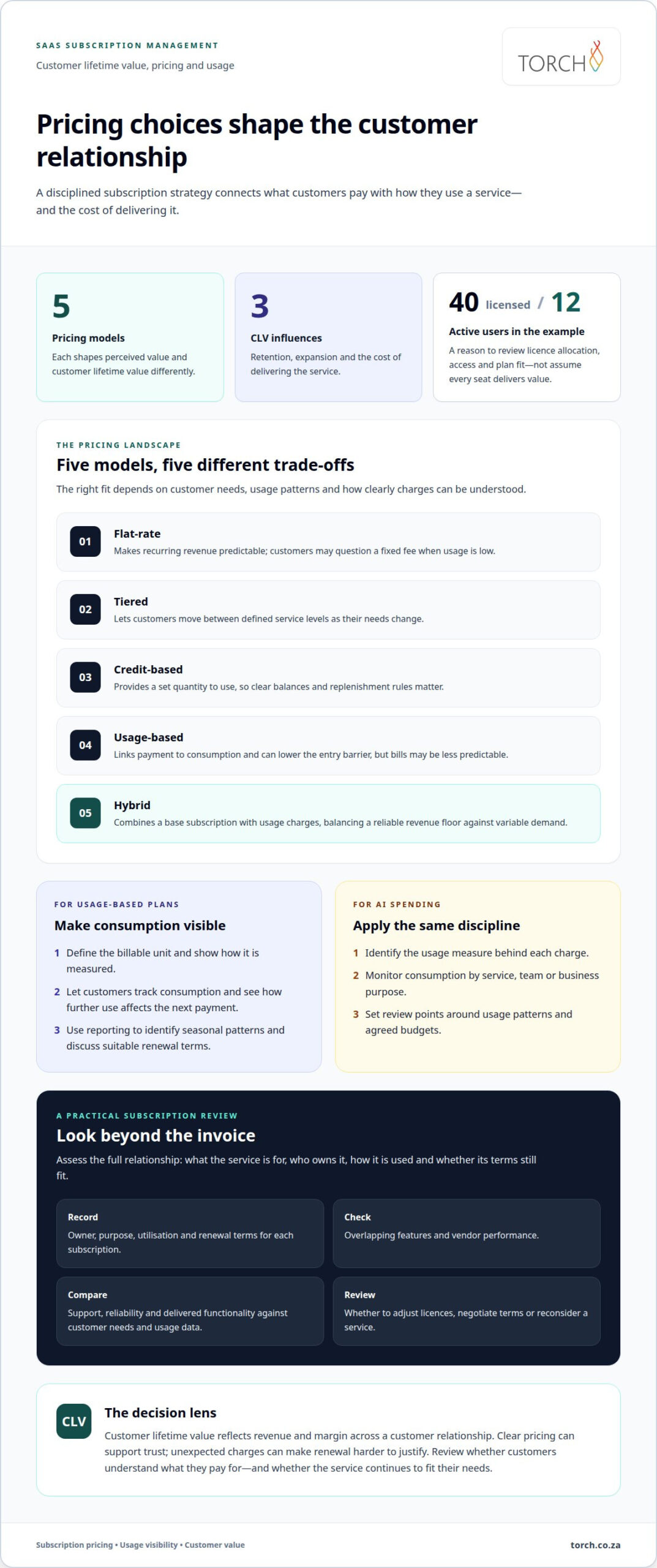
Customer lifetime value reflects the revenue and margin a business earns over a customer relationship. Pricing affects that value through retention, expansion and the cost of delivering the service. When customers understand what they are paying for, they can judge whether continued use remains worthwhile. Clear pricing can support trust, while unexpected charges can make renewal harder to justify.
Each pricing model shapes the customer relationship differently. Flat-rate pricing makes recurring revenue predictable, but customers may question a fixed fee when usage is low. Tiered pricing lets customers move between defined service levels as their needs change. Credit-based pricing gives customers a set quantity to use, so clear balances and replenishment rules matter. Usage-based pricing links payment to consumption, which can lower the entry barrier but make bills less predictable. Hybrid pricing combines a base subscription with usage charges, balancing a reliable revenue floor against variable demand.
For usage-based plans, define the billable unit and show how it is measured. A dashboard should let customers track consumption, see the amount already used, and understand how further use affects the next payment. For example, compare 40 licensed employees with 12 active users. That gap signals a need to review licence allocation, user access and plan fit, rather than assume every seat delivers value. Usage reporting also helps teams identify seasonal patterns and discuss suitable terms at renewal.
AI spending needs the same discipline. Identify the usage measure behind each charge, such as a provider-defined unit, then monitor consumption by service, team or business purpose. When deploying AI tools to streamline operations, set review points based on usage patterns and agreed budgets. If demand rises, reporting can show whether customers receive corresponding value or face an unexpected bill. If usage falls, teams can assess whether another plan would better support adoption and retention.
Review the full subscription relationship, not just the invoice. Record each subscription’s owner, purpose, utilisation and renewal terms; then assess overlapping features and vendor performance. Compare support, reliability and delivered functionality with customer needs and usage data. SaaS subscription reviews can reveal where to adjust licences, negotiate terms or reconsider a service. For telecom-related technology expenditure, telecom expense management can help connect usage and billing information to stronger cost governance.
2. What is SaaS subscription management?
SaaS subscription management coordinates the records and decisions governing a software service from purchase through renewal or closure. It connects the agreement, approved business purpose, account owner, access record, billing instructions and change history. Together, these details show who authorised the service and which terms govern it, giving teams a traceable basis for decisions.
A reliable subscription record should identify the contracting entity, service scope, renewal conditions, cancellation process, agreed support terms and internal approver. It should also preserve contract amendments, allowing teams to distinguish current terms from superseded versions. For example, if procurement approves a revised service scope, retain the approval and effective date with the updated agreement.
Transparency means presenting the information customers need to assess a commitment before agreeing. Show the service charges, renewal conditions, available plans and any training or installation costs, with an estimate of software costs for the first 12 months. Explain how a change in users or service scope affects the agreement. Clear documentation helps customers understand the commitment and gives sales, finance and billing teams a consistent reference.
For South African VAT and tax treatment, consult the South African Revenue Service’s guidance, as the correct treatment depends on the transaction and supplier circumstances. The Information Regulator’s guidance is relevant to personal information processed through a subscription. POPIA applies within its scope, including its provisions and exceptions, so organisations should account for how subscriber data is collected, accessed and handled.
Poor oversight can leave access active after someone changes roles, obscure who approved an application or make it difficult to show how subscriber information is handled. Connect each subscription record to its business owner and access-management process. This makes responsibility visible and helps teams address security and compliance risks when ownership or business needs change.
Governance also depends on controlled updates. Keep an authoritative record of approved contract terms and assign responsibility for recording changes, approvals and renewal decisions. For example, sales and finance teams should work from the same current agreement, not separate copies. This reduces discrepancies between agreed terms and operational actions, while making decisions easier to trace during internal reviews.
3. Flexible pricing and subscription billing challenges
Flexible pricing can suit different customer needs, but each exception adds operational complexity. A negotiated discount, revised service scope or volume adjustment needs an approval record and clear billing treatment. For example, if a customer qualifies for a discount after expanding usage, teams need to record who approved it, when it applies and whether it changes future invoices.
Subscription management covers the decisions and records surrounding a service throughout its lifecycle. Recurring billing is narrower: it calculates and collects charges according to agreed terms. A payment can be processed successfully even when the subscription has an outdated quantity, expired discount or unrecorded amendment. Connecting billing instructions to the current agreement helps teams identify such mismatches.
Flexible billing becomes harder to manage when changes arrive through separate channels. A sales email may confirm a revised plan while a service team updates access without notifying finance. Establish one authorised route for changes, record the effective date and pass approved details to billing. This gives finance a traceable basis for calculating charges and helps customer-facing teams explain adjustments consistently.
Automation can apply approved rules consistently, but it cannot resolve unclear terms on its own. Define how the system handles plan changes, discounts, cancellations, failed payments and billing exceptions. For example, route a charge that conflicts with the signed agreement for review instead of issuing it automatically. Record the decision and correction so teams can explain the outcome to the customer.
Revenue leakage can result from unbilled usage, incorrect quantities, discounts that remain active after their terms end, or services billed after cancellation. Reconcile subscription records with usage and invoice data, then investigate variances before finalising the billing period. Distinguish a failed payment from a disputed charge: the first may require a payment-method update, while the second calls for a review of the agreement and supporting records.
Maintain flexibility through controlled pricing updates. Assign an owner to review proposed changes, assess their effect on current agreements and approve the corresponding billing rules before implementation. Keep approved terms accessible to sales, service and finance teams. This reduces manual interpretation and helps maintain accurate billing as customer requirements evolve.
4. Choosing a subscription management platform
A subscription management platform should fit your operating model, not dictate it. Start by mapping who approves subscriptions, which teams maintain records and how changes reach finance. Then identify where spreadsheets, email or disconnected systems cause delays. This creates a practical requirements list based on actual workflows, rather than a catalogue of features.
Test the platform against your billing cycles and contract scenarios. For example, model a customer changing plans partway through a billing period while a separate service amendment awaits approval. Assess whether the system records the decision, applies the correct terms and clearly shows the resulting change. Include exceptions such as a disputed charge or a cancellation request requiring authorisation.
Define the metrics that matter before comparing platforms. These might include invoice correction rates, unresolved billing exceptions, time spent reconciling records and the completeness of renewal information. Decide how each metric will be calculated and which teams own the underlying data. A tool that cannot report on your chosen measures may leave important management questions unanswered.
Check how the platform integrates with your existing finance, customer and service systems. Confirm that customer identifiers, contract amendments and billing data stay aligned as records move between systems. Assess access permissions, audit trails, data exports and how users correct errors. For South African operations, include Rand handling and the tax processes relevant to your transactions.
Run a structured evaluation. Mark each requirement as essential, useful or unnecessary, then demonstrate priority scenarios using representative data. Compare the effort needed to configure, administer and maintain each option, alongside its stated charges. Consider how easily your team can retrieve records and explain billing decisions. The best fit is the platform that supports your controls without adding avoidable process burdens.
Document the selection rationale, accountable owner and implementation measures before committing. This creates a baseline for reviewing whether the chosen system supports your workflows as intended. A considered evaluation helps decision-makers prioritise operational fit, reliable records and useful reporting over an extensive feature list.
Torch Services
Torch Services is a natural next step when subscription decisions sit within wider IT cost governance gaps. Its proposition, “One Partner, Six Integrated Service Lines”, brings together TEM, TLM, UEM, FinOps, ITAM and SecOps. Torch is independent, carrier-agnostic and vendor-neutral, with no commissions, supporting objective oversight of technology expenditure and supplier relationships.
For organisations reviewing technology costs, connected records can clarify who uses each asset, which cost centre funds it and how expenditure changes. ITAM, UEM and FinOps provide a shared view, linking each asset to an owner and cost centre. This helps connect asset records, endpoint management and financial reporting instead of treating each as a separate governance exercise.
The ITAM asset-management service maintains an asset register, attributes assets to cost centres and tracks their lifecycle from procurement to decommissioning. UEM supports oversight and management of endpoints. Together, these views help teams connect assigned assets with responsible owners, supporting informed decisions about use, access and ongoing costs.
IT FinOps-as-a-Service is relevant when invoices and technology expenditure need stronger operational controls. It covers invoice reconciliation and variance analysis against contracts and purchase orders; accruals, journals and recharges; budgeting and forecasting support; vendor and procurement engagement; and monthly IT finance packs in Excel and PowerBI. These activities bring contract, purchase and invoice records into a clearer review process.
Telecom Expense Management can support governance when mobile or telecom invoices form part of wider technology spending. Connected service lines help decision-makers consider cost, asset ownership and operational context together. Torch’s offer is a managed-services approach to IT cost governance, including controls around technology assets and expenditure, rather than a SaaS subscription billing platform.
When responsibility for technology costs is spread across teams, records do not align, or invoice and asset information is difficult to reconcile, a complimentary audit of a sample of your invoices can help identify where to focus. This provides a practical starting point for reviewing IT cost governance requirements.
Request a complimentary audit of a sample of your invoices.
Make your next decision a governed one
A well-governed SaaS subscription management strategy is not a one-off platform decision. It is an ongoing way to connect technology choices with clear ownership, commercial accountability and the value each subscription delivers. As products, teams and usage change, keep decisions visible and make responsibility explicit.
Start with the governance gap that matters most to your organisation. It may be unclear ownership, disconnected cost records or difficulty aligning technology expenditure with business needs. A focused discussion with Torch can help define the next step and where independent oversight could support better decisions.
With clear priorities and accountable ownership, your organisation can make subscription decisions with greater confidence and build a stronger foundation for sustainable customer value.
Frequently Asked Questions
What is SaaS subscription management?
SaaS subscription management is the coordinated oversight of software agreements, accounts and subscription changes. It helps connect decisions made by procurement, IT, finance and business teams. For example, when a department requests a new application, a defined approval process can record its business purpose, authorised owner and renewal responsibility before the subscription becomes an ongoing commitment.
How does it impact Customer Lifetime Value (CLV)?
Subscription management can influence CLV by shaping whether customers continue, expand or reduce their relationship with a service. For example, a customer whose needs change may be more likely to stay if they can move to a suitable plan rather than pay for unused capacity. Clear account records also help teams identify appropriate renewal conversations and address friction before it affects the customer relationship.
What revenue leakage does it prevent?
It can help identify revenue that is missed or recorded incorrectly, such as billable usage omitted from an invoice, an unapproved discount applied to an account, or a cancellation taking effect later than agreed. Compare each invoice with the customer agreement and recorded service activity. Investigating differences before revenue reporting helps teams correct errors and maintain a clear audit trail.
What is a SaaS subscription management strategy?
A SaaS subscription management strategy sets out how an organisation approves, records, reviews and changes software subscriptions. It defines decision rights, record ownership, contract controls and review triggers. For example, a policy can require a named business owner and an approved purpose before acquiring a new subscription. It should also specify how teams handle exceptions, such as urgent requests or contract amendments.
How do SaaS subscription management tools compare on features and pricing?
Compare tools against the work they need to support, rather than relying on feature counts. Assess contract records, user and usage data, renewal alerts, billing workflows, reporting, integrations and access controls. For pricing, examine the charging basis and the operational costs of implementation, administration and data migration. Test the same realistic scenarios in each tool, such as a plan change, disputed invoice or cancellation.
How can businesses track SaaS licences, usage, renewals and spending?
Use a central register or management tool that connects each subscription to its owner, contract, billing schedule, renewal date, licence count and usage records. Assign responsibility for updating changes, then reconcile records with invoices and access data. For example, a renewal review can flag licences assigned to inactive users and prompt an authorised decision to retain, reallocate or discontinue them before the contract continues.