
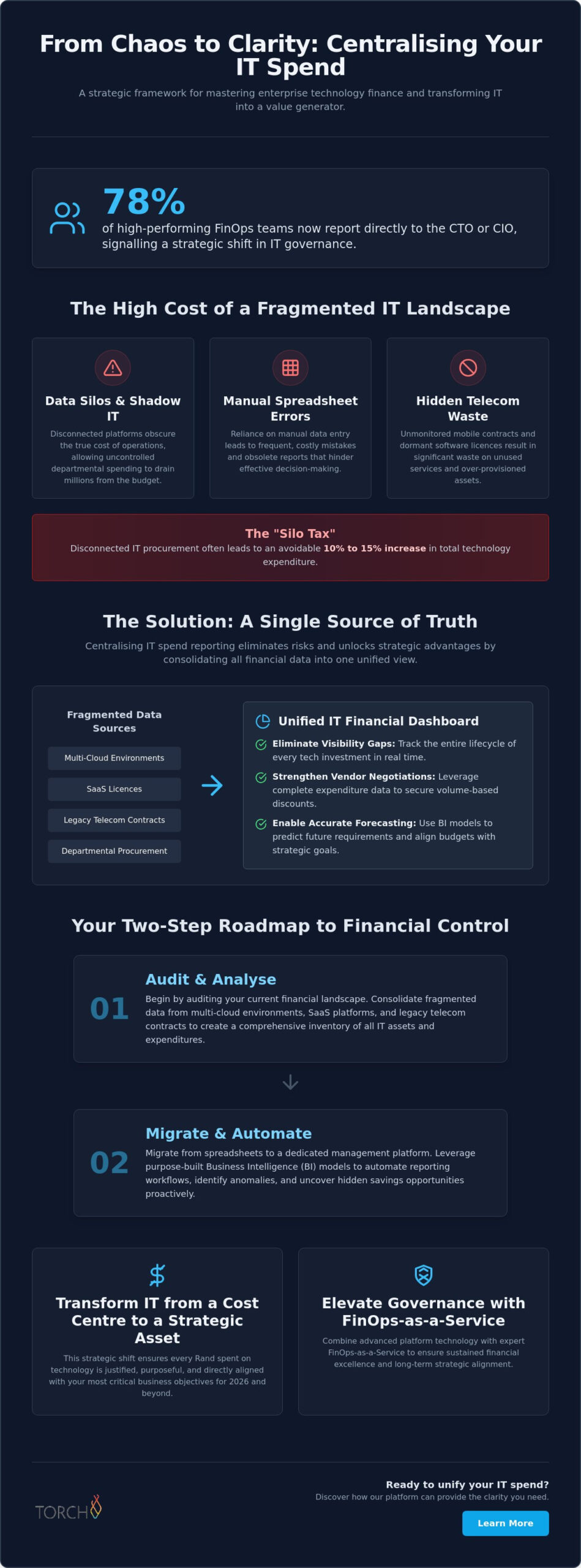
Did you know that 78% of high-performing FinOps teams now report directly to the CTO or CIO rather than the finance department? This shift reflects a global move toward treating technology not just as a cost centre, but as a strategic engine for growth. In South Africa, many enterprises still struggle with fragmented data silos and manual spreadsheet errors that obscure the true cost of digital operations. When you choose to centralise IT spend reporting, you eliminate the visibility gaps caused by shadow IT and hidden telecom billing inaccuracies that often drain R-millions from the annual budget.
Managing a multi-vendor environment is complex when your financial data is scattered across disconnected platforms. We understand the pressure to maintain agility whilst AI workloads and SaaS licensing costs continue to escalate. This guide provides the framework to master the transition from chaotic spreadsheets to a unified IT financial dashboard that uncovers hidden savings. We’ll explore how to automate your reporting workflows and align your 2026 budget with your most critical strategic objectives.
Key Takeaways
- Define a single source of truth by consolidating fragmented data from multi-cloud environments and legacy telecom contracts into one unified view.
- Leverage purpose-built BI models to transform IT from a reactive cost centre into a strategic asset that accurately predicts future technology requirements.
- Follow a practical, two-step roadmap to centralise IT spend reporting by auditing your current financial landscape and migrating to a dedicated management platform.
- Overcome data complexity by integrating disparate vendor formats, which eliminates the manual spreadsheet errors and shadow IT risks that drain enterprise resources.
- Enhance long-term governance by combining advanced platform technology with expert FinOps-as-a-Service to ensure sustained financial excellence and strategic alignment.
The Fragmented State of Enterprise IT Spend in 2026
Centralised IT spend reporting is the strategic consolidation of every technology-related financial data point into a single, verifiable source of truth. It’s no longer sufficient to view IT costs as a series of isolated line items; instead, leadership requires a holistic view that bridges the gap between procurement and operational value. Fragmentation is the natural byproduct of rapid digital expansion. As organisations scale, their financial data scatters across multi-cloud environments, decentralised departmental procurement, and legacy telecom contracts that often go unreviewed for years. Effective Information Technology Management in this environment demands a shift away from reactive accounting toward proactive governance.
The reliance on manual spreadsheets has become a significant liability for the modern enterprise. Whilst a spreadsheet might have sufficed for a smaller operation, it cannot keep pace with the complexity of managing thousands of endpoints across multiple provinces. Manual entry is prone to human error, and by the time a report is compiled, the data is frequently obsolete. This lag creates a vacuum where “Shadow IT” thrives. Departmental spending often bypasses central oversight entirely, leaving the organisation with a bloated budget and no clear understanding of which assets are actually driving revenue.
To regain control, leaders must centralize IT spend reporting to eliminate these visibility gaps. This process isn’t merely about gathering invoices; it’s about establishing a disciplined framework that tracks the entire lifecycle of every technology investment.
The Hidden Costs of Data Silos
Disconnected billing systems are a primary driver of financial waste. When data lives in silos, duplicate payments for the same SaaS subscriptions or cloud services become common, and volume-based rebates from major South African vendors are frequently missed. These silos act as a drag on executive decision-making speed, forcing leaders to wait weeks for consolidated figures that should be available in real time. The Silo Tax is the cumulative cost of uncoordinated IT procurement, often resulting in an avoidable 10% to 15% increase in total technology expenditure.
Why Decentralised Reporting Fails the Modern CFO
Inaccurate forecasting is the greatest risk of a decentralised model. When financial data is trapped in departmental pockets, the CFO cannot predict future R-expenditure with any degree of certainty. This lack of oversight also introduces severe compliance and governance risks, as unmonitored IT assets become easy targets for security breaches. Auditing corporate mobile contracts becomes an impossible task without a unified view, leading to thousands of Rand in wasted spend on unused SIM cards and over-provisioned data bundles that no longer serve the business.
The Strategic Imperative to Centralise IT Spend Reporting
Modern financial leadership requires more than just historical accounting; it demands foresight. When you centralize IT spend reporting, you convert raw invoice data into a high-level strategic roadmap that shifts IT from a perceived cost centre to a value-generating asset. This transition is essential for South African enterprises facing volatile market conditions where every Rand must be justified through its contribution to business outcomes. The adoption of a Technology Business Management framework demonstrates that transparency is the foundation for aligning technology investments with corporate goals, ensuring that your digital footprint remains lean and purposeful.
Visibility is the ultimate leverage in vendor negotiations. Without a unified view of your total expenditure across multiple service providers, you’re negotiating from a position of weakness. Real-time data allows you to identify volume-based discounts that were previously obscured by departmental silos. Enterprises that leverage purpose-built BI models can move beyond simple cost-tracking to predictive resource allocation, allowing them to scale infrastructure up or down with surgical precision. This level of agility is what separates market leaders from those struggling with legacy overheads.
Uncovering Hidden Savings through Visibility
Fortifying Governance and Risk Management
Overcoming Common Obstacles to a Unified Reporting Framework
Many executives hesitate to centralize IT spend reporting because they believe their internal data is too unorganised to consolidate. It’s a valid concern; when you’re dealing with disparate formats from South African telecom providers alongside global cloud invoices, the lack of uniformity is staggering. Technical hurdles often arise when trying to synchronise real-time data across legacy on-premises systems and modern cloud platforms. Without a unified approach, these obstacles lead to paralysis, leaving the organisation vulnerable to cost overruns and inefficient resource allocation. The challenge isn’t just technical; it’s a matter of creating a disciplined environment where data from every vendor is normalised and actionable.
Integrating global and local vendor data requires a robust translation layer. A local invoice for mobile data might use entirely different metrics compared to a global SaaS subscription, making direct comparisons difficult. To bridge this gap, enterprises must move beyond the “messy data” excuse and implement a structured ingestion process. This ensures that every line item, regardless of its origin or currency, is categorised correctly within the broader financial strategy. When you successfully centralize IT spend reporting, you transform these disparate data streams into a clear narrative that informs executive decision-making rather than clouding it.
Data Sanitisation and Standardisation
Cleaning your data is a non-negotiable prerequisite for centralisation. You cannot build a reliable reporting framework on a foundation of duplicate entries or misallocated costs. Establishing a common taxonomy for IT expenses across the entire organisation ensures that every department speaks the same financial language. This standardisation allows for meaningful benchmarking and trend analysis. Data quality is the foundation of any BI model. Without it, your predictive insights will be flawed, leading to strategic errors that could cost the business R-millions in wasted investment.
Managing the Cultural Shift to Transparency
Resistance often comes from departments that prefer to “own” their own budget data. These silos are frequently guarded by managers who fear that increased visibility will lead to budget cuts or “policing” of their spend. Overcoming this requires a shift in perspective. Leadership must position visibility as a tool for empowerment, showing departments how consolidated data helps them identify their own efficiencies. As highlighted in the EDUCAUSE Review on IT centralization patterns, executive sponsorship is vital in driving these reporting initiatives. When the CIO and CFO are aligned, the transition from fragmented silos to a unified framework becomes a shared strategic goal rather than an administrative burden.
A Practical Roadmap for Centralising IT Financial Data
Transitioning from fragmented spreadsheets to a unified financial view requires a methodical execution strategy. It’s not enough to simply desire transparency; you must build the infrastructure that supports it. To effectively centralize IT spend reporting, organisations should follow a disciplined roadmap that prioritises data integrity and scalable automation. This journey begins with a forensic look at your current commitments and ends with a continuous cycle of optimisation that protects your bottom line. By following a structured approach, you ensure that every Rand spent on technology is visible, justifiable, and strategically sound.
The roadmap follows five essential phases:
- Step 1: Audit the landscape. Identify all sources of technology spend, including hidden departmental accounts and legacy contracts.
- Step 2: Consolidate data. Migrate your disparate records into a purpose-built Asset management platform to create your single source of truth.
- Step 3: Automate ingestion. Connect your vendor billing systems directly to your platform to eliminate manual entry errors.
- Step 4: Analyse with BI. Apply purpose-built BI models to identify usage trends, cost anomalies, and potential savings.
- Step 5: Iterate and optimise. Use monthly insights to refine your procurement strategies and governance policies.
Audit and Inventory: Knowing What You Own
A successful centralisation project lives or dies by the quality of the initial audit. You must employ automated IT asset tracking to verify that every line item on your telecom and cloud invoices corresponds to a functioning, assigned asset. This phase often uncovers “Ghost Assets”. These are services like mobile data contracts or cloud instances that are still being billed despite the associated employee or project having ended months ago. Documenting these vendor contracts and their renewal dates prevents automatic rollovers on unfavourable terms, ensuring you only pay for the resources that actually contribute to your operations.
Automation: The Key to Scalable Oversight
Manual reporting cannot scale with the complexity of modern enterprise operations. Automated user support systems play a vital role here by feeding usage data directly into your spend reports. This integration allows you to see the direct correlation between support volume and technology costs in real time. By automating invoice processing, you reduce the administrative burden on your finance teams and eliminate the risk of human error. This is particularly critical for organisations scaling across multiple national regions in South Africa, where managing disparate billing cycles from various service providers becomes a full-time task without technological intervention.
Elevating Oversight with FinOps-as-a-Service
Software platforms are foundational, yet they often lack the human nuance required to navigate the complexities of South African corporate procurement. Whilst automation removes the burden of data entry, it cannot replace the strategic insight needed to challenge vendor billing behaviours or interpret intricate contract clauses. To effectively centralize IT spend reporting, enterprises must look beyond the dashboard and embrace a partnership that combines advanced technology with expert oversight. This collaborative model ensures that financial data is not just collected but is actively used to fortify the organisation’s market position.
This is where IT FinOps-as-a-Service becomes a strategic imperative. Torch Services provides a managed layer that uncovers hidden savings automated tools frequently overlook; such as identifying misapplied tariff structures or negotiating credits for service level agreement breaches. Purpose-built BI models then translate these findings into executive-level insights, ensuring that every R-value, including the AI workloads that 98% of FinOps practitioners now manage according to 2026 research, is mapped to a specific business outcome. This approach ensures that the “single source of truth” mentioned in earlier sections is not just a collection of numbers, but a tool for financial excellence.
The Torch Advantage: Beyond Simple Reporting
Managed services offer an objective, third-party perspective that internal teams, often stretched thin by operational demands, might lack. By integrating Telecom Expense Management with Unified Endpoint Security & Management, Torch provides a holistic view of the technology lifecycle. This integration ensures that cost-saving measures do not compromise the organisation’s security posture or endpoint governance. Every report is customised to meet the specific needs of South African enterprise stakeholders, including the nuances of local regulatory requirements and departmental budget structures. This level of precision allows for a more granular understanding of how technology investments drive competitive advantage in the local market.
Achieving Long-Term Financial Excellence
The ultimate goal of centralising your financial data is to move from reactive reporting to a proactive IT financial strategy. Instead of explaining why a budget was exceeded at the end of the quarter, leaders can use real-time insights to adjust spending before waste occurs. Continuous auditing acts as a permanent guardrail, maintaining a lean and agile IT budget that can pivot as business needs evolve. This disciplined approach ensures that your technology environment remains an engine for growth as you work to centralize IT spend reporting for maximum visibility. Discover how Torch Services can centralise your IT spend reporting and provide the visibility your executive team requires for 2026 and beyond.
Securing Your Competitive Advantage through Financial Clarity
The transition from fragmented spreadsheets to a unified financial dashboard isn’t merely a technical upgrade; it’s a fundamental shift in how your organisation values technology. By eliminating the ‘Silo Tax’ and reclaiming capital from underutilised assets, you transform IT from an opaque cost centre into a lean, strategic engine. To effectively centralize IT spend reporting, you need a framework that combines rigorous data sanitisation with the depth of purpose-built BI models.
Torch Services is a leading technology managed services provider across Africa, specialising in uncovering hidden savings in IT procurement that standard auditing tools often miss. We provide the expert management and enterprise-level insights necessary to maintain a lean, agile budget whilst scaling your digital operations. Partner with Torch Services to Uncover Hidden Savings in Your IT Budget and gain the visibility required to lead with confidence. Financial excellence is within reach when you replace uncertainty with actionable clarity.
Frequently Asked Questions
What is the primary benefit of centralising IT spend reporting?
The primary benefit is the establishment of a single source of truth that aligns technology expenditure with corporate strategy. By gaining full visibility, executives can move beyond simple cost-cutting to strategic reinvestment. This clarity allows for more precise resource allocation, ensuring that every Rand spent contributes directly to the organisation’s operational goals and long-term digital maturity.
How does centralised reporting help in reducing shadow IT?
Centralised reporting exposes departmental spending that occurs outside the purview of central procurement or IT governance. When you centralize IT spend reporting, you illuminate hidden SaaS subscriptions and hardware purchases that create security risks and financial waste. This oversight allows leadership to consolidate these disparate accounts, leveraging volume-based discounts whilst fortifying the enterprise’s security perimeter.
Can centralised reporting help with telecom invoice auditing?
It is a critical component of telecom expense management, as it enables the automated identification of billing inaccuracies across hundreds of monthly invoices. Many South African enterprises continue to pay for dormant lines or incorrect tariff structures because they lack a unified view. Centralised data allows for granular auditing, ensuring that you only pay for active, verified services.
Is it better to use a manual spreadsheet or an automated platform for IT spend?
An automated asset management platform is essential for modern enterprise scale, as manual spreadsheets are inherently prone to human error and data latency. Whilst spreadsheets might suffice for static reporting, they cannot handle the dynamic, real-time data ingestion required to manage thousands of endpoints. A purpose-built platform ensures data integrity and provides the agility needed to respond to fluctuating market conditions.
What is the role of BI models in IT financial management?
Purpose-built BI models serve as the analytical engine that transforms raw financial data into predictive strategic insights. These models identify subtle trends and anomalies in technology consumption that would be invisible in standard reports. This allows leadership to forecast future requirements with high precision, shifting the focus from historical accounting to proactive financial management.
How long does it typically take to centralise IT spend data for a large enterprise?
The timeline varies based on the complexity of the vendor landscape, but most enterprises see significant visibility within three to six months. A phased approach is typically recommended, starting with high-impact areas like telecom or cloud spend. This allows the organisation to realise immediate savings whilst gradually integrating more complex data sources into the unified dashboard.
Does centralised reporting require an overhaul of our current IT infrastructure?
No, centralising your reporting does not require an overhaul of your existing IT infrastructure. It functions as a non-intrusive data integration layer that sits above your current systems, ingesting billing and usage data via APIs or direct vendor feeds. This allows you to gain oversight without disrupting your existing operational workflows or requiring significant capital expenditure on hardware.
How does FinOps-as-a-Service differ from standard IT accounting?
FinOps-as-a-Service differs from standard accounting by being proactive and value-driven rather than reactive and historical. Whilst traditional accounting focuses on balancing the books after spend has occurred, FinOps-as-a-Service provides real-time governance and strategic partnership. It combines advanced platform technology with expert analysis to ensure that technology spend is continuously optimised for maximum business value.