
The Endpoint Governance Gap: Why Visibility Alone Fails the Board
For many South African enterprises, the conversation around device management is dominated by visibility. Dashboards glow with metrics on patching status, software versions, and security compliance. Yet, despite this flood of data from Unified Endpoint Management (UEM) tools, a critical governance gap persists. This gap represents the chasm between knowing what you have and holding it accountable—financially, commercially, and operationally. True endpoint governance framework is the strategic oversight, policy, and accountability layer that governs every device connecting to the corporate network, from laptops and servers to the smartphones in your employees’ pockets.
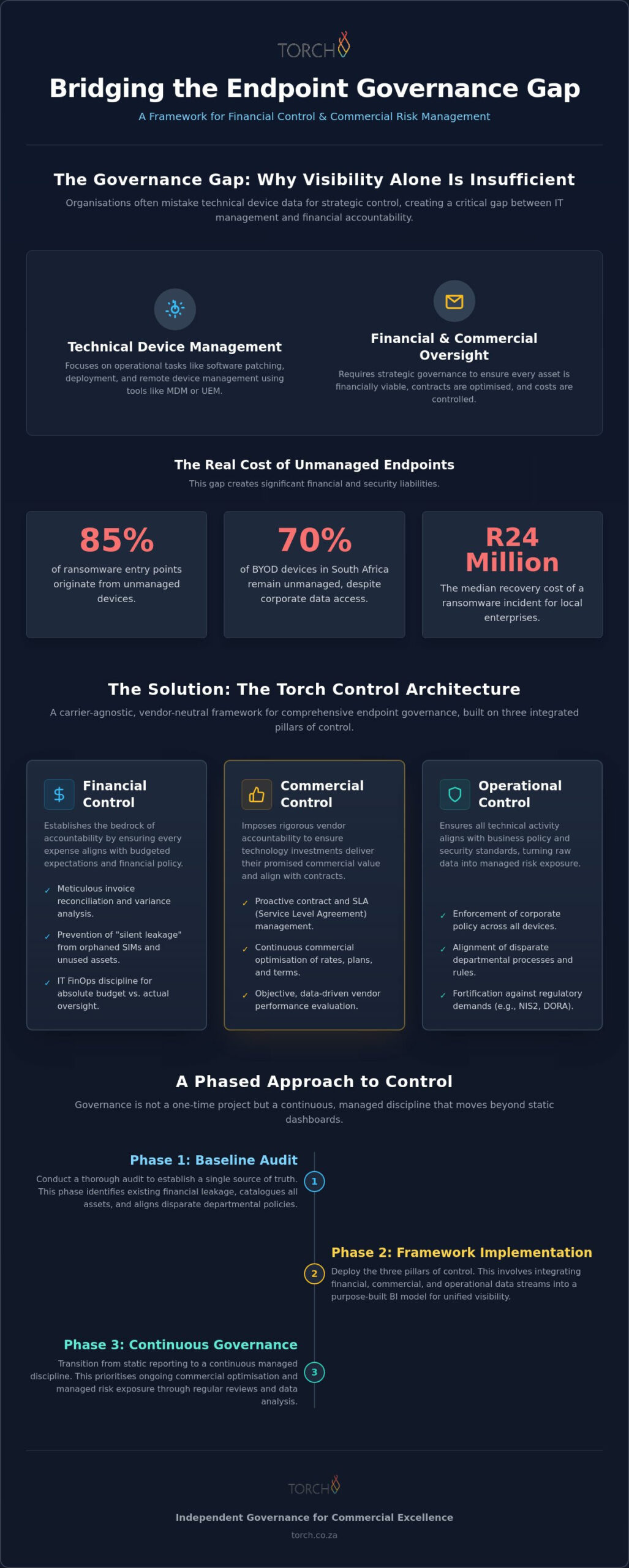
UEM tools are excellent at providing data, but a framework is what enforces accountability. Without it, organisations suffer from “operational drift,” a subtle but corrosive process where unmanaged, underutilised, or insecure devices create silent financial leakage and open dangerous security backdoors. The urgency is no longer just operational; it is a matter of corporate resilience. With 85% of ransomware entry points originating from unmanaged endpoints, a lack of governance is a direct invitation for business disruption.
Management vs. Governance: A Crucial Distinction
It is essential to distinguish between the technical act of management and the strategic discipline of governance. Endpoint management is the execution layer: deploying patches, installing software, and enforcing security configurations. It is the tactical work performed by IT teams using tools like Microsoft Intune or ManageEngine. Governance, however, is the policy, audit, and accountability layer that sits above it.
Governance answers the critical business questions that management tools cannot:
- Is this device commercially optimised for its user’s needs?
- Are we paying the correct rate for its data plan according to our carrier agreement?
- Does the existence of this device align with our HR and finance policies?
- Who is financially accountable for its lifecycle, from procurement to disposal?
Tools like Intune are vital components of a governance strategy, but they are not the entire framework. They provide the operational data, but governance provides the context and control. As one CFO recently noted, “Governance is the bridge between what your technical tools report and what your financial ledger requires.”
The Real Cost of Fragmented Visibility
Without a unifying framework, the cost of fragmented visibility accumulates rapidly. IT and finance teams are burdened with the manual reconciliation of mobile invoices, the allocation of costs for shared data pools, and the tracking of thousands of SIM cards. In the South African context, this problem is particularly acute, where it is estimated that over 70% of Bring Your Own Device (BYOD) endpoints accessing corporate data remain unmanaged by IT.
This governance deficiency has a direct and measurable impact on cyber-resilience. Local regulators are taking notice. The Financial Sector Conduct Authority (FSCA) and Prudential Authority’s Joint Standard on Cybersecurity and Cyber Resilience, in force since 2025, places stringent requirements on regulated institutions to manage technology risks. Alongside the Protection of Personal Information Act (POPIA), these regulations demand that organisations demonstrate defensible control over every endpoint that processes sensitive data.
The financial consequences of failure are severe. For a South African enterprise, the median ransom demand now sits at R18 million, whilst the average total recovery cost—including downtime, professional fees, and reputational damage—has climbed to R24 million. A robust governance framework is one of the most effective controls for mitigating this risk by ensuring no device is left unmanaged, unmonitored, or unsecured.
The Three Pillars of a Comprehensive Endpoint Governance Framework
A sustainable endpoint governance framework cannot be built on a single pillar like security or asset tracking. It requires a multi-dimensional approach that integrates financial, commercial, and operational controls into a unified doctrine. The Torch Control Architecture is built on this principle, establishing three pillars that create a holistic and defensible governance model.
To be effective, this framework must be carrier-agnostic and vendor-neutral. Its purpose is to provide objective oversight, not to be influenced by the sales targets of mobile networks or software vendors. By implementing a “Control Doctrine” across these three domains, enterprises can move beyond reactive management to achieve sustainable optimisation. This is often visualised through purpose-built Business Intelligence (BI) models that translate complex technology spend into clear, board-level insights.
Pillar 1: Financial Control and Spend Accountability
The first pillar addresses the fundamental question: “Are we paying the right amount for the services we consume?” This domain is focused on establishing rigorous financial accountability for every endpoint. It involves detailed invoice reconciliation to identify billing errors, variance analysis to compare actual spend against budget, and the allocation of costs to the correct cost centres.
This is where the discipline of IT FinOps becomes critical. By applying a FinOps mindset to the endpoint estate, organisations can prevent the “silent leakage” that occurs through unrecovered VAT, incorrect tariffing, and charges for dormant services. This pillar embodies the “Sage” archetype, providing the executive team with absolute clarity and enabling precise oversight of one of the largest and most fragmented areas of IT spend.
Pillar 2: Commercial Control and Vendor Accountability
Financial control ensures you are billed correctly; commercial control ensures the rates you are billed against are fair and competitive. This pillar focuses on holding vendors and mobile carriers accountable for their contractual obligations and market positioning. It requires continuous market benchmarking against major South African carriers to ensure your organisation is benefiting from the best available rates and technologies.
Using advanced analytics and “TorchLight” scenario modelling, a governance framework allows you to model the impact of different contract scenarios during renewal negotiations, empowering you with data-driven leverage. Furthermore, it establishes a mechanism for independent advisory, ensuring that vendors are held to their Service Level Agreements (SLAs) and that commercial agreements are structured for your benefit, not just the carrier’s.
Pillar 3: Operational and Security Control
The third pillar is the technical engine of the framework, focused on the physical and digital control of the assets themselves. It encompasses the “cradle-to-grave” lifecycle management of all hardware, from procurement and deployment to refresh and secure disposal. This ensures that your asset register is always accurate and that you are not paying for devices you no longer possess.
To ensure this technical layer is managed effectively, you can discover Networking2000, a specialist in managed IT support and infrastructure that provides the foundation for secure systems management.
For remote and hybrid workforces, this pillar addresses policy enforcement, solving challenges like the “two-phone problem” (where employees carry both a personal and a corporate device) and ensuring secure access to corporate data from any location. This is where Unified Endpoint Management (UEM) platforms serve their purpose, acting as the technical toolset to enforce the policies defined by the overarching governance framework.
Implementing Your Framework: A Phased Approach to Control
Establishing an endpoint governance framework is not a single project but a structured journey from chaos to control. A phased approach allows an organisation to achieve immediate wins whilst building the foundations for long-term, sustainable governance. This methodical process ensures buy-in from all stakeholders—including IT, Finance, HR, and Procurement—and demonstrates value at every stage.
- Step 1: Baseline Audit. The journey begins with a comprehensive, no-cost billing and asset audit. This initial diagnostic phase is designed to identify the current state of the estate, uncovering immediate financial leakage from sources like dormant SIM cards, incorrect tariff plans, or ghost assets still on the books.
- Step 2: Policy Harmonisation. A framework cannot succeed if it is built on conflicting policies. This step involves aligning HR, Finance, and IT policies regarding device usage, BYOD stipends, security requirements, and user responsibilities. A single, harmonised policy becomes the constitution for your entire endpoint estate.
- Step 3: Tool Standardisation. Many organisations suffer from fragmented management tools, with different solutions for mobile devices, laptops, and servers. This step focuses on consolidating these disparate systems into a single, unified platform that can provide a consistent data source for the governance layer.
- Step 4: Continuous Monitoring. Governance is not a one-time event. This phase establishes the rhythm of continuous oversight, with regular audit cycles, real-time consumption monitoring, and automated alerts for policy deviations or anomalous spending.
- Step 5: Executive Reporting. The final step is to translate the rich data gathered from the framework into actionable, board-level intelligence. This involves creating concise IT finance packs that communicate performance in the language of the CFO, focusing on financial outcomes, risk posture, and commercial optimisation.
The First 90 Days: From Chaos to Visibility
The initial 90 days of implementation are critical for building momentum. The focus is squarely on uncovering “quick wins” that deliver an immediate return on investment. By identifying and eliminating dormant SIM cards, redundant software licences, or out-of-bundle charges, the framework can often self-fund its implementation within the first quarter.
This is the “Hero” archetype in action: rescuing the budget from immediate and ongoing wasteful spending. A platform providing “SpotLight” real-time consumption monitoring is invaluable here, offering immediate visibility into usage patterns and allowing for proactive intervention before costs escalate. This initial phase proves the value of governance and builds the business case for deeper, long-term optimisation.
Developing a Robust Mobile and Endpoint Policy
A central output of the implementation process is a clear, enforceable mobile and endpoint policy. This document must address the realities of a hybrid workforce, providing clear guidance on the approved mobility models: company-owned, an allowance-based (BYOD) approach, or a hybrid structure. The policy should also define the security requirements for all devices accessing corporate data, mandating the use of containerisation to segregate personal and business information on employee-owned devices.
Developing this policy is a strategic exercise that balances user flexibility with corporate security and financial control. For organisations seeking to formalise this process, a structured approach to Telecoms Expense Management provides a proven methodology for designing and implementing a policy that is both effective and sustainable.
Beyond the Dashboard: Governance as a Continuous Managed Discipline
Software alone is insufficient to deliver sustained control. A dashboard can show you a problem, but it cannot fix it. True governance is not a platform you buy; it is a discipline you execute. This requires dedicated expertise, consistent effort, and an unwavering focus on the details of invoice reconciliation, contract management, and policy enforcement. For many over-extended internal IT and finance teams, executing this discipline consistently is an impossible task.
This is the fundamental difference between “platform-only” providers and “governance-led” managed services. A platform provides the tools, but a governance partner provides the execution. By augmenting your internal team with outsourced governance specialists, you ensure that the framework is not just implemented but continuously operated, optimised, and adapted to the changing needs of the business and the market.
The Role of an Independent Governance Partner
Objectivity is the cornerstone of effective governance. A mobile network carrier should not be responsible for auditing its own bills, just as a software vendor should not be the sole advisor on its own licensing. An independent governance partner provides the critical layer of impartial oversight needed to hold all vendors accountable.
A partner with deep industry experience can interpret complex carrier contracts, identify hidden clauses, and provide the market intelligence needed to negotiate from a position of strength. This value is amplified in a specialised market like South Africa. As detailed in the comparison of Brightfin vs Torch Services, a strategic partner with local expertise and a long history of independent advisory offers a distinct advantage over global platforms that lack nuanced market insight. Choosing a partner with over 100 years of combined industry experience ensures you are guided by seasoned experts, not just software.
Achieving Long-Term Financial and Operational Agility
The ultimate outcome of a mature endpoint governance framework is a governed, visible, and secure estate that acts as an enabler of corporate growth, not a drain on its resources. When your device and mobility data is clean, defensible, and aligned with your financial ledger, it empowers smarter, faster procurement and strategy decisions.
You can confidently invest in new mobile technologies, knowing you have the controls in place to manage their cost and security. You can adapt to changing work styles, knowing your policies are robust enough to handle any scenario. This is the “Caregiver” archetype, delivering the final, crucial element of governance. True governance provides the reassurance that your digital estate is secure, compliant, and commercially optimised every single day.
Ready to bridge the gap between management and governance? Book a 30-minute governance review with Derek King — no obligation, no sales pitch.