
An effective IT asset lifecycle management strategy is no longer a technical inventory-keeping exercise; it is a core financial and operational discipline. For the modern South African enterprise, where technology estates are increasingly complex and dispersed, the primary objectives are unequivocal: visibility and control. Without a governance-led framework, organisations suffer from silent financial leakage, often beginning the moment a new device or service is procured.
IT Asset Lifecycle Management (ALM) is the strategic oversight of technology spend, contracts, and risk from acquisition to disposal. This discipline ensures that every rand invested in technology delivers its intended value, is fully accounted for, and is retired securely and responsibly.
To explore how a unified technology partner can support your organisation in achieving these objectives, read more about SF Consortium Pty Ltd and their range of comprehensive IT services.
Bridging the Gap Between Finance and IT Procurement
A persistent challenge in many large organisations is the “control deficiency” that arises when Finance and IT functions operate in silos. IT teams, focused on operational stability and user enablement, may procure assets without a clear line of sight into their long-term financial implications. Conversely, Finance teams often lack the technical context to scrutinise technology invoices effectively, leading to budget variances and an erosion of financial control.
A managed IT asset governance approach systematically closes this gap. By establishing a single, verifiable source of truth for all technology assets—from mobile devices and data subscriptions to software licences and cloud infrastructure—it restores confidence in the financial numbers. This is crucial for the Chief Financial Officer (CFO), who is ultimately accountable for presenting defensible data in board-level reporting. When every asset is tracked, validated, and mapped to a specific cost centre and user, the budget becomes a strategic tool rather than a source of contention. This unified approach enables rapid, data-backed decisions, as evidenced by organisations like the Tsogo Group, which achieved strategic alignment on their technology estate within six weeks of implementing a governed framework.
The Importance of Independent, Carrier-Agnostic Advice
When managing a vast telecom estate, a fundamental conflict of interest exists: carriers cannot be expected to validate their own revenue or audit their own bills with complete impartiality. Their commercial imperatives are naturally aligned with maximising their service consumption, not with optimising their clients’ expenditure. Relying on a carrier to manage your mobile fleet is akin to asking a vendor to mark their own homework.
This is where an independent partner, acting as a Sage archetype, provides indispensable value. By offering objective oversight without the bias of selling connectivity or hardware, a governance partner ensures that your organisation’s interests are the sole priority. Independent benchmarking of carrier contracts, tariffs, and service levels provides the commercial leverage needed during renegotiations. It transforms procurement from a reactive, price-driven transaction into a proactive, value-focused engagement, ensuring that your agreements are not just competitive at signing but remain optimised throughout their lifecycle.
Governing the Active Phase: Visibility and Endpoint Security
Once an asset is deployed, the strategy enters the “Operational Control” domain. The objective here is to ensure every user and every device is accounted for, secured, and managed daily. In the South African business landscape, the rise of hybrid work models has amplified challenges like the “two-phone problem”—where employees use both a corporate and a personal device for work—and the proliferation of unmanaged Bring Your Own Device (BYOD) assets accessing the corporate network.
This lack of visibility is not merely a financial concern; it is a significant security vulnerability. Industry data consistently shows that the vast majority of cyber-attacks, particularly ransomware, originate at the endpoint. With an estimated 85% of initial ransomware access starting from unmanaged or poorly secured devices, asset visibility becomes a foundational pillar of risk mitigation.
Whilst global benchmarks like IBM’s 2025 report cite a $4.44M average data breach cost, local figures are more pressing for South African leadership. Recent Sophos data for South Africa reveals a median ransom demand of R18 million and an average total recovery cost of R24 million. An effective IT asset lifecycle management strategy acts as a Hero, rescuing the budget and the organisation by identifying and deactivating these “ghost” assets and unmanaged endpoints before they become liabilities.
Unified Endpoint Management (UEM) as a Governance Tool
A modern Unified Endpoint Management (UEM) platform is a critical tool for enforcing governance across a diverse fleet of devices. More than just an inventory system, a UEM solution automates the application of corporate policy, ensuring that every device—whether corporate-owned or personal—adheres to established security and compliance standards. For a distributed workforce, the ability to implement policies remotely is non-negotiable.
This includes enforcing password complexity, restricting unauthorised applications, and ensuring operating systems are patched and up to date. Furthermore, best practices such as “selective wiping” allow IT administrators to remove sensitive corporate data from an employee’s personal device upon their departure from the organisation, without affecting their personal files. This capability is essential for protecting intellectual property while respecting employee privacy in a BYOD environment.
Managing Complex Telecom and Mobile Estates
For most large enterprises, the telecom and mobile estate represents one of the most complex and opaque areas of IT spend. The “commercial optimisation” of these assets requires continuous, granular analysis of usage patterns against contracted tariffs. It is a common scenario for an employee to be on a high-usage data plan when their actual consumption is minimal, or vice versa. These mismatches accumulate into significant financial waste over time.
A disciplined Telecom Expense Management (TEM) programme addresses this head-on. By continuously adjusting subscriptions to match real-world usage, organisations can achieve material savings, often in the region of 19.6% on their mobile spend alone. TEM also provides the data-driven evidence required to manage and resolve billing disputes with carriers, turning contentious, time-consuming queries into factual, evidence-based conversations that protect the budget.
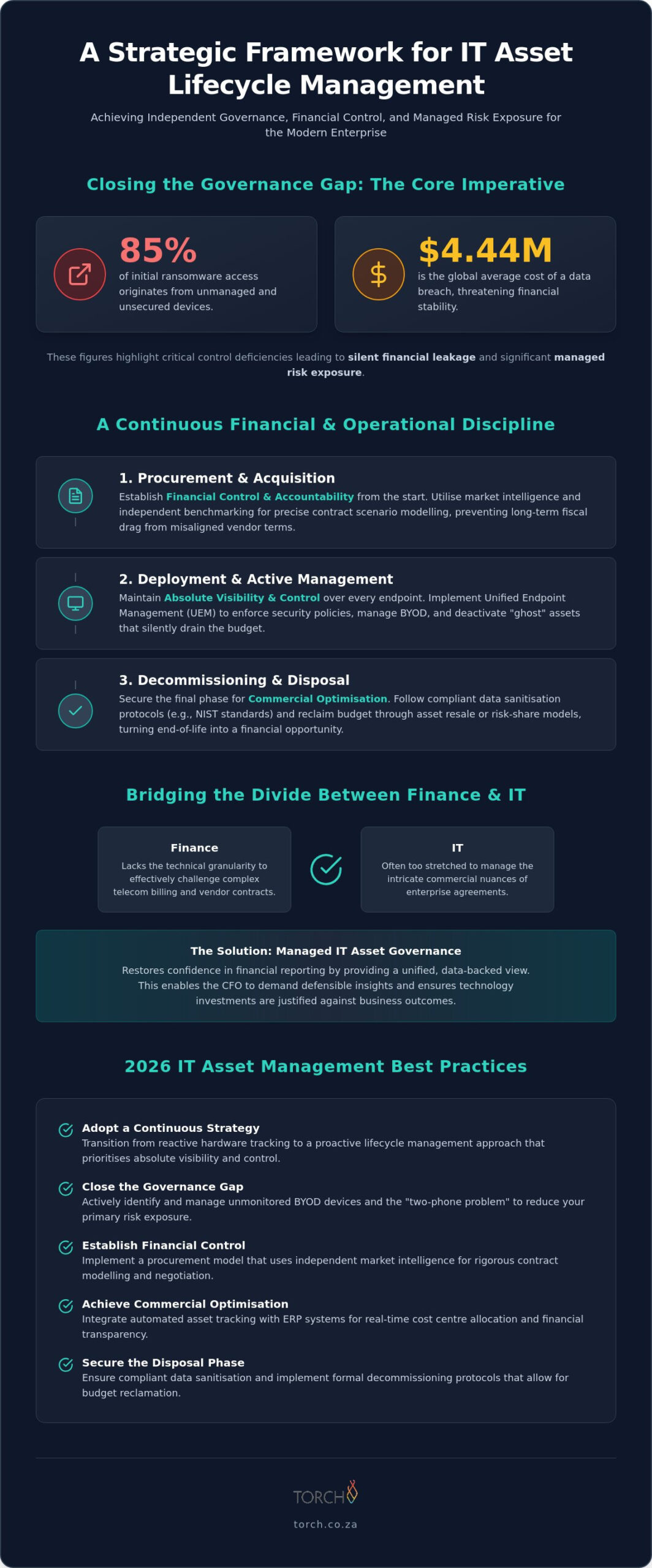
The 2026 IT Asset Management Best Practices Checklist
A forward-looking IT asset lifecycle management strategy must be built on a foundation of repeatable, auditable processes. This checklist provides a governance-first framework for organisations aiming to achieve mature financial and operational control over their technology estate by 2026.
- Establish a “Governance-First” procurement model that uses independent market intelligence for contract scenario modelling before any purchase order is raised.
- Implement automated asset tracking that integrates directly with core business systems, such as ERP and HRM platforms, for real-time cost centre allocation and user assignment.
- Conduct quarterly billing validation and contract audits as a standard operational rhythm to identify and eliminate invoice variances before they accumulate.
A robust checklist must include monthly reconciliation of vendor invoices against purchase orders to prevent financial drift.
Procurement and Deployment Controls
Effective governance begins before an asset even enters the organisation. Each stage of the procurement and deployment process must be governed by strict controls to prevent the cycle of waste and risk from starting.
- Requirement Mapping: Verify that every new acquisition is mapped against a specific, documented user profile or operational requirement. This prevents speculative or non-essential purchases that contribute to asset bloat; for guidance on evaluating hardware specifications, IT TECH 4 ALL provides insights into technical performance factors like memory timing.
- Pre-Deployment Enrolment: Ensure all endpoint devices are enrolled in the corporate UEM platform and configured with the correct security policies before being issued to employees. This closes the window of vulnerability between unboxing and first use.
- Chain of Custody: Document the complete “cradle-to-grave” chain of custody for all high-value hardware assets, providing a clear and auditable trail of ownership and responsibility from deployment to disposal.
Maintenance and Compliance Auditing
In the active phase of the lifecycle, continuous monitoring and auditing are essential to maintain security posture and ensure commercial optimisation. This is not a once-a-year activity but an ongoing discipline.
- Vulnerability Reporting: Schedule regular, automated reports from your UEM and security platforms to highlight unpatched software, non-compliant devices, or other vulnerable endpoints that require immediate remediation.
- Contract Benchmarking: Perform independent benchmarking of all major telecom and technology contracts every 12 to 18 months to ensure pricing and terms remain competitive with the current market.
- Policy Audits: Regularly audit device and application compliance against established corporate security policies and regulatory mandates, such as South Africa’s Joint Standard on Cybersecurity and Cyber Resilience, which has been in force since 1 June 2025.
Closing the Loop: Decommissioning and FinOps Integration
The final phase of the asset lifecycle, “Disposal,” is a critical and often overlooked opportunity to reclaim value and mitigate risk. This stage involves more than simply unplugging old hardware; it requires secure data sanitisation and environmentally responsible hardware retirement. From a financial perspective, decommissioning is a pivotal point for reclaiming budget, especially when managed through “risk-share” savings models with a governance partner.
This is where an independent governance partner acts as a strategic guide (the Sage), providing the framework to manage the administrative burden of SIM swaps and cost centre recharges, whilst acting as the Hero to rescue internal teams from this complex, time-consuming process. This disciplined approach embodies the Torch Control Doctrine: Control is the only sustainable form of optimisation.
Secure Disposal and Data Sanitisation
The legal and compliance necessity of certified data destruction cannot be overstated. Simply deleting files or reformatting a hard drive is insufficient to protect sensitive corporate or customer information. A formal decommissioning process must include certified data sanitisation methods that render data completely irrecoverable, protecting the organisation from potential breaches and reputational damage long after an asset has left the premises.
Managing the physical transition from old to new hardware must be planned meticulously to avoid operational disruption. This includes coordinating logistics, ensuring new devices are ready for deployment, and, most importantly, updating the central asset register immediately upon an asset’s decommissioning. Failure to do so results in “ghost assets” that remain on the books, distorting financial reporting and security audits.
Reclaiming Value Through IT FinOps-as-a-Service
A mature asset lifecycle management strategy naturally evolves into a broader IT FinOps discipline. FinOps-as-a-Service brings financial accountability and commercial acumen to technology spending, transforming IT from a cost centre into a value-driven business partner. It provides the clarity needed to improve budget accuracy and make smarter investment decisions.
Through the use of “Purpose-built BI models,” technology spend is visualised in a way that is meaningful for executive decision-making. Instead of impenetrable spreadsheets of billing data, leadership receives clear, actionable insights into where money is being spent and what value it is generating. Ultimately, a well-executed FinOps programme, underpinned by a robust asset lifecycle strategy, restores complete confidence in the numbers. This allows the CFO and CIO to plan, budget, and invest in future technology initiatives with certainty, knowing that every rand is spent with purpose.