
Beyond the Purchase Price: What Are Hidden Costs in IT Procurement?
For many executives, IT procurement is seen as a transactional event: negotiate the best price, sign the contract, and move on. Yet, this perspective overlooks a critical reality. The initial purchase price is merely the visible tip of a financial iceberg. The true financial impact of any technology investment lies in its total cost of ownership (TCO), a figure frequently inflated by an array of unmonitored, unmanaged, and often invisible expenses. These are the hidden costs in IT procurement.
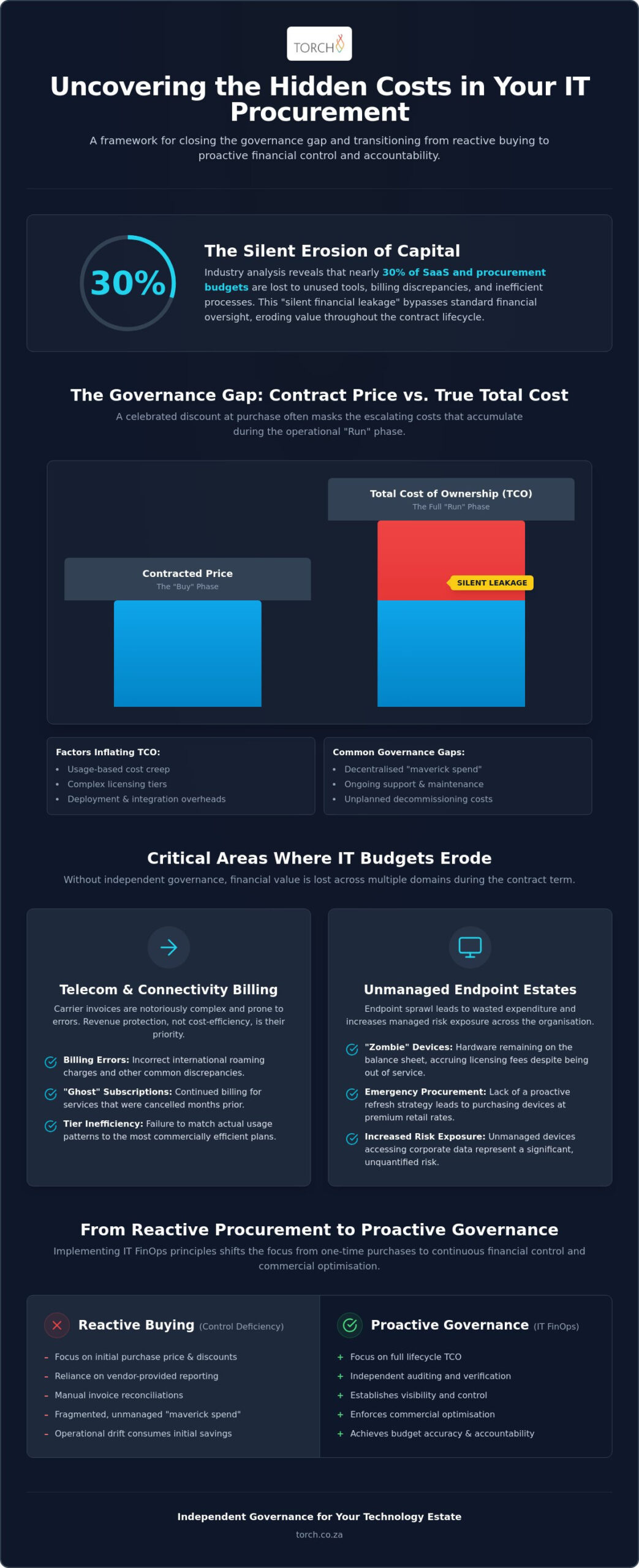
Hidden costs represent the delta between the price you agreed upon and the amount you actually spend over the technology’s lifecycle. IT procurement is uniquely susceptible to this kind of cost creep. Unlike purchasing physical goods with a fixed price, technology services—from mobile data to cloud computing—are often governed by complex, usage-based billing models and multi-year contracts. This complexity creates fertile ground for what we term “Silent Financial Leakage”: a steady erosion of your IT budget that occurs whilst contracts are technically active and services are operational.
The core of the problem lies in the distinction between traditional procurement (the “Buy”) and technology lifecycle governance (the “Run”). A successful negotiation is only the first step. Without continuous, independent oversight during the operational phase, even the best-negotiated contract can become a source of significant financial waste.
The Distinction Between Price and Total Cost of Ownership
A “good deal” on paper often masks substantial operational overheads. The initial discount on a software licence or a mobile contract can be quickly negated by the costs of deployment, integration, ongoing support, and eventual decommissioning. These elements of the TCO must be factored in from the outset, not treated as afterthoughts.
Furthermore, in large, decentralised organisations, “maverick spend” can introduce significant unbudgeted costs. When individual departments or employees procure IT services outside of established channels, the organisation loses purchasing leverage, introduces security vulnerabilities, and creates a fragmented technology estate that is almost impossible to govern effectively. True cost control requires a holistic view of the entire lifecycle, from initial sourcing to final retirement.
Why Traditional Procurement Teams Struggle with IT Complexity
Procurement departments are masters of commercial negotiation, but they are seldom equipped for the granular, technical auditing required to validate complex technology invoices. The skills needed to negotiate a master service agreement are fundamentally different from those required to audit a carrier’s billing data for thousands of mobile lines or verify cloud consumption against a pay-per-use contract.
Many organisations assume their Enterprise Resource Planning (ERP) systems will catch these discrepancies. However, ERPs are typically designed to match a purchase order to an invoice total; they lack the sophistication to validate the thousands of line items within a complex telecom bill or a cloud provider’s statement. They can confirm that you were billed, but not if the billing was correct. Relying solely on vendor-provided reporting for financial validation is akin to letting a supplier mark their own homework—it creates a fundamental conflict of interest and leaves your budget exposed.
The “Silent Leakage”: Four Critical Areas Where IT Budgets Erode
Hidden IT costs are not random; they tend to accumulate in specific, predictable domains across the enterprise technology estate. By understanding where to look, financial and IT leaders can begin to plug the leaks that silently drain their budgets. These four areas represent the most common sources of financial leakage.
Telecom and Connectivity Billing Discrepancies
Telecommunications contracts are notoriously complex, and billing errors are far more common than most organisations realise. Carriers should not be expected to proactively validate their own revenue streams. Our audits consistently uncover systemic issues, from incorrect roaming charges and legacy “ghost” subscriptions for former employees to services billed at out-of-contract rates. Another frequent source of overspend is the failure to match actual usage to the most efficient commercial tariff or bundle. An employee consistently exceeding their data allowance, for example, incurs preventable overage charges that a simple plan adjustment could eliminate. Effective telecoms expense management provides the independent, line-by-line reconciliation required to identify and dispute these errors, ensuring you only pay for the services you actually consume at the rates you agreed.
Unmanaged Endpoint Estates and Security Risks
The proliferation of corporate-owned and bring-your-own-device (BYOD) endpoints creates another significant area of hidden cost. “Endpoint sprawl” leads to “zombie” devices—laptops, tablets, and smartphones that remain assigned to the organisation and connected to billing plans long after an employee has left. Each of these devices represents a recurring monthly cost with zero return. Beyond the direct financial waste, an unmanaged device is a security liability. Without proper oversight, it becomes an unpatched, unauthorised gateway to your corporate network. Poor lifecycle management also forces “emergency” procurement at premium prices when a device fails, rather than a planned, cost-effective refresh cycle. A robust unified endpoint management strategy is essential for maintaining visibility and control, linking financial governance directly to your security posture.
The High Price of “Software Shelfware”
Software asset management is a discipline in itself, and one of its greatest challenges is “shelfware”—software licences that are provisioned and paid for but are never, or are rarely, utilised. This is particularly prevalent in large enterprises with complex licence agreements for vendors like Microsoft, SAP, or Salesforce. Without a clear process for tracking utilisation and reclaiming unused licences, a significant portion of the software budget is effectively wasted. The problem is compounded by the shift to subscription-based Software-as-a-Service (SaaS) models, where unused seats can generate recurring monthly costs that fly under the radar of traditional procurement audits.
Contractual Drift and Non-Compliance
Contracts are not static documents. Over their lifespan, “contractual drift” can occur, where vendor performance fails to meet the agreed-upon Service Level Agreements (SLAs) without any financial recourse for your business. Are you receiving credits for service outages as stipulated in your agreement? Are your vendors meeting their performance targets? Without active monitoring, you are likely paying in full for a sub-standard service.
Furthermore, hidden penalties for early termination or failure to meet minimum volume commitments can create unexpected financial shocks. Perhaps most dangerous are “silent” renewals, where contracts automatically extend on unfavourable, outdated terms because the renewal deadline was missed. Independent benchmarking is crucial to ensure your rates remain market-related throughout the contract lifecycle, not just at the point of signing.
Auditing the Lifecycle: How to Identify and Quantify Hidden Procurement Costs
For CFOs and CIOs determined to regain control over their technology spend, a structured audit is the essential first step. Moving from suspicion to certainty requires a clear methodology to baseline the current environment, identify discrepancies, and quantify the gap between expected and actual expenditure. This four-step process provides a framework for establishing true financial governance.
- Baseline the Current Estate: You cannot control what you cannot see. The initial step is a comprehensive asset and service discovery process to create an accurate, real-time inventory of every device, circuit, subscription, and software licence across the organisation. This baseline serves as the single source of truth against which all contracts and invoices will be measured.
- Perform a Three-Way Match: With a complete inventory, the next step is a meticulous three-way match. This involves comparing your service contracts (what you agreed to pay), your purchase orders (what you approved for payment), and your actual vendor invoices (what you were billed for). It is in the discrepancies between these three documents that the majority of financial leakage is found.
- Benchmark Costs Against Market Intelligence: Once you have verified the accuracy of your billing, the focus shifts to value. Are the rates you are paying competitive? This requires benchmarking your costs against independent, up-to-date market intelligence. Using a service like Torch’s TorchLight platform provides objective data on pricing within the specific South African commercial landscape, giving you significant leverage for contract renegotiations.
- Quantify the “Governance Gap”: The final step is to quantify the “Governance Gap”—the total financial difference between your contracted, expected spend and your actual, audited spend. This figure represents the sum of billing errors, unused services, and non-competitive rates. Presenting this data-backed figure to the board provides a powerful, undeniable case for implementing a continuous governance framework.
Establishing Visibility with Purpose-Built BI
Generic financial dashboards and ERP systems are not designed to highlight the nuances of IT spend. They may show a top-line figure for “telecoms” or “software,” but they cannot reveal the granular detail of per-user consumption or pinpoint a specific billing anomaly. Purpose-built Business Intelligence (BI) is required to translate raw billing data into actionable financial insights. Monitoring consumption at the user or cost-centre level is critical for accurate internal cost allocation and for identifying outliers that signal waste or inefficiency. SpotLight is Torch’s real-time governance visibility platform, designed specifically to provide this level of granular insight into complex technology estates.
Benchmarking Against the South African Market
Global benchmarks for technology pricing often fail to reflect the unique commercial and regulatory landscape of the South African market. Local carrier pricing structures, connectivity options, and enterprise agreements have their own distinct characteristics. Attempting to negotiate with a local vendor using data from European or North American markets is ineffective. True negotiating power comes from using hyper-local, current competitive intelligence. This data also enables powerful “scenario modelling,” allowing you to analyse the financial impact of different technology choices or contract structures before committing to a Request for Proposal (RFP).
From Procurement to Governance: Establishing Control with IT FinOps
The traditional, transactional approach to IT procurement is fundamentally broken. It optimises for a single moment in time—the purchase—while ignoring the financial realities of the entire technology lifecycle. At Torch, we operate under a core principle: the Torch Control Doctrine, which states that “Control is the only sustainable form of optimisation.” Lasting financial health is not achieved through one-off savings initiatives but through the establishment of continuous, independent governance.
This is the domain of IT FinOps (Financial Operations). It represents a crucial cultural and operational shift, creating a bridge between procurement, finance, and IT operations to manage technology spend as a strategic business function. An IT FinOps-as-a-Service model provides the expertise, processes, and platforms to implement this governance framework, transforming financial data from a source of confusion into a tool for strategic decision-making.
An embedded managed service does not just report on discrepancies; it takes ownership of resolving them. This includes managing disputes with vendors, reclaiming funds from billing errors, and proactively optimising services to prevent future overspend.
The Role of IT FinOps-as-a-Service
For most enterprises, building an in-house team with the specialised skills to audit complex telecom, cloud, and software billing is impractical. A managed financial operations service removes this heavy administrative burden from your internal teams, freeing them to focus on core business objectives. The benefits of engaging an independent partner for IT FinOps are clear: you gain access to specialised expertise for invoice reconciliation, dispute resolution, and contract management without the overhead of hiring and training. As an independent, carrier-agnostic advisor, a FinOps partner works solely on your behalf, ensuring accountability and transparency from your vendors.
Restoring Board-Level Confidence
The ultimate goal of financial governance is to restore confidence in the numbers. It is about moving from a position of uncertainty—”I think we are saving money”—to one of empirical proof: “I can prove our technology estate is governed and our spend is optimised.” When financial data is defensible, accurate, and transparent, it empowers the board to make smarter, more agile strategic decisions about future technology investments.
This is the role of an authoritative expert and strategic partner. By providing the deep industry knowledge and rigorous analysis (the Sage archetype) and actively correcting overspending and enforcing accountability (the Hero archetype), an independent governance partner provides the clarity and control needed to navigate complex environments. This disciplined approach ensures that every Rand spent on technology delivers its maximum intended value, transforming the IT budget from a source of financial leakage into a powerful engine for business growth.
Book a 30-minute governance review with Derek King — no obligation, no sales pitch.