
For Chief Financial Officers and IT leaders in large South African enterprises, the gap between procured technology and its actual use represents a significant source of financial leakage. Manual tracking systems, often reliant on spreadsheets, are no longer sufficient to manage the complexity of modern IT estates, especially with the rise of hybrid workforces and decentralised procurement. This lack of visibility creates a control deficiency where organisations lose money on assets they cannot effectively track or govern.
Transitioning from manual spreadsheets to a system of automated IT asset tracking is not merely an operational upgrade; it is a strategic imperative for restoring financial control. This guide explores how a continuous financial governance discipline closes the gap between procurement and operational reality, delivering quantifiable IT asset management cost savings and strengthening an organisation’s security posture.
The Visibility Gap: Why Manual IT Asset Tracking Fails Modern Enterprises
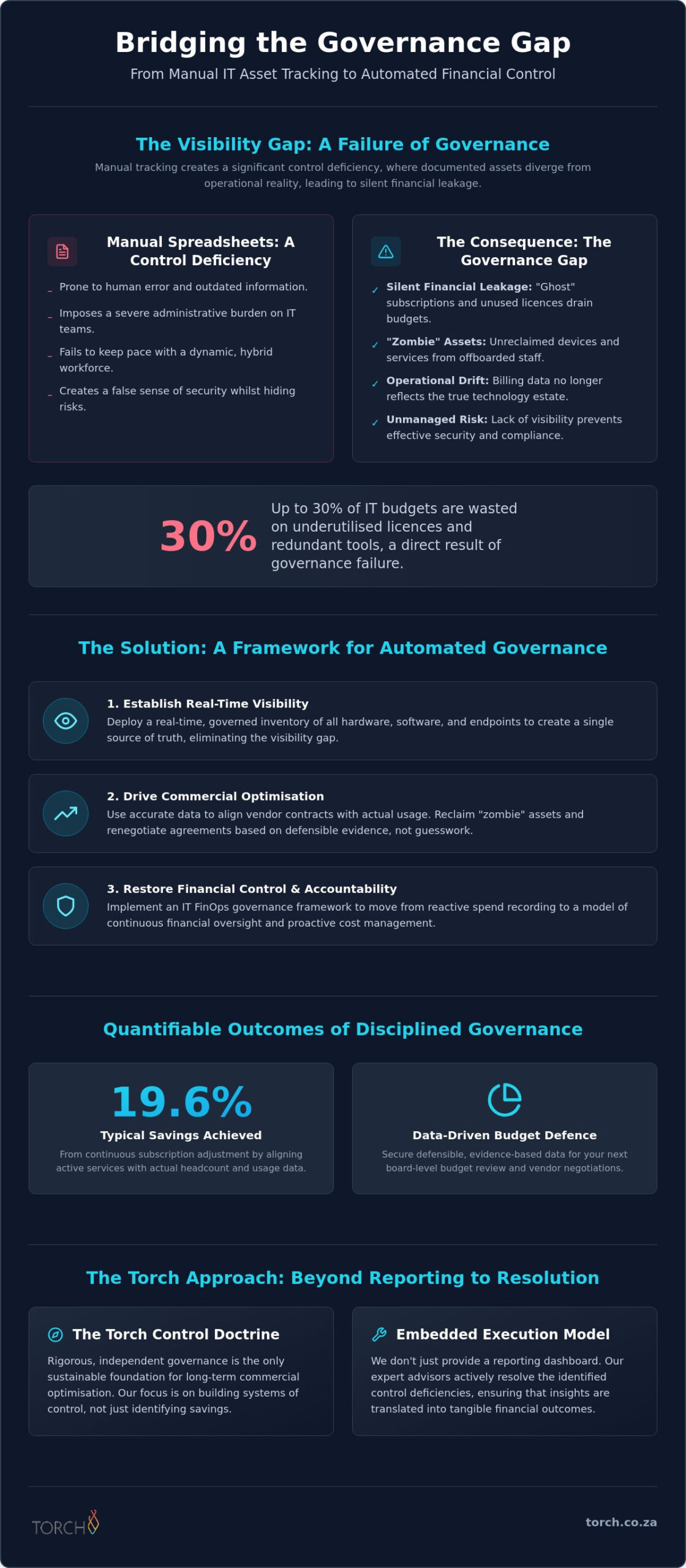
Automated IT asset tracking provides a real-time, governed inventory of all hardware, software, and endpoints across an organisation. It moves beyond a static list to create a dynamic, single source of truth that reflects the current state of the technology estate. This stands in stark contrast to the traditional approach, which often involves manual spreadsheets, disparate departmental records, and decentralised procurement processes. These outdated methods inevitably create a ‘visibility gap’—a blind spot where assets are procured but never properly managed through their lifecycle.
From a strategic perspective, relying on manual tracking is a reactive behaviour that fails to address the core need for governance. It treats assets as a simple inventory to be counted, rather than a portfolio of investments to be actively managed. True governance aligns the reality of asset usage with contractual agreements and financial budgets, transforming IT asset management from an administrative task into a discipline of financial control.
The True Cost of Silent Financial Leakage
The most immediate consequence of the visibility gap is silent financial leakage. When devices, subscriptions, and software licences are not actively managed, they continue to incur costs long after they have ceased to provide value. Unmanaged devices from offboarded employees often retain active SIM cards or software subscriptions, becoming ‘ghost’ assets that drain the budget. This phenomenon, known as ‘operational drift’, describes the gradual divergence between billing data and the reality of asset deployment. Over time, this drift creates a significant ‘governance gap’—the space where wasteful spending occurs, undetected by finance and uncorrected by over-extended IT teams.
Why Spreadsheets are a Control Deficiency
For any large enterprise, spreadsheets are not a tool for asset management; they are a control deficiency. They are highly susceptible to human error, from simple typos to complex formula mistakes, and place an immense administrative burden on teams who should be focused on strategic initiatives. Furthermore, manual tracking cannot keep pace with the fluid nature of modern workforces. In a dispersed, hybrid environment, assets are constantly moving between locations and users, making any spreadsheet-based inventory obsolete almost as soon as it is created.
This is where the need for independent governance becomes critical. To achieve true financial accountability, an organisation must be able to validate vendor billing against an accurate, real-time record of actual asset usage. A spreadsheet can never provide this level of defensible data, leaving the enterprise exposed to billing errors and unable to challenge vendor invoices with confidence.
How Automated IT Asset Tracking Drives Quantifiable Cost Savings
Automating IT asset tracking provides the real-time data necessary for robust ‘commercial optimisation’. With a clear view of every asset, organisations can analyse usage patterns, identify redundancies, and renegotiate vendor contracts from a position of strength. This proactive approach to financial control ensures that every rand spent on technology is justified by its actual use and aligned with strategic business objectives.
The cost-saving opportunities are immediate and substantial. For example, by instantly identifying and reclaiming ‘zombie’ assets from offboarded employees, companies can eliminate recurring subscription and connectivity costs. This direct link between asset visibility and financial control allows budget forecasts to be based on verified usage data rather than historical spending patterns. Furthermore, complete endpoint visibility is a cornerstone of modern cybersecurity, directly reducing ransomware risk by ensuring no device is left unmanaged, unpatched, or unsecured.
Commercial Optimisation and Contractual Alignment
A key benefit of automation is its ability to detect subtle yet costly inefficiencies. An automated system can flag SIM cards that are active but consuming no data, or identify enterprise software licences assigned to users who have not logged in for months. These insights provide the leverage needed for effective contract renegotiation. Armed with precise usage data and market benchmarking, procurement teams can challenge carrier rates and software agreements, ensuring contractual terms align with actual consumption.
This entire process is managed within a structured framework known as IT FinOps, a discipline dedicated to bringing financial accountability and commercial optimisation to the variable spend models of modern technology. It bridges the gap between IT, Finance, and Procurement to manage technology spend as a strategic investment.
Eliminating Wasteful Spending in Telecom and Endpoints
The role of an independent governance partner often embodies the ‘Hero’ archetype: rescuing the budget by meticulously auditing vendor invoices against automated asset logs. This continuous, data-driven process uncovers billing errors, overcharges, and redundant services that would otherwise go unnoticed. Through this rigorous subscription adjustment and invoice validation, our governed clients typically see savings of 19.6% in this specific area alone.
Whilst the Hero archetype focuses on financial recovery, the ‘Caregiver’ role is equally important. Automation supports internal IT teams by offloading the administrative burden of user-level monitoring and asset recovery. By providing clear, actionable data and managing the resolution process, a governance partner empowers internal teams to focus on high-value strategic work rather than chasing down unreturned devices or reconciling billing disputes.
Building a Framework for Automated Asset Governance
The journey towards effective IT asset management involves a deliberate transition from an ‘unmanaged’ to a ‘governed’ technology estate. This requires more than just implementing a new software platform; it demands a shift in mindset towards a culture of continuous oversight and accountability. At Torch, this philosophy is encapsulated in our Control Doctrine: control is the only sustainable form of optimisation. Lasting cost savings are not the result of a one-time audit but the outcome of a permanent governance framework.
A crucial element of this framework is ‘carrier-agnostic’ oversight. An independent advisor without ties to any specific network or software vendor can provide objective analysis and benchmarking, ensuring all recommendations are based solely on the client’s best interests. This framework is built upon Three Control Domains: Financial (budgeting, forecasting, and invoice validation), Commercial (contract negotiation and vendor management), and Operational/Security (endpoint visibility and compliance).
Integrating UEM for Comprehensive Visibility
The technical foundation for asset governance is often provided by a Unified Endpoint Management (UEM) platform. UEM solutions offer the granular, real-time data needed to track the location, status, and security posture of every device, from company-owned laptops to employee-owned smartphones (BYOD). In a BYOD context, modern UEM tools use containerisation to separate corporate data from personal data, enabling selective wiping of business information upon employee offboarding whilst protecting user privacy.
By providing this detailed operational data, UEM serves as the ‘operational anchor’ for financial asset governance. The data it collects on device health, software deployment, and user activity is fed into the governance framework, enabling the financial and commercial controls that drive cost savings.
Establishing a Single Source of Truth with BI Models
To be effective, asset data must be centralised and presented in a way that is meaningful to business leaders. This is where purpose-built Business Intelligence (BI) models are essential. By integrating data from UEM, carrier invoices, and internal systems like Human Resource Management (HRM) and Enterprise Resource Planning (ERP), a BI model creates a single source of truth for all technology spending. Tools like our SpotLight platform provide real-time visibility, allowing finance teams to conduct budget vs. actual oversight with confidence.
This integration is particularly critical for automating the asset offboarding process. When an employee resignation is logged in the HRM system, it can automatically trigger workflows to reclaim hardware, deactivate software licences, and terminate mobile contracts, closing the loop and preventing financial leakage from the moment an employee departs.
Restoring Financial Control: The Torch Approach to Asset Governance
Many organisations believe that purchasing an IT asset management platform is enough to solve their visibility problems. However, platform-only solutions often fail because they lack the dedicated resources and expertise to act on the data they produce. This is the core difference in Torch’s ‘governance-led’ execution model. We contrast this with the common industry approach of simply providing a dashboard and leaving the complex work of analysis and remediation to the client’s already over-extended teams.
Our ‘embedded execution’ strategy means that our own staff are responsible for investigating the issues identified by the data and driving them to resolution. We act as the independent advisor that bridges the gap between Finance, IT, and Procurement, translating operational data into commercial action. This approach elevates asset tracking from a departmental IT function to a board-level strategic imperative, focused on financial control and risk mitigation.
Beyond the Dashboard: Managed Execution
A dashboard is excellent at showing you a problem, but it cannot solve it. Governance ensures problems are solved. Without a dedicated team to analyse the data, challenge vendors, and manage the asset recovery process, even the most sophisticated platform becomes little more than a reporting tool. Our role as a ‘Caregiver’ is to relieve internal teams of this burden through our managed services, providing the manpower and expertise to execute the necessary changes.
This hands-on approach delivers more than just cost savings; it produces defensible financial data. When the CFO is asked to justify technology spend in a boardroom discussion, they can do so with verified, auditable information that connects every line item on an invoice to a specific, actively managed asset.
Securing the Estate through Asset Accountability
The link between asset management and cybersecurity cannot be overstated. With industry data indicating that 85% of ransomware attacks start at unmanaged endpoints, a lack of asset visibility is not just a financial risk but a critical security vulnerability. Every untracked device is a potential entry point for a malicious actor. By ensuring every endpoint is visible, managed, and secured, automated asset governance directly mitigates this risk.
Ultimately, a governed estate is a secure estate. This discipline reduces compliance exposure, minimises operational risk, and provides the executive team with the peace of mind that comes from knowing their technology environment is visible, controlled, and secure. For organisations looking to apply this same level of control to physical infrastructure, Rocatech provides smart automation and advanced security solutions that ensure business premises are as well-governed as the IT network.
Frequently Asked Questions (FAQs)
What is the difference between IT asset tracking and IT asset governance?
IT asset tracking is the process of inventorying technology assets (hardware, software, etc.). It answers the question, “What do we have and where is it?” IT asset governance is a broader strategic discipline that uses this tracking data to enforce financial, commercial, and operational controls. It answers the question, “Are we paying the right price for the assets we are actually using, and are they secure?”
How does automated IT asset tracking help with cloud cost optimisation?
Whilst this guide focuses on physical and licensed assets, the principles are identical. Automated tracking provides visibility into cloud resource consumption, identifying orphaned instances, underutilised virtual machines, and redundant storage. This data is essential for rightsizing cloud environments and aligning spend with actual demand, forming a key part of an effective FinOps strategy.
Can automated tracking reduce the risk of a ransomware attack?
Yes, significantly. A primary vector for ransomware is unmanaged or unpatched devices. Automated tracking ensures complete visibility of all endpoints connected to the network, allowing IT teams to enforce security policies, deploy patches, and isolate non-compliant devices, thereby reducing the attack surface.
Is a dedicated platform enough for effective IT asset management?
A platform is a necessary tool, but it is not sufficient on its own. Effective IT asset management requires a governance framework and dedicated resources to interpret the data, manage vendor relationships, and execute remediation tasks. A platform shows you the problem; a governance service solves it.
How long does it typically take to see cost savings from automated tracking?
Initial cost savings can often be identified within the first 90 days, typically from uncovering ‘ghost’ assets and correcting major billing errors. Deeper, more substantial savings from commercial optimisation and contract renegotiation are realised over the first 6-12 months as the governance framework becomes fully embedded.
What role does an independent advisor play in IT asset procurement?
An independent advisor provides objective, data-driven insights to inform procurement decisions. By benchmarking vendor proposals against market rates and validating new requests against existing asset utilisation, they ensure the organisation only buys what it needs at the most competitive price, preventing the procurement of redundant technology.