
Could the spreadsheet your finance team relies on be the very reason your telecom costs remain stubbornly high? For many CFOs, CIOs, and Finance Directors in South Africa’s mid-to-large enterprises, the familiar grid of an Excel sheet offers a comforting illusion of control. Yet, beneath the surface of manually entered data and VLOOKUP formulas, these static documents often conceal significant financial leakage, operational drift, and unresolved billing errors.
This is not merely an administrative inconvenience; it is a fundamental governance gap. Manual spreadsheets, by their nature, are unable to enforce vendor accountability or provide the dynamic visibility required to manage a complex enterprise telecom estate. This article will uncover why this manual approach facilitates silent financial leakage and map out a strategic transition to a governed, controlled financial model for your technology spend.
The Governance Gap: Why Spreadsheets Fail Telecom Expense Management
In the context of enterprise technology, a governance gap occurs when manual processes lack the rigour, automation, and oversight needed to enforce vendor accountability and financial control. Spreadsheets are the primary enabler of this gap. Whilst familiar and seemingly free, their limitations create an environment where billing inaccuracies, contractual non-compliance, and operational inefficiencies go unchallenged, leading to significant and sustained overspend.
- The Familiarity Trap: CFOs and finance teams trust Excel because it is a known entity. However, this reliance means unknowingly accepting high operational risk. The tool is perceived as a control mechanism, but in reality, it is a passive repository of data that cannot actively interrogate carrier invoices or enforce contractual terms.
- Static Data vs. Dynamic Estates: A monthly spreadsheet is a snapshot in time. It cannot effectively track the constant flux of a modern telecom estate, which involves SIM swaps, new connections, device upgrades, and tariff changes. This disconnect means decisions are based on outdated, incomplete information.
- The Strategic Shift: The objective is evolving beyond simple cost reduction. Leading enterprises now recognise independent financial governance as a strategic imperative, focusing on sustainable control and accountability rather than reactive, one-off savings exercises.
The Illusion of Visibility in Manual Reporting
Looking at numbers in a cell is not the same as having governed oversight. A spreadsheet can tell you what was spent, but it cannot explain why, whether it was correct, or if it aligns with your commercial agreements. This creates a dangerous illusion of visibility, where leadership believes spend is being managed when it is merely being recorded.
For an organisation managing thousands of SIM cards, mobile devices, and data endpoints, stale data is a critical liability. A report compiled weeks after invoices are paid is an archive, not a management tool. It cannot flag a billing error in time to dispute it or identify an unsanctioned data bundle before it consumes the budget. This is how spreadsheets facilitate silent financial leakage; without automated variance analysis, discrepancies are absorbed into the operational budget, becoming part of the accepted cost base month after month.
The Scalability Ceiling for Mid-to-Large Enterprises
A manual, spreadsheet-based approach to invoice reconciliation has a definitive scalability ceiling. For a small business with a few dozen connections, it may be manageable. For a mid-to-large enterprise, however, it quickly becomes unsustainable. Once an estate exceeds a few hundred connections, the complexity of cross-referencing invoices against contracts, asset inventories, and usage data overwhelms even the most diligent finance team.
This places an immense administrative burden on already over-extended finance and procurement professionals, pulling them away from strategic activities and into low-value, repetitive data entry. The scalability ceiling for manual telecom management is the point at which the volume and complexity of the estate make accurate, timely, and complete billing validation impossible without automated, governed systems.
This shift towards digital oversight is common across many technical industries; for example, businesses looking to automate their industrial compliance records can visit SOCWeld to see how they manage welding documentation.
Structural Risks: From Financial Leakage to Operational Drift
The reliance on spreadsheets introduces structural risks that extend far beyond simple budget overruns. These risks are embedded in the manual process itself, from the high probability of human error in data entry to the inability to model complex commercial scenarios. The result is a gradual erosion of financial control and a growing disconnect between contracted services and actual usage—a phenomenon known as operational drift.
- The Cost of Human Error: A single out-of-place parenthesis or an incorrect cell reference in a complex formula can have cascading financial consequences, draining IT budgets silently over months or even years.
- Commercial Optimisation: Spreadsheets cannot perform the complex scenario modelling required to ensure you are on the most commercially advantageous tariffs. They lack the intelligence to compare actual usage against the intricate terms of carrier contracts, leaving significant optimisation opportunities undiscovered.
- Operational Drift: This is the critical disconnect between what you are billed for and what your employees actually use. Spreadsheets cannot track this, leading to payment for ghost assets, underutilised services, and features that deliver no business value. This is one of the many hidden costs in IT procurement that erodes financial health.
The Cost of Human Error in Billing Validation
Whilst industry myths often cite inflated, unbelievable figures, our own analysis at Torch reveals a more precise and actionable truth: billing errors from major carriers typically account for 7-12% of total monthly invoice value. These are not minor mistakes; they are systemic issues that manual audits frequently miss.
Common errors include double billing for a single service, incorrect tariff application, and failure to apply agreed-upon discounts. The complexity of pro-rata charges and mid-month contract changes makes validation in Excel exceptionally difficult and prone to error. A governed Telecom Expense Management (TEM) framework provides a systematic and rigorous correction of these overcharges, moving from manual spot-checks to comprehensive, automated validation of every line item on every invoice.
Security and Managed Risk Exposure
The governance gap created by spreadsheets is not just a financial issue; it is a significant security concern. A lack of real-time asset visibility means your organisation cannot account for every device connected to its network. Industry data suggests a strong link between unmanaged assets and security breaches, with many ransomware attacks originating from unmanaged or unpatched endpoints.
Effective asset visibility is the foundational prerequisite for a robust Unified Endpoint Management (UEM) strategy. If you don’t know a device exists, you cannot manage, patch, or secure it. This creates a tangible managed risk exposure. Furthermore, the presence of “ghost” SIMs and unaccounted-for devices introduces serious compliance risks, particularly concerning data governance regulations like South Africa’s Protection of Personal Information Act (POPIA).
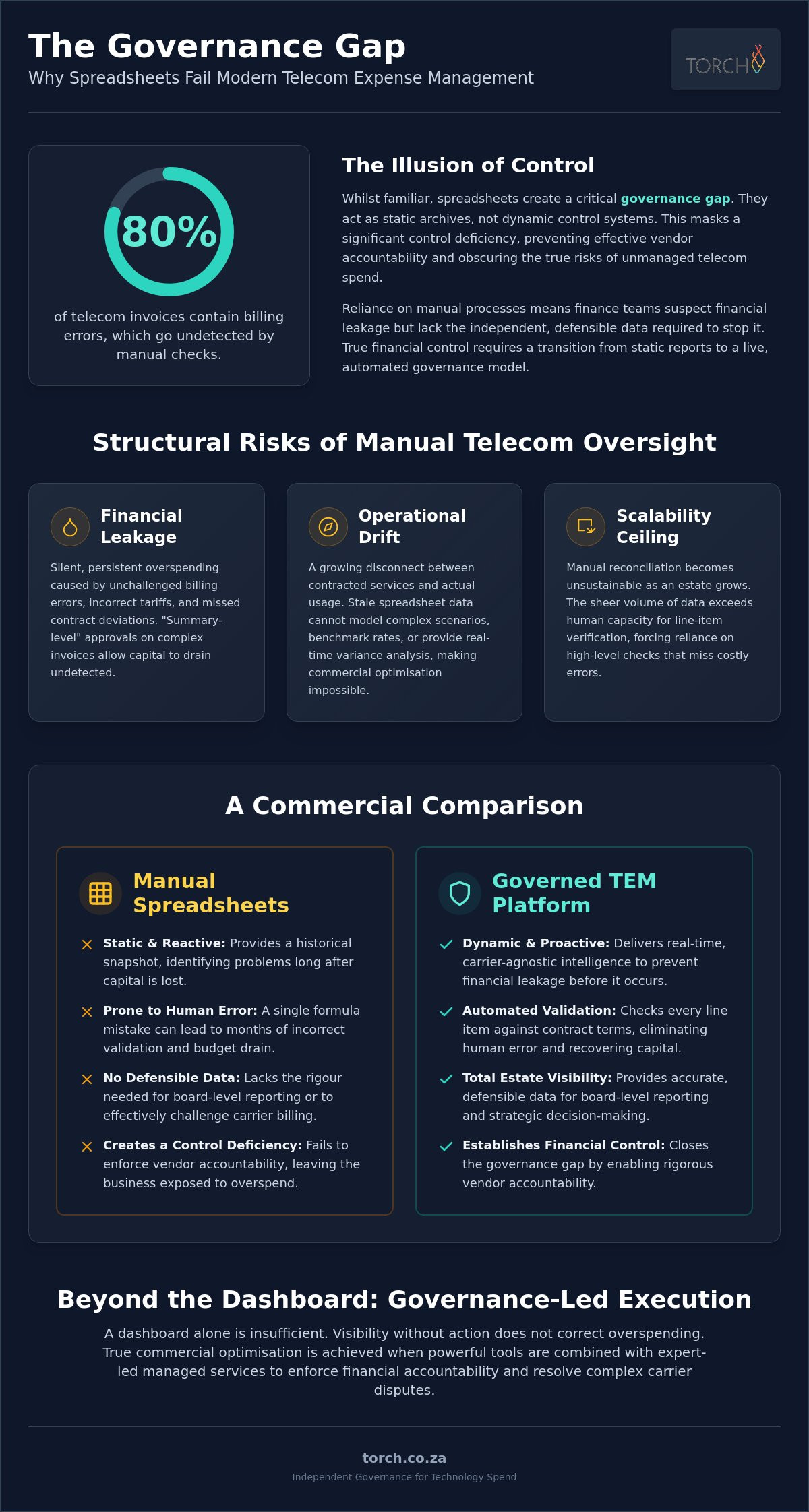
TEM Platform vs Manual Spreadsheets: A Commercial Comparison
Transitioning from spreadsheets to a dedicated Telecom Expense Management (TEM) platform is not simply about swapping one tool for another. It represents a fundamental shift from passive data recording to active financial governance. The commercial comparison extends beyond features to encompass visibility, accountability, and the quality of data available for strategic decision-making.
- Real-Time Analytics vs. Static Snapshots: A TEM platform moves your organisation from reviewing what happened last month to understanding what is happening right now, enabling proactive intervention rather than reactive analysis.
- Carrier-Agnostic Benchmarking: Relying on carrier-provided data is akin to allowing a vendor to mark their own homework. An independent TEM partner uses proprietary market intelligence, such as our TorchLight™ analytics engine, to benchmark your spending against the broader South African market, ensuring your rates are not just correct but also competitive.
- Automated Variance Analysis: A key function of a TEM platform is to detect silent financial leakage the moment it occurs by automatically flagging any deviation from expected costs or contractual terms.
- Centralised Governance: A platform provides a single, indisputable version of the truth, eliminating the fragmented and often contradictory spreadsheets held by Finance, IT, and Procurement.
Centralised Governance vs. Fragmented File Sharing
One of the most significant risks of a spreadsheet-led approach is the proliferation of multiple “final_final_v2” versions of a file across different departments. This fragmentation erodes confidence in the numbers and undermines financial reporting. When the CFO and CIO are working from different data sets, strategic alignment becomes impossible.
A governed IT FinOps model, powered by a central platform, restores this confidence. It ensures that all stakeholders are viewing the same validated, real-time information. This creates defensible financial data, which is the cornerstone of effective board-level reporting: it is complete, accurate, auditable, and provides the clear context needed for strategic oversight and capital allocation decisions.
Efficiency and Resource Allocation
The time and effort your teams spend on manual data entry, invoice matching, and dispute resolution represent a significant hidden cost. By automating these repetitive tasks, a managed TEM service redirects your highly skilled finance and IT professionals towards high-value strategic initiatives that drive business growth.
The return on investment (ROI) of moving to a managed service model is compelling when compared to the internal cost of manual labour. It is not just about the hours saved; it is about the value created when your best people are focused on commercial optimisation and strategic vendor management instead of administrative reconciliation. Automated systems drastically reduce the daily administrative burden, freeing IT teams to focus on service delivery and innovation.
Beyond the Dashboard: Why Governance-Led Execution Wins
Many organisations fall into the “Platform Trap,” believing that simply implementing a software tool will solve their telecom spend challenges. But a dashboard, no matter how sophisticated, is insufficient for resolving financial leakage. It can show you a problem, but it cannot solve it. A dashboard might highlight a R150,000 billing discrepancy; it cannot pick up the phone, navigate the carrier’s bureaucracy, and negotiate a credit note.
- Embedded Execution: This is where the role of managed services becomes critical. True value lies not in the data alone, but in the expert-led execution that uses that data to drive resolution. This involves actively managing carrier disputes, renegotiating contracts, and implementing optimisation changes.
- The Torch Control Architecture: Our approach combines powerful proprietary tools like TorchLight™ (for analytics) and SpotLight™ (for asset management) with expert-led governance. This architecture ensures that insight is always paired with action.
- A Structured Transition: Moving away from spreadsheets does not have to be an overwhelming administrative burden. A structured, phased approach, guided by an experienced partner, ensures a smooth transition to full visibility and control.
Moving from Reporting to Resolution
Data without interpretation and action is just noise. A Sage advisor—an expert who understands the nuances of the South African carrier landscape—is needed to interpret the data, identify the root cause of overspend, and drive vendor accountability. This requires deep industry knowledge and carrier-agnostic negotiation skills to ensure your contracts are not only fair but also fully optimised for your usage profile.
At Torch, our specialists act as a dedicated extension of your finance and procurement teams. We handle the time-consuming process of dispute resolution and credit recovery, ensuring that identified errors are not just reported but rectified, with the financial benefits returned directly to your bottom line.
Achieving Sustainable Optimisation
Many organisations are caught in a cycle of one-time savings projects that yield temporary results, only for costs to creep back up over time. This is because they address the symptoms, not the underlying lack of governance. The Torch Control Doctrine is simple: control is the only sustainable form of optimisation.
By establishing a framework of continuous, independent governance, you move beyond short-term fixes to build a long-term technology lifecycle management strategy. This ensures that your telecom estate remains optimised, compliant, and aligned with your business objectives month after month. The ultimate strategic value lies not in a single cost-cutting event, but in the enduring financial control and accountability delivered by true independent governance.
Take Control of Your Telecom Spend
If you suspect your spreadsheets are hiding more than they reveal, it is time to transition from passive reporting to active governance. Eliminate the risks of unmanaged telecom spend and achieve total visibility and control over your technology estate.
Book a 30-minute governance review with Derek King — no obligation, no sales pitch
- Independent, carrier-agnostic governance
- Up to 47.2% total savings in governed estates
- Over 20 years of experience in the South African market
Frequently Asked Questions (FAQ)
- Is it risky to manage enterprise telecom spend in Excel?
- Yes, it is extremely risky for mid-to-large enterprises. Spreadsheets create a significant governance gap by being prone to human error, lacking real-time data, and being unable to scale. This leads to silent financial leakage, poor visibility, and a lack of vendor accountability.
- What are the most common errors found in manual telecom billing audits?
- The most common errors include incorrect tariff plans being applied, charges for ceased services, double billing, and failure to apply contractual discounts. Our analysis shows these billing errors typically account for 7-12% of the total monthly invoice value, which manual spot-checks often miss.
- How does a TEM platform differ from a standard financial reporting tool?
- A standard financial tool reports on what was spent. A TEM platform is a specialised governance tool that validates spend against contracts and assets, automates invoice processing, analyses usage for optimisation, and provides the intelligence to control future costs. It moves from passive reporting to active management.
- Can a TEM platform help with South African carrier billing complexities?
- Absolutely. A robust TEM solution, especially when combined with a managed service, is designed specifically to navigate the billing complexities of South African carriers like Vodacom, MTN, and Telkom. It understands their unique billing structures, pro-rata charge calculations, and invoice formats to ensure accuracy.
- How much can a business save by moving from spreadsheets to a governed TEM model?
- While results vary, businesses that implement a fully governed TEM model can achieve significant results. Torch has delivered total savings of up to 47.2% in actively governed estates. These gains come from error correction, contract optimisation, and eliminating wasteful spending through improved visibility and control.
- Does a TEM platform require a full replacement of our current IT infrastructure?
- No. A modern, cloud-based TEM platform and managed service integrates with your existing systems. It does not require a “rip and replace” of your infrastructure. The goal is to enhance your financial and operational control with minimal disruption to your core business processes.