
A software purchase is easy to approve; its full cost is harder to see. A business case for IT expense management software should set out the problem, the full cost of ownership, the expected financial and operational benefits, implementation requirements, risks and measures of success. Its purpose is to help decision-makers judge whether the investment is justified and how it will strengthen oversight of IT spending.
A business case for IT expense management software should compare more than the software price with projected savings. Account for recurring charges, support, implementation and the internal effort needed to manage the solution. Distinguish capital expenditure (CapEx) from operating expenditure (OpEx) for planning, while recognising that the appropriate accounting treatment depends on the purchase and the organisation’s accounting policies.
This article explains which costs to include, how to frame the CapEx and OpEx distinction, and what a persuasive business case should cover. It also shows how to link proposed benefits, such as stronger invoice validation and lifecycle control, to clear assumptions and measurable outcomes so finance and IT can assess the decision consistently. Effective cost governance can also reduce security exposure by improving visibility of assets, users and services, helping organisations identify unsupported, unpatched or unauthorised technology and maintain stronger audit evidence.
Key Takeaways
- Build a complete cost picture by including licences, subscriptions, support, implementation and the internal effort required to manage software.
- Assess CapEx and OpEx according to the nature of each purchase, and apply your organisation’s accounting policies to the treatment.
- Connect the investment rationale to specific governance gaps, such as invoice discrepancies, incomplete inventories and weak renewal controls.
- Set out costs, expected benefits, risks, implementation needs and measures of success so decision-makers can evaluate the proposal clearly.
- Consider how invoice reconciliation, asset management and IT finance support can improve visibility across technology expenditure.
Software expense categories and total cost of ownership
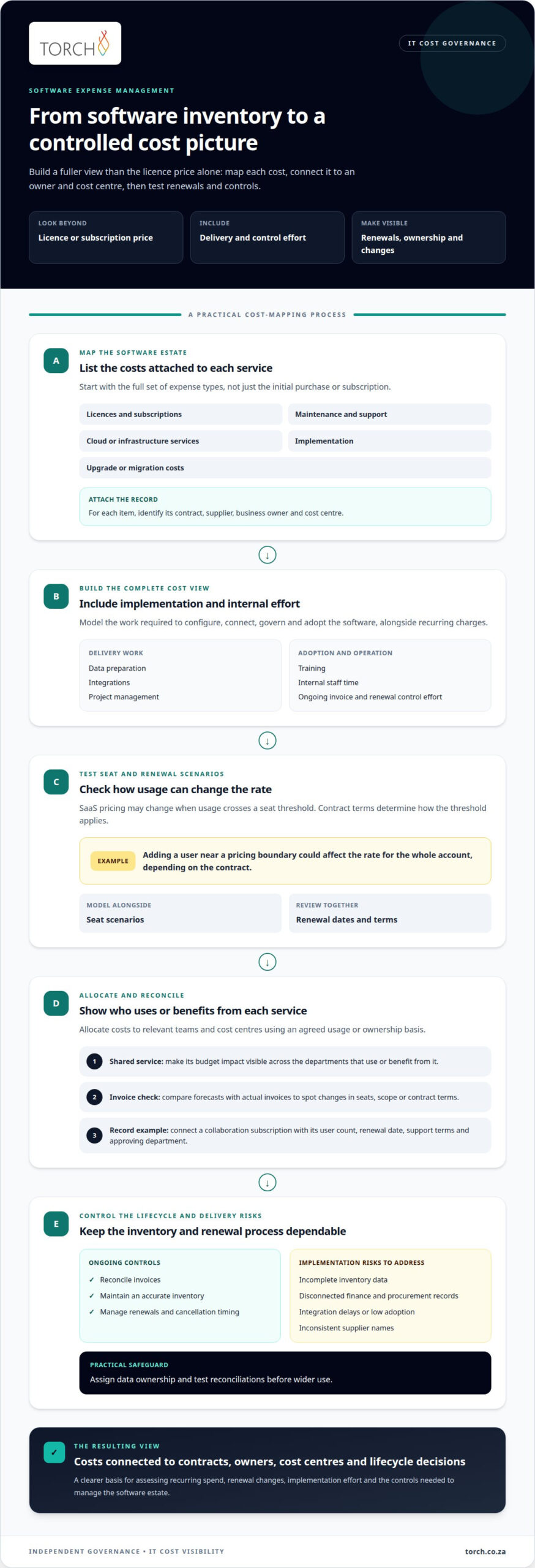
Software’s total cost of ownership goes beyond its licence or subscription price. For a complete view, link each expense to the service, owner, cost centre and lifecycle stage.
Implementation costs and pricing thresholds
Implementation costs cover the work needed to configure, connect, govern and adopt software beyond its subscription charge. Include data preparation, integrations, project management, training and internal staff time in the investment model.
SaaS pricing can change at user thresholds: a contract may charge one rate within a seat band, then apply a higher tier when usage crosses its boundary. For example, adding a user near a pricing threshold could affect the rate for the whole account, depending on contract terms. Model seat scenarios alongside renewals rather than as isolated purchases.
Map the full software estate by expense type: licences and subscriptions, maintenance and support, cloud or infrastructure services, implementation, and upgrade or migration costs. Then connect each item to its contract, supplier, business owner and cost centre. For example, show a collaboration subscription alongside its user count, renewal date, support terms and approving department, or track industry-specific tools such as Fuel360 against operational cost centres.
For South African planning, distinguish tax classification, POPIA-related personal-information handling and procurement controls when assessing software expenditure. These considerations affect how costs are recorded, what information the system processes and how purchases align with internal approval processes.
Software cost growth and budget allocation
Software asset cost growth is the increase in expenditure as licensing, support, usage and service requirements change over time. Budget for recurring charges and renewal changes rather than simply repeating the previous year’s allocation.
Allocate costs to the teams and cost centres that use or benefit from each service. For example, apportion a shared analytics subscription using an agreed usage or ownership basis, making its budget impact visible across departments. Compare forecasts with actual invoices to spot changes in seats, scope or contract terms.
Total cost of ownership also includes control effort and lifecycle decisions. A licence retained after a user leaves can continue generating recurring charges; delayed cancellation may extend that exposure through another renewal period. Include the work needed to reconcile invoices, maintain an accurate inventory and manage renewals. For telecom expenditure, Telecom Expense Management connects recurring charges with services and account records.
Implementation risks include incomplete inventory data, disconnected finance and procurement records, integration delays and low adoption. For example, inconsistent supplier names can make invoice matching unreliable. Assign data ownership and test reconciliations before wider use.
CapEx versus OpEx treatment of software
CapEx and OpEx distinguish investment in an asset from spending on services used during operations. For software, the accounting treatment depends on what the organisation acquires, how it controls the resource and its accounting policies. Hardware such as servers is generally capitalised and depreciated, while recurring SaaS subscriptions and support are generally operating expenses. These are broad treatments, not substitutes for reviewing the specific arrangement.
Separate the components before assigning a category. For example, a bundled IT agreement might include hardware, a software licence, implementation and ongoing maintenance. Those elements may require different treatment, so the invoice and contract should document each component and its purpose. A perpetual licence that gives the organisation a controlled software asset may be assessed differently from access to an externally hosted service. The label on a supplier invoice alone does not settle the accounting question.
Internal and external systems also have different cost profiles. Software developed or hosted internally can involve infrastructure, staff time, maintenance and upgrades; an external SaaS service usually has recurring subscription charges and supplier support. A hybrid arrangement may combine both. For example, an organisation could run an internal application while paying an external supplier for cloud hosting and support. Its accounting workflow should distinguish those charges rather than treating the arrangement as one undivided expense.
IT expense management software focuses on technology charges, contracts, suppliers and assets. Spreadsheets can record a manually maintained view, but they rely on timely updates and consistent ownership. ERP tools support broader financial workflows, including purchase orders and accounting entries; specialised expense management can add detail about services, users, renewals and billed items. These tools can complement one another: an invoice workflow might match a supplier charge to contract records, then pass approved financial data into the ERP.
For each material purchase, document the contract terms, service period, ownership, implementation components and maintenance obligations. Then map each line item to the organisation’s accounting policy and approval workflow. A subscription paid in advance, for example, may relate to service delivered over a period, while a server purchase has a different asset profile. Finance and IT should agree on the underlying facts before budgets, forecasts and reporting use the classification.
That distinction matters in a business case because CapEx and OpEx affect budget presentation and the timing of reported expenses. Keep the assumptions visible, especially for mixed internal and external arrangements. A governance review can help structure the discussion around software charges, ownership and cost allocation.
Purpose and benefits of a software business case
A software business case gives finance, IT and procurement a shared basis for deciding whether an investment addresses a defined challenge. For an IT expense management proposal, connect current control gaps with expected financial and operational outcomes, implementation requirements and the evidence used to assess progress.
Start with a clear decision. For example, finance may be unable to reliably connect technology invoices to active services, approved contracts or accountable owners. The business case should explain the impact of that gap, identify the proposed response and show how the decision supports business priorities. Record alternatives too, including improving an existing workflow instead of buying new software.
Financial benefits come from making expenditure easier to validate and govern. A proposal can model value from correcting billing discrepancies, recovering credits, disconnecting unnecessary services, improving inventory accuracy and managing supplier terms. Treat each as a separate assumption: identify its evidence, responsible owner and expected timing. This helps finance distinguish recurring effects from one-off corrections instead of presenting them as a single projected saving.
Software benefits extend beyond invoice checks. A central inventory can connect a service to its users, owner, contract and renewal date, helping teams identify overlapping licences, unmanaged renewals or assets without clear accountability. For example, an application renewal workflow can flag a contract for review before approval, giving IT time to confirm ongoing need and procurement time to assess the terms.
Choose features that directly support the required controls: invoice validation against contracts and purchase orders, a searchable inventory, renewal tracking, cost allocation, approval workflows and reporting by supplier or cost centre. Integration with finance systems can reduce duplicate data handling, while role-based access and an audit trail help document decisions. Prioritise fit with the organisation’s purchasing and accounting processes over the longest feature list.
Apply the same discipline to operational benefits as to financial ones. If staff spend time reconciling invoices manually, define which workflow the proposed system would change, which teams are involved and how implementation will be scheduled. Include data preparation, integration testing, training and ongoing ownership. For example, a phased rollout can start with one supplier category, test invoice matching, then inform wider deployment.
A strong business case for IT expense management software makes assumptions visible and outcomes measurable. Set a baseline, assign each measure to an owner and schedule reviews after implementation. Measures might include invoice exceptions resolved, renewal decisions completed before approval, or assets linked to cost centres. This gives decision-makers a practical way to assess whether the investment addresses the original challenges.
Business case purpose and contents
Build the case by documenting current expense-management challenges, assessing options, and presenting expected benefits, risks and delivery requirements. This gives executive leadership a structured basis for deciding whether the proposal supports IT cost governance and merits investment.
Purpose of a business case
A business case connects a defined IT expense-management problem to a proposed response and its expected outcomes. It matters because finance, IT and procurement need a shared rationale before committing budget, staff time or system changes.
For example, an organisation may struggle to reconcile supplier invoices with contracts and active services. Explain the impact of this gap, identify the decisions required and show how improved controls would address it. State the baseline and assumptions clearly so leadership can distinguish evidence from projections.
ISO/IEC 19770 and ITIL 4 can provide useful references when defining asset-management and IT service-management practices. Use them to frame governance expectations and responsibilities, then relate the proposed approach to the organisation’s existing processes.
Building the case and setting out its contents
Building the case means bringing evidence, a delivery plan and a financial rationale together in a decision document. A clear structure helps executives understand what will change, who owns the work and how outcomes will be assessed.
Begin with the current state: describe inventory gaps, invoice-validation challenges, supplier or agreement risks, and relevant internal workflows. Then set out the project overview, scope, main system components and external connections. For example, explain how invoice records will connect with contract data and finance reporting.
Make the cost model transparent. Include software, implementation, data preparation, integration, training and ongoing support, along with internal staff effort. Include related costs even when they sit outside the project budget, so the proposal reflects the resources required. Separate one-off expenditure from recurring charges and state the assumptions behind each expected benefit.
Set out the delivery schedule, ownership and adoption plan. Identify the teams responsible for data quality, approvals, integrations and user support. For example, explain how invoice validation will be tested before wider deployment and who will resolve exceptions. This makes dependencies visible instead of treating implementation as software installation alone.
Finally, define how leadership will assess performance. Link each measure to a baseline, an owner and a review point. Measures could include discrepancies resolved or assets linked to accountable cost centres. Present risks, support arrangements and reporting needs alongside expected benefits, giving decision-makers a balanced view of value and ongoing responsibilities.
Torch Services: Telecom Expense Management
Torch Services is independent, carrier-agnostic and vendor-neutral, with no commissions. Its proposition is “One Partner, Six Integrated Service Lines”, supporting organisations that need clearer governance across telecom and IT expenditure.
Telecom Expense Management supports oversight of telecom charges. IT FinOps-as-a-Service covers invoice reconciliation and variance analysis against contracts and purchase orders, as well as accruals, journals, recharges, budgeting and forecasting support, vendor and procurement engagement, and monthly IT finance packs. TorchLight™ supports cost allocation, modelling and scenario planning, while PowerBI integration supplies real-time analytics for strategic decision-making.
The asset-management service maintains a full asset register, with every asset attributed to an owner and cost centre and tracked from procurement to decommission. ITAM, UEM and FinOps share this view, helping teams connect costs, assets and accountability.
To discuss your IT expense governance needs, contact Torch Services.
Turn the business case into sustained governance
Approval marks the start of the work, not its finish. A business case for IT expense management software becomes useful when its assumptions lead to clear ownership, defined workflows and regular review. Assign responsibility for resolving exceptions, managing renewals and keeping service records aligned with business use. That turns a decision into an operating discipline rather than a one-off project.
Apply the agreed measures consistently and give teams a clear route for escalating issues. This helps finance and IT track whether governance changes are being adopted and where further attention is needed.
Discuss your organisation’s IT cost governance priorities in a 30-minute review with Derek King, with no obligation or sales pitch.
A considered next step can help make IT spending more accountable and manageable.
Frequently Asked Questions
What is IT expense management software and what costs does it track?
IT expense management software helps organisations organise and analyse technology expenditure across suppliers, services and business owners. Depending on its scope, records may cover telecom charges, software subscriptions, cloud services, hardware-related costs, support and supplier agreements. For example, finance can use a consistent view to trace a mobile service charge to its account and responsible team. This supports more informed review of technology spend without replacing accounting systems.
What are the business benefits of IT expense management software?
Benefits include clearer ownership of technology charges, stronger invoice scrutiny and better information for renewal decisions. A business case for IT expense management software can also connect expenditure data with operational priorities, helping leaders identify where controls need attention. For instance, a department reviewing a service renewal can use usage and ownership records to decide whether the service still meets its needs, rather than relying only on last year’s budget.
How much can IT expense management software reduce IT spending?
Assess the financial impact using verified changes in your organisation’s own expenditure, rather than assuming a standard reduction. Establish a baseline, then track confirmed billing corrections, credits received, unused services removed and contract changes implemented. Separate one-off recoveries from ongoing changes, and record the evidence and owner for each item. This creates a credible view of realised impact and distinguishes completed actions from projected savings.
What is the typical ROI and payback period for IT expense management software?
Calculate return on investment by subtracting investment costs from measured gains, then dividing by those costs. Estimate payback by comparing cumulative, evidenced benefits with implementation and ongoing costs over time. Include internal effort, integration, training and support in the cost model; count only benefits linked to documented actions. For example, a validated invoice correction belongs in realised gains, while a proposed renewal change remains a forecast until it takes effect.