
A cloud bill is more than a usage total: it reflects decisions about capacity, data movement and who owns each service. A cloud services cost management framework brings those costs into view, assigns them to teams or workloads, and connects spending decisions with business needs. FinOps gives Finance, IT and engineering a shared way to manage those trade-offs.
Unpredictable budgets and fragmented reports make it difficult to explain changes in cloud spending or determine whether they delivered value. Data-transfer fees add complexity: moving information between services or locations can create charges that are easy to miss when costs are reviewed separately.
This guide explains cloud cost management, why forecasting and reporting can become unreliable, and how to account for transfer costs. It also shows how FinOps supports ongoing visibility, accountability and informed decisions, helping teams manage cloud expenditure with greater clarity.
Key Takeaways
- Use showback to make consumption visible and chargeback to assign its financial impact, where your organisation’s policy calls for it.
- Build rolling forecasts from usage trends and unit costs, rather than relying on static budgets or best-guess commitments.
- Trace data-transfer charges to the workloads and services driving them, then assess whether placement, caching or local processing could reduce unnecessary movement.
- Normalise billing data across cloud environments and apply consistent metadata so spending can be allocated to the right teams, projects or owners.
- Use FinOps to bring Finance, IT and engineering into ongoing decisions about cloud cost, performance and business value.
1. Budget unpredictability and fragmented reporting
Cloud budgets become difficult to explain when forecasts rely on fixed assumptions instead of changing workloads. A FinOps practice starts with the drivers of consumption: compute demand, storage growth, data movement and planned product releases. Finance and engineering can then connect forecast changes to operational decisions, such as launching a service in another region or retaining more data.
Build driver-based forecasts from usage patterns and unit metrics, then update them through rolling planning cycles. For example, before launching an application, a team can model expected user activity, storage demand and service configuration. Compare actual consumption with those assumptions each reporting period, identify the cause of any variance and revise the forecast when demand changes.
Fragmented reports obscure these drivers when cloud invoices, account dashboards and internal cost-centre records use different labels. Establish consistent ownership metadata for teams, services and projects, then map billing records to that structure. Finance and engineering can then see which workloads changed and whether the change supports a business requirement.
Budgets need monitoring as well as forecasting. Set alerts against approved budgets and projected usage, then route each alert to the team responsible for the affected workload. Spending controls can flag unusual consumption or prevent specified actions under agreed policies. Automate notifications where possible, while retaining a clear escalation path for releases that legitimately increase demand.
Risks include outdated forecasts, missing ownership tags and alerts without enough context to prompt action. These gaps can leave unexpected consumption unexplained, delay intervention and encourage broad cuts that affect service performance. Base rightsizing on workload evidence, not blanket reductions, so optimisation addresses idle capacity without compromising the service.
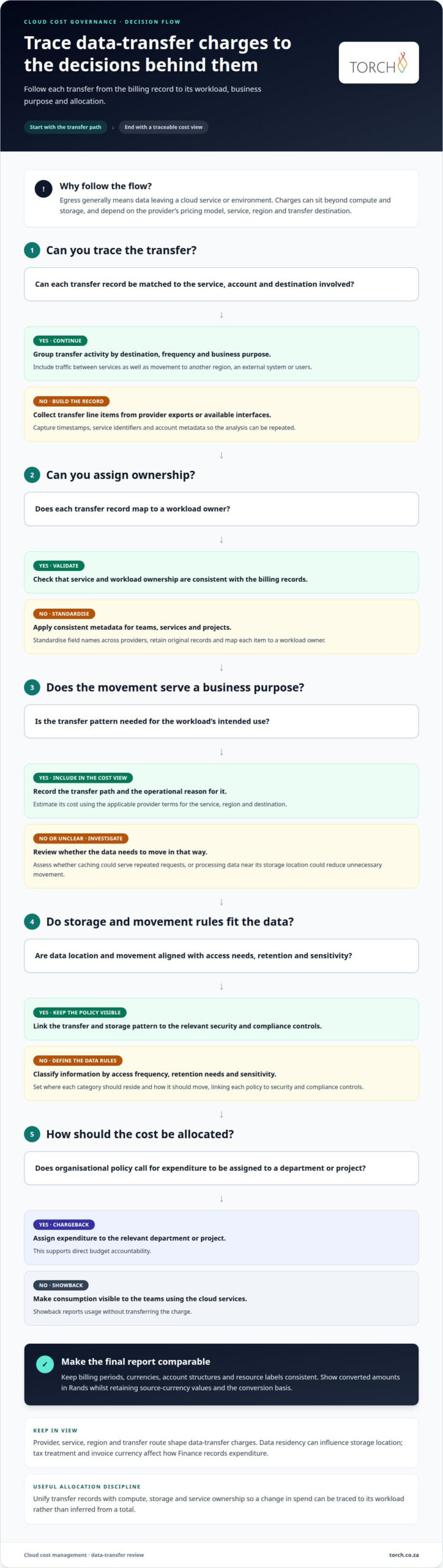
Showback reports cloud consumption to the teams using it, making costs visible without transferring the charge. Chargeback assigns expenditure to a department or project, supporting direct budget accountability. The right approach depends on internal policy; either method requires consistent allocation rules and enough detail to explain shared services.
Use rand-denominated reports and align cloud categories with existing IT cost reporting. For example, a finance pack can show a project’s cloud usage beside its other technology costs, while preserving the underlying service detail. Telecom expense management applies similar allocation discipline to telecom expenditure, helping organisations interpret IT spending across distinct cost categories.
2. Egress charges and data-transfer costs
For South African workloads, the provider, service, region and transfer route shape data-transfer charges. Data residency requirements can influence storage location, while tax treatment and invoice currency affect how Finance records expenditure. Compare applicable provider terms with organisational requirements before choosing a deployment pattern.
Egress generally means data leaving a cloud service or environment. Charges depend on the provider’s pricing model and the transfer destination. A workload that sends large datasets to another region, an external system or users may incur costs beyond compute and storage. Map each transfer path, including traffic between services, before estimating total consumption.
Engineering teams can investigate transfer drivers step by step. First, identify which instances and services send or receive data. Then group flows by destination, frequency and business purpose. For example, caching can serve repeated requests for the same information, while processing data near its storage location can reduce unnecessary movement.
Programmatic access to billing and usage data makes this analysis repeatable. Use provider exports or available interfaces to collect transfer line items, timestamps, service identifiers and account metadata. Standardise field names across providers, retain original records and map each item to a workload owner. This makes cost allocation traceable instead of dependent on manual spreadsheet interpretation.
Data lifecycle governance also affects transfer and storage patterns. Classify information by access frequency, retention needs and sensitivity, then define where each category should reside and how it should move. For example, an infrequently accessed archive dataset may need a different storage policy from operational data. Link each policy to security and compliance controls so cost optimisation does not weaken access safeguards.
Unifying cost data connects transfer records with compute, storage and service ownership. Keep billing periods, currencies, account structures and resource labels consistent across reports. Show converted amounts in Rands while preserving source-currency values and the conversion basis. This helps Finance distinguish a genuine change in consumption from a reporting difference.
Where transfer patterns cross teams or environments, a structured review can clarify ownership and allocation rules. Book a cloud cost governance discussion to examine how those flows fit your wider IT cost controls.
Egress costs vary by provider pricing model, service, region and transfer destination, so compare the applicable terms for each transfer path. Data residency requirements can shape storage location, while tax treatment and invoice currency affect how Finance records costs. Provider-specific rates and tax details are not covered here.
3. What Is Cloud Cost Management?
Cloud cost management means understanding, allocating and governing expenditure across cloud services. In a multi-cloud environment, providers may describe comparable resources differently. Normalisation translates billing records into a consistent view, allowing Finance to analyse compute, storage and support charges together. Keep original provider fields alongside standard categories to preserve traceability.
Start by mapping each provider’s account, service, resource, usage period and charge fields to a shared reporting structure. Then align naming conventions for business units, applications and environments. For example, records labelled “production”, “prod” and “live” can map to one approved environment category. This improves cloud spend analysis without obscuring the source of each charge.
Tags and governance policies connect consumption to accountable owners. Define required metadata for services, such as application, team, environment and cost centre, then validate it when resources are created. A compute instance without an owner tag is difficult to allocate; a consistent tag links its charges to the responsible team. Review exceptions and correct missing or inconsistent values during routine cost reporting.
Not every expense belongs to one team. Shared networks, monitoring services or central data platforms may support several applications. Set an allocation policy based on a defensible driver, such as usage, capacity or an agreed departmental share. Document the method and apply it consistently across reporting periods. This makes shared-cost allocation explainable instead of dependent on arbitrary adjustments.
Unit economics connect cloud spending to delivered activity. Choose a business measure that reflects the service, such as cost per transaction, customer account or processed data set. Compare that measure with service volume and allocated cloud expenditure over the same period. If total spend rises while transaction volume rises faster, unit cost may improve. If spend rises faster, investigate workload changes and resource configuration.
Effective allocation creates accountability without treating every increase as waste. Engineering can explain the technical driver, while Finance assesses the cost against the service’s business value. A cloud cost optimisation review can distinguish necessary growth from idle capacity, duplicated services or inconsistent allocation. These practices form the operating discipline behind a cloud services cost management framework: consistent data, transparent policies and decisions informed by actual use.
4. Cloud cost management and FinOps
FinOps makes cloud cost management an ongoing operating practice, not a Finance-only reporting task. Finance, IT and engineering consider usage, pricing and business priorities before deciding how to deploy or change workloads. The goal is to make cloud costs visible while balancing delivery speed, performance and budget needs. An increase can be justified when it supports a valuable service or growing demand.
FinOps works through a recurring cycle. Teams review cloud usage and allocation, identify a variance or design choice, agree on an action and measure its effect. For example, engineering might assess whether an oversized compute resource needs rightsizing before changing production capacity. Finance can then evaluate the cost effect alongside the service’s requirements, rather than treating lower spend as the only measure of success.
Clear governance defines who can make decisions and which controls apply. Assign ownership for each environment, establish approval paths for material changes, and review budget alerts alongside service performance. Scheduling a development environment to stop outside working periods may reduce idle consumption. A production environment, by contrast, may require continuous capacity to meet operational needs.
Forecasts should inform commercial as well as technical choices. Before committing to a pricing arrangement, compare expected usage with historical consumption and planned deployments. Review licence requirements and cloud consumption together, so one optimisation decision does not create avoidable expenditure elsewhere.
FinOps also needs to account for security and operational risk. For example, removing a storage control or reducing monitoring to lower a bill may expose sensitive workloads or weaken visibility. Include security requirements, data handling and service performance in review criteria. This keeps governance focused on sustainable optimisation, rather than short-term changes that shift costs or risks between teams.
The cost of cloud cost management tools and FinOps support depends on scope, data sources, integrations, reporting needs and the number of environments involved. Tool pricing models vary. Assess total cost alongside implementation and ongoing operating requirements, with amounts stated in Rands.
A useful FinOps review connects billing evidence to decisions: which workloads drive consumption, who owns them, what the service delivers and what action is appropriate. Apply that sequence across environments, then track whether the decision improved cost visibility without compromising performance or governance.
Torch Services: IT FinOps-as-a-Service
Torch Services’ IT FinOps-as-a-Service helps organisations strengthen IT cost governance when expenditure is difficult to reconcile, forecast or allocate. The service supports invoice reconciliation and variance analysis against contracts and purchase orders, accruals, journals and recharges, budgeting and forecasting, and vendor and procurement engagement.
As an independent, carrier-agnostic and vendor-neutral partner with no carrier commissions, Torch Services brings an objective perspective to IT spend. Its proposition is “One Partner, Six Integrated Service Lines”, supporting a joined-up approach to technology governance without reducing FinOps to cloud costs alone.
If you need a more structured view of IT expenditure and its drivers, contact Torch Services to discuss your requirements.
Turn cloud visibility into better decisions
A cloud services cost management framework is valuable when it changes how teams make decisions, not just how they report expenditure. Start with a cloud service or workload where ownership, business purpose and cost can be considered together. Use the review to agree how future changes will be assessed, including their effects on delivery, performance and managed risk exposure.
This creates a practical basis for ongoing commercial optimisation. Cost cutting asks where expenditure can be removed; spend optimisation asks what each rand delivers. This distinction helps decision-makers support valuable investment while addressing governance gaps that make spending difficult to explain or manage.
For organisations seeking support to connect cloud costs with wider IT expenditure, Torch Services’ IT FinOps-as-a-Service can help establish consistent reporting and financial processes. A discussion can clarify the priorities and operating needs that should shape the next steps.
A focused conversation can clarify the next steps, while better visibility gives teams a firmer basis for action.
Frequently Asked Questions
What Is Cloud Cost Management?
Cloud cost management is the ongoing oversight of expenditure on cloud resources and services. It helps an organisation understand what it pays for and assess whether that spending supports business activity. For example, a database may become more expensive as an application gains users. Reviewing its usage alongside service demand helps teams decide whether to adjust capacity, configuration or application design.
What is a cloud services cost management framework?
A cloud services cost management framework is a set of agreed processes, responsibilities and controls for managing cloud expenditure. It defines how teams capture billing data, assign ownership, review changes and act on findings. For example, an organisation can require each new workload to have an owner, business purpose and cost centre before deployment. This makes financial review part of service delivery.
What are the core components of cloud cost management and FinOps?
Core components include reliable cost data, clear ownership, forecasting, governance and regular collaboration between Finance, IT and engineering. FinOps brings these disciplines into cloud decisions, helping teams assess cost alongside performance and delivery needs. Before expanding a service, for example, its technical owner can explain the capacity requirement while Finance considers the budget effect and business case.
Which cloud cost allocation, tagging, and chargeback practices work best?
Effective practices use a small, consistent set of required tags, such as application, owner, environment and cost centre. Apply the same definitions across accounts and providers, and assign someone to correct missing or invalid tags. Use showback to report consumption to teams, or chargeback where policy assigns expenditure to their budgets. Document how shared services are divided so allocations remain explainable.
How can organisations monitor cloud spending and set budgets and alerts?
Monitor expenditure through regular reports combining provider charges with service ownership and business context. Set budgets for defined workloads or teams, then configure alerts for actual or forecast spending approaching those limits. Route each alert to someone able to investigate its cause. For example, assess a deployment-related increase against release plans before changing capacity or pausing activity.
How can cloud teams optimise compute, storage, databases, and network costs?
Match compute capacity to observed workload needs, and schedule development or test environments to stop when unused. For storage, classify information by access pattern and apply suitable lifecycle policies. Review database capacity and query behaviour before resizing. For network costs, process data near its source, use caching where suitable and examine traffic between services. Check performance and security requirements alongside each proposed change.