
Beyond Conduct: Why Your Corporate Mobile Policy is a Financial Instrument
For many organisations, the corporate mobile phone policy is an HR document, a guide focused on acceptable use and employee conduct. It addresses issues like texting while driving or using personal devices for work. Whilst important, this view is dangerously incomplete. For the modern CFO and CIO, a mobile policy is not a conduct guide; it is a critical financial and security governance instrument. Without it, the organisation is exposed to silent financial leakage, security vulnerabilities, and a significant governance gap.
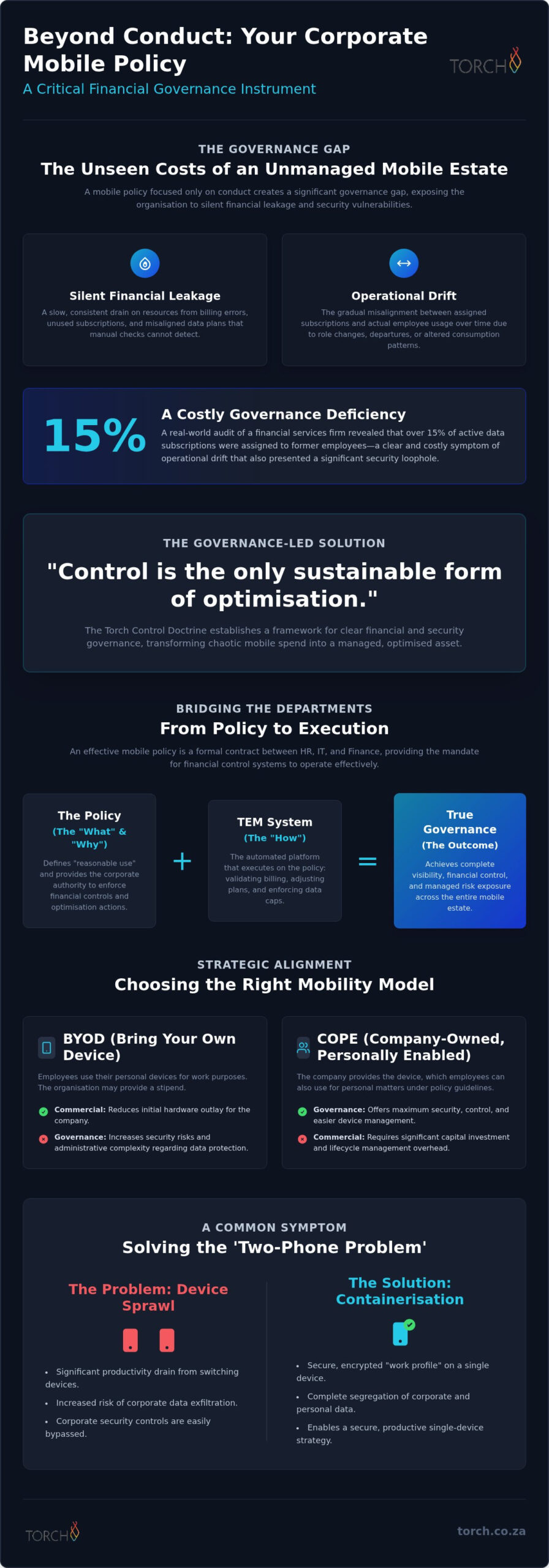
This gap emerges from an unmanaged mobile estate where costs escalate unchecked and security protocols are non-existent. “Silent financial leakage” describes the slow, consistent drain on resources from billing errors, unused subscriptions, and misaligned data plans. A policy focused solely on conduct leaves the finance department with no framework to enforce fiscal discipline. This is where the Torch Control Doctrine becomes essential: Control is the only sustainable form of optimisation. Establishing clear control through a robust policy is a foundational step to closing this governance gap and transforming mobile spend from a chaotic liability into a managed asset.
The Real Cost of Financial Leakage
Unmanaged mobile spend is a primary source of financial leakage in large enterprises. This drain is not caused by a single catastrophic event but by the cumulative effect of unvalidated billing and “operational drift.” Operational drift is the slow misalignment of subscriptions and actual usage over time, as employees change roles, leave the company, or alter their data consumption patterns without corresponding adjustments to their mobile plans. Manual invoice reconciliation, once a staple of accounts payable, is no longer sufficient to manage the complexity and data volumes of a 2026 enterprise mobile estate. Spreadsheets cannot effectively track thousands of SIM cards, data bundles, and roaming charges, making it impossible to spot costly anomalies.
Without an automated, governance-led approach, organisations consistently overspend. A highly effective method for eliminating this persistent drain is through automated validation systems that reconcile billing against actual, real-time usage data. For example, by applying GetMetrix analytics to the mobile estate of a leading South African financial services firm, we identified that over 15% of active data subscriptions were assigned to former employees—a clear and costly case of operational drift. Correcting this single governance deficiency delivered immediate, recurring savings and closed a significant security loophole. You can learn more about the dangers of manual tracking in our guide on the risks of unmanaged telecom spend.
Bridging the Gap Between HR and IT Finance
A governance-led mobile policy acts as a formal contract between the employee, the IT department, and the finance department. It moves beyond simple etiquette to establish clear financial accountability. A crucial element of this contract is defining “reasonable use” within a data-heavy enterprise environment. This definition provides the baseline against which all consumption can be measured, audited, and controlled.
This focus on employee alignment is central to modern HR; to see how professional engagement and staffing solutions can further unify your workforce, you can learn more about Bosse Events Creative Event Concepts.
Crucially, the policy must be designed to support and integrate with core financial governance workflows, particularly Telecom Expense Management (TEM). A TEM framework relies on the policy to provide the authority for its actions, such as reclaiming costs for personal use, adjusting data plans based on consumption, or enforcing data caps. The policy is the “what” and “why”; the TEM system is the “how.” Without a policy that explicitly authorises these financial controls, any attempt to optimise spend lacks the necessary corporate mandate and is likely to meet with resistance.
Choosing the Right Mobility Model for Your Organisation
Selecting a mobility model is a significant strategic decision with long-term financial and operational consequences. South African enterprises typically choose between three primary models: Bring Your Own Device (BYOD), Company-Owned, Personally Enabled (COPE), and a Hybrid approach combining elements of both. Each model presents distinct commercial nuances, security considerations, and administrative overheads.
A BYOD model can reduce initial hardware outlay but often increases security risks and administrative complexity, especially concerning data protection and device wiping. A COPE model offers greater control and security but requires significant capital investment and lifecycle management. Before committing, organisations should conduct thorough scenario modelling to understand the total cost of ownership (TCO) for each approach. This analysis must account for hardware, software, support, and security management costs. Tools like TorchLight can provide essential market benchmarking data, helping you make an evidence-based decision that aligns with your organisation’s financial and operational objectives.
Solving the ‘Two-Phone Problem’
A common symptom of an undefined mobility strategy is the “two-phone problem,” where employees carry separate personal and work devices. This practice is not just inconvenient; it introduces significant productivity drains and security risks. Employees are less efficient when switching between devices, and corporate data is more likely to be exfiltrated or stored on unsecure personal hardware. Furthermore, it often leads to employees using personal devices for work out of convenience, completely bypassing corporate security controls.
Modern technology offers a definitive solution. Containerisation, a core feature of Unified Endpoint Management (UEM) platforms, allows for the creation of a secure, encrypted “work profile” on a single device. This segregates corporate data, apps, and communications from the employee’s personal information. The organisation can manage, secure, and wipe the corporate container without ever touching the user’s personal data. A well-structured policy is essential for facilitating this transition. It provides the framework and assurance employees need, clarifying that their privacy is protected whilst corporate data remains secure, enabling a productive and secure single-device strategy.
Commercial Optimisation and Contractual Alignment
Your corporate mobile policy must be written in direct alignment with your carrier contracts. A policy that is disconnected from commercial reality will inevitably lead to out-of-bundle charges and budget overruns. For instance, if your organisation has negotiated preferential rates through a corporate Access Point Name (APN) or has access to large, shared data pools, the policy must mandate their use. It should explicitly state that data consumption outside these approved channels will not be reimbursed.
Furthermore, a forward-looking policy allows for dynamic, continuous optimisation. It should include clauses that permit the organisation to adjust employee subscriptions and data allocations based on verified usage data from platforms like GetMetrix. This ensures that the company is not paying for oversized data bundles for low-usage employees or, conversely, incurring expensive overage charges for high-usage power users. The policy provides the authority to make these data-driven adjustments, ensuring the mobile estate is commercially optimised on an ongoing basis.
The Essential Corporate Mobile Policy Checklist
A corporate mobile phone policy fit for 2026 must be a comprehensive governance document. It moves beyond basic rules of conduct to include robust clauses covering financial accountability, security governance, and data protection. Below is a high-level checklist of non-negotiable elements that form the foundation of a modern, defensible policy.
- Scope and Applicability: Clearly define which employees, devices (BYOD, COPE), and data types are covered by the policy.
- Roles and Responsibilities: Outline the duties of the employee, IT department, finance department, and HR in upholding the policy.
- Acceptable Use: Define appropriate and prohibited activities, including personal use limitations and guidelines for using corporate devices.
- Financial Accountability: Detail the processes for reimbursement, data cap enforcement, and managing international roaming costs.
- Security and Data Protection: Mandate specific security controls, including passwords, MFA, and the use of UEM solutions.
- Device and Data Wiping: Explicitly detail the company’s right to wipe corporate data. For BYOD, this must specify “Selective Wiping” of the corporate container to protect employee privacy.
- Compliance and Enforcement: State the consequences of non-compliance and outline the process for regular audits and compliance checks.
Financial and Billing Accountability Clauses
These clauses transform the policy into a tool for financial control. They must be unambiguous and directly enforceable.
Just as internal policies must be unambiguous, external professional engagements also require clear financial frameworks. For example, you can explore legal fees for legal representation and law services at Moran Gohar Law Office to understand how transparency is established in legal agreements.
- Personal Use Reimbursement: A clear process for identifying and recovering costs associated with excessive personal use of company-paid resources.
- Data Cap Enforcement: The right for the company to implement and enforce data caps, with a clear process for users to request temporary extensions for valid business reasons.
- Lost or Stolen Device Reporting: A strict requirement for employees to report a lost or stolen SIM or device within a specified timeframe (e.g., 2 hours) to mitigate fraudulent usage and security risks.
- International Roaming Governance: A mandatory pre-approval process for activating international roaming, requiring a business justification and acknowledgement of the associated costs.
Security, UEM, and Data Protection Standards
With ransomware demands in South Africa reaching a median of R18 million, security cannot be an afterthought. The policy is your primary tool for mandating non-negotiable security standards across the entire mobile fleet.
- Mandatory UEM Enrolment: A clause requiring that any device accessing corporate data—whether company-owned or personal—must be enrolled in the company’s Unified Endpoint Management (UEM) platform. This is the technical foundation for enforcing all other security rules.
- Authentication and Access Control: Enforce the use of strong passwords or biometrics, device-level encryption, and multi-factor authentication (MFA) for accessing all corporate applications and systems.
- Prohibition of Unmanaged Devices: An explicit ban on accessing sensitive corporate systems (e.g., ERP, CRM, financial platforms) from any device not enrolled in the UEM and compliant with the policy.
Implementing Governance: From Policy to Execution
A policy document, no matter how well-written, is ineffective if it remains a static file on a server. The critical final step is translating the policy into active, automated governance. This is the transition from documenting intent to embedding execution into daily operations. Without automated enforcement tools, the policy becomes a paper tiger—well-intentioned but ultimately reliant on manual checks and employee goodwill, which are insufficient for managing risk at an enterprise scale.
The concept of “embedded execution” means that the rules defined in the policy are automatically enforced by technology, removing the potential for human error or oversight. This approach bridges the traditional gap between the finance department, which sets the budget, and the IT department, which manages the technology. Torch specialises in creating this bridge, ensuring that financial governance is not just a theoretical goal but an operational reality.
Automating Compliance through Technical Control
Modern UEM platforms like Microsoft Intune are the engines of policy enforcement. They allow IT administrators to configure, deploy, and enforce the rules of your mobile policy remotely and at scale, without ever physically touching a device.
Through UEM, containerisation can be mandated, automatically segregating personal and business data on BYOD devices to protect both corporate security and employee privacy. Security settings like mandatory PINs, encryption, and restrictions on app installations can be pushed to every enrolled device, ensuring a consistent security posture across the fleet. Real-time monitoring within these platforms can detect policy violations—such as a jailbroken device or the installation of a blacklisted application—and trigger automated responses, like revoking access to corporate data, before they escalate into a breach.
Continuous Auditing and Lifecycle Governance
The implementation of a mobile policy is not a one-time project; it is the beginning of a continuous discipline. This marks the shift from periodic, manual audits to the principles of IT FinOps, where financial accountability and operational management are intertwined and ongoing. Governance is a continuous discipline, not a one-time event. The mobile environment is dynamic—employees join and leave, data needs change, and new security threats emerge.
Your governance framework must be equally dynamic. Platforms like SpotLight provide the real-time visibility needed to ensure ongoing policy compliance and budget accuracy. This allows finance and IT leaders to see precisely how mobile resources are being consumed, identify deviations from policy, and make proactive adjustments. This continuous loop of policy, enforcement, monitoring, and optimisation is the hallmark of a mature governance strategy, transforming your mobile policy from a document into a living framework for control.
Ready to transform your mobile policy from a conduct guide into a powerful governance instrument?