
Hybrid work has moved the security boundary from the office to every device an employee uses. For South African organisations, endpoint security for hybrid workforce environments must account for laptops and phones connecting from home, shared workspaces and other locations beyond the corporate network. When device visibility is limited, controls vary between company-owned and personal devices, or no one owns remediation, gaps can persist unnoticed.
The challenge is not simply to add more security tools. Organisations need proportionate controls that follow the user, make device status visible and clarify who acts when a device falls short of policy. That calls for practical governance as well as technical measures, with oversight suited to the organisation’s risk exposure.
This guide explains the endpoint risks associated with hybrid work and how to address them without adding unnecessary operational complexity. It covers practical ways to manage different device types, improve visibility and assign responsibility for endpoint governance and remediation. The aim is a consistent, manageable approach to protecting company data wherever work happens.
Key Takeaways
- See why endpoint security is a governance issue, not just a matter of installing security tools.
- Understand how device visibility, policy enforcement and security monitoring work together, and where Unified Endpoint Management fits.
- Use a practical assessment sequence to identify control gaps and assign clear ownership for follow-through.
- Explore how endpoint security for hybrid workforce environments can support consistent oversight across company-owned and personal devices.
- Compare ad hoc oversight, tool-based visibility and managed governance to identify an approach suited to your organisation’s risk exposure.
Why endpoint security for a hybrid workforce is a governance issue
An endpoint is a device people use to access an organisation’s information and systems. Endpoint security refers to the measures used to protect those devices and the data they handle. It differs from network security: a network connects devices and carries information, while endpoint controls focus on the devices themselves. The Endpoint security overview provides useful background.
For an organisation, the issue is not simply which security tools are installed. Leaders need to know which devices are in use, what controls apply to them and who is responsible for addressing gaps. That makes endpoint security for a hybrid workforce a matter of governance and risk management as well as a technical consideration. Microsoft Security reports that 85% of ransomware entry points start from unmanaged devices, reinforcing the importance of visibility and accountability. This section focuses on enterprise devices, oversight and practical controls, rather than comparing security products.
What counts as an endpoint in a hybrid workplace?
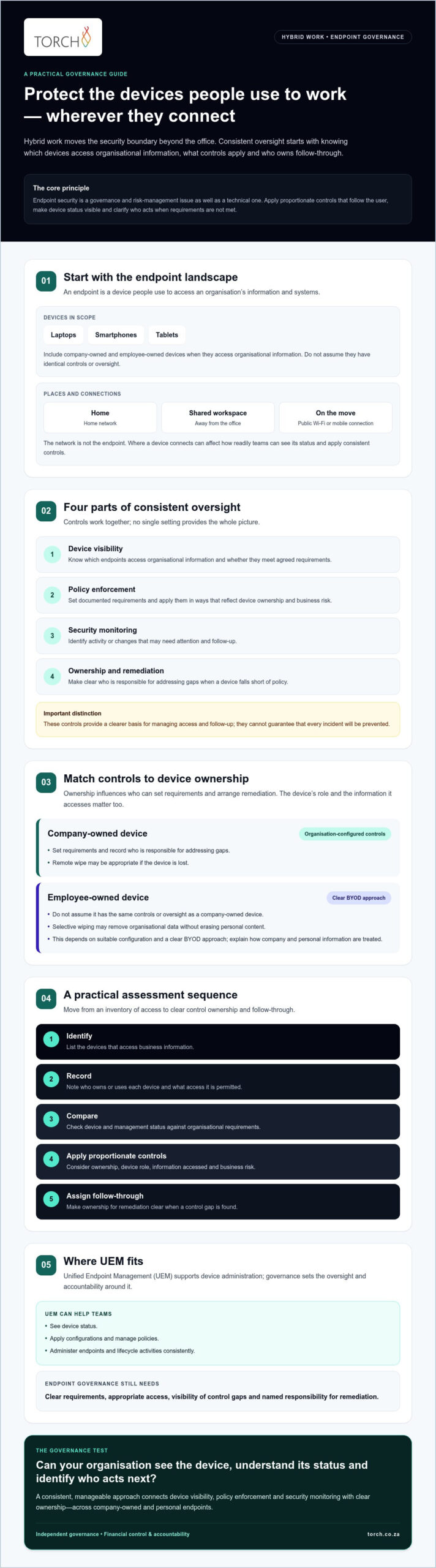
Laptops, smartphones and tablets all count as endpoints when they access organisational information. Some may be company-owned and configured to meet organisational requirements; others may belong to employees. These devices should not automatically be treated as having identical controls or levels of oversight.
Ownership affects who can set device requirements and arrange remediation. The device’s role and the information it accesses matter too. Clear governance records what devices are in use, who owns or uses them, and what access they are permitted. This gives teams a basis for applying suitable controls without assuming every endpoint is alike.
Why does working outside the office change the risk picture?
A device may connect through a home network, public Wi-Fi or a mobile connection. The network is not the endpoint, but where a device connects can affect how readily the organisation can see its status and apply consistent controls. Devices that rarely return to the office may also be less visible to teams relying on physical checks or office-based processes.
Hybrid endpoint security protects the devices people use to access organisational information, while providing the oversight needed to apply controls and manage risk across locations. If a device is unmanaged or its status is unknown, the organisation has less assurance about how its data is accessed or protected. That is a potential exposure to assess across personal and off-site devices.
A practical starting point is to establish which devices access business information and who owns decisions about their security. Then compare the devices and their management status with the organisation’s requirements. This helps teams identify control gaps and assign follow-through across company-owned and employee-owned endpoints, rather than relying on location or device type as a substitute for oversight.
How endpoint security controls protect hybrid users and company data
Effective endpoint protection depends on connected controls, not a single setting. Device visibility helps an organisation understand which endpoints access its information and whether they meet agreed requirements. Policy enforcement applies those requirements, while security monitoring can help identify activity or changes that need attention. Together, these controls give teams a clearer basis for managing access and follow-up.
Which endpoint controls matter across work locations?
Define controls consistently for office, home and mobile use, then apply them in a way that reflects device ownership and business risk. Practical measures include checking whether a device meets documented compliance requirements before granting access, and deploying approved applications so users can work without relying on unmanaged alternatives.
Access should also be proportionate. Users and devices should reach the organisational resources needed for their work, under conditions set by the organisation. Remote wipe may be appropriate if a company-owned device is lost. On a personal device, selective wiping may help remove organisational data without erasing personal content, but this depends on suitable configuration and a clear BYOD approach. Document how these actions work and explain the distinction between company and personal information to users.
How do UEM and endpoint security work together?
Unified Endpoint Management (UEM) centralises the management of devices, policies and lifecycle activities. It can help teams see device status, apply configurations and administer endpoints consistently. Endpoint security is the broader protective discipline: it addresses how endpoints are secured and how potential issues are identified and handled. UEM can support that work, but it does not replace every security tool or response capability an organisation may require.
For example, if a device falls out of compliance, management information can help establish which device is affected and who should act. The organisation still needs clear ownership for deciding whether access should change, what remediation is appropriate and how completion is recorded. Connecting visibility to follow-through turns technology controls into operational accountability.
Torch Services’ Unified Endpoint Management and Unified Endpoint Security Management capabilities include centralised device control, policy enforcement, endpoint security, lifecycle management and compliance auditing.
How to assess endpoint security for a hybrid workforce
A useful assessment moves from what the organisation can see to what it can govern. Rather than beginning with a tool purchase or a device-by-device policy exercise, establish the size and ownership of the estate, compare existing controls with documented requirements, then assign responsibility for unresolved gaps. This gives decision-makers a clearer basis for prioritising risk across the business.
Start with an accurate view of devices and users
Bring together available inventory records and map device types, ownership, assigned users and working arrangements. Compare those records with device management information to find endpoints with unclear owners, stale details or inconsistent oversight. Where possible, reconcile records held by different teams so that missing or duplicate entries become easier to spot. The aim is a useful enterprise-wide picture, not a perfect inventory before any action can begin.
Reliable endpoint oversight depends on accurate device visibility and clear accountability for the decisions and actions that follow. Record which teams maintain inventory accuracy, approve security requirements and resolve issues. If responsibilities are split, make the hand-offs explicit so that a gap does not sit between teams.
Prioritise controls, exceptions and response responsibilities
Next, compare existing controls with the organisation’s risk tolerance and documented requirements. Focus first on material gaps that affect multiple teams or device groups. Then check whether responsibilities are clear for common exceptions:
- Lost device: who receives the report and decides what action is appropriate?
- Non-compliant device: who assesses the issue and determines whether access or remediation needs attention?
- Leaver: who confirms that access and organisational information are handled through the relevant process?
These are assessment prompts, not prescribed policies. For example, an organisation might find that its records identify company-owned laptops clearly but do not show which employee-owned devices access work information. That illustrative example is not a Torch benchmark; it shows how an inventory gap can raise a governance question.
Review BYOD and monitoring controls with privacy and legal obligations in mind. POPIA may be relevant where personal information is processed, but the appropriate requirements depend on the circumstances. Confirm applicable obligations and exceptions before prescribing controls, particularly where personal devices or employee information are involved.
For technical teams, reviewing how endpoint detection and response capabilities fit into existing tools and processes can help clarify whether monitoring and issue handling align with organisational requirements. Any tool assessment should complement, rather than replace, clear ownership and documented response responsibilities.
Close the assessment by recording each priority gap, its accountable owner and the agreed follow-up. Endpoint security for hybrid workforce environments becomes more manageable when visibility leads to decisions, and decisions have named owners.
How managed endpoint governance can sustain security across hybrid work
Endpoint oversight can be organised in several ways. Ad hoc processes rely on teams to notice and resolve issues as they arise, which can leave responsibilities unclear. A management platform may improve device visibility, but visibility alone does not ensure that exceptions are investigated or resolved. Managed governance connects oversight to defined decision-making and follow-through, while keeping accountability clear between the organisation and its service partner.
This distinction matters for endpoint security for hybrid workforce environments: a dashboard can show a device status, but teams still need agreed ownership for deciding what that status means and what action follows. Managed governance connects visibility with defined decisions and follow-through.
What should an endpoint management partner be accountable for?
Agree the scope before work begins. Device oversight, policy enforcement and lifecycle responsibilities should have named owners, along with a clear process for escalating and resolving endpoint issues. Reporting is useful when it helps teams act, not simply record device status. Ask how exceptions are surfaced, who decides the response and how completion is tracked.
Torch’s Unified Endpoint Management and Unified Endpoint Security Management capabilities include centralised device control, policy enforcement, endpoint security, lifecycle management and compliance auditing, including support for BYOD and remote-work protection. Its technology solutions provide broader context on its services. Torch’s track record includes R667.5M since 2004 across 12 African countries. These capabilities support governance and oversight; no security approach can eliminate every risk, so organisations should assess controls against their own requirements.
How can organisations measure whether governance is improving?
Start with a baseline before judging progress. Track whether device records are current, how clearly management status is known, whether devices meet documented requirements and how endpoint issues are handled. Agree what counts as timely resolution for your organisation, then report against that definition consistently rather than adopting an unsupported universal target.
These indicators also support operational and financial control and accountability. Unmanaged hybrid devices can create unmanaged spend alongside security exposure: orphaned SIMs may continue generating costs, while devices that cannot be reconciled to a user are difficult to recover, reassign or remove from billing. Knowing which devices are active, assigned and managed helps teams review whether resources and support are aligned with actual use. Keep measures tied to decisions: each indicator should have an owner and a next step when it highlights a gap.
With clearer oversight, your organisation can support hybrid work with greater confidence and control.
Frequently Asked Questions
What is endpoint security for a hybrid workforce?
Endpoint security for a hybrid workforce means protecting the laptops, smartphones and tablets people use to access organisational information, wherever they work. It combines device visibility, security requirements, controlled access and processes for addressing issues. The goal is to manage risk across company-owned and employee-owned devices, not to assume every device can or should have identical controls. Clear ownership helps ensure that identified gaps receive appropriate follow-up.
Why is endpoint security important for hybrid working?
Hybrid working means devices may connect from home, public or mobile networks rather than routinely operating on company premises. This can make device status and control harder to assess consistently. Endpoint security helps organisations understand which devices access their information and whether they meet documented requirements, supporting managed risk exposure.
Can endpoint security protect employee-owned devices?
Yes, organisations can apply appropriate controls to employee-owned devices that access work information, but the approach should account for personal use and privacy. For example, access requirements may differ from those for a company-owned laptop, and selective removal of organisational data may be preferable to wiping an entire personal device. Before setting controls, clarify consent, responsibilities and any applicable privacy obligations, including POPIA where relevant.
How does Unified Endpoint Management support endpoint security?
Unified Endpoint Management (UEM) helps centralise device administration, policy enforcement and lifecycle activities. It can give teams information about device status and help apply consistent configurations across managed endpoints. UEM supports endpoint security, but the terms are not interchangeable: management provides oversight and control, while endpoint security also involves protective measures and handling potential security issues. Organisations should assess whether additional security tools or capabilities are needed for their requirements.
What should an organisation check first when assessing hybrid endpoint security?
Start by establishing which devices access organisational information, who owns or uses them, and whether their management status is known. Compare inventory records with available device information to identify unclear ownership, stale records or unmanaged endpoints. Then assign responsibility for maintaining the inventory, deciding security requirements and resolving issues. This baseline helps prioritise control gaps before the organisation considers new tools or changes to its approach.