
What if the biggest enterprise mobility risk isn’t a missing tool, but the gaps between the tools and teams already in place? Enterprise mobility management challenges often arise when device visibility, user records, contracts, spend and security controls sit in separate silos. The result can be unclear ownership, inconsistent policies and avoidable manual work for IT and Finance.
For South African enterprises with a dispersed workforce, mobility decisions need to balance operational efficiency, financial control and managed risk exposure. Adding technology alone won’t resolve fragmented oversight. Teams also need clear accountability and reliable evidence to guide action.
This guide offers a practical framework for identifying which mobility management gaps to address first and how to make improvements sustainable. It covers operational, financial and security challenges, then explains how Telecom Expense Management, Unified Endpoint Management and IT FinOps, as part of Torch Services’ six integrated service lines, can connect visibility with accountable execution. The aim is clearer oversight, stronger governance and better-informed mobility decisions.
Key Takeaways
- Enterprise mobility management covers more than devices. It also requires oversight of users, policies, lifecycles and related services.
- Fragmented device, carrier, finance and support records can obscure the estate-wide picture and create avoidable manual work.
- Use a practical sequence to scope the estate, reconcile records, assess controls, assign owners and track remediation.
- Prioritise enterprise mobility management challenges by operational impact, financial exposure, security relevance and the quality of available evidence.
- Torch Services’ six integrated service lines — TEM, TLM, UEM, FinOps, ITAM and SecOps — can connect visibility to accountable action.
Enterprise mobility management challenges: where control breaks down
Mobile devices help employees communicate, access business systems and complete daily work. Each device also creates connected oversight needs: who uses it, what information it can access, which policies apply, who supports it and how its costs are managed. Enterprise mobility management challenges emerge when these responsibilities are treated as separate administrative tasks instead of parts of one governance picture.
Enterprise mobility management (EMM) is the oversight of mobile devices, users, policies, asset lifecycles and related services. A neutral overview of Enterprise Mobility Management describes familiar components, including device, application and content management. In practice, effective oversight also depends on reliable records and clear ownership across the organisation.
What enterprise mobility management covers
Device administration is one part of the picture. Broader governance connects each asset to its user, business purpose, applicable policies and support arrangements. Lifecycle oversight follows the device from allocation through user or role changes, ongoing support and eventual retirement. This helps keep records useful as circumstances change.
Connectivity costs and endpoint controls are related, but distinct. Telecom Expense Management supports oversight of connectivity services and associated expenditure; endpoint management focuses on devices and their policies. Connecting these disciplines helps build a more complete view. Torch Services’ Unified Endpoint Management service supports endpoint governance through centralised device control, policy enforcement and lifecycle oversight.
Why mobility challenges reach beyond IT
When records sit in separate systems, IT may spend time reconciling users and devices manually, while Finance lacks a consistent basis for reviewing expenditure. Procurement decisions can also be affected if teams cannot establish what is assigned, still needed or due for change. Common symptoms include fragmented visibility, repeated administration, unclear ownership and reporting that varies between teams.
Disconnected mobility records weaken financial control and operational accountability because teams can’t confidently connect a device, its user, its cost and its current status. Limited visibility also makes it harder to assess service continuity and managed risk exposure, including whether endpoint controls still match the device’s current use.
Illustrative example: An employee moves into a different role and their device is reassigned. If the asset record, user details, connectivity account and support responsibilities aren’t updated together, teams may rely on conflicting information. Assigning an owner to each part of the change helps keep records aligned and decisions traceable.
Why enterprise mobility management challenges compound across silos
Enterprise mobility management challenges compound when each team holds only part of the picture. An asset register may identify a device, a carrier record may show its connectivity, Finance may hold the charge and support may track a separate user or ticket reference. If those records don’t align, leaders can’t reliably see the full estate or determine which information needs correcting.
Fragmented visibility and accountability
Industry commentary on common enterprise mobility challenges also points to inventory accuracy, cost control and ownership as connected concerns. A dashboard can bring data together, but visibility alone won’t resolve mismatches. Someone still needs to validate the evidence, decide what action is appropriate and follow through.
Decision rights should reflect how the organisation operates, rather than follow a universal structure. IT may oversee endpoint controls and support; Finance may review expenditure and reporting; Procurement may manage commercial decisions; and HR may hold relevant employee or role information. The essential control is clarity: define who owns each decision, what evidence informs it and who confirms that agreed actions are complete.
Operational friction, spend and security are connected
Manual reconciliation uses staff capacity and can delay decisions. If a lifecycle change isn’t reflected across asset, user and service records, the organisation may be working with outdated information. Access, support arrangements and spend can then fall out of alignment, making commercial optimisation harder and complicating oversight of managed risk exposure.
Inconsistent endpoint controls add a further concern, but they don’t mean an incident is inevitable. Microsoft Security reports that 85% of ransomware entry points originate from unmanaged devices. This is a reason to strengthen oversight of unmanaged endpoints, not a prediction of breach likelihood for any particular organisation.
Mobility governance works when ownership, reliable evidence and follow-through connect device, financial and security decisions. Clear decision rights and documented remediation help teams turn visibility into accountable action.
How to assess enterprise mobility management challenges and prioritise controls
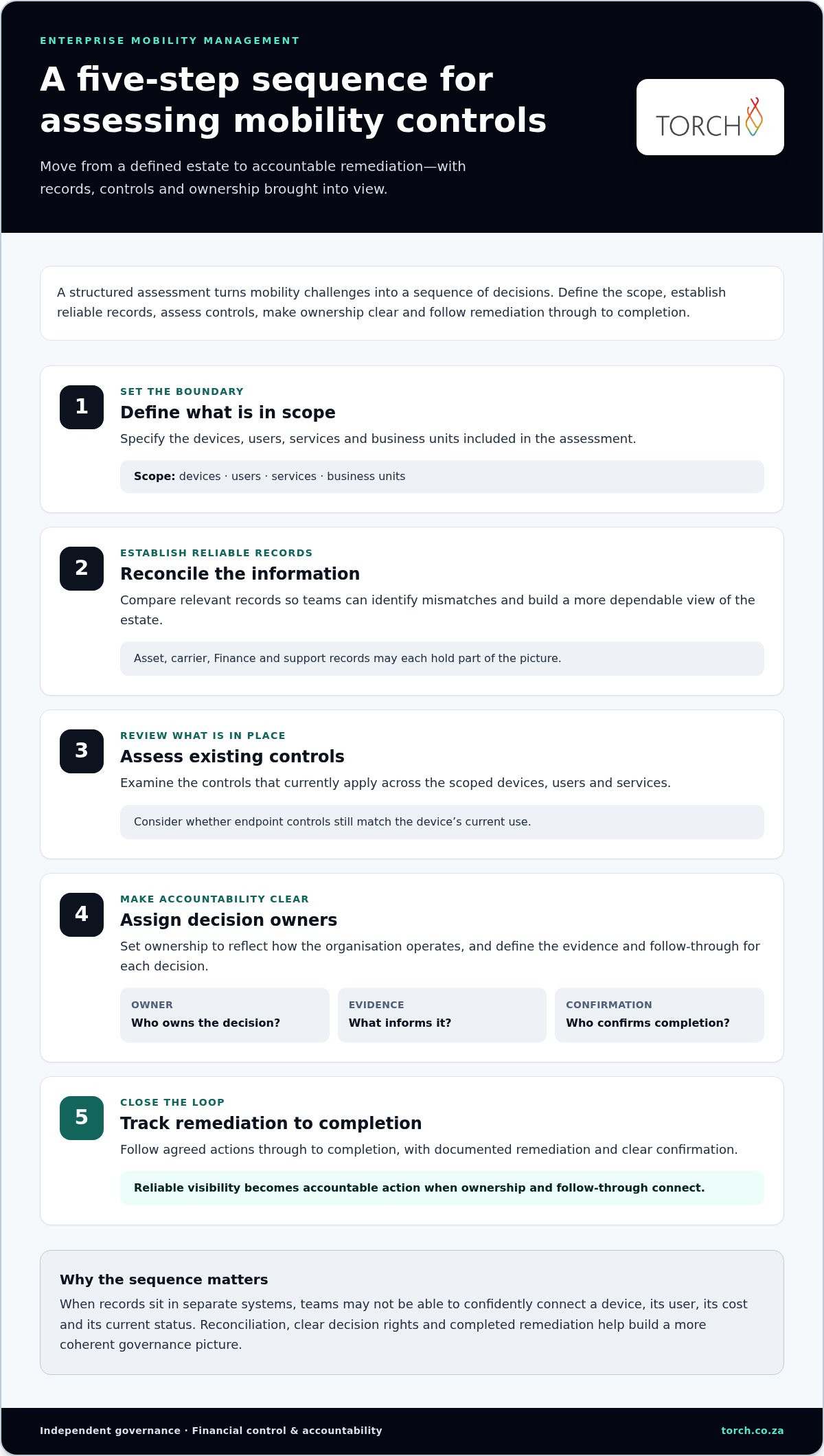
A structured assessment turns enterprise mobility management challenges into a sequence of decisions, rather than a broad list of concerns. Start by defining which devices, users, services and business units are in scope. Reconcile relevant records, assess existing controls, assign accountable owners and track remediation to completion.
Build a reliable mobility baseline
Map device populations to user ownership, lifecycle status and relevant connectivity or support relationships. Compare operational records with available financial information, noting where details agree, conflict or are missing. Separate verified findings from assumptions. A gap in the evidence is worth recording, but it shouldn’t be presented as a confirmed control failure.
Illustrative example, not a Torch Services benchmark: If an asset record shows a device as active but the corresponding user assignment is blank, record the status as unresolved. Identify which team can validate the assignment, then agree how the corrected information will be reflected in connected records.
Turn identified gaps into controlled action
Assess each gap against four factors: operational impact, financial exposure, security relevance and evidence quality. This helps distinguish an issue that could disrupt work or weaken endpoint oversight from a record discrepancy that needs validation before its significance is known.
Separate quick visibility improvements, such as resolving duplicate or incomplete entries, from structural changes that need policy or process ownership. Give each control gap an accountable function, a practical milestone and a clear way to verify completion. Depending on the organisation, IT may own endpoint policy, while Finance or Procurement may lead on expenditure or service records. Agree decision rights rather than assuming one team owns every part.
Connect endpoint policy enforcement to lifecycle processes and financial control. For example, a device status change should prompt relevant teams to review whether its assignment, access, support and associated service information remain appropriate. Unified Endpoint Management supports centralised endpoint control, policy enforcement and lifecycle management.
Measure progress against an agreed baseline. Track each finding’s status, evidence, responsible owner and next milestone, then review it at a consistent, agreed cadence. This shows what has been completed and what is still in progress.
A governance-led response to enterprise mobility management challenges
Enterprise mobility management challenges need more than a consolidated dashboard. The test is whether visibility leads to decisions, assigned responsibility and verified action. Consider the difference between three approaches:
- Fragmented ownership: Teams hold separate records and resolve issues case by case, often without a shared view of progress.
- Dashboard-only visibility: Information is easier to see, but gaps may remain open if nobody owns the investigation or remediation.
- Integrated governance: Financial, telecom and endpoint information informs decisions, with owners and follow-through defined.
What an integrated governance model changes
Torch Services provides six integrated service lines: Telecom Expense Management (TEM), Telecom Lifecycle Management (TLM), Unified Endpoint Management (UEM), IT FinOps, IT Asset Management (ITAM) and Security Operations (SecOps). FinOps supports financial visibility and accountability; Telecom Expense Management focuses on connectivity services and related expenditure; Unified Endpoint Management supports endpoint oversight. Together, these services can help teams connect commercial optimisation and lifecycle decisions with endpoint controls, rather than treating each as an isolated task.
As an independent, carrier-agnostic governance partner, Torch Services provides oversight across the mobility estate while carriers continue to provide their services. Explore Telecom Expense Management alongside IT FinOps to see how financial and service visibility can inform accountable decisions. TorchLight supports market benchmarking and procurement modelling, while SpotLight provides visibility into budget versus actual spend, cost-centre allocation and user-level consumption.
Torch Services reports more than 20 years of operating experience in South Africa and states that it has saved R667.5M+ since 2004 across 12 African countries. These figures describe Torch Services’ reported track record.
Move from assessment to accountable next steps
Once priorities are clear, convert each finding into an action with an accountable owner, an agreed milestone and evidence of completion. The Tsogo Group example illustrates how this can support decision-making: Torch Services structured an RFP across all four major cellular providers, with proposals modelled against real user profiles. The engagement produced a data-backed decision within six weeks of the RFP kick-off, resulting in a hybrid mobility model, with change-management and HR documentation completed before go-live. The CFO said, That insight alone was worth more than the RFP itself
.
Clear ownership, agreed milestones and evidence of completion help organisations move from assessment towards sustained mobility governance.
Put mobility governance into practice
Enterprise mobility management challenges become more manageable when organisations move from fragmented records to clear ownership, reliable evidence and tracked action. Start by establishing a baseline, then prioritise gaps according to operational impact, financial exposure, security relevance and evidence quality. Dashboards can improve visibility, but accountable follow-through is what turns insight into control.
For South African enterprises, connecting financial control with endpoint governance can support more informed decisions about mobility services, devices and risk. Torch Services’ independent, carrier-agnostic approach provides six integrated service lines: TEM, TLM, UEM, FinOps, ITAM and SecOps. Torch Services states that it has more than 20 years of operating experience in South Africa and has saved R667.5M+ since 2004 across 12 African countries. These figures reflect Torch Services’ stated track record.
A clearer governance model can help teams make decisions with greater confidence and strengthen accountability over time. A practical next step is to review where the estate’s records, ownership and controls don’t align.
With the right owners, evidence and review rhythm in place, your organisation can build a more sustainable approach to mobility oversight.
Frequently Asked Questions
What are the main enterprise mobility management challenges?
The main enterprise mobility management challenges are fragmented visibility across devices and services, unclear ownership, manual administration, inconsistent endpoint controls and weak links between mobility activity and financial oversight. The balance differs by enterprise and workforce model. These symptoms can point to disconnected records or governance gaps. Diagnose the estate, confirm the evidence and clarify responsibilities before selecting technology or changing policy.
How can an enterprise improve mobility management without adding more work for IT?
An enterprise can improve mobility management without adding work by first establishing a reliable baseline, clarifying ownership and prioritising remediation. Rather than add another reporting layer, identify repeated manual tasks and whether consistent lifecycle processes or appropriate automation can address them. Managed operational support can also take on defined activities. Agree responsibilities and measures before implementation, then review workload and control progress without assuming a specific reduction.
Does enterprise mobility management include security and cost control?
Yes, although EMM commonly focuses on oversight of mobile devices and policies, while cost control and security can involve connected but distinct processes and services. Endpoint policy management concerns device controls; Telecom Expense Management addresses connectivity services and related expenditure. Coordinating ownership and reporting helps teams assess these areas together. A platform may support parts of this work, but it doesn’t automatically provide full financial control or eliminate every security risk.
What should a business assess before changing its mobility management approach?
Before changing its mobility approach, a business should map device populations, user ownership, lifecycle status, related services, existing processes and responsible teams. Compare operational and financial records to identify evidence gaps, recurring manual work and priority concerns. Separate confirmed findings from assumptions, then sequence actions by operational impact, financial exposure and security relevance. This creates a defensible starting point for selecting controls or revising policy.
How does unified endpoint management help address mobility challenges?
Unified Endpoint Management (UEM) supports centralised oversight of endpoints, policy enforcement, application deployment and lifecycle management, depending on its implementation. It helps teams apply and monitor endpoint controls more consistently across managed devices. Effective use still depends on agreed ownership, clear lifecycle processes and ongoing remediation of identified gaps. UEM addresses endpoint governance; it doesn’t by itself resolve telecom expenditure oversight or every security risk.
When should an enterprise consider independent mobility governance support?
Consider independent mobility governance support when a complex estate involves multiple vendors, recurring reconciliation, unclear accountability or reports that don’t lead to action. An independent partner can help reconcile records, assess controls, define ownership and support remediation across financial and endpoint processes. This can be useful where internal teams lack a joined-up view or execution capacity. Support should be assessed against the estate’s needs, rather than treated as a guarantee of savings.