
What value does a shared data bundle deliver if teams cannot see who is using it, where demand is growing or which allowances go unused? Enterprise shared data bundle optimisation makes pooled mobile-data use visible, helping organisations align capacity with operational needs and govern spending more clearly.
A shared bundle can simplify management, but pooling data alone will not resolve fragmented usage information or unclear ownership. Effective optimisation combines visibility with clear allocation and accountability, helping decision-makers assess usage, identify governance gaps and make informed choices about mobile-data spending.
This article explains how enterprise data optimisation can connect teams and support better business decisions. It covers practical management processes, useful indicators for assessing usage and how independent governance can bring greater control to complex technology costs in South Africa.
Key Takeaways
- Assess shared data use against operational demand to identify where allocation and oversight need to improve.
- Bring teams together around consistent usage information, clear ownership and agreed data definitions.
- Measure performance through practical indicators such as utilisation, workflow efficiency and the quality of decisions.
- Align data access and security controls with how information is shared to manage exposure as well as expenditure.
- Explore how Torch’s integrated services can support stronger governance across technology costs, assets and users.
Business outcomes and measurable performance improvements
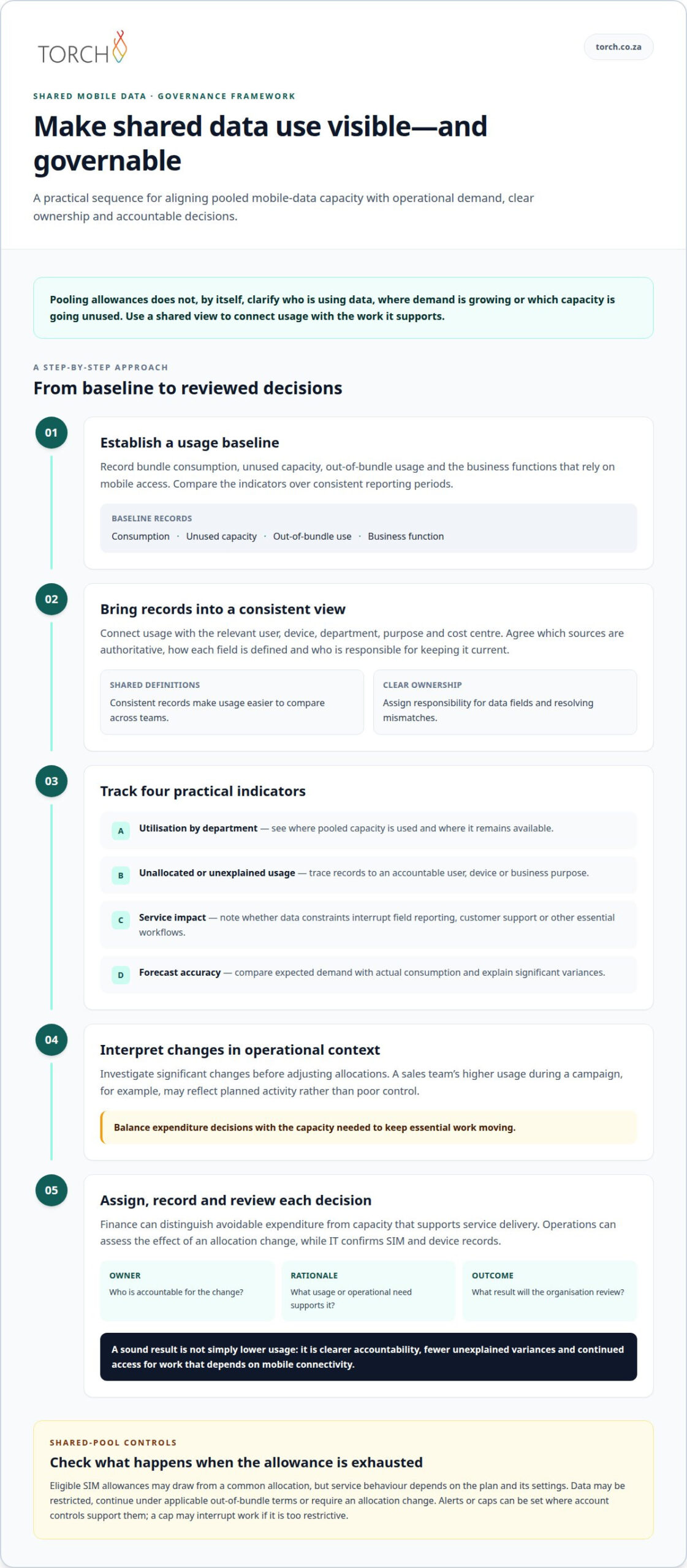
Enterprise shared data bundle optimisation creates value when pooled mobile data is managed according to operational demand, rather than treated simply as a shared allowance. For example, a field-services team may need reliable connectivity for job updates, while a head-office team uses data differently. A clear view of usage by user, department and purpose helps decision-makers assess whether allocations reflect actual work. It also clarifies what each rand supports, where usage is concentrated and which governance gaps need attention.
Establish a baseline before changing allocations. Record bundle consumption, unused capacity, out-of-bundle usage and the business functions that rely on mobile access. Compare these indicators over consistent reporting periods, then investigate significant changes in their operational context. Increased usage by a sales team during a campaign, for instance, may reflect planned activity rather than poor control. This distinction helps avoid financial measures that restrict necessary work.
Use a focused set of indicators that connect usage with business performance:
- Utilisation by department: identify where pooled capacity is used and where it remains available.
- Unallocated or unexplained usage: trace records to an accountable user, device or business purpose.
- Service impact: record whether data constraints interrupt field reporting, customer support or other essential workflows.
- Forecast accuracy: compare expected demand with actual consumption and explain significant variances.
These measures support balanced decisions. Finance can distinguish avoidable expenditure from capacity that protects service delivery. Operations can assess whether a proposed allocation change would affect field staff or customer-facing teams. Shared definitions are essential: if one department records a device as active while another marks it unassigned, reporting becomes unreliable. Governance should establish consistent ownership, usage categories and review responsibilities.
Consider an illustrative example: an organisation in South Africa finds that one team regularly exhausts its allowance while another has unused capacity. Reviewing user-level records, device assignments and operating schedules can show whether reallocation is appropriate. Success is not measured by lower usage alone. It also means clearer accountability, fewer unexplained variances and continued access for work that depends on mobile connectivity. Sound data architecture and reporting help bring relevant information into a consistent view. Each change should have an owner, a rationale and an outcome the organisation can review.
Data silos and cross-departmental collaboration
When finance, operations and IT keep separate SIM records, teams may disagree about usage and ownership. A shared format helps everyone work from the same information.
Cross-departmental data sharing
Cross-departmental data sharing makes relevant bundle and SIM information accessible to different teams using consistent definitions. Finance can review spending, operations can explain demand, and IT can manage device records. For example, a field worker’s high usage is easier to interpret when the job schedule and SIM assignment are visible together.
Data management improves when teams agree which sources are authoritative for users, devices, departments and cost centres. A practical integration approach links those records while preserving their business context. If HR records a staff transfer before IT updates the SIM register, a shared process can reveal the mismatch for resolution instead of leaving finance with an unexplained allocation.
Shared pool allocation and usage limits
A shared data pool combines eligible SIM allowances, with usage drawn from the common allocation under the applicable plan. Administrators can assign SIMs, set usage limits and monitor consumption where those controls are available. This matters because a sales SIM and a field-service SIM may have different operational needs, even when they draw from the same pool.
When the shared allowance is exhausted, service behaviour depends on the plan and its settings. Data may be restricted, continue under applicable out-of-bundle terms or require an allocation change. Administrators can set alerts or caps where account controls support them. An alert can prompt a review before the allowance runs out; a cap can limit use but may interrupt work if it is too restrictive.
To implement a workable strategy, agree who owns each data field and who responds to alerts. Operations can explain a usage spike, IT can confirm the SIM assignment, and finance can assess the cost-centre treatment. Record decisions consistently, then review exceptions through a shared governance process. This connects platform data to daily operations and makes cross-team decisions easier to trace.
These practices rely on standards that make records usable beyond the team that created them. Enterprise data quality depends on consistency across users and departments. In mid-market and large enterprises, information may be spread across many systems, making SIM assignments, users and cost-centre records harder to compare. A unified data architecture can integrate different sources while supporting consistency and interoperability, helping teams connect records without losing their meaning or context.
A data catalog can centralise an organisation’s data assets and support discovery, understanding and governance. Catalogs can provide metadata, descriptions, user ratings and comments to help stakeholders find and assess information. Finance and IT, for example, can use these details to determine whether a record is suitable for a review and understand how it is defined. Data lineage describes information’s origins, transformations and dependencies across its lifecycle, and can inform integration strategies. Understanding how a SIM record moves between systems can help teams locate a mismatch and decide which connection or process needs attention. Shared standards, catalog information and lineage give departments a clearer basis for resolving conflicting records and maintaining trusted data.
Benefits of enterprise data optimisation
Enterprise data optimisation helps South African organisations connect mobile usage, operational needs and billing decisions. Its value depends on consistent records, clear controls and security suited to how teams use shared data.
Independent analysis can assess enterprise offers against pool rules, billing structures, coverage needs and available controls. Shared-plan availability and terms depend on the offer.
Useful analysis compares SIM-level consumption with department, user and device records. It can identify recurring peaks, inactive lines, unexpected usage and out-of-bundle charges, then assess whether allocation changes fit operational demand. A field team’s higher consumption may reflect route updates, while a dormant SIM may point to an outdated assignment. This evidence supports decisions based on actual use rather than assumptions.
Analysing mobile data usage
Mobile data analysis reviews usage records against SIM assignments, business roles and billing periods. A shared allowance can conceal high-use lines or spare capacity, so teams can group usage by department, flag exceptions for investigation and establish a baseline before recommending changes. Where reporting tools allow, alerts can help teams respond before unusual consumption affects the pool.
Reducing enterprise mobile data costs
Commercial optimisation matches plan structure and allocation to business requirements rather than cutting data indiscriminately. Cost cutting asks what expenditure can be removed; spend optimisation asks what each rand delivers. Invoice reconciliation against line records can reveal duplicate or inactive services and help assess available enterprise offers against observed usage. Moving capacity between teams, for example, may address recurring overages if the change preserves access needed for daily operations.
Shared bundles also present security, privacy and billing risks. Poorly managed SIM records can obscure who uses a line, while excessive access to detailed usage information can expose sensitive employee behaviour. Role-based access, documented ownership and regular exception reviews help manage these risks. Billing disputes can arise when usage is assigned to an outdated cost centre or user; reconciled records make investigations more precise.
For a migration, map existing numbers, SIMs, users, departments and plan terms first. Then identify lines suited to a shared arrangement, plan allocation and control settings, and coordinate the transfer with the selected network. After migration, review invoices and usage records against the agreed allocation. This process supports continuity while creating a consistent basis for future commercial decisions.
What is enterprise shared data bundle optimisation?
Enterprise shared data bundle optimisation is the structured management of pooled mobile data across an organisation’s eligible SIMs. It aligns shared capacity with business demand, assigns clear ownership and monitors usage against agreed controls. A logistics operation, for example, may allocate data from one pool to drivers, dispatchers and managers while tracking each SIM’s use separately.
Pooling changes how an allowance is used, not the need for oversight. A shared balance can support teams with different demand patterns, but it can also obscure who is using capacity and why. A sound process links each SIM to a user, device, department and business purpose. Those records help explain usage and guide allocation decisions.
A professional optimisation process typically examines four connected areas:
- Eligibility: identify which lines can participate under the relevant enterprise plan.
- Allocation: align access with roles, such as field staff needing mobile job updates.
- Controls: set appropriate limits and alerts where plan or account settings allow them.
- Review: compare usage and billing records, then investigate exceptions before adjusting the arrangement.
A regional sales team, for example, may use more data during a product launch while an office-based department uses less. Reviewing those patterns alongside operational schedules helps distinguish a temporary increase from a persistent allocation mismatch. The goal is not simply to minimise consumption, but to ensure capacity supports work and material changes have a clear rationale.
Enterprise shared data bundle optimisation also relies on accurate records and defined governance. If a transferred employee remains linked to an old SIM assignment, usage may be attributed to the wrong department. Correcting user records, cost-centre mapping and approval processes improves reporting and billing reviews. Access to detailed usage information should also be restricted to appropriate roles to support privacy and security.
In practice, the approach connects commercial review with operational context. Finance can understand how charges relate to assigned users, while IT can identify line and device discrepancies. Operations can explain changing demand, such as seasonal field activity. Together, these perspectives provide a more reliable basis for managing pooled data and assessing whether the arrangement still fits the organisation’s needs.
An organisation can make governance more consistent by documenting relevant information in a data catalog. Data owners decide what is included and control access, while data stewards keep definitions and quality scores current. For shared mobile data, this distinction clarifies who can approve visibility and access, and who maintains useful descriptions and quality indicators. The catalog provides a common reference for allocation and review, rather than leaving teams to interpret labels differently.
For practical use, teams can agree which descriptions inform decisions about eligibility, allocation, controls and review, then assign responsibility for maintaining them. Catalog access controls can support careful handling of usage information. Current definitions make comparisons easier to interpret, while up-to-date quality scores give reviewers a signal to consider before relying on a record. This does not replace operational judgement; it gives everyone a shared vocabulary and a clear way to maintain information used in governance.
Torch: One Partner, Six Integrated Service Lines
Torch Services brings IT cost governance together through its proposition, “One Partner, Six Integrated Service Lines”. The framework spans TEM, TLM, UEM, FinOps, ITAM and SecOps. Torch’s relevant services include Telecom Expense Management, Automated User support, asset management and IT FinOps-as-a-Service. This integrated approach can connect mobile usage, ownership records and technology expenditure when fragmented information makes shared-bundle decisions difficult.
For asset visibility, Torch’s asset-management service maintains a full asset register. Every asset is attributed to a cost centre, with lifecycle tracking from procurement to decommission. ITAM, UEM and FinOps share one view, with every asset tied to an owner and a cost centre. That connection helps teams relate technology costs to the people and business areas responsible for them.
TorchLight™ is Torch’s cost allocation, modelling and scenario-planning engine. For CFOs and CIOs, PowerBI board packs built on TorchLight data support analysis of technology expenditure and allocation. In a shared data context, this helps bring costs into a clearer management view alongside relevant ownership and usage information.
Torch has operated in the South African market for over 20 years and reports R667.5M+ saved since 2004 across 12 African countries. Specific examples include R38.4M saved over 26 months for a South African insurer, supported by PwC audit evidence; 22% of the IT team’s capacity had been spent on telecom administration. In banking, R8.9M was saved over 18 months, with SBSA verification. These are distinct engagements, not guaranteed outcomes for another organisation.
Torch’s independent governance approach is relevant when an organisation needs a clearer link between telecom spending, users, assets and operational requirements. Telecom Expense Management supports the review of telecom costs, while IT FinOps-as-a-Service addresses wider IT cost governance. The right focus depends on which records and controls need attention.
To discuss your organisation’s requirements, contact Torch Services.
Frequently Asked Questions
Enterprise data optimisation: How and why does it matter?
Enterprise data optimisation helps organisations make better decisions by connecting reliable information with clear business priorities. For shared mobile data, it can help decision-makers assess whether a bundle supports essential work, such as customer service or field operations, and whether access is appropriately controlled. The value comes from using consistent, relevant information to guide action rather than relying on fragmented records or assumptions about demand.