
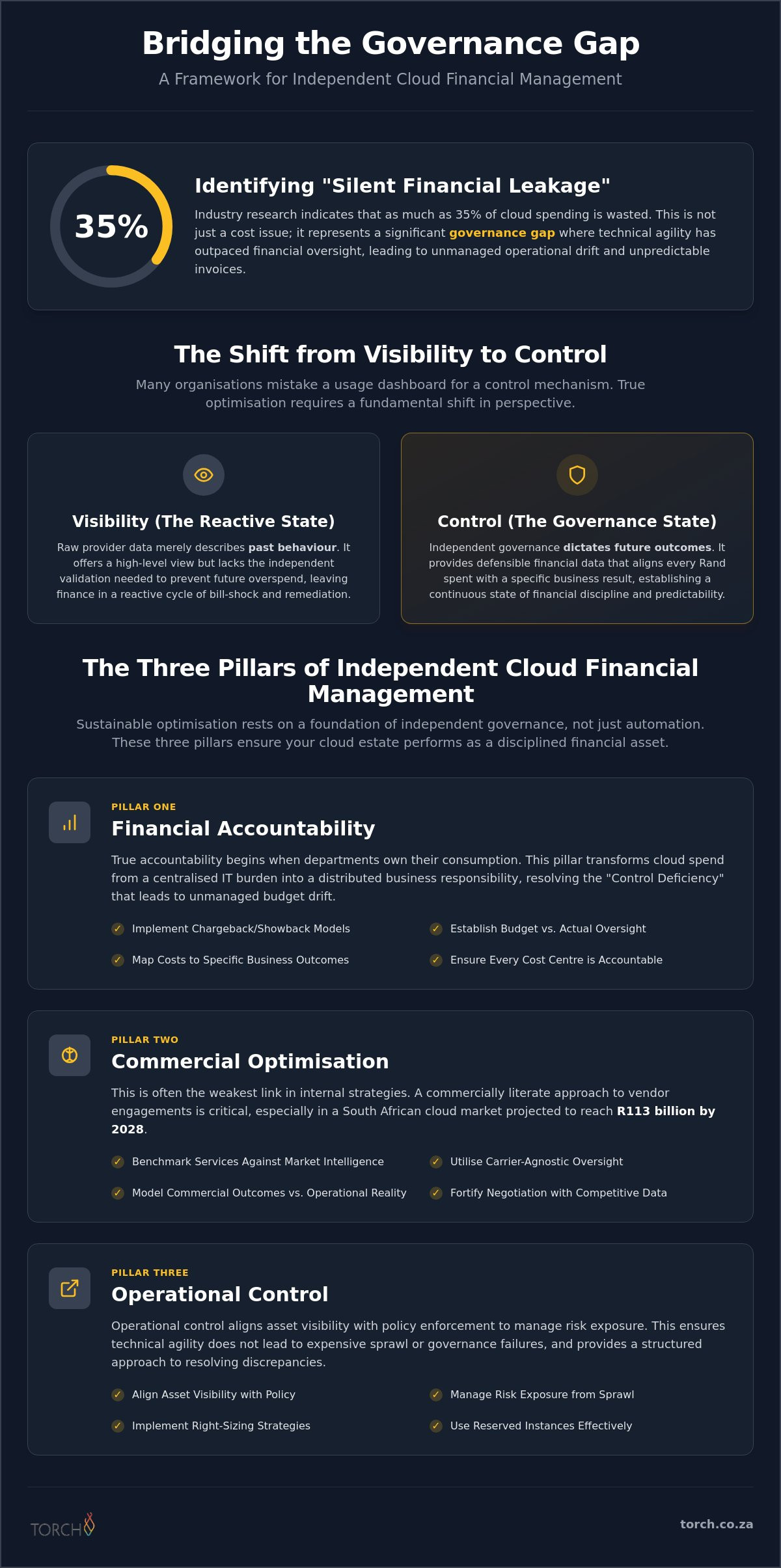
Industry research indicates that as much as 35% of cloud spending is wasted due to inefficient management and a lack of visibility. For local enterprises, establishing effective cloud cost optimization South Africa is no longer a technical preference; it’s a strategic necessity for business health. You’ve likely experienced the frustration of unpredictable monthly invoices, often worsened by the volatility of the ZAR/USD exchange rate. It’s difficult to align IT usage with Finance budgets when costs fluctuate without clear justification.
We understand that this lack of control creates a significant governance gap. This guide explains how you can eliminate silent financial leakage and bridge that gap through independent FinOps principles. We’ll explore how to transform raw usage data into defensible financial reporting that satisfies board-level scrutiny whilst restoring predictability to your IT budget.
Key Takeaways
- Understand why effective cloud cost optimisation South Africa requires a transition from passive monitoring to a continuous discipline of rigorous financial governance.
- Bridge the governance gap by establishing clear accountability through precise cost centre allocation and detailed budget variance analysis.
- Learn to fortify your commercial position by benchmarking vendor engagements against current market intelligence to eliminate silent financial leakage.
- Identify practical strategies like right-sizing and Reserved Instances to manage risk exposure.
- Recognise why a managed model provides the embedded execution necessary to resolve billing discrepancies.
Defining Cloud Cost Optimisation: Moving Beyond Dashboards
Cloud cost optimisation is often misunderstood as a simple exercise in trimming monthly invoices. In reality, it is the continuous discipline of aligning cloud computing consumption with business value through rigorous financial governance. For enterprises pursuing cloud cost optimization South Africa, the primary challenge is rarely technical; it is usually a “control deficiency” where the speed of technical agility has far outpaced the maturity of financial oversight.
Whilst provider-native visualisation tools offer high-level data, they frequently lack the independence required for objective financial validation. These interfaces are designed by the vendors to encourage consumption rather than scrutinise it. There is a fundamental distinction between a one-time “cost reduction” event and a state of “governance.” The latter represents a continuous state of control where every Rand spent is mapped to a specific business outcome.
The Governance Gap in South African Enterprises
A persistent gap exists between IT teams and Finance departments. IT speaks in terms of availability and latency, whilst Finance focuses on budget variance and predictability. This disconnect creates “silent financial leakage.” Technical resources are often provisioned without commercial stress-testing, leading to unmanaged operational drift that only becomes visible when the monthly bill arrives. Without independent oversight, the organisation remains in a reactive cycle of bill-shock and panicked remediation.
Why Visibility is Not the Same as Control
Many organisations mistake a simple usage interface for a control mechanism. Raw data merely describes past behaviour; independent governance dictates future outcomes. To move from visibility to control, CFOs require defensible financial data that stands up to board-level reporting. IT FinOps-as-a-Service provides the structured framework needed to bridge this gap. The Control Doctrine is the foundational principle that sustainable optimisation is impossible without first establishing absolute financial control and accountability.
The Three Pillars of Independent Cloud Financial Management
While automation is often touted as the primary solution for reducing spend, it lacks the strategic context required for true cloud cost optimization South Africa. Sustainable management rests on three pillars: financial, commercial, and operational control. These pillars ensure that your cloud estate is not just running efficiently but is performing as a disciplined financial asset. Independent advisors play a critical role here by providing carrier-agnostic oversight that uncovers discrepancies vendor-aligned tools might overlook.
Establishing Financial Accountability
True accountability begins when departments own their consumption. Implementing chargeback or showback models transforms cloud spend from a centralised IT burden into a distributed business responsibility. This requires integrating granular usage data into a broader IT FinOps framework. By aligning spend with the FinOps framework, organisations gain real-time visibility into budget vs. actual oversight. It’s about ensuring every cost centre is accountable for its variance, preventing the “Control Deficiency” that leads to unmanaged budget drift.
Commercial Optimisation and Benchmarking
Commercial control is frequently the weakest link in internal strategies. Internal procurement teams often lack the specific market intelligence needed to benchmark cloud services effectively against current global and local trends. Achieving effective cloud cost optimization South Africa requires a commercially literate approach to vendor engagements. With the local cloud market projected to reach R113 billion by 2028, the stakes for contract negotiation are high. Using competitive intelligence allows for scenario modelling, helping you map commercial outcomes against operational realities before signing long-term commitments.
Operational control aligns asset visibility with policy enforcement to manage risk exposure. It ensures that technical agility doesn’t lead to expensive sprawl or governance gaps. If you’re concerned about your current levels of oversight, you might consider how a professional review of your cloud estate could restore financial discipline. Establishing this level of control provides the defensible data required for board-level reporting and long-term fiscal stability.
Book a 30-minute governance review with Derek King — no obligation, no sales pitch.
Practical Strategies for Optimising Cloud Spend in South Africa
Moving from a state of visibility to active control requires tactical precision. While the strategic pillars provide the framework, execution depends on identifying specific inefficiencies within your estate. Effective cloud cost optimization South Africa involves more than just deleting unused resources; it requires a disciplined approach to matching consumption with actual workload requirements. Industry data suggests that as much as 35% of cloud spending is wasted, a figure that can be significantly reduced through rigorous technical and commercial alignment.
- Right-sizing: You should continually assess instance performance to ensure you aren’t paying for over-provisioned capacity. Matching resource size to actual demand is the first step in rescuing a bloated budget.
- Reserved Instances and Savings Plans: Committing to long-term usage can lead to commercial discounts of up to 72% compared to on-demand pricing. This strategy provides the predictability Finance departments require.
- Spot Instances: For non-critical or stateless workloads, leveraging spare provider capacity can offer savings of up to 90%, though this requires sophisticated operational management to handle interruptions.
- Automated Policy Enforcement: Implementing automated guards prevents “zombie” resources from draining budgets after projects have concluded.
Managing Currency Volatility and ZAR/USD Impact
South African enterprises face a unique challenge: the volatility of the Rand against the US Dollar. Since most major cloud providers bill in USD, a sudden shift in the exchange rate can invalidate a monthly budget overnight. To manage this risk exposure, you must structure forecasts with a currency-driven variance buffer. Independent financial engagement is essential here; it provides the commercial literacy needed to manage vendor billing disputes that often arise from complex exchange rate calculations. If you’re struggling to reconcile these fluctuations, you can schedule a consultation to review your cloud billing governance.
Lifecycle Governance and Asset Visibility
Financial leakage often stems from a lack of asset visibility. If you can’t see an asset, you can’t govern it. Integrating cloud resources into broader Unified Endpoint Management principles ensures that every instance is accounted for and secured. This reduces the risk of shadow IT, where technical teams provision resources outside of official procurement channels. 85% of ransomware entry points start from unmanaged endpoints. By maintaining absolute visibility and control over your technological estate, you fortify your security posture whilst simultaneously ensuring financial accountability. Organisations seeking to deepen this level of oversight can benefit from implementing robust IT spend analytics for enterprises, which moves beyond basic visualisations to achieve absolute asset accountability across complex technology estates.
Book a 30-minute governance review with Derek King — no obligation, no sales pitch.
Transitioning to a Managed FinOps-as-a-Service Model
A software platform alone is rarely sufficient for complex enterprise governance. Whilst dashboards provide visibility, they do not provide the “embedded execution” required to resolve billing discrepancies or enforce policy at scale. Effective cloud cost optimization South Africa requires a transition from passive reporting to active, independent financial oversight. This managed approach ensures that your internal IT and Finance teams are relieved of the administrative burden of manual invoice reconciliation and validation.
Confidence in financial data is restored through rigorous reconciliation. Rather than simply identifying a “Control Deficiency,” a managed service specialist actively engages with vendors to correct errors and fortify your commercial position. This level of dedication moves beyond simple cost-tracking; it establishes a permanent state of financial control and accountability that aligns technical usage with corporate budgetary goals. It’s about ensuring that the data presented to the board is not just visible, but defensible.
The Torch Approach: Governance-Led Execution
Our methodology focuses on providing the intelligence needed for genuine commercial leverage. Through the use of tools like TorchLight and SpotLight, we uncover the nuances of your technology estate that generic platforms often miss. This independent governance model ensures that your interests are prioritised over vendor-aligned agendas. High-touch managed services provide the necessary weight to resolve complex accountability issues, ensuring that your IT FinOps-as-a-Service experience results in measurable business value rather than just another set of charts.
Next Steps for South African CFOs
The first step towards sustainable control is evaluating your organisation’s current maturity. Many enterprises operate with a significant “governance gap” that leads to unmanaged risk exposure and financial leakage. By choosing a partner focused on cloud cost optimization South Africa, you can begin identifying immediate opportunities for uncovering hidden savings within your existing technology estates. This process starts with a structured diagnostic to determine where your current controls may be failing and where your oversight can be fortified.
This requirement for robust oversight is not limited to the digital realm; industrial operations also require high-quality components to prevent operational drift. To support your physical technology estate, you can explore Manufacturing and supply of medium-voltage electrical infrastructure options from Africa Switchgear & Transformers.
Securing Financial Predictability in a Volatile Market
Establishing effective cloud cost optimization South Africa is the only sustainable way to protect your margins from currency volatility and unmanaged operational drift. By bridging the governance gap, you move beyond mere reporting and into a state of active financial accountability. Independent governance has been shown to deliver up to 47.2% in total savings compared to unmanaged estates. This level of commercial optimisation is only possible when your strategy is informed by objective, carrier-agnostic oversight.
With over 100 years of combined industry experience in the South African market, our team provides the strategic map needed to navigate complex vendor billing and technical sprawl. Transitioning to a managed FinOps model ensures that your financial data is defensible at the board level whilst relieving your internal teams of administrative burden. You don’t have to accept unpredictable cloud invoices as an unavoidable cost of doing business.
Request the Torch FinOps Readiness Assessment — a 20-minute diagnostic for CFOs. Establishing this level of control today ensures that your organisation remains agile, resilient, and financially disciplined for years to come.
Frequently Asked Questions
What is the difference between cloud cost management and cloud cost optimisation?
Cloud cost management focuses on the basic monitoring and reporting of expenses, whereas cloud cost optimisation is the continuous discipline of aligning consumption with business value through rigorous financial governance. Management is often a reactive process of tracking spend; optimisation involves proactive commercial optimisation to ensure that every technical resource serves a specific, defensible business purpose.
Why are our cloud costs so much higher than our initial estimates?
Initial estimates frequently fail to account for operational drift and the governance gap that occurs when technical agility outpaces financial oversight. Costs are also inflated by regional price premiums, as major providers often charge 20% to 24% more for services in the Africa region compared to the US. Without independent governance, over-provisioning and “zombie” resources quickly drive invoices beyond their original projections.
How does the ZAR/USD exchange rate affect my cloud bill in South Africa?
Because major global providers bill in US Dollars, the volatility of the Rand creates significant budget variance that is difficult to forecast. Even if your technical usage remains flat, a shift in the exchange rate can cause your monthly costs to spike. Effective cloud cost optimization South Africa requires structuring forecasts with currency-driven variance buffers and performing regular invoice reconciliation to manage this risk exposure.
Can we manage cloud costs effectively using only AWS or Azure native tools?
Native tools provide valuable technical data but often lack the independence required for objective financial validation. These dashboards are designed by vendors to encourage consumption rather than to scrutinise it from a commercially literate perspective. They cannot provide the carrier-agnostic oversight or market benchmarking needed to identify silent financial leakage across complex, multi-cloud estates.
What is FinOps-as-a-Service and how does it differ from traditional consulting?
Traditional consulting usually results in a one-time report, while IT FinOps-as-a-Service provides embedded execution and continuous financial control. This managed model doesn’t just report on problems; it actively resolves billing discrepancies and enforces governance policies on your behalf. It provides a permanent state of visibility and control that traditional, project-based consulting cannot sustain.
How much can a typical South African enterprise save through independent cloud governance?
South African organisations often uncover substantial hidden savings when transitioning from unmanaged to governed estates. Independent governance has been documented to deliver up to 47.2% in total savings by correcting overspending and enforcing rigorous accountability. These results are achieved by bridging the control deficiency and ensuring that technical resources are precisely matched to actual workload requirements.
Book a 30-minute governance review with Derek King — no obligation, no sales pitch.