
What if every line on a telecom invoice had to match an agreed contract, an active service or recorded usage? For South African enterprises, learning how to audit telecom invoices for errors starts with that test. Yet bills often combine multiple services, users, devices and billing periods, making it difficult to identify charges that don’t align with contracts or service records. Torch/TLM data indicates that billing errors average 7–12% of monthly invoice value, showing why line-level validation matters.
Manual checks can take valuable time, while unresolved exceptions leave finance and IT without a shared record of the evidence, query and outcome. A repeatable audit process brings these moving parts into view. It helps teams validate charges independently, investigate discrepancies and document credits and follow-up actions.
This guide explains how to reconcile invoices against contracts, service inventories and usage data, then resolve exceptions and establish ongoing controls. You’ll get a practical framework for strengthening financial control and accountability, improving visibility across telecom spend and reducing managed risk exposure, including risks linked to unused or unmanaged services.
Key Takeaways
- Set a clear audit scope by vendor, service type, billing period or business unit before reviewing charges.
- To learn how to audit telecom invoices for errors, reconcile invoice lines with contract terms, service records and usage evidence.
- Classify each discrepancy as a confirmed error, a valid charge or an unresolved item that needs further evidence.
- Keep an exception log with the invoice reference, variance, supporting evidence, owner and resolution status.
- Assess whether your internal review has the capacity and access to support repeatable checks, or whether independent TEM support could strengthen accountability.
Why audit telecom invoices? Find the discrepancies that weaken financial control
A telecom invoice audit tests whether each billed charge is supported by the agreement, the service in place, recorded usage and the appropriate approval. A telecommunications audit provides a useful foundation, but enterprise reviews also need to account for the organisation’s own contracts, service inventory and authorisation records.
Invoice reconciliation means matching billed items to contract terms and service evidence, then investigating differences before deciding what action to take. An unfamiliar charge is a discrepancy to investigate, not automatically a confirmed error. Check the relevant records first, then raise a query with clear supporting evidence.
Multiple vendors, service types, users and billing periods can make this review demanding. Charges may appear in different formats, while the records needed to validate them sit across finance, procurement, IT and business units. Independent governance connects those records and strengthens financial control & accountability, rather than relying on an invoice total or a single explanation.
Which telecom invoice errors should an enterprise check first?
Start with line items that can be tested against existing records: possible duplicate charges, unexpected recurring fees and services that don’t appear in the current inventory. Compare billed rates, discounts and service dates with the signed contract and any amendments. For usage charges, check the relevant billing period and available usage records, including whether the activity aligns with authorised user activity. Treat a mismatch as a prompt to verify, not proof of an error. In a Torch/TLM banking case study, 340 inactive SIMs were deactivated in month one, illustrating the value of checking services that remain active without a current business need.
Why do telecom billing discrepancies persist?
Records can become fragmented across finance, procurement, IT, carriers and business units. For example, a staff or device change may be recorded in one system but not reflected promptly in another. Service cancellations and contract amendments can create similar gaps, leaving teams unsure which record is current.
Reviewing only the invoice total won’t show which individual lines changed, whether a credit was applied or whether an earlier query remains unresolved. A line-level view makes these exceptions visible and gives teams a stronger basis for action. For organisations seeking a structured approach, Telecom Expense Management supports billing validation, contract review and ongoing commercial optimisation.
How to audit telecom invoices for errors: a repeatable reconciliation process
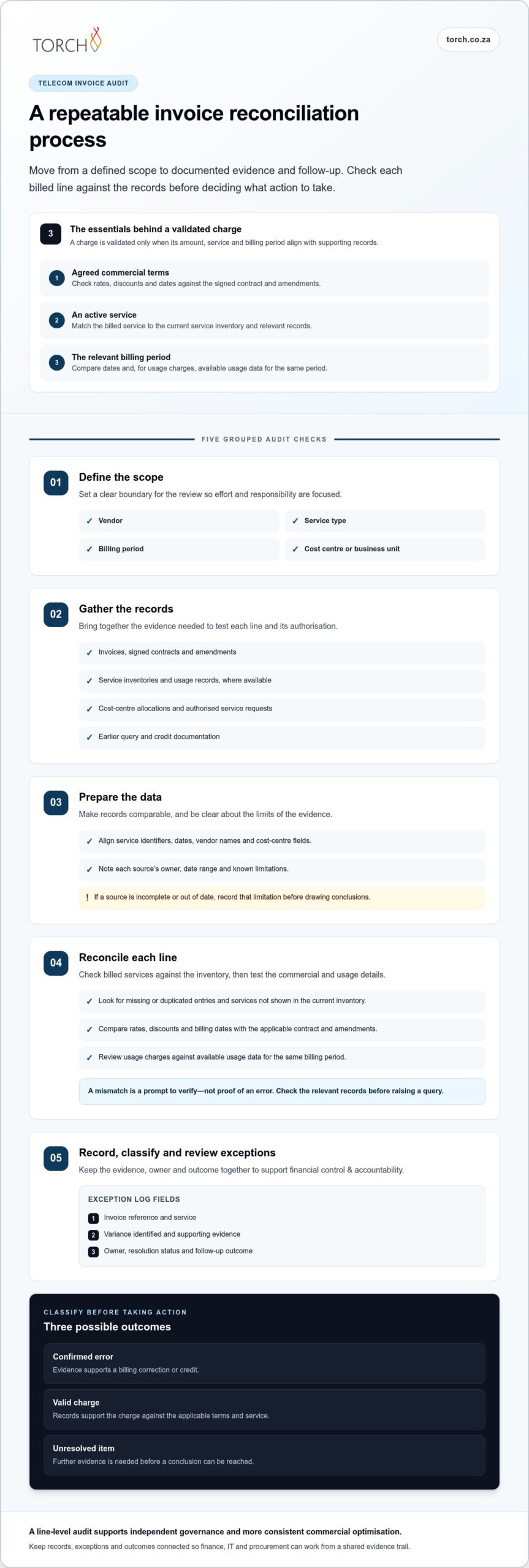
A consistent workflow turns invoice review from a periodic scan into a repeatable control. To establish how to audit telecom invoices for errors, move from a defined scope to documented evidence and follow-up, rather than treating each bill as a standalone check.
- Define the scope. Select the vendor, service type, billing period, cost centre or business unit under review. A clear boundary helps teams focus their effort and assign responsibility.
- Gather the records. Bring together invoices, signed contracts, amendments, service inventories, usage records, cost-centre allocations, authorised service requests and earlier query or credit documentation.
- Prepare the data. Align service identifiers, dates, vendor names and cost-centre fields so the same service can be compared across records. Note each source’s owner, date range and known limitations.
- Reconcile each line. Match billed services to the active inventory, check for missing or duplicated entries, and compare rates, discounts and billing dates with the applicable contract and amendments. Review usage charges against available usage data for the same period.
- Record and review exceptions. Flag unexplained variances for investigation, record the evidence and owner, then track the outcome, including any confirmed correction or credit.
What records do you need before checking an invoice?
Start with supplier invoices, contracts, order changes and service records. Add usage data where available, cost-centre allocations and the approvals or service requests that support an order. Record who maintains each source and the period it covers. If a source is incomplete or out of date, note that limitation. Don’t treat an apparent mismatch as conclusive until there is enough evidence to assess it.
How should teams reconcile invoice lines?
Compare each charge against three essentials: the agreed commercial terms, an active service and the relevant billing period. A charge is validated only when its amount, service and billing period align with supporting records. If one element differs, investigate the variance before classifying it as an error. This keeps valid charges separate from confirmed exceptions and unresolved questions.
How to investigate telecom invoice discrepancies and close them properly
Finding a variance is the start of an investigation, not its conclusion. A clear exception process helps finance, IT and procurement distinguish a confirmed billing error from a valid contractual charge or an item that still needs evidence. It also creates an audit trail that supports financial control & accountability.
Build an exception log and establish the facts
Record each issue against its invoice reference and service. Include the variance identified, supporting evidence, assigned owner and current status. Classify it as a confirmed error, a valid charge or unresolved pending further information. This prevents an open question from being treated as a credit that has already been agreed.
Before raising a query, assemble the relevant invoice line and the evidence supporting your position, such as the contract clause, amendment or service record. Show the billed amount alongside the expected amount, and explain how you calculated the difference. Keep correspondence and supporting records together so the rationale remains clear if ownership changes.
Raise queries, track outcomes and prevent repeat issues
Submit a factual query through the process specified in the applicable contract, and check that contract for any dispute deadline before sending it. Track the supplier’s response, any agreed adjustment and whether a credit appears on a later invoice. Keep the exception open until the evidence supports a recorded outcome.
A raised query is not a resolved exception; closure requires recorded evidence and a documented outcome. That outcome might confirm the charge was valid, record a correction or credit, or explain why more evidence is needed.
Use recurring exceptions to strengthen controls. Once a service change or cancellation is verified, update the relevant inventory and cost-centre records, then assign an owner to review recurring issue types, ageing items and closure status. If an unused or unmanaged service remains active, the concern may extend beyond spend to security oversight and managed risk exposure. Microsoft Security reports that 85% of ransomware entry points start from unmanaged devices, reinforcing the importance of identifying and governing services and devices that are no longer actively managed.
A disciplined approach to how to audit telecom invoices for errors depends on carrying evidence through to resolution, not simply logging a variance. That follow-through turns individual findings into more reliable commercial governance.
Internal review or independent TEM support: choosing a sustainable audit model
The right audit model depends on the size and complexity of your telecom estate, the quality of your records and your capacity to review invoices consistently. A defined internal process can work well for a smaller, simpler estate. As vendors, services and exceptions multiply, additional specialist capacity may help maintain continuity, independent governance and clear accountability. The goal is a sustainable way to apply how to audit telecom invoices for errors, not a choice between internal ownership and external support.
When can an internal telecom invoice audit work well?
Internal review is practical when contracts and service records are accessible, responsibilities are clear and teams can set aside recurring time for reconciliation and follow-up. Finance can coordinate invoice and cost-centre checks, procurement can manage contract evidence, and IT can validate services and usage. Agree who approves queries and tracks responses. If capacity is constrained or exceptions remain unresolved, the process may lose consistency. That’s a signal to review how the work is resourced, not a reflection on the team’s capability.
What does independent TEM add to invoice governance?
Independent, carrier-agnostic Telecom Expense Management adds dedicated capacity to validate charges against contract, service and usage evidence, engage vendors and track exceptions through to resolution. Dashboards can surface spend patterns; analysts provide the investigation, validation and follow-through those patterns may require. Torch Services’ Telecom Expense Management service combines billing validation, contract audits, vendor engagement and commercial optimisation.
Torch Services cites over 20 years in the South African market and reports R667.5M+ saved since 2004 across 12 African countries. These company-reported proof points provide context for its experience, not a forecast of results for any individual enterprise. Internal teams can retain ownership of approvals and service decisions, while independent support adds capacity and a consistent review process.
For a considered discussion about which audit model fits your estate, a 30-minute governance review with Derek King is available with no obligation or sales pitch.
Make telecom invoice control a repeatable discipline
Reliable invoice governance rests on three habits: reconcile charges against contracts and service evidence, document each exception through to its outcome, and maintain controls that keep finance and IT aligned. A clear process for how to audit telecom invoices for errors helps turn individual checks into stronger financial control and accountability.
Torch reports R667.5M+ saved since 2004 across 12 African countries and cites over 20 years in the South African market. Its Telecom Expense Management risk-share model is based on a percentage of verified savings. These proof points provide context for Torch’s experience, not a forecast of results for your organisation.
A practical next step is a complimentary telecom billing audit of a sample of invoices at no cost or obligation.
With clear evidence, accountable owners and consistent follow-through, your organisation can build a more controlled view of telecom spend and move forward with confidence.
Frequently Asked Questions
How do you audit a telecom invoice for errors?
To learn how to audit telecom invoices for errors, compare invoice lines with the relevant contract, amendments, active service inventory, available usage records and approvals. Confirm that each charge relates to the correct service and billing period, and check rates and discounts against agreed terms. Record unexplained differences in an exception log, assign an owner and track each item until the evidence supports a clear outcome.
What are common errors found on telecom invoices?
Common exceptions include duplicate line items, recurring charges for services no longer in use, rates or discounts that differ from contract terms, and charges for unexpected service dates. Usage charges may also warrant investigation if they don’t align with available records or authorised activity. Treat these as items to verify, not confirmed errors: a contract amendment, billing-period difference or other supporting record may explain the charge.
What documents do I need to check a business telecom bill?
Gather the invoice, signed contract and amendments, order or service-change records, current service inventory and available usage data. Cost-centre allocations and authorised service requests can help confirm ownership and approval. Include previous queries and credit documentation so you can see whether an earlier issue was resolved. Note who maintains each source and the period it covers, particularly if records are incomplete or don’t align.
How often should a business audit telecom invoices?
Review invoices as part of each billing cycle so discrepancies can be identified while the supporting records are accessible. The appropriate review depth depends on the size and complexity of the estate, available capacity and the organisation’s control requirements. In addition to routine checks, review services and contract records after material changes, such as a cancellation or amendment. Check the applicable contract for any query deadlines.
Can an enterprise audit telecom invoices without specialist software?
Yes. A smaller estate can be reviewed using invoices, contracts, service records and a structured spreadsheet or exception log. Record the charge, evidence, owner and status, and keep source documents together. As vendors, services and billing lines increase, manual matching may become harder to repeat and oversee. Specialist tools can support spend visibility and benchmarking, while analysts investigate exceptions and follow them through to resolution.
What should a business do when a telecom provider disputes an invoice query?
Review the response against the contract, invoice line and evidence used to raise the query. If the explanation doesn’t resolve the variance, reply with a clear calculation and relevant supporting records, then follow the contract’s stated query or escalation process. Check any applicable deadline in the contract. Keep correspondence and decisions in the exception log, and don’t record an adjustment or credit as confirmed until it’s documented.