
What if a reported telecom saving reflects a once-off credit or spend that was never going to occur, rather than a lasting reduction? For Finance, the difference matters. Telecom costs are spread across services, users, contracts and suppliers, so a headline figure is difficult to defend without a comparable baseline and a clear audit trail. That’s why how to calculate cost savings from TEM starts with evidence, not a percentage.
It’s reasonable to expect Telecom Expense Management to uncover billing errors, unused services and opportunities to improve contracts. But these gains shouldn’t be grouped together or attributed to TEM without validation. A credible calculation distinguishes recurring reductions from credits and avoided future spend, and separates active management from commercial negotiation outcomes.
This guide sets out a finance-led method to establish a like-for-like baseline, verify changes against invoices and reconcile savings over time. You’ll also learn how to report results transparently in Rands, account for relevant costs and put governance in place to sustain financial control and accountability. The aim is a savings figure Finance can trace, challenge and defend.
Key Takeaways
- Define the financial outcome before measuring it: compare like-for-like telecom spend and support each change with evidence.
- Use a consistent scope and period to build a baseline, then reconcile actual spend against it.
- Learn how to calculate cost savings from TEM without overstating results by separating recurring reductions, negotiation outcomes, credits and cost avoidance.
- Link each claimed saving to a documented action, and report the period and attribution clearly.
- Use ongoing invoice, contract and usage oversight to identify reversals and sustain financial control.
What Counts as a TEM Saving? Define the Financial Outcome First
What changed, against which baseline, and what evidence supports the change? These questions establish whether a lower telecom bill represents a genuine saving or simply reflects a different service mix, billing period or one-off adjustment. For Finance, a TEM saving is a verified reduction in comparable telecom spend, linked to an evidenced change. A smaller invoice on its own is not proof.
Expense management covers the oversight and control of business expenses; the Telecom Expense Management (TEM) Overview provides a general introduction to its telecom-specific application. In practice, billing validation and service oversight help make spend measurable. A disciplined Telecom Expense Management approach can support that work by connecting costs to services, accounts and documented actions.
Keep gross and net impact distinct. Gross measured savings show the verified reduction before programme fees and other agreed costs. Net financial impact deducts those costs for the same period. Reporting both gives decision-makers a clearer view of the result without obscuring the cost of achieving it.
Baseline spend versus the current-state cost
The baseline is the agreed reference period and scope before measured interventions begin. Define which services, accounts, users and suppliers are included, and record exclusions such as a newly acquired business unit. Document material changes, including a service being added or a user group being transferred, so that genuine operational shifts aren’t mislabelled as savings.
Compare like with like: use consistent service units, service levels and reporting periods. If the baseline covers a full billing cycle, compare it with an equivalent cycle rather than a partial month. Where scope changes, adjust or explain the comparison before drawing a conclusion. This makes the calculation more useful for financial control and accountability.
Savings, cost avoidance and credits are not interchangeable
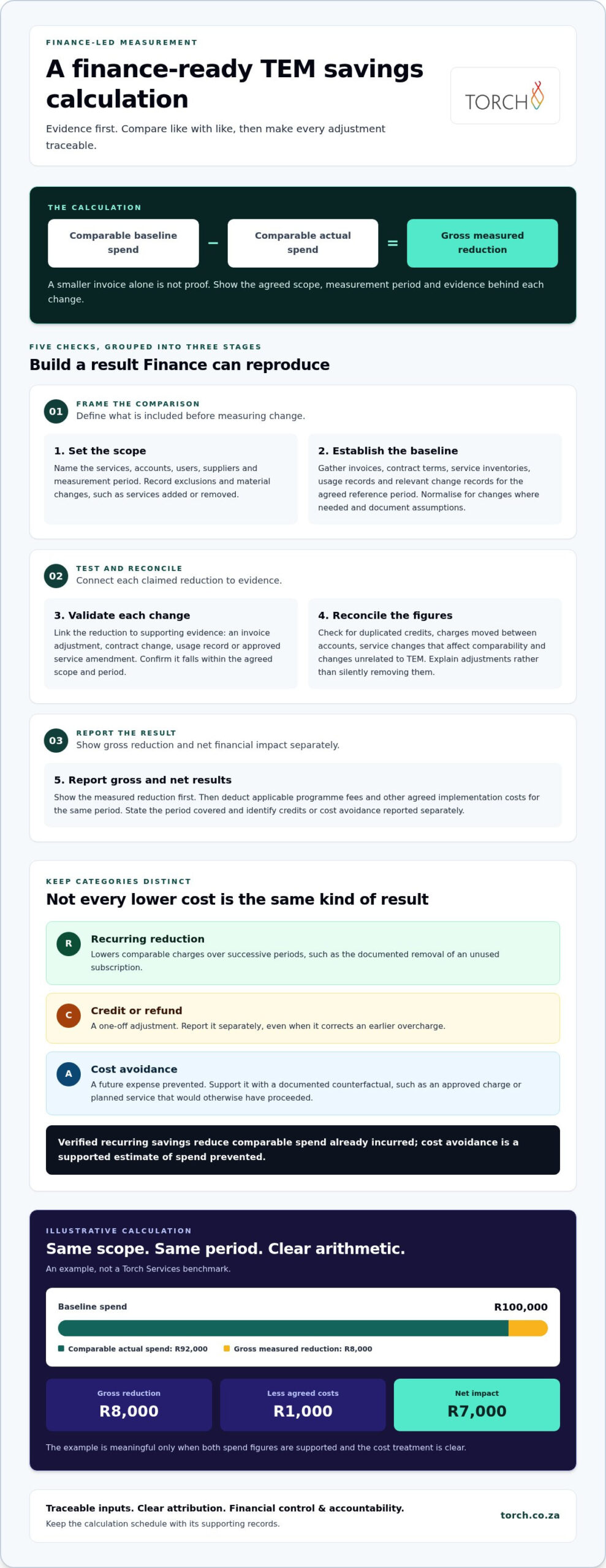
A recurring reduction lowers comparable charges over successive periods, such as a documented removal of an unused subscription. A credit or refund is a one-off adjustment: report it separately, even if it corrects an earlier overcharge. Cost avoidance describes a future expense that was prevented, so it needs a documented counterfactual, such as an approved charge or planned service that would otherwise have proceeded. Don’t treat an assumed future bill as a realised reduction.
Verified recurring savings reduce comparable spend already incurred; cost avoidance is a supported estimate of spend prevented. Keeping these categories separate clarifies how to calculate cost savings from TEM and helps Finance assess the evidence, timing and net impact of each result. The outcome will depend on the estate in scope, baseline quality, measurement period and changes that can be evidenced.
How to Calculate TEM Savings with a Verifiable Baseline
A finance-ready calculation needs a repeatable method, not a comparison of two headline totals. Keep the scope, period and evidence visible so another reviewer can follow each adjustment and reproduce the result.
- Set the scope. Identify the services, accounts, users and suppliers included, the measurement period, and any exclusions. Record material changes, such as services added or removed, so they can be treated consistently.
- Establish the baseline. Gather invoices, contract terms, service inventories, usage records and relevant change records for the agreed reference period. Normalise for changes in users or services where needed, and document assumptions so Finance can repeat the calculation.
- Validate each change. Link a claimed reduction to supporting evidence, such as an invoice adjustment, contract change, usage record or approved service amendment. Confirm that the change occurred within the agreed scope and period.
- Reconcile the figures. Check for duplicated credits, charges moved between accounts, service reductions that affect comparability, and changes unrelated to TEM. Explain any adjustment rather than silently removing it from the calculation.
- Report gross and net results. Show the measured reduction first, then deduct applicable programme fees and other agreed implementation costs to present the net financial impact. State the period covered and identify any items reported separately, such as credits or cost avoidance.
Comparable baseline spend minus comparable actual spend equals gross measured reduction. To verify the result, every input needs a source, an accountable owner, a defined period and a documented treatment. Keep the calculation schedule alongside the supporting records, rather than relying on a dashboard total that cannot be traced to invoices or approved changes.
For example, an illustrative calculation, not a Torch Services benchmark, might compare baseline spend of R100,000 with comparable actual spend of R92,000 for the same scope and period. The gross measured reduction is R8,000. If applicable programme fees and agreed implementation costs for that period total R1,000, the net impact is R7,000. The example is meaningful only if both spend figures are supported and the cost treatment is clear.
This method makes how to calculate cost savings from TEM more transparent: Finance can inspect the inputs, challenge assumptions and confirm the arithmetic. If you’d like to discuss a finance-ready approach for your telecom estate, book a governance review.
How to Attribute TEM Savings Without Overstating Results
A measured reduction is more useful when Finance can see what caused it. Record the action, evidence, owner and period for each result, then classify it before reporting a total. This makes active management, contract outcomes and one-off adjustments visible without assigning unrelated changes in supplier pricing, business demand or estate size to TEM.
Recurring operational optimisation and negotiation outcomes
Active management gains arise from evidenced operational changes, such as removing an unused subscription or adjusting a service to match recorded usage. Independent negotiation gains come from documented contract outcomes, supported by comparable commercial terms. Keep these categories separate in working papers and management reporting; combine them only after each has been validated.
| Outcome | How to attribute and report it |
|---|---|
| Recurring reduction | Link the ongoing lower charge to an implemented service, subscription or usage adjustment. Show the effective date and whether the reduction continued in later periods. |
| Negotiation outcome | Record the agreed contract change and compare relevant terms on a like-for-like basis. Attribute the measured difference to that documented commercial outcome. |
| Credit or refund | Identify the invoice and reason for the one-off adjustment. Report it separately from recurring reductions and check it hasn’t been counted twice. |
| Cost avoidance | Describe the documented decision or action that prevented a cost, alongside the evidence for the counterfactual. Keep it distinct from spend already reduced. |
For context, GetMetrix analysis of South African financial-services billing data covering mobile lines (voice and data) only found up to 47.2% total saving on telecom spend, split into 19.6% active management and 27.5% independent negotiation. This is a scoped research result, not a forecast for every organisation. Estate composition, baseline quality, timing and verified actions affect what can be measured. Don’t apply the percentages as a universal expectation or use them in place of your own evidence. A separate banking outcome recorded R8.9M in SBSA-verified savings over 18 months.
One-off items, scope changes and reporting periods
Show credits and refunds separately from ongoing monthly reductions, with the invoice period and reason recorded. If services or users are added or removed, identify the change and adjust the like-for-like comparison transparently rather than treating the full invoice movement as a TEM result. Report realised savings by period, noting whether each change remains active, has reversed or requires further validation.
To apply this attribution approach to your telecom spend, how to calculate cost savings from TEM depends on keeping each claimed outcome distinct and traceable.
Sustain Verified TEM Savings Through Independent Governance
A verified reduction can erode if a service is reactivated, a contract term changes or usage grows without review. Ongoing oversight helps identify these reversals and keeps results connected to current invoices and operational decisions. The calculation is a starting point; sustained financial control & accountability depend on what happens next.
Turn a calculation into a repeatable control
Assign clear owners for invoice validation, contract changes, exceptions and savings sign-off. Agree a review cadence that follows billing and financial reporting cycles, and retain records of adjustments and approvals. That trail allows Finance to revisit a result and check whether the change remains in effect.
A dashboard can flag a variance, but it can’t resolve the cause by itself. Someone still needs to investigate the invoice or service record, decide whether action is appropriate and track the outcome. Use recurring reviews to:
- Compare billed services with approved contracts and current service records.
- Review usage and investigate material changes against the agreed scope.
- Record corrective actions, responsible owners and whether a control needs further attention.
Where telecom services are tied to devices or users, governance also helps keep service assignments aligned with operational needs. Reviewing who uses an assigned service can support cost control and managed risk exposure, particularly when roles or device allocations change.
What independent TEM governance contributes
Independent governance brings measurement and follow-through together. Torch’s carrier-agnostic Telecom Expense Management work includes validating invoices, auditing contract terms, benchmarking charges and supporting commercial optimisation. These activities help surface discrepancies, assess options and track agreed changes beyond the initial review. The Telecom Expense Management service connects this oversight with billing validation, remediation and ongoing governance.
Torch’s risk-share model is based on a percentage of verified savings. It aligns the model with evidenced results; it isn’t a guarantee of a particular outcome. The estate, baseline and changes that can be validated still determine what is measurable.
For CFOs considering how to calculate cost savings from TEM and maintain control over time, independent oversight can provide a structured way to review evidence, actions and reversals.
Make Telecom Spend a Continuing Finance Control
A defensible TEM calculation can become more than a reporting exercise. Use it to inform budget decisions, clarify accountability and identify when a change needs attention. As your estate evolves, keep the measurement approach aligned with current services and business priorities so Finance can continue to rely on the results.
For decision-makers considering how to calculate cost savings from TEM, the next step is to apply the method to their own telecom environment and examine the evidence behind reported changes. Torch brings 100+ years of combined industry experience and more than 20 years in the South African market to this work. Since 2004, Torch has saved R667.5M+ across 12 African countries.
With a clear view of the evidence and a practical governance path, you can strengthen financial control and manage telecom spend with greater confidence.
Frequently Asked Questions
What baseline period should an organisation use to calculate TEM savings?
Choose a period that reflects the operating pattern you need to assess, including any known seasonal variation. For example, a period affected by a temporary campaign or unusual travel may not represent ordinary demand. Check whether the selected invoices cover complete billing cycles and whether usage records align with them. If the period contains an exceptional event, explain its effect or use a more representative comparison before presenting the result to Finance.
Is TEM return on investment the same as telecom savings?
No. Telecom savings describe a change in spend, whilst return on investment (ROI) assesses the benefit against the investment required to achieve it. An ROI assessment may also consider the period over which benefits accrue and whether they are realised in cash or represent avoided expenditure. Agree these assumptions with Finance before reporting ROI, and avoid presenting a savings percentage alone as evidence of investment return.
Can a telecom bill credit be counted as recurring TEM savings?
A credit can be a valid recovery, but it shouldn’t be presented as a recurring reduction. Check whether the credit has actually been applied to the account, rather than merely promised or raised for review. If it offsets a disputed charge, make sure the original charge and the credit aren’t both counted as separate benefits. Record the accounting treatment consistently so the same recovery doesn’t appear in multiple reporting periods.
How should an organisation treat a carrier price change when measuring TEM savings?
Use the effective date to divide the comparison into periods before and after the change. Compare the same service and unit of usage under the relevant price terms, rather than treating the entire invoice movement as a saving. For example, a lower rate per unit may coincide with higher usage. Separate those effects in the analysis so Finance can see the rate impact without confusing it with changes in demand.
What evidence does Finance need to verify TEM savings?
A useful control is an evidence register that gives each claimed result a reference number and identifies where its supporting records are stored. Include who reviewed the item, who approved its treatment and whether any follow-up remains open. This helps Finance sample or investigate individual claims without searching across unrelated files. It also makes review handovers clearer when responsibility moves between procurement, IT and finance teams.
How often should TEM savings be recalculated?
Alongside scheduled reporting, reassess the calculation when a material event could change the result. Examples include a contract renewal, a service migration, an acquisition or a shift in how telecom costs are allocated internally. These trigger-based checks help identify changes between regular reporting points. Keep the trigger and resulting review visible in the control process, so teams can distinguish routine monitoring from an event-driven reassessment.