
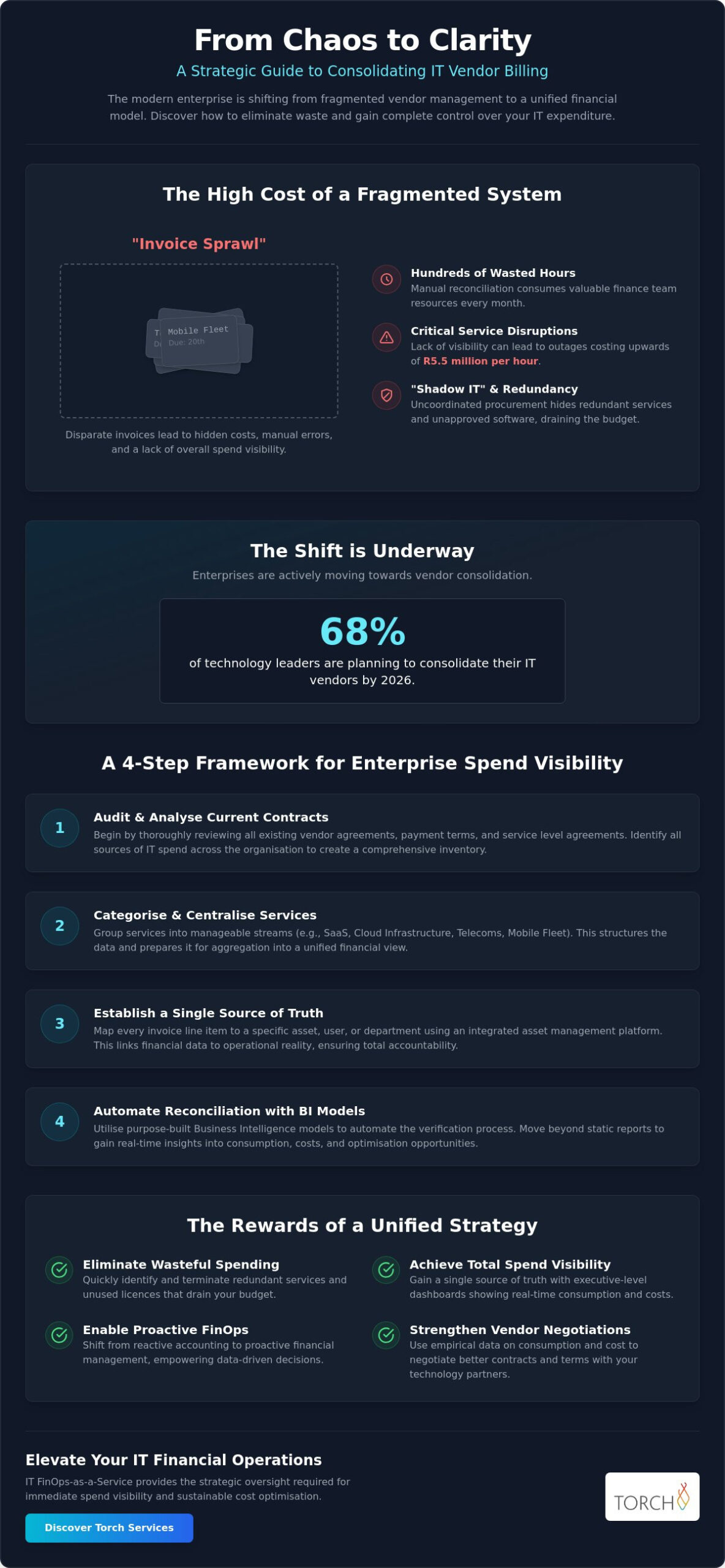
For IT and finance leaders in large organisations, the constant influx of technology invoices can feel like a relentless storm. Hundreds of bills from SaaS providers, cloud platforms, telecom carriers, and hardware vendors arrive with different formats, billing cycles, and payment terms. This is “invoice sprawl,” a state of disorganised financial data that obscures visibility, invites wasteful spending, and consumes countless hours in manual reconciliation.
The traditional response—hiring more accounts payable staff—no longer scales. Instead, leading enterprises are turning to a more strategic solution: consolidating IT vendor billing. This is not merely an accounting exercise; it is a foundational step towards a mature IT financial operations (FinOps) model that transforms technology spend from a reactive cost centre into a strategic, governed asset.
Master the transition from fragmented invoice sprawl to a centralised IT financial operations model that uncovers hidden savings.
The Strategic Necessity to Consolidate IT Vendor Billing
IT vendor billing consolidation is the process of aggregating disparate technology and telecom invoices into a single, unified financial stream. By centralising this data, organisations move beyond simply paying bills to actively managing and optimising their technology expenditure. The alternative is to remain buried under a mountain of administrative complexity that directly hinders business performance.
The High Cost of Fragmented IT Procurement
The true cost of a decentralised billing system extends far beyond the salaries of the finance team. The hidden costs of manual reconciliation in large-scale enterprises are substantial, manifesting in several critical areas:
- Lost Productivity: Highly skilled IT and finance professionals spend a significant portion of their time chasing, verifying, and processing invoices instead of focusing on strategic, value-added initiatives.
- Financial Penalties: With hundreds of invoices arriving at different times, it is easy for some to be misplaced or overlooked, leading to late payment fees and damaging vendor relationships.
- Cash Flow Complexity: Multiple billing dates and inconsistent payment terms make it nearly impossible to forecast technology spend accurately, creating unnecessary cash flow challenges for the CFO.
At its core, “Invoice Sprawl” is the primary barrier to IT spend visibility, creating a fog of data that prevents leaders from making informed decisions about their technology investments.
Moving Towards IT FinOps Maturity
For organisations aiming to adopt a FinOps culture, consolidating IT vendor billing serves as the essential entry point. FinOps is a discipline that brings financial accountability to the variable spend model of modern technology, but it cannot function without clean, centralised, and reliable data. Unified billing provides this foundation.
This centralisation allows for the creation of executive-level technology dashboards that provide a single source of truth for the CTO and CFO. Instead of relying on outdated spreadsheets and manual reports, leaders can see precisely where money is being spent, by which departments, and on which services. This level of insight is also essential for modern endpoint governance, as it ensures that every device, licence, and subscription is accounted for, authorised, and linked to a specific cost centre.
Designing a Framework for Enterprise Spend Visibility
A successful consolidation programme is built on a robust framework that ensures data integrity, auditability, and departmental accountability. The goal is to create a single source of truth by mapping every invoice line item to a specific, governed asset or service. This requires moving beyond simple aggregation and implementing a system that provides deeper financial intelligence.
This framework must be designed to handle the complexities of a modern enterprise, including multi-currency transactions and vendor contracts that span multiple legal jurisdictions. It also needs a clear chargeback or showback model, allowing departmental heads to see their technology consumption without being overwhelmed by raw invoice data. This ensures that even with centralised billing, accountability remains distributed throughout the organisation.
Mapping Assets to Invoices
The critical link in any consolidation framework is the ability to connect every cost to a tangible asset, user, or service. This is where an integrated asset management platform becomes indispensable. Without it, a consolidated bill is just a long list of charges with no business context.
Effective techniques for creating this link include:
- Integrating with an Asset Database: Your billing platform should integrate directly with your IT asset management system to automatically link hardware serial numbers, software licence keys, and mobile device identifiers to their corresponding invoices.
- Departmental Tagging: Implement a system for tagging all cloud resources, SaaS subscriptions, and telecom lines to the specific departments or projects that use them.
- Maintaining Audit Trails: The system must preserve the original invoice data and create a clear, auditable trail from the consolidated summary back to the individual line items, ensuring transparency and compliance.
Leveraging Purpose-Built BI Models
At an enterprise scale, spreadsheets and manual tracking inevitably fail. The volume and complexity of IT spend data require more powerful tools. Purpose-built Business Intelligence (BI) models are essential for transforming raw billing data into actionable strategic insights.
A well-designed BI model allows an organisation to:
- Uncover Trends: Identify patterns in vendor pricing, data usage, and subscription renewals that would be invisible in fragmented reports. This data is crucial for negotiating better contract terms.
- Detect Anomalies: Automatically flag unusual spikes in spending or deviations from historical trends, enabling proactive investigation into potential billing errors or unauthorised usage.
- Visualise Spend for Leadership: Present complex technology spend data in clear, intuitive dashboards for the CFO and CTO, facilitating faster, more informed decision-making.
A Step-by-Step Approach to Vendor Invoice Consolidation
Transitioning from a fragmented to a consolidated billing model requires a methodical, phased approach. Rushing the process without proper planning can lead to disruption and loss of data integrity. The following steps provide a proven roadmap for a successful implementation.
- Conduct a Comprehensive Audit: Begin by gathering and analysing all current IT and telecom contracts and invoices. This initial discovery phase is crucial for understanding the full scope of your vendor landscape.
- Categorise Vendors and Services: Group vendors by service type, such as SaaS, IaaS, Telecom, and Hardware. This helps in identifying areas of redundancy and opportunities for consolidation.
- Establish a Centralised Procurement Gateway: Mandate that all new technology requests flow through a single, approved channel. This prevents the growth of shadow IT and ensures all future spending is captured within the consolidated system.
- Implement an Automated Platform: Deploy a specialised platform for automated invoice ingestion, data extraction, and reconciliation. This technology is the engine of your consolidation framework.
- Set Up an Endpoint Governance Framework: Ensure that only authorised and managed devices, users, and services are permitted to incur costs, linking financial control directly to your asset management strategy.
Phase 1: The IT Audit and Categorisation
The audit phase is where the first significant savings are often found. This deep dive into your existing contracts and invoices frequently uncovers “zombie” services—subscriptions that are still being paid for long after the employee or project they were tied to has left the organisation. It also exposes duplicate subscriptions where multiple departments are paying for the same software.
During this phase, you should also analyse the payment terms of your top-tier vendors and identify opportunities to standardise them, simplifying cash flow management. This is also the ideal time to evaluate the strength of your existing asset register. A robust process of IT asset management for enterprises is fundamental, as it provides the inventory against which all invoices will be validated. Without a clear view of what assets you own, you cannot effectively validate what you are being billed for. This process offers natural opportunities to strengthen the link between financial data and your physical and digital assets, ensuring every line item corresponds to a governed component of your technology estate.
Phase 2: Automation and Integration
With a clear understanding of your vendor landscape, the next phase is to implement the technology that will drive efficiency. Select a Telecom Expense Management (TEM) or FinOps platform that can integrate seamlessly with your existing Enterprise Resource Planning (ERP) and accounting systems. This integration is vital for creating a fluid flow of financial data across the organisation.
A key goal of this phase is to reduce the administrative burden on your internal teams. Automate user support for common billing queries by providing employees with self-service access to their departmental spend data. Furthermore, establish automated approval workflows for recurring IT expenses. This ensures that standard, predictable costs are processed efficiently whilst flagging any exceptions for management review, striking a balance between speed and control.
Overcoming Common Implementation Hurdles
The path to consolidated IT vendor billing is not without its challenges. Proactively addressing common hurdles is key to a smooth transition. These challenges are often rooted in organisational change management, vendor negotiations, and technical integration complexities.
Common objections often include fears of losing granular detail needed for audits, resistance from long-standing vendors accustomed to established processes, and the complexities of migrating legacy contracts. A successful strategy must include clear communication to address these concerns, a firm but fair approach to vendor management, and a phased rollout plan to manage technical risk.
Maintaining Granular Audit Trails
A frequent objection from finance and audit teams is the fear that consolidation will obscure the line-item detail necessary for compliance and departmental chargebacks. However, modern platforms provide more granularity, not less. They achieve this by creating “digital twins” of every invoice, preserving all original data whilst linking it to the consolidated view.
This approach allows for deep-dive auditing at any time. You can set up automated alerts to flag billing anomalies, such as a subscription cost increasing by more than a predefined percentage. In this context, “Digital Auditability” is the ability to trace any charge from a high-level summary report directly back to its source line item on an original vendor invoice, all within a single, integrated system. This provides a more robust and efficient audit trail than any manual, paper-based process.
Vendor Management and Compliance
Some vendors may be resistant to changing their billing processes or integrating with a third-party portal. The key is to make consolidation a standard requirement in all new Master Service Agreements (MSAs). For existing vendors, explain the efficiency benefits for both parties, such as faster, more reliable payments.
When integrating with a third-party platform, it is crucial to maintain strict security and compliance standards, especially concerning regional data protection laws. During the transition, consider running the new and old systems in parallel for a short period. This ensures business continuity and allows you to validate the accuracy of the new consolidated system before fully decommissioning the old workflows.
Elevating IT Financial Operations with Torch Services
Consolidating IT vendor billing is a complex undertaking that requires specialised expertise. Torch Services acts as a strategic partner for enterprises across Africa, providing managed IT financial operations that deliver clarity, control, and significant cost savings. Our approach is built on a foundation of complete independence and data-driven analysis.
As a carrier-agnostic and vendor-neutral partner, we take no commissions from any technology provider. Our recommendations are driven purely by the best outcomes for our clients, ensuring our advice is always objective. This independence is our core differentiator, allowing us to negotiate on your behalf without conflict of interest and deliver audited, verifiable results.
Our IT FinOps-as-a-Service model provides the platform, processes, and expert oversight needed to achieve rapid spend visibility. While full savings are realised through sustained governance, our platform can quickly centralise your billing data to give you an immediate, accurate picture of your total technology expenditure.
Uncovering Hidden Savings with Torch
Our value is measured in the tangible savings we deliver. Through automated auditing and expert oversight, we identify wasteful spending that goes unnoticed in complex organisations. Our track record is proven and verified:
- R8.9M saved over 18 months for a major financial institution (SBSA-verified, banking).
- R38.4M saved over 26 months for a leading insurance provider (PwC-audited, insurance).
- Over R667.5M in total client savings delivered since 2004 across 12 African countries.
We move clients from the chaos of fragmented billing to a state of strategic asset governance, where every cent of IT spend is visible, justified, and optimised. The Torch asset management platform bridges the critical gap between your physical and digital inventory and the invoices you receive, ensuring you only pay for what you actually use.
Your Map to IT Financial Clarity
A governed technology estate is not only more cost-effective; it is also more secure. An unmanaged endpoint or unauthorised software subscription is both a financial leak and a security risk, as many data breaches trace back to ungoverned devices. Our managed endpoint security and governance services directly address this, linking financial control to a stronger security posture.
By leveraging our purpose-built BI models, your leadership team gains the clear, data-led insights needed for high-stakes decision-making. We provide the map to IT financial clarity, backed by decades of specialised experience in the African enterprise market.
Enquire about Torch’s IT FinOps-as-a-Service today.
Frequently Asked Questions (FAQs)
Will consolidating IT vendor billing hide the line-item details I need for audits?
No, a modern consolidation platform actually enhances auditability. It preserves a digital copy of every original invoice and links each line item to the summarised bill. This creates a clear, easily searchable “digital audit trail” that allows you to drill down from a high-level summary to the specific source data far more efficiently than with manual, paper-based systems.
How does billing consolidation help in identifying shadow IT?
By establishing a centralised procurement gateway and integrating all known vendor invoices, consolidation creates a comprehensive baseline of authorised IT spend. Any technology expenses that appear outside of this system, such as those on departmental credit cards or expense reports, are immediately flagged as potential shadow IT, allowing you to investigate and bring them under proper governance.
Can I consolidate billing for both hardware and software subscriptions?
Yes. A comprehensive consolidation strategy should encompass all technology-related expenditures, including hardware procurement (often managed through suppliers like hjstechnology.co.uk), software-as-a-service (SaaS) subscriptions, infrastructure-as-a-service (IaaS) from cloud providers, and traditional telecom services. The goal is to create a single, unified view of your entire technology estate.
What is the difference between consolidated billing and a managed TEM service?
Consolidated billing is the process of aggregating multiple invoices into one. A managed Telecom Expense Management (TEM) service, like that offered by Torch, is a far more comprehensive solution. It includes the technology for consolidation but adds expert oversight, contract negotiation, invoice auditing, dispute resolution, and strategic reporting to actively optimise your spend and processes.
How long does it typically take to transition to a consolidated billing model?
The timeline for transitioning to a consolidated billing model varies depending on the size and complexity of the organisation, the number of vendors, and the state of existing systems. A phased approach is typically recommended, starting with the highest-spend categories like telecom. While initial visibility can be achieved in a few months, a full transition for a large enterprise can be a multi-quarter project.
Is billing consolidation suitable for enterprises operating in multiple African countries?
Absolutely. In fact, for multi-national enterprises, consolidation is even more critical. A centralised platform can normalise data from vendors across different jurisdictions, manage multiple currencies, and ensure consistent financial governance and reporting standards are applied across the entire organisation, simplifying an otherwise highly complex operational challenge.
What role does a BI model play in managing consolidated IT invoices?
A Business Intelligence (BI) model transforms the raw data from consolidated invoices into strategic insights. It moves you beyond simply viewing costs to understanding spending trends, forecasting future needs, benchmarking against industry standards, and identifying anomalies that could indicate billing errors or waste. It is the analytical engine that turns data into actionable intelligence for the CTO and CFO.
How much can an enterprise expect to save by consolidating IT vendor billing?
Savings are driven by the visibility and control that consolidation enables. According to Torch’s 2026 White Paper, “Governed vs Unmanaged” (based on GetMetrix analysis of 71 months of South African billing data), governed technology estates can save up to 47.2% compared to their unmanaged equivalents. This saving is composed of 19.6% from active management and optimisation, and an additional 27.5% achieved through independent, expert-led vendor negotiation.