
For executive leadership teams, the procurement landscape has fundamentally shifted. While corporate IT departments historically held strict custody over technology investments, decentralised operational models, remote working arrangements, and the rapid proliferation of on-demand digital tools have eroded traditional boundaries. Today, Chief Financial Officers (CFOs) and Chief Information Officers (CIOs) confront a persistent operational dilemma: the acceleration of decentralised procurement that circumvents established commercial oversight.
Understanding how to control shadow IT spending is no longer merely an administrative exercise in license management. It is a critical financial control and operational governance imperative. Left unmanaged, unchecked technology acquisition generates silent balance sheet leakage, fractures commercial negotiation leverage, and exposes the enterprise to severe cybersecurity and regulatory vulnerabilities. By approaching this challenge through a structured governance framework rather than reactive software monitoring, South African enterprises can reassert financial control and accountability across their digital estates.
Enterprise Definition: Shadow IT Spending
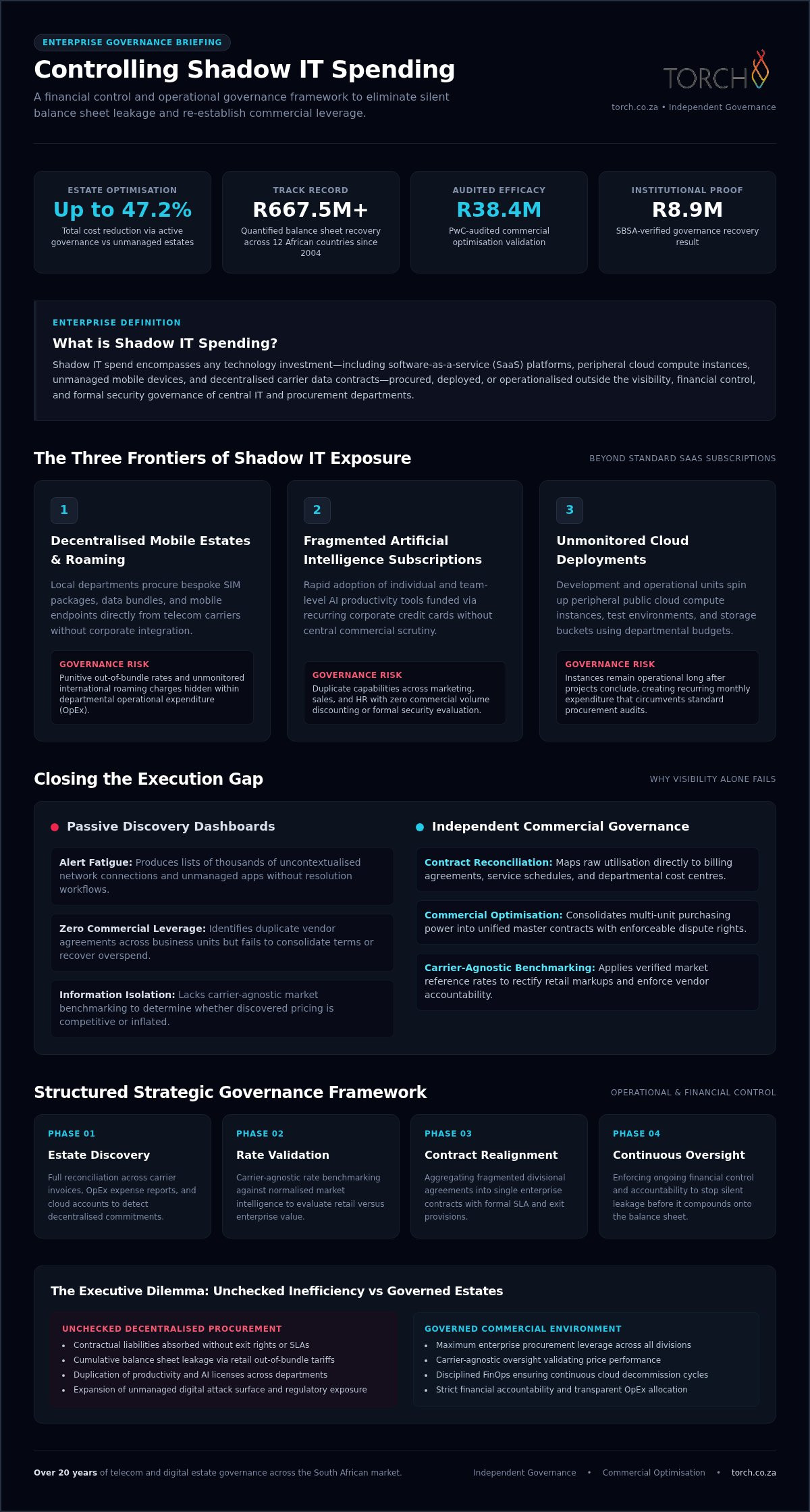
Shadow IT spend encompasses any technology investment—including software-as-a-service (SaaS) platforms, peripheral cloud compute instances, unmanaged mobile devices, and decentralised carrier data contracts—procured, deployed, or operationalised outside the visibility, financial control, and formal security governance of central IT and procurement departments.
Defining Shadow IT Spend in the 2026 Enterprise Landscape
The enterprise operating environment has evolved beyond the simple scenario of an employee expensing a file-sharing tool on a corporate credit card. In modern business operations, shadow spend manifests as systemic “Silent Leakage”—an ongoing, distributed accumulation of recurring commitments across various business units. Business divisions frequently bypass central procurement channels not out of malice, but to achieve agility, bypass perceived administrative friction, and maintain operational pace within hybrid workplace models.
However, when individual business units act as autonomous technology buyers, the enterprise loses consolidated procurement power. More critically, the enterprise absorbs contractual liabilities without standard commercial scrutiny, dispute-resolution rights, or exit clauses. Controlling shadow IT spend requires leadership teams to recognise that technology consumption patterns have shifted across three distinct frontiers.
The Evolution of Shadow Spend: Beyond SaaS
While industry commentary often equates shadow IT exclusively with unsanctioned SaaS applications, enterprise technology leaders face broader exposure across multiple categories of infrastructure and operational expenditure:
- Decentralised Mobile Estates and Unmanaged Roaming: As workforces operate across distributed locations, local departments frequently procure bespoke SIM packages, data bundles, and mobile endpoints directly from telecom carriers. Operating outside a unified corporate agreement, these services accumulate punitive out-of-bundle rates and unmonitored international roaming charges, often buried within departmental operational expense (OpEx) reconciliations.
- Fragmented Artificial Intelligence Subscriptions: The enterprise adoption of productivity-enhancing AI tools has created a surge in individual and team-level subscriptions. These recurring credit-card payments rarely receive security evaluations or commercial volume discounts, resulting in duplicate capabilities across marketing, sales, customer operations, and human resources.
- Unmonitored Cloud Deployments: Development and operational teams routinely spin up peripheral public cloud compute instances, storage buckets, or test environments using departmental operational budgets. Without disciplined continuous financial operations oversight, these instances remain operational long after their initial project concludes, driving persistent monthly expenditure that avoids standard procurement audits.
Why Visibility Alone is Insufficient
A prevalent misconception in modern IT financial management is that installing a discovery dashboard resolves shadow expenditure. In practice, standalone software platforms frequently exacerbate the problem by generating alert fatigue. Enterprise IT and finance personnel are confronted with thousands of detected applications and disparate network connections without the commercial context or operational bandwidth required to resolve them.
Visibility without commercial leverage provides negligible financial return. Merely seeing that twelve business units possess individual agreements with the same communication or collaboration vendor does not standardise their terms, consolidate their licensing, or recover historical overspend. Sustainable governance requires closing the execution gap—moving from passive asset discovery to active contract reconciliation, vendor accountability, and commercially literate renegotiation.
Furthermore, internal procurement teams often lack carrier-agnostic benchmarking data. Without access to normalised market intelligence, an enterprise cannot accurately evaluate whether a newly identified piece of shadow infrastructure is priced appropriately or subject to inflated retail rates. Genuine control requires an objective external reference point to validate value and enforce commercial discipline.
The Financial and Security Risks of Unmanaged IT Spend
The operational risks associated with shadow technology acquisition span two major domains: quantifiable balance sheet leakage and catastrophic enterprise vulnerability. When technology procurement bypasses governance, financial leaders face escalating contractual commitments, whilst security leaders lose oversight of the attack surface.
Quantifying Financial Leakage in Rands
The financial impact of unmanaged technology adoption is rarely immediate; instead, it compounds month after month through fragmented invoicing and structural inefficiency. Historical enterprise analysis demonstrates that actively governed technology estates achieve up to 47.2% total cost reduction compared to unmanaged equivalents. When technology spend is decentralised, the enterprise loses the economies of scale that formal procurement governance is designed to deliver.
Industry observations frequently show that billing discrepancies, misapplied contract rates, and unadjusted services consistently compromise technology budgets. Rather than speculative estimates, verified data reveals that billing errors within complex carrier and technology invoices average between 7% and 12% of monthly invoice value. In estates lacking continuous commercial reconciliation, these errors are routinely paid in full, absorbing substantial capital year after year.
Consider the cumulative impact across three primary financial leakage mechanisms:
- Duplicate and Redundant Procurement: In mid-to-large enterprises, multiple divisions frequently procure functionally identical software applications or conflicting connectivity services under separate vendor contracts. This practice forfeits tier-based volume discounts and incurs multiple base-level platform administrative fees.
- Subscription Bloat and Unused Capacity: Software and infrastructure subscriptions are frequently sized for peak demand or procured with premium feature packages that remain largely dormant. Active subscription adjustments—the continuous calibration of software tiers to actual consumption profiles—yields an average of 19.6% direct savings across managed corporate estates.
- Evergreen Contractual Commitments: Departmentally procured contracts frequently feature automatic renewal provisions tied to punitive cancellation notice periods. When central procurement remains unaware of these contracts, notice deadlines pass unnoticed, binding the enterprise into multi-year commercial commitments for obsolete or superseded software tools.
The scale of recoverable capital through structured financial intervention is well documented. In rigorous institutional audits, independent commercial reconciliations have delivered verified, demonstrable returns. These include a R8.9M SBSA-verified recovery and a R38.4M PwC-audited commercial correction, demonstrating that rigorous forensic oversight extracts substantial capital from legacy technology arrangements.
Compliance and the POPIA Exposure
Beyond direct financial inefficiency, shadow technology deployment introduces legal liabilities under South African statutory frameworks. When employees adopt unsanctioned SaaS tools, cloud storage providers, or messaging platforms to process corporate information, they routinely bypass mandated data protection controls.
Under the Protection of Personal Information Act (POPIA) No. 4 of 2013, the enterprise remains the responsible party for any personal information processed under its operational purview. Section 109 of the Act empowers the Information Regulator to impose administrative fines of up to R10 million for non-compliance, alongside the risk of civil compensation claims from data subjects and significant reputational damage. When an unvetted cloud application processes employee records, customer personal information, or financial metrics without formal data processing agreements or cross-border data transfer compliance, the enterprise is exposed to direct statutory liability.
The Ransomware Connection: Unmanaged Endpoints
The security risks of shadow IT extend into network architecture. In enterprise operating environments, endpoint devices—including laptops, tablets, and smartphones deployed across hybrid operations—represent the frontline of defense against external threats. However, unmanaged mobile devices, forgotten peripheral hardware, and Bring Your Own Device (BYOD) hardware operating without enterprise-grade security oversight present substantial vulnerabilities.
Comprehensive security research indicates that up to 85% of ransomware entry points originate from unmanaged devices or shadow endpoints operating beyond the scope of corporate security policies. When an endpoint bypasses central device governance, it operates without timely security patches, verified antivirus definitions, or active threat monitoring. This vulnerability allows threat actors to establish initial access, elevate privileges, and execute lateral movement across the enterprise network.
Mitigating this exposure requires robust Unified Endpoint Management (UEM). By enforcing standard encryption protocols, multi-factor authentication, and remote wipe capabilities across every endpoint accessing corporate data, leadership teams can safeguard enterprise continuity while curtailing rogue hardware adoption.
A Strategic Framework to Control Shadow IT Spending
Regaining authority over technology expenditure does not require draconian operational restrictions that stifle employee innovation. Effective control balances operational agility with structural oversight. Enterprises require a repeatable governance methodology to transition from unstructured spending to disciplined financial stewardship.
The Enterprise Shadow IT Governance Lifecycle
Discovery & Reconciliation → Commercial Benchmarking → Endpoint Enforcement → Continuous Managed FinOps
Step 1: Discovery and Silent Leakage Detection
The first phase of governance establishes absolute transparency regarding all technology-related liabilities. Enterprise leadership cannot govern what it cannot account for. This step demands a dual-stream audit: reconciling accounts payable general ledgers alongside technical network discovery.
Organisations must implement continuous financial discovery through specialised IT FinOps practices. By integrating proprietary visibility platforms such as SpotLight™ directly into Enterprise Resource Planning (ERP) and human resource systems, finance teams can automatically surface recurring operational credit card payments, anomalous vendor disbursements, and unbudgeted software renewals. This financial monitoring should be matched with technical interrogation of corporate domain usage and network gateway logs to identify rogue SaaS subscriptions.
Once identified, shadow expenditure must be benchmarked against current market conditions. Utilising competitive intelligence engines such as TorchLight™, enterprises can evaluate identified vendor costs against broad industry pricing models, establishing whether unmanaged departmental contracts are operating at competitive rates or accumulating unwarranted commercial premiums.
Step 2: Commercial Renegotiation and Consolidation
Discovery must lead directly to commercial rationalisation. Once an enterprise identifies the full spectrum of software, cloud, and mobile assets running across business units, procurement teams must execute vendor consolidation and contract optimisation.
This process begins by mapping functional redundancies across the enterprise. If three departments have purchased disparate project tracking tools or video conferencing licenses, procurement must establish an enterprise standard. By aggregating these disparate accounts into a unified, enterprise-tier contract, leadership achieves immediate volume discounts whilst establishing single-sign-on (SSO) security controls.
Independent, carrier-agnostic benchmarking is a vital mechanism during vendor negotiations. Unbiased market intelligence gives procurement teams the leverage needed to challenge incumbent commercial structures, routinely delivering up to 27.5% negotiation savings on renegotiated telecommunications and software contracts. Proactive contract governance also eliminates evergreen renewal traps by standardising termination notification windows across all vendor arrangements.
Step 3: Enforcing Endpoint Governance and Automated Support
Addressing shadow IT spending sustainably requires governing the physical devices and access points that consume digital services. Mobile contracts and edge devices represent a continuous area of unmanaged expenditure if left to individual discretion.
Leadership teams must establish clear policy frameworks governing Corporate-Owned Personally-Enabled (COPE) and Bring Your Own Device (BYOD) hardware. Through structured telecoms expense management, mobile connections must be tied directly to dynamic cost centres. Automated provisioning and policy enforcement ensure that international roaming capabilities, data bundle caps, and subscription authorizations are governed by role-based operational policies.
To ensure policy compliance does not degrade user productivity, modern enterprises deploy automated user support bots. Tools such as Boost™ empower employees to resolve operational mobile needs—such as requesting necessary temporary data top-ups or reporting compromised SIM cards via automated SMS interfaces—within predetermined financial parameters. This level of self-service maintains workforce agility while maintaining strict budget caps and eliminating rogue out-of-policy purchasing.
Sustainable Optimisation: The Six Integrated Service Lines Model
Historically, enterprise initiatives to rein in shadow IT have followed a predictable, disappointing cycle: an internal audit identifies substantial waste, a temporary cost-reduction program clawbacks budget, and within twelve months, unmanaged spending returns to previous levels. This regression occurs because internal IT and procurement personnel cannot maintain manual invoice-by-invoice reconciliation amidst their everyday operational responsibilities.
Sustainable financial control cannot rely exclusively on dashboards or one-off procurement exercises. It requires an embedded operational framework that integrates financial oversight with day-to-day technology administration. To build enduring governance, forward-thinking enterprises deploy Torch’s Six Integrated Service Lines model. This multi-layered structure ensures that every facet of the technology environment—from procurement through to retirement—is held to rigorous financial and operational standards.
The Six Integrated Service Lines of Technology Governance
- IT FinOps-as-a-Service: Continuous invoice-to-contract reconciliation, variance identification, cost-centre accruals, and boardroom-level financial intelligence reporting to stop silent leakage before invoices are approved.
- Telecom Expense Management (TEM): Forensic billing verification, carrier-agnostic rate benchmarking, commercial renegotiations, and end-to-end fixed and mobile connectivity lifecycle administration.
- Unified Endpoint Security and Management (UESM): Policy-driven device governance, continuous vulnerability scanning, remote wipe capabilities, and standardised software distribution to secure the hardware boundary.
- Mobile Lifecycle Management: Comprehensive management of mobile assets from initial provisioning and staging through user support, repair workflows, and secure electronic disposal.
- Fixed-Line Managed Services: Strategic oversight, consolidation, and commercial validation of branch infrastructure, software-defined wide area network (SD-WAN) fabrics, and primary data centre connectivity.
- Strategic Telecom and IT Advisory: Senior consulting on long-term procurement architecture, complex multi-carrier RFP management, and digital transformation roadmaps designed to preserve commercial agility.
By implementing these six service lines, the traditional structural divide between IT operations, cybersecurity teams, and financial procurement is resolved. An independent governance partner brings dedicated analytical expertise and market leverage, lifting the manual reconciliation burden from internal technical staff. With carrier-agnostic advisory, the enterprise secures unbiased vendor oversight—ensuring that external technology providers are continuously evaluated against verified performance metrics and market-aligned fee structures.
Crucially, this structural approach aligns commercial incentives through risk-share operational models, where advisory compensation is directly tied to verified, audited balance-sheet savings. This framework replaces internal guesswork with measurable financial discipline, sustaining commercial optimisation year after year.
Frequently Asked Questions
What is the primary difference between SaaS management and Shadow IT control?
SaaS management focuses narrowly on discovering, provisioning, and tracking software-as-a-service applications deployed within the enterprise. Shadow IT control is a broader governance discipline encompassing the financial and security management of all unsanctioned technology assets—including unmanaged telecom contracts, mobile SIM packages, cloud infrastructure instances, and edge devices operating outside central procurement channels.
How much can a South African enterprise realistically save by controlling Shadow IT?
While savings vary based on historical estate governance, mid-to-large enterprises actively governing their estates achieve up to a 47.2% total cost reduction compared to unmanaged environments. Specific interventions, such as carrier-agnostic contract benchmarking, routinely unlock 27.5% savings, while active subscription adjustment delivers an average of 19.6% in direct software cost recoveries.
Why should I use an independent advisor instead of my telecom carrier?
Telecom carriers have an inherent commercial conflict of interest; their revenue model depends on driving service consumption, network utilisation, and expanding service lines. A carrier cannot provide unbiased audits of its own invoices or advise you to migrate away from high-margin services. An independent, carrier-agnostic governance partner operates solely in your financial interest, validating billing accuracy, renegotiating contracts against market rates, and enforcing accountability.
Can Shadow IT control be achieved without slowing down employee productivity?
Yes. Effective governance is not about blanket restrictions; it establishes structured, low-friction pathways for teams to access the capabilities they need. By utilising automated user support platforms, self-service request portals, and standardised enterprise tool suites, organisations provide teams with rapid access to verified digital tools within transparent budget parameters, accelerating rather than hindering operational output.
What are the most common billing errors found in unmanaged technology estates?
The most common discrepancies include charges for terminated or inactive lines, incorrect tariff applications, miscalculated international roaming rates, duplicate feature subscriptions, uncredited hardware rebates, and unapplied volume discounts negotiated in prior agreements. Within complex carrier environments, these errors average between 7% and 12% of total monthly billing value.
How does Unified Endpoint Management (UEM) help in controlling shadow spend?
UEM provides complete visibility and administrative control over the physical and virtual devices accessing corporate systems. By maintaining continuous inventory of active hardware, identifying unauthorised applications running on network endpoints, and automating device lifecycle decommissioning, UEM prevents rogue technology adoption and closes critical attack vectors—directly mitigating the 85% of ransomware entry points that originate on unmanaged hardware.
Next Steps for the CFO: The Governance Review
Controlling shadow IT spending is fundamentally a question of leadership strategy. Technology-driven decentralisation will continue to evolve, making reactive operational policing an unsustainable long-term approach. Sustainable fiscal resilience demands proactive, independent governance frameworks that bridge the gap between initial asset visibility and aggressive, continuous contract execution.
With more than 20 years of experience operating across the South African and African enterprise landscape, Torch has delivered more than R667.5M in verified savings across 12 African countries. Our methodology provides the structured operational governance, forensic analytics, and commercial leverage necessary to reclaim control over complex digital investments.
If your leadership team is confronting recurring monthly budget variances, unmanaged software accumulation, or unmonitored carrier expenditure, we invite you to take the first step toward sustained commercial discipline. Connect directly with our executive advisory team to schedule a focused, confidential evaluation of your current technology procurement landscape.
This consultation is an objective, high-level governance assessment designed specifically for executive leadership—strictly no obligations or sales presentations.