
What if cloud bill shock begins as a governance gap, long before it appears as a budget variance? Cloud usage can change faster than review cycles, and a cost alert may flag an increase without showing who owns it, what caused it or what action is appropriate. For finance and engineering teams, preventing cloud bill shock means connecting spend visibility to clear accountability, not simply reacting to an unexpected invoice.
The challenge is to act early without compromising service reliability or security. That requires a repeatable process for detecting material changes, tracing them to their causes and assigning responsibility for the response.
This guide explains how to build that process: assign ownership for budgets and resources, investigate variances, and turn findings into accountable corrective action. It also covers how ongoing FinOps practices, including invoice reconciliation, variance analysis, budgeting and forecasting, and financial reporting, can support stronger financial control and commercial optimisation.
Key Takeaways
- Distinguish an unexpected spend variance from a billing discrepancy by checking how metered usage and allocated capacity affect charges.
- Trace a spike methodically: confirm the variance, narrow it to a service and time period, then investigate relevant changes and usage.
- Make preventing cloud bill shock part of a regular control cycle that connects forecasts, budget thresholds, named owners and documented actions.
- Use alerts to prompt investigation, not automatic resource deletion that could affect essential services or security.
- Compare self-managed controls, provider billing tools and ongoing FinOps support to determine how your organisation can sustain cost governance.
What causes cloud bill shock, and why is the invoice often correct?
Cloud bill shock is an unexpected difference between actual cloud spend and the amount an organisation budgeted or forecast. It is a variance to investigate, not proof of a billing error. Charges may reflect metered consumption, such as activity during a billing period, or capacity allocated to a service, which can incur charges even when usage is low. Understanding the charging basis helps teams separate a genuine invoice discrepancy from valid costs generated by usage they had not tracked.
Start by checking the billed service, period, quantity and applicable rate against usage records and agreed commercial terms. If these details align, the invoice may be correct even if the resource or its owner is unclear. Disputing a valid charge will not resolve the governance gap that allowed unplanned consumption to continue. This overview of cloud management and cost optimisation places cost oversight within the broader work of managing cloud environments.
Which cloud charges commonly catch teams by surprise?
Idle compute, unattached storage and resources left running after tests can continue generating charges. Traffic growth can increase consumption, while a configuration change may alter how a service uses capacity or processes requests. An estimate may also miss billable dimensions, rely on assumptions that no longer hold, or fail to account for changing demand. Review estimates alongside actual usage and the assumptions behind them.
Illustrative example: A team creates a test environment for a short project, then moves on without assigning an owner to decommission it. The environment and its associated storage remain in place and continue generating charges. The invoice can accurately reflect those resources, while the organisation still has a control deficiency: no one was accountable for reviewing or closing them.
Why pay-as-you-go still needs financial control
Flexible consumption supports changing workloads, but it can make forecasts less reliable when demand and provisioning change between budget reviews. In a distributed environment, an engineering team may create or adjust resources for a valid operational reason, while finance sees the resulting charges later in a consolidated invoice. The decision and its financial impact are separated.
A provider’s meter confirms what was recorded and billed; it does not establish which internal budget should absorb the spend or who must investigate a variance. The party metering and billing the spend should not be the entity responsible for explaining it; independent governance should provide that explanation. Preventing cloud bill shock therefore depends on connecting consumption to budget owners, usage context and follow-up action. Torch Services’ IT FinOps-as-a-Service supports ongoing financial visibility through activities such as invoice reconciliation, variance analysis, budgeting and forecasting.
How to trace a cloud spend spike without disrupting essential services
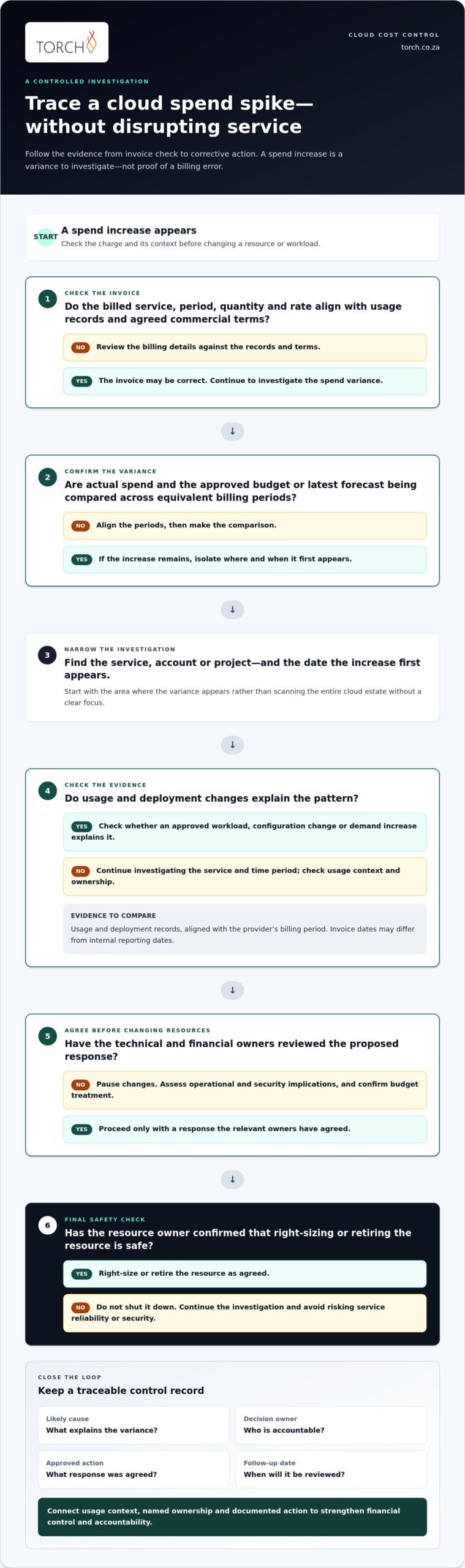
A spend increase needs a controlled investigation, not an immediate shutdown. Removing a resource before understanding its role can interrupt a critical workload or weaken security. First establish what changed, who depends on it and which budget owns the spend. Then agree any corrective action between technical and financial owners.
Use a repeatable sequence:
- Confirm the variance: Compare actual spend with the approved budget and latest forecast. Check that the comparison covers equivalent billing periods.
- Isolate the change: Identify the service, account or project, and the date when the increase first appears.
- Inspect the evidence: Compare usage and deployment changes with the billing period. Check whether an approved workload, configuration change or increase in demand explains the pattern.
- Agree the response: Have the technical owner assess operational and security implications, and the financial owner confirm budget treatment before resources or workloads are changed.
How should teams investigate a sudden increase?
Start where the variance first appears, narrowing the review by service and time period rather than scanning the entire estate without a clear focus. Align usage and deployment records with the provider’s billing period, since invoice dates may not match the dates used in internal reporting. Check whether a planned release or demand change explains the increase before treating it as an anomaly.
Which evidence helps distinguish a spike from normal growth?
Consistent allocation tags or labels for teams, environments and applications help connect usage to responsible owners. Compare current consumption with an agreed baseline and forecast, accounting for known workload changes. Record the likely cause, decision owner, approved action and follow-up date. This creates a traceable basis for financial control and accountability, and helps teams recognise whether a similar increase is expected next time.
Cloud cost management should balance financial discipline with operational needs. Investigate first, then right-size or retire a resource only when its owner confirms it is safe to do so. Blanket shutdowns can create reliability or security risks instead of resolving the underlying governance gap.
For enterprises seeking a consistent approach to IT FinOps governance, independent oversight can connect variance analysis with clear ownership and documented follow-through. A 30-minute governance review with Derek King is one way to discuss how those controls fit your environment.
How to prevent cloud bill shock with practical financial controls
Reliable control comes from a recurring process, not a one-off review after an unexpected invoice. Each month, compare actual spend with budget and forecast, investigate material variances, confirm accountable owners and record agreed actions. This creates a clear trail from financial signal to operational decision, while giving finance and engineering a shared basis for discussion.
Start with ownership. Assign a financial owner to each budget and a technical owner to each service, application or environment. Cost ownership also supports security ownership: unowned resources are also unreviewed resources, so ownership reviews should cover both financial and security responsibilities. Temporary resources need a named owner and an agreed review or end date. Consistent naming and tagging help teams attribute usage, while provisioning standards and approval steps clarify why resources were created. Schedule reviews for idle, underused or over-provisioned resources, but assess business purpose and service impact before making changes.
Which preventive controls should organisations implement first?
Build the monthly cycle around a small set of repeatable controls: update forecasts, review variances, confirm owners and document decisions. Set budget thresholds that prompt investigation before spend moves materially beyond plan. Review pricing and capacity choices against workload requirements, and validate provider-specific terms before committing to a change. This supports commercial optimisation without treating the lowest-cost option as automatically suitable.
How can alerts and automation avoid creating operational risk?
An alert should start a decision, not make one blindly. Route it to a named owner, define who handles unresolved or higher-priority variances, and give the owner enough context to investigate. Automation can improve visibility and carry out approved actions, but safeguards should protect critical workloads and security controls. Avoid automatic deletion or shutdown unless the action has been assessed and authorised for that resource.
Review thresholds and exceptions as forecasts, workloads and service needs change. Syracuse University’s iSchool discusses the relationship between cost management and FinOps and cloud bill shock. In practice, preventing cloud bill shock means connecting spend information to accountable decisions. Torch’s ongoing FinOps work supports this through budgeting and forecasting, invoice reconciliation, variance analysis and financial reporting. These activities form part of IT FinOps-as-a-Service and can support a repeatable financial control process.
When does FinOps support help make cloud cost control sustainable?
The right operating model depends on whether your organisation can consistently turn spend information into decisions. Provider-native billing tools can help teams inspect consumption and identify patterns. Internal controls can work well when people have access to relevant data, clear ownership and enough time to review it. Ongoing FinOps support can add independent governance where analysis, follow-through or financial accountability is difficult to sustain internally.
A dashboard is useful evidence, not the control process itself. It can show where spend has changed, but governance establishes who investigates, whether a variance is acceptable, which action is approved and when its impact will be reviewed. That distinction is central to preventing cloud bill shock as workloads and business priorities evolve.
When are internal cloud cost controls enough?
Self-managed controls may be sufficient when finance and engineering have reliable access to billing and usage information, named owners for budgets and services, and a regular review cadence. Provider tools can contribute visibility, while internal teams retain responsibility for interpreting results and acting on them. Document the process, including how variances are escalated and how agreed actions are closed. If reviews repeatedly slip or issues remain unresolved, the gap may be capacity or accountability rather than a lack of dashboards.
What does ongoing FinOps governance add?
Ongoing support helps connect spend analysis with forecast updates and accountable business decisions. Invoice reconciliation and variance analysis can clarify what changed; budgeting, forecasting and financial reporting help teams assess the financial impact and track follow-through. Independent review can complement engineering’s understanding of workload requirements and finance’s oversight of budgets, without taking operational decisions away from the teams responsible for services.
Use a practical decision test: can your current model explain material variances, identify a responsible owner, record the decision and revisit the outcome? If yes, strengthen and maintain those controls internally. If that chain is inconsistent, additional governance may help make it repeatable. Torch’s IT FinOps-as-a-Service includes invoice reconciliation, variance analysis, budgeting, forecasting and financial reporting, supporting financial control and accountability rather than relying on a dashboard alone.
Learn more about IT FinOps-as-a-Service and how ongoing financial governance can support a consistent control process.
Make cloud financial control a repeatable discipline
Preventing cloud bill shock depends on more than identifying a variance. Teams need to establish whether charges are valid, trace changes to their cause and assign owners before taking action. A regular control cycle that connects forecasts, spend reviews and documented decisions helps finance and engineering maintain financial control without compromising service reliability or security.
Internal processes may be sufficient when teams have clear ownership and capacity to follow through. Where additional independent governance would help, ongoing FinOps support can connect invoice reconciliation and variance analysis with budgeting, forecasting and financial reporting. Torch has more than 20 years in the South African market and 100+ years of combined industry experience. Its R667.5M+ saved since 2004 across 12 African countries reflects organisation-wide results, not cloud-specific savings.
With clear ownership and consistent review, your organisation can strengthen visibility, respond thoughtfully to change and build greater confidence in cloud spending.
Frequently Asked Questions
What causes cloud bill shock?
Cloud bill shock usually reflects a gap between expected and actual cloud spend, rather than an incorrect invoice. Usage can rise as traffic or workload demand changes, while allocated resources may incur charges even when activity is limited. Estimates can also omit billable dimensions or rely on assumptions that no longer hold. Preventing cloud bill shock starts with checking the service, billing period and usage before deciding whether charges are wrong.
Are cloud billing errors common?
An unexpected increase alone does not establish that billing errors are common or that a particular invoice is wrong. Charges may accurately reflect metered usage or allocated capacity. Validate a variance by matching the invoice period and service with recorded quantities and applicable rates, then compare them with usage and agreed commercial terms. If those details do not reconcile, document the difference and investigate it as a possible discrepancy.
How can I identify what caused a cloud cost spike?
First confirm the variance against the budget or forecast and identify the billing period in which it appeared. Narrow the review to the service, account or project showing the change, then compare service-level usage with deployments, configuration changes and demand during that period. Check whether an approved workload explains the increase. Finally, identify the technical and financial owners, record the likely cause and agree the next action.
Can cloud cost alerts prevent bill shock?
Alerts can help teams detect spend changes earlier, but they do not prevent bill shock on their own. Set thresholds that prompt investigation, route each alert to a named owner and define how unresolved variances are escalated. The response should include checking usage and business context before approving a change. Avoid automatic shutdowns or deletions that could affect essential services. Review thresholds as budgets and workload needs change.
How often should an organisation review cloud spend?
Set a formal review cadence that reflects how quickly consumption changes, how closely spend must track budgets and how much capacity the team has to investigate variances. A monthly review can align actual spend with forecasts, owners and documented actions. More volatile workloads may need more frequent monitoring between reviews. Alerts can surface material changes, while scheduled reviews help explain patterns and update forecasts without relying on alerts alone.
Is a cloud cost dashboard enough to control spending?
A dashboard can make spend patterns and variances easier to see, but visibility is not the same as control. Effective governance connects the information to a named owner, an investigation, an agreed decision and follow-up on any corrective action. Finance and engineering should understand their respective responsibilities. Provider billing tools can support analysis, while an ongoing FinOps process helps ensure findings inform forecasts, budgets and operational decisions.