
Software licensing and security are closely connected: a licence gap can indicate unauthorised software, excessive access, or weak joiner, mover and leaver controls. Preventing software licence audit penalties starts with comparing what is deployed and in use with the entitlements the organisation holds, then addressing discrepancies. Linking this work directly to security controls brings unapproved software and access risks into view, helping the organisation protect information while maintaining compliant software use.
It’s understandable to focus on licence counts when preparing for an audit. But a count alone can miss software installed outside procurement processes, inactive accounts with ongoing subscriptions, or access that no longer matches a user’s role.
This article explains how to build a reliable view of software deployments and entitlements, conduct regular internal reviews, and connect licence management with security and governance. You’ll learn how clear procurement and retirement controls, accurate records, and visibility across environments can help reduce audit exposure and shadow IT. The practical aim is to make software use easier to account for, manage, and align with business needs.
Key Takeaways
- Understand how licensing gaps can affect both operating costs and the organisation’s ability to use software.
- See how a professional builds a reliable licence position by comparing deployment, usage and entitlement data across environments.
- Learn why vendor-supplied reports benefit from an independent cross-check against organisational records.
- Connect software access and procurement controls with security governance to bring shadow IT into view.
- Explore how coordinated asset management and IT cost oversight can support clearer ownership and accountability.
What Is Software License Compliance?
Software compliance means using each software asset within its licence rights. A professional establishes the licence position, identifies gaps, and plans corrective action before renewal or an audit.
-
Identify common causes of non-compliance
Trace how software enters the enterprise, then investigate unapproved purchases, overlapping subscriptions, leavers’ accounts, and unrecorded installations. Cloud, virtualised, remote, and hybrid environments can use different licence metrics, such as named users, devices, cores, or concurrent use. For example, an employee’s old account may remain active after a role change. Review each product’s terms before assuming a licence can move between users or environments.
-
Review software categories covered by audits
Include desktop applications, server and database software, cloud productivity suites, endpoint security, virtual desktop access, and specialist engineering platforms such as CAD and PLM. Include automated workloads and shared access, not just software assigned to named employees. This can reveal use that a simple list of user accounts misses.
-
Check governing laws and contract terms
For a South African organisation, start with the software agreement, order documents, product-use rights, subscription terms and audit clauses. These documents provide the relevant terms to review for permitted use, measurement rules, evidence requests and the audit process. Requirements can differ between publishers and products, so do not assume one vendor’s procedure applies to another. ISO/IEC 19770 offers a reference for software asset management.
-
Assess audit costs and consequences
Have a professional assess any claimed gap against the vendor’s licence metric, deployment evidence, contract terms, and relevant period of use. A true-up may involve acquiring licences for uncovered use; backdated charges, audit fees, interest, and penalties depend on the agreement and findings. Vendors do not use one universal calculation, so review the assumptions and terms behind each charge.
Non-compliance can disrupt operations if a business must purchase licences or stop using affected software until it is compliant. Paying a penalty does not necessarily grant ongoing use rights. Treat a vendor demand and the right to continue using the software as separate questions, and assess each against the relevant agreement.
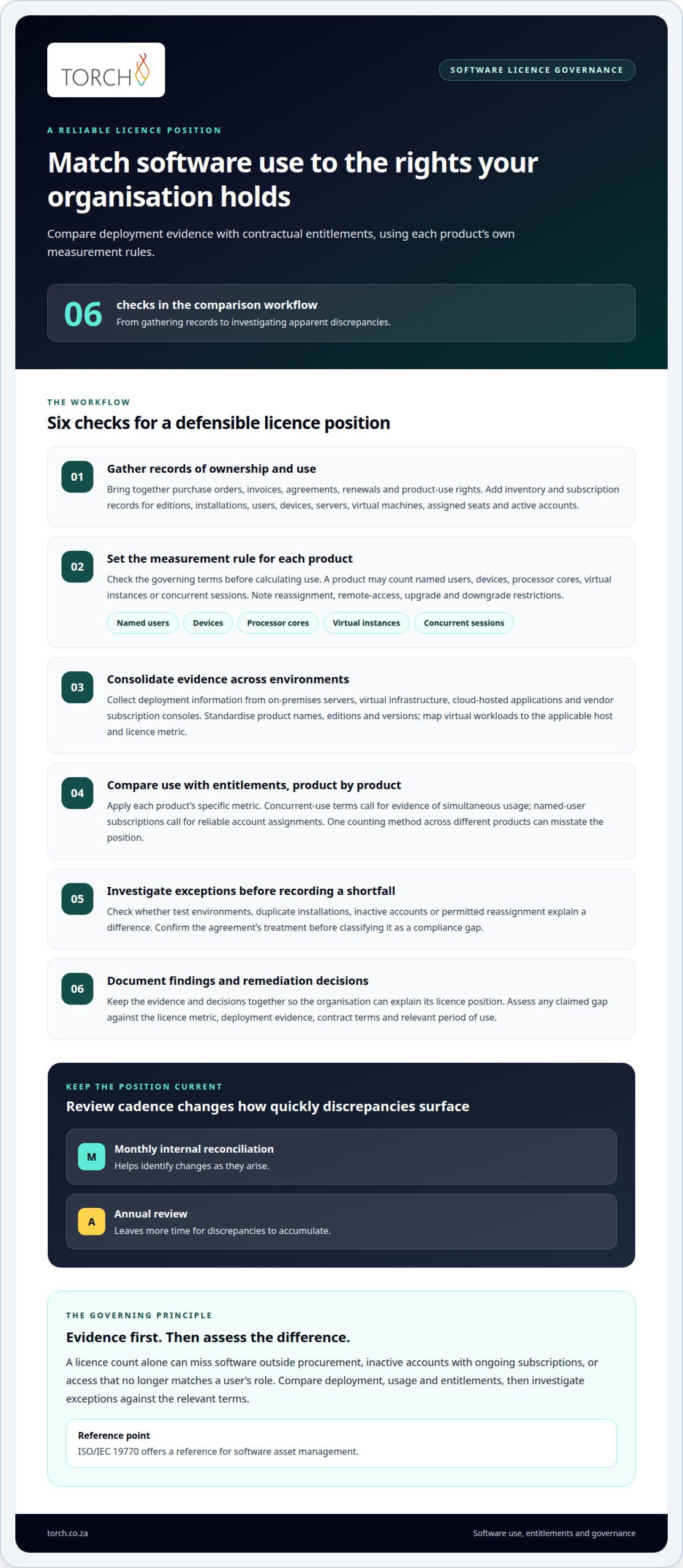
- Use software asset management processes to maintain an accurate inventory, monitor usage, manage entitlements, document procurement, and retire unused software. A professional can securely collect and reconcile deployment evidence with purchase records and contract rights, then document remediation decisions. Monthly internal reconciliation helps identify changes as they arise; annual reviews leave more time for discrepancies to accumulate. Keep supporting records together to explain the organisation’s licence position.
How a professional compares software deployments with entitlements
A professional develops a defensible licence position by matching deployment evidence to contractual entitlements. This comparison helps identify where records, access, and purchasing decisions need attention before renewal or a vendor review.
- Collect records that establish ownership and use. Gather purchase orders, invoices, agreements, renewal documents, and product-use rights. Add inventory data showing software editions, installations, users, devices, servers, and virtual machines. Subscription records should identify assigned seats and active accounts. A purchase order without a matching entitlement record, for example, needs investigation before it can support a compliance position.
- Define each product’s measurement rules. Extract the licence metric from the governing terms before calculating consumption. A product may count named users, devices, processor cores, virtual instances, or concurrent sessions. Record restrictions on reassignment, remote access, upgrades, and downgrade rights. A reviewer should distinguish a permitted temporary installation from a separate deployment by consulting the product’s agreement, not assuming a general rule.
- Consolidate deployment evidence across environments. Collect information from on-premises servers, virtual infrastructure, cloud-hosted applications, and vendor subscription consoles. Standardise product names, editions, and versions so inconsistent labels do not obscure the actual deployment. For virtual workloads, map the relevant host and configuration data to the applicable licence metric. This can reveal differences between technical inventory records and subscription information.
- Match consumption to entitlements product by product. Compare deployment evidence using each product’s specific metric. For example, a concurrent-use agreement requires evidence of simultaneous usage, not merely the number of installed copies. A named-user subscription instead requires a reliable account assignment record. These distinctions matter: applying one counting method across different products can create inaccurate findings and misdirect remediation.
- Investigate exceptions before recording a shortfall. Assess whether test environments, duplicate installations, inactive accounts, or permitted reassignment explain a discrepancy. An employee with separate work and test accounts, for instance, may appear twice in a raw report. Confirm whether the agreement treats those accounts as separate users before classifying the difference as a compliance gap.
- Document the evidence behind every position. Link each deployment record to its source, collection date, product, and entitlement evidence. Retain normalised data securely for later consumption analysis and audit support. Record unresolved items, assumptions, and contract interpretations separately. This gives decision-makers a clear basis for distinguishing verified use from questions that need further assessment.
- Translate findings into controlled remediation. Present confirmed surpluses, shortfalls, and uncertain records, then assess options such as reallocating eligible entitlements, removing unused installations, or purchasing additional licences. Complete the assessment well before renewal or true-up, allowing time for decisions and implementation. This measured process supports preventing software licence audit penalties by turning findings into accountable actions.
How a provider helps avoid software audit fines and shadow IT
In South Africa, a software licence audit examines whether use aligns with the publisher’s licensing agreement. The contract sets the scope and process, so a provider first reviews its audit terms and requested evidence.
-
Prepare for a vendor audit with professional support
Establish a response process before a vendor notice arrives. Identify a formal contact, record the notice date, review the stated scope, and coordinate procurement, IT, and legal input. Gather relevant agreements, purchase records, and deployment evidence, then organise responses against each request. This reduces inconsistent submissions and helps teams distinguish verified records from unresolved questions.
-
Check vendor reports independently with professional support
Compare the vendor’s report with independently collected deployment and entitlement records. Check product names, editions, versions, users, devices, and licence metrics, then investigate any differences. For example, a report may count a virtual instance differently from the metric permitted by the contract. Record the source and rationale for each adjustment instead of accepting a vendor figure without supporting evidence.
-
Respond to vendor-initiated audits with professional support
Review the audit notice and agreement before providing information or running verification scripts. Map each request to available records, track what is shared, and refer disputed interpretations for appropriate legal review. In South Africa, the agreement’s audit clause informs the process; do not assume one publisher’s procedure applies to every vendor or product.
- Establish controls that surface unlicensed software. A provider reviews procurement policies, approval records and software access patterns to identify installations outside authorised channels. It can monitor changes in deployment and subscription records, then compare them with approved purchasing data. Where use may exceed entitlements, the issue is documented for investigation before it becomes an unresolved audit finding.
- Prepare evidence and decisions for the audit response. Organise records by product, entitlement, environment, and time period so each claim has a traceable basis. Separate confirmed discrepancies from data gaps and contract questions. The business can then decide whether to correct deployment, reassign eligible licences, or address a genuine shortfall. Keep a record of decisions and communications for consistent follow-up.
A structured governance review can help clarify audit evidence and response priorities.
Integrating license management with security and governance
Licence oversight is more effective when it informs access decisions, security controls, and procurement governance. Connect these functions so software findings lead to clear ownership and action.
- Connect software records with identity governance. Associate each software account with an accountable owner, role, and approval record. Include service identities and automated workloads, not just employee accounts. When someone changes responsibilities, review whether their software access still supports their role. This links access decisions with the organisation’s records of authorised software use.
- Bring endpoint security findings into the review. Compare approved software records with applications detected on managed devices. An unfamiliar application on a device with access to sensitive business information may need a security assessment as well as a licensing review. Coordinate the response between IT asset management and security teams so remediation considers exposure and operational need, rather than removing software without understanding its purpose.
- Apply consistent lifecycle controls. Define how software is requested, approved, purchased, deployed, changed and retired. Assign responsibility for updating records at each hand-off, such as when procurement completes a purchase or IT decommissions an application. ISO/IEC 19770 and ITIL 4 provide useful references for structuring asset and service-management practices. The specific agreement still determines each product’s permitted use.
- Give governance findings an accountable owner. Record the issue, supporting evidence, business impact, and next action in a shared governance process. For example, an application needed by a business team but absent from approved purchasing records may call for procurement review and security assessment. Assigning owners and due actions helps prevent findings from remaining in reports without an operational decision.
- Use changes as prompts for review. Connect licence oversight to relevant business events, including software renewals, new deployments, access changes, and technology retirements. Review exceptions with procurement, IT, and security stakeholders, then record the decision and update the relevant asset and entitlement records. This makes governance part of routine change management, rather than an exercise that happens only when a vendor requests information.
Torch Services
Torch Services helps organisations strengthen IT cost governance by connecting asset records, spending, and operational oversight. Its asset-management service supports a clearer view of software assets and ownership, while IT FinOps-as-a-Service helps structure IT cost information. Torch is independent and does not earn commission from software or service recommendations, helping organisations make decisions based on their requirements. These services are relevant when records are fragmented, procurement decisions lack visibility, or teams need better oversight of technology use. They complement internal licence controls; the relevant agreement still determines software entitlements.
For organisations also managing endpoint access, Unified endpoint security and management (UEM) can connect device oversight with broader governance. The right focus depends on where records, ownership, or controls need attention.
Contact Torch Services to discuss your IT governance needs.
Make licence governance part of routine oversight
Preventing software licence audit penalties is not a one-off exercise. Treat software entitlement oversight as an ongoing governance discipline, with clear ownership for decisions, exceptions, and remediation. As environments change, consistent oversight helps keep commercial commitments aligned with operational and security priorities.
The next step is to identify where your organisation needs specialist support: an upcoming renewal, an audit notice, fragmented software records or limited visibility of unapproved applications. A focused discussion can help define the scope, evidence and stakeholders required to move forward, without assuming every organisation needs the same approach.
Stronger governance begins with a clear view of the challenge and an agreed path to address it. Build that clarity into your next decision.
With clear ownership in place, your organisation can approach software oversight with greater confidence and control.
Frequently Asked Questions
How do you know you are ready for an audit?
You’re better prepared when a sample software record can be traced from purchase approval to current use and an accountable owner. Test whether responsible teams can retrieve that evidence promptly and explain any exception consistently. Include recent role changes, departed employees, and software used for testing. If these cases expose unclear ownership or missing records, address the gaps before treating the estate as audit-ready.
How does automated discovery identify shadow IT and unapproved SaaS?
Automated discovery can surface applications by correlating signals from managed devices, identity systems, network activity, and purchasing records. For example, sign-in activity for an application absent from approved procurement records warrants investigation. Discovery identifies usage signals, not whether a contract permits that use. A reviewer still needs to establish who uses the service, what information it handles, and whether an authorised subscription covers it.
What can go wrong during audits?
Audit findings can be harder to resolve when a business submits incomplete records, counts a product using the wrong metric, or gives inconsistent answers across teams. A rushed response may also include data outside the agreed scope. Assign one response coordinator, maintain a record of information shared, and document the basis for disputed calculations. These controls help organise the process without assuming every vendor request has identical terms.
What causes software audit penalties?
Penalties or other charges may follow when an audit identifies use outside the applicable licence terms, such as more users or deployments than the entitlement permits. Misunderstood product rights, unrecorded purchases, and unapproved installations can contribute to discrepancies. Consequences depend on the agreement and audit findings, so assess a reported gap against the relevant contract before accepting a proposed amount or remedy.
What is a licence true-up?
A licence true-up adjusts recorded entitlements to align with measured software use. If an organisation’s covered use exceeds its entitlements, the adjustment may involve acquiring additional licences under the applicable terms. It is not automatically the same as a penalty, and paying a charge does not necessarily grant ongoing use rights. Check the agreement and the calculation’s assumptions before approving a proposed adjustment.
What is the difference between a SAM engagement and a formal audit?
A software asset management (SAM) engagement is generally an organisation-led assessment of software records, use, and licence position. It can identify discrepancies for remediation before a publisher conducts a review. A formal audit is initiated under the relevant agreement and follows its stated scope and process. The distinction matters: an internal assessment helps prepare and govern the estate, but does not replace obligations under a contract.