
Buying handsets separately may reduce the cost bundled into a corporate mobile contract, but it will not automatically lower the overall bill. To reduce a corporate mobile phone bill, compare the full cost of handsets and service with the contract option, then match each line’s plan to actual use. Carrier discounts, inclusive minutes, contract ownership and network coverage all affect the decision.
It makes sense to question whether a bundled deal still delivers value, especially when employees use their phones differently or contracts are due for renewal. The goal is not simply to choose the lowest monthly tariff, but to understand what each rand pays for and avoid unused allowances or services.
This guide explains how to assess carrier benefits, choose minutes and data allowances, compare company-owned and personal contracts, and evaluate lower-cost networks in South Africa. You will have a clearer basis for deciding whether to buy handsets separately and which costs to scrutinise.
Key Takeaways
- Compare carrier discounts against the full plan cost, including the terms attached to each benefit.
- Use actual calling patterns to assess whether inclusive minutes or a different allowance better fits each role.
- Weigh the handset and service costs together when deciding between company-owned and personal contracts.
- Assess lower-cost network options against coverage and service requirements, not price alone.
- Telecom Expense Management can help bring mobile charges, contracts and usage into clearer view.
Checking carrier benefits and discounts
South African businesses can negotiate volume discounts and pooled data or minutes with a carrier. Eligibility and value depend on the number of lines, usage patterns, plan terms and included services.
Assess the whole commercial arrangement, not just the advertised tariff. A discount may offer little value if it applies to only a few employees or requires a payment commitment that outweighs the reduction.
-
Compare employer and carrier discounts
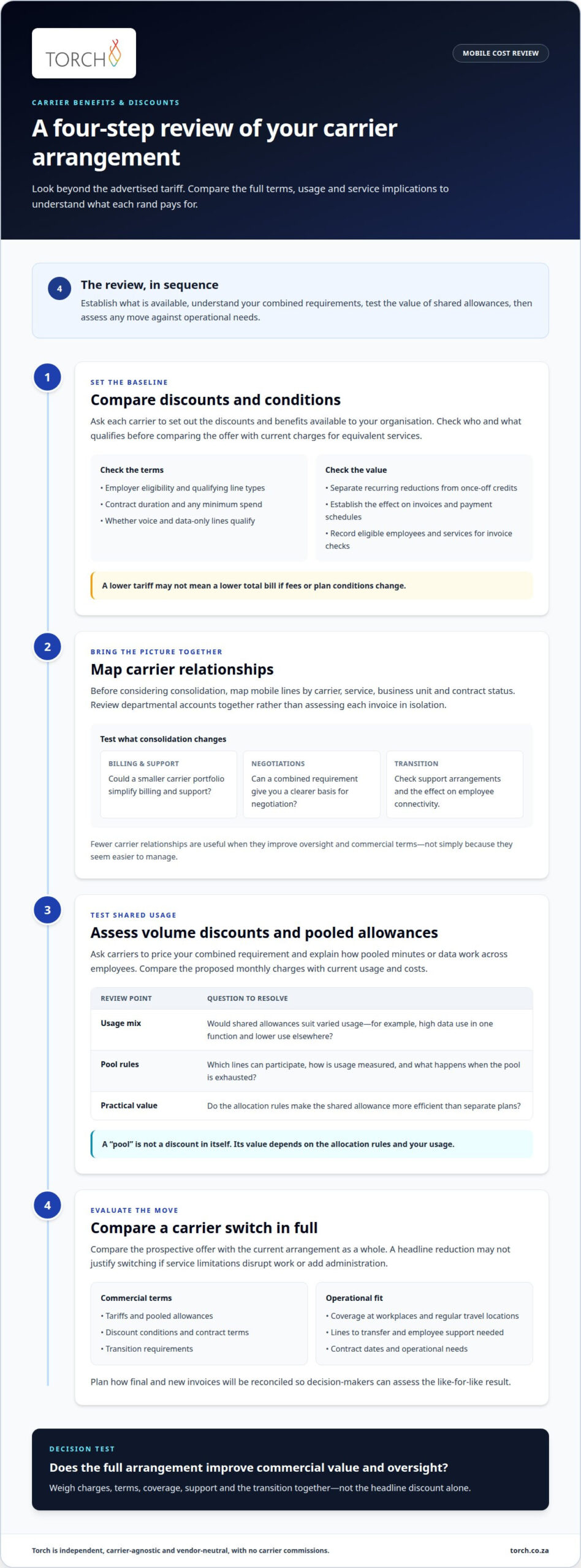
Start by asking each carrier to set out the discounts and benefits available to your organisation. Compare employer eligibility, qualifying line types, contract duration and any minimum spend attached to the offer. For example, a discount on employee voice plans may not apply to data-only connections. Separate recurring reductions from once-off credits, and establish how each affects the invoice and payment schedule.
Compare the discounted proposal with current charges for equivalent services. A lower tariff does not necessarily mean a lower total bill if fees or plan conditions change. Record which employees and services qualify so you can verify the savings against invoices.
-
Consolidate carrier relationships
Map mobile lines by carrier, service, business unit and contract status before considering consolidation. A smaller carrier portfolio can simplify billing and support, while giving you a clearer combined requirement to present in negotiations. For example, review separate departmental accounts together rather than assessing each invoice in isolation.
Before moving lines, compare the full proposal with existing terms. Check how pooled allowances are allocated, how support requests are handled and whether the transition affects employee connectivity. Consolidation is useful when it improves oversight and commercial terms, not simply because fewer carrier relationships seem easier to manage.
-
Assess volume discounts and pooled allowances
Ask carriers to price your organisation’s combined requirement and explain how pooled minutes or data work across employees. The key question is whether varied usage makes shared allowances more efficient than separate plans. For example, a team with high data use in one function and lower use elsewhere may benefit from pooling, provided the terms allow the group to share allowances.
Clarify which lines can participate, how usage is measured and what happens when the pool is exhausted. Compare proposed monthly charges with current usage and costs. Do not treat “pool” as a discount in itself: the allocation rules determine its practical value.
-
Evaluate a carrier switch
Compare a prospective carrier’s full offer with the current arrangement, including coverage at employees’ workplaces and regular travel locations. Review proposed tariffs, pooled allowances, discount conditions, contract terms and transition requirements together. A headline reduction may not justify switching if service limitations disrupt work or add administration.
Plan any move around contract dates and operational needs. Identify which lines would transfer, what support employees need, and how the organisation will reconcile final and new invoices. A like-for-like comparison gives decision-makers a clearer basis for deciding whether switching improves commercial value and control.
Choosing inclusive minutes plans
Match each plan to observed calling and data use instead of defaulting to the largest allowance. Monthly charges should reflect how employees work, including whether voice calls can move to VoIP.
- Compare minutes used with minutes included. Review call records across each account and compare actual monthly usage with the plan allowance. Separate frequent callers from employees who make occasional calls. A business plan offering 1,000 minutes per month is one example of an allowance that could suit a team with similar requirements. Compare its full charge with the cost of the minutes employees actually use.
- Check how calls are billed. Review whether the plan rounds call duration up to the nearest minute. This can make short calls consume more allowance than their recorded duration suggests. Compare itemised calls with monthly allowances and charges, then account for rounding when assessing usage. This can reveal whether an apparently suitable plan leaves employees paying for minutes they rarely use.
- Match data allowances to employee roles. Compare monthly data consumption by role, rather than assigning identical bundles across the organisation. A 10 GB monthly plan is an example for users who don’t need unlimited data, not a universal recommendation. Field employees using maps and business applications may need a different allowance from staff who mainly use office Wi-Fi. Look for recurring overuse or unused data before changing plan sizes.
- Separate mobile calls from VoIP traffic. Identify calls that can move to VoIP, especially between international offices, where VoIP-to-VoIP calls are often free or very low cost. Then assess how much mobile voice capacity each role still needs. Avoid paying for large inclusive-minute bundles to cover calls that could use an existing business calling arrangement.
- Compare prepaid and pay-as-you-go options carefully. Prepaid services can help control spending and may allow customised minute allowances. However, low-minute options can have the highest per-minute rates. Compare total monthly charges with actual call patterns, including occasional busy periods. A lower fixed commitment can cost more overall if employees regularly exceed the allowance.
- Review plans against changing usage. Reassess each plan when employee responsibilities or calling patterns change, and compare the revised usage with current charges. High volumes of local or domestic long-distance calls will almost always cost less on an unlimited or high-inclusive-minutes plan than through per-minute billing. For a structured review of mobile usage and plan charges, book a mobile cost governance discussion.
Contract ownership and company versus personal contracts
Ownership determines who controls the contract, receives the monthly bill and manages changes. Compare these responsibilities alongside renewal dates and calling requirements.
-
Review contract ownership
Map each line to its contract holder, payer and primary user. A company-owned contract can centralise billing and give the organisation oversight of plan changes. With a personal contract, employees may manage the account while the business contributes to the cost. Compare the total business expense and administration for each arrangement, not just the handset or monthly tariff.
Set a clear process for approving changes, handling leavers and assigning responsibility for charges. Avoid paying for the same service through both a company plan and an employee reimbursement.
-
Check personal contracts and number retention
Identify employees using personal contracts for business calls, then record the contract holder, monthly bill and business-use arrangement. If a number needs to move to a company contract, plan the transfer with the employee and carrier before changing the service. Keeping the number can preserve continuity for customers and colleagues, but the employee’s existing contract terms still affect the transition.
Compare the cost of continuing the personal arrangement with a company-owned alternative. Document who pays each charge and how business use is accounted for. This helps prevent duplicate payments and unclear ownership when an employee changes role or leaves.
-
Negotiate telecom contracts
Prepare a negotiation before renewal using line counts, usage records, current charges and the organisation’s requirements. Businesses within 3-6 months of a contract renewal date may be able to negotiate lower rates. Ask for the proposed terms in writing, including any free minutes, cost-saving features, duration and conditions that apply to each benefit.
Compare the offer with the full cost of the existing arrangement. Do not judge a special rate without checking when it ends and what pricing follows. After a business phone contract expires, new pricing may be double or triple the former rate. Track renewal dates as part of contract oversight rather than waiting for the next monthly bill.
-
Control international calling costs
Separate international calls from local usage in call records. Identify destinations, frequent callers and whether calls are made to customers, suppliers or other offices. This gives negotiators a clearer basis for assessing international rates and choosing appropriate calling arrangements.
For international calls, compare services that offer the same low rates throughout the day and connections through existing phone numbers. Include plan conditions and the effect on employee calling workflows. After a contract change, review charges against actual use to see whether the revised arrangement delivers the expected value.
Switching to a low-cost mobile virtual network operator
A lower-cost provider may suit lines with predictable usage, but compare coverage, service terms and total expense before moving. In South Africa, cancellation and change costs depend on the business contract’s terms, including applicable notice, early termination charges and outstanding device payments.
-
Evaluate a low-cost MVNO switch
Compare the MVNO’s coverage where employees work and travel with the current network. Assess voice and data options against actual line usage, then review support arrangements, billing detail and contract conditions. A lower monthly tariff may not offer better value if poor coverage interrupts work or adds administrative effort.
Model the full expense for the lines under consideration, including existing commitments and the proposed service. Start with a defined group of suitable users, such as employees with predictable data needs, rather than moving every line at once. This makes it easier to assess service impact and invoice changes before expanding the switch.
-
Check cancellation and change costs
Read the relevant contract clauses before requesting cancellation, a tariff change or a transfer. Identify notice requirements, early termination charges, remaining handset instalments and any fees for changing the service. These terms determine the financial impact. Do not assume a lower replacement tariff removes existing obligations.
Ask the current provider for an itemised settlement amount and an explanation of its calculation. Compare that figure with the cost of keeping the service until renewal. For example, switching may be less attractive when the remaining contract commitment outweighs the revised monthly charges. Keep the written quote with the contract records.
- Request a waiver of upgrade or switching fees. If a proposed change includes an upgrade or transfer fee, ask for it to be waived as part of the negotiation. Explain which lines are involved and what service change you are considering, then compare the revised offer with the full cost of staying. Record any waiver in the written proposal rather than relying on a verbal assurance.
- Assess SIP trunking for fixed-line calling. SIP trunking is a separate decision from changing mobile networks, but it can affect overall telephony expense. Compare current PSTN line costs and call patterns with the capacity required for concurrent calls over SIP. Include migration, ongoing service and any required system changes, and retain mobile plans for employees who need calls away from a desk.
- Coordinate the change. Assign an owner to track contract end dates, transfer requests, number continuity and final invoices. Schedule the transition to avoid unnecessary overlap between services, and reconcile the first bills against the agreed terms. A documented change plan helps you identify unexpected charges and service gaps promptly.
Torch Services
Torch Services provides Telecom Expense Management as an independent, carrier-agnostic and vendor-neutral advisor, with no carrier commissions. An Enterprise Customer in South African insurance saved R38.4M over 26 months, with PwC audit evidence. In banking, R8.9M was saved over 18 months, with SBSA verification. Torch has supported R667.5M+ saved since 2004 across 12 African countries and has operated in South Africa for over 20 years.
IT FinOps-as-a-Service covers invoice reconciliation and variance analysis against contracts and purchase orders; accruals, journals and recharges; budgeting and forecasting support; vendor and procurement engagement; and monthly IT finance packs in Excel and PowerBI.
For a discussion about mobile cost governance, contact Torch Services.
Make mobile governance an ongoing discipline
A lower-cost plan is a starting point, not a lasting control. Include mobile spend in regular IT cost governance, with clear ownership for reviewing charges, approving contract changes and tracking decisions. This helps your organisation respond as employee roles and service needs evolve instead of letting old arrangements continue by default.
To reduce your corporate mobile phone bill sustainably, connect tariff decisions to broader accountability for devices and user support. Telecom Expense Management can bring charges and contracts into focus, while automated user support and an asset-management service help address related operational needs. The aim is commercial optimisation: understand what each rand delivers, then make informed changes.
For a focused discussion about your mobile costs and governance priorities, speak with Torch Services about Telecom Expense Management.
A considered review gives your organisation a clearer basis for its next decision.
Frequently Asked Questions
What if I buy the handset myself?
Buying the handset personally can work if the organisation sets clear rules for business access and support. Agree who handles repairs, replacement decisions and device security, and how company information is protected when employment ends. For example, a personal handset used for work should have a defined process for removing business access when the employee leaves. Clear boundaries help avoid disputes over device costs and responsibility.
What if I buy the phone outright?
An outright purchase can simplify the arrangement by avoiding a handset finance commitment, but plan for maintenance and eventual replacement. Decide how the business will handle damaged devices, approved models and secure disposal before purchasing. For example, a team that buys phones at different times may need a consistent record of each device’s purchase and assigned user. This supports continuity when a handset needs repair or replacement.
How can South African businesses reduce corporate mobile phone bills?
Start by assigning an owner to mobile spend and documenting who can approve new lines, plan changes and exceptions. Use a decision log to record why a change was made and its expected outcome. For example, if a department requests additional data, record the business need and review later whether the change remains appropriate. This creates accountability without treating every lower tariff as automatically better value.
Can a business save money by switching from contracts to SIM-only or prepaid plans?
SIM-only or prepaid options may suit temporary staff, project teams or devices used only during specific work periods. The decision depends on how predictable the need is and how much administration the arrangement creates. A contract may suit a stable role requiring uninterrupted service, while prepaid can help contain usage for a short-term assignment. Compare operational fit as well as charges before changing the arrangement.
How can businesses audit mobile usage and identify unnecessary charges?
Compare employee movement and device assignment records with the dates lines were activated, reassigned or disconnected. This can reveal charges that continued after a role change or device return. Separate recurring items from one-off adjustments, then track whether queried charges are corrected on later invoices. For example, a line transferred between departments should have a clear handover record, reducing uncertainty about who approved its ongoing use.
How can businesses reduce roaming, international calls and out-of-bundle data charges?
Set a travel approval process that identifies which employees need roaming and what business activity requires it. Before each trip, brief travellers on approved calling methods and data-intensive tasks, such as large file transfers. Where practical, schedule downloads over secure Wi-Fi rather than relying on mobile data. After travel, compare charges with the itinerary and approval record, then use recurring patterns to refine future travel guidance.