
In-house vs Outsourced TEM: Defining the Governance Dilemma
For Chief Financial Officers and IT leaders, the decision between managing Telecom Expense Management (TEM) in-house or engaging an external partner is a critical governance dilemma. The choice is not merely operational; it defines the organisation’s capacity to enforce financial discipline, mitigate risk, and achieve sustainable commercial optimisation across its entire telecom estate. Understanding the fundamental differences between these two approaches is the first step toward establishing genuine control.
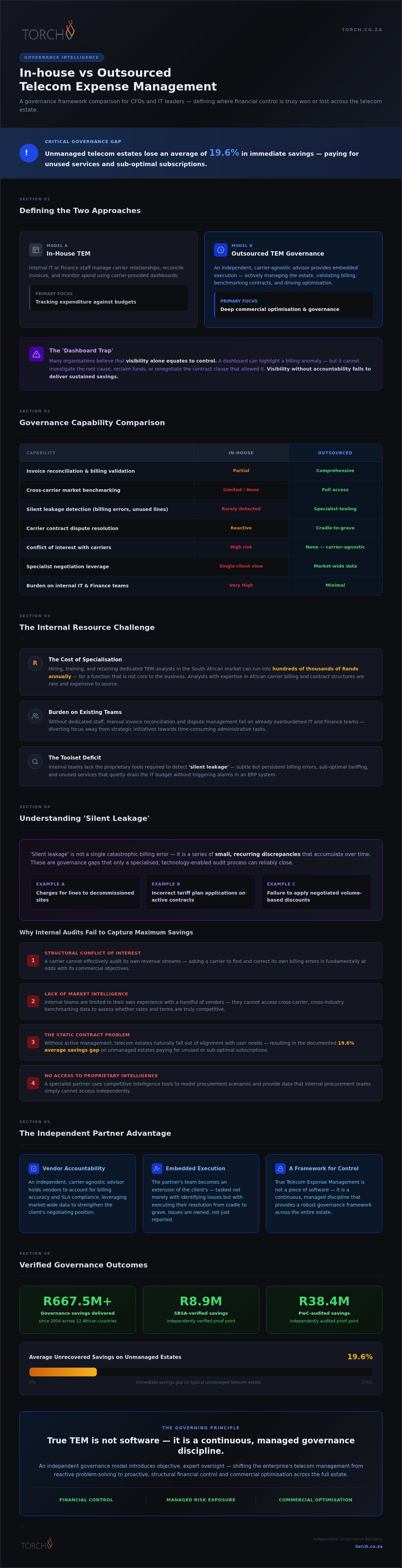
- Define In-house TEM: This model relies on internal staff, often within IT or finance departments, to manage carrier relationships, reconcile invoices, and monitor spend using carrier-provided or third-party dashboards. The primary focus is typically on tracking expenditure against budgets.
- Define Outsourced TEM Governance: This approach involves partnering with an independent, carrier-agnostic advisor. The relationship moves beyond simple reporting to embedded execution, where the partner actively manages the estate, validates billing, benchmarks contracts, and drives optimisation initiatives on the client’s behalf.
- The ‘Dashboard Trap’: Many organisations fall into the ‘Dashboard Trap,’ believing that visibility alone equates to control. A dashboard can highlight a billing anomaly, but it cannot investigate the root cause, reclaim the funds, or renegotiate the contract clause that allowed it. Visibility without accountability fails to deliver sustained savings.
- Identify the primary goal: The central question is whether the objective is merely tracking spend or achieving deep commercial optimisation. In-house teams are often equipped for the former, whilst a specialist partner is structured to deliver the latter.
The Internal Resource Challenge
Attempting to build a specialist TEM function internally presents significant financial and operational hurdles. The skills required—a blend of data analysis, contract law, procurement intelligence, and carrier negotiation expertise—are rare and expensive. In the South African market, the cost of hiring, training, and retaining dedicated TEM analysts can easily run into hundreds of thousands of Rands annually, often for a function that is not core to the business.
- The cost of specialisation: Sourcing analysts with deep expertise in African telecom carrier billing and contract structures is a formidable challenge for most HR departments.
- The burden on existing teams: Without dedicated staff, the responsibility for manual invoice reconciliation and dispute management falls upon already overburdened IT and Finance teams, diverting their focus from strategic initiatives to time-consuming administrative tasks.
- The toolset deficit: Internal teams often lack the sophisticated, proprietary tools needed to detect ‘silent leakage’—subtle but persistent billing errors, sub-optimal tariffing, and unused services that quietly drain the IT budget without triggering obvious alarms in an ERP system.
The Independent Partner Advantage
An outsourced governance partner fundamentally realigns the dynamic between an enterprise and its telecom carriers. By introducing an objective, expert third party, the model shifts from reactive problem-solving to proactive, structural control. The key lies in independence; a partner that does not sell connectivity has no conflict of interest and is motivated solely to secure the best commercial and operational outcome for the client.
- Vendor accountability: An independent, carrier-agnostic advisor holds vendors to account for billing accuracy and service level agreements, leveraging market-wide data to strengthen the client’s negotiating position.
- Embedded execution: This model differs from traditional vendor-client relationships. The partner’s team becomes an extension of the client’s, tasked not just with identifying issues but with executing their resolution from cradle to grave.
- A framework for control: This approach provides a robust governance framework for the entire estate. True Telecoms Expense Management is not a piece of software; it is a continuous, managed discipline.
Why Internal Telecom Audits Often Fail to Capture Maximum Savings
Even organisations with dedicated internal audit teams struggle to achieve the level of savings that an independent TEM partner can secure. The reasons are not related to effort or competence but to structural disadvantages in market intelligence, negotiating leverage, and inherent conflicts of interest. An internal audit can verify that an invoice matches a contract, but it cannot determine if the contract itself is commercially optimised against the current market.
- The conflict of interest: A carrier cannot effectively audit its own revenue streams. Asking a carrier to find and correct its own billing errors is fundamentally at odds with its commercial objectives.
- Lack of market intelligence: Internal teams are limited to their own experience with a handful of vendors. They cannot access the cross-carrier, cross-industry benchmarking data required to know if their rates and terms are truly competitive.
- The ‘Static Contract’ issue: Without active management, telecom estates naturally fall out of alignment with user needs. Our analysis shows that unmanaged estates lose an average of 19.6% in immediate savings due to paying for unused services or sub-optimal subscriptions.
- Proprietary competitive intelligence: A specialist partner utilises tools like TorchLight™, a competitive intelligence engine, to model procurement scenarios and provide data that internal procurement teams simply cannot access.
Detecting Silent Leakage and Financial Gaps
‘Silent leakage’ is one of an organisation’s most persistent and insidious financial drains. It is not a single, catastrophic billing error but a series of small, recurring discrepancies that accumulate over time. These issues are not governance failures in the traditional sense; they are governance gaps that only a specialised, technology-enabled audit process can close.
- A governance gap, not a simple error: Examples include charges for lines to decommissioned sites, incorrect tariff plan applications, or failure to apply volume-based discounts. These are rarely detected by standard financial controls.
- Impact on board-level reporting: Inaccurate cost-centre allocation, a common form of leakage, compromises the integrity of financial reporting, making it impossible for the board to get a true picture of departmental or project-level profitability.
- Real-time visibility: Platforms like SpotLight™ provide real-time visibility into consumption and spend, integrating with ERP and HR systems to ensure that every Rand is correctly allocated and accounted for, a level of granularity internal systems often miss.
The Benchmarking Deficit
The single greatest advantage an independent partner brings is access to live, carrier-agnostic market data. This intelligence transforms contract negotiations from a subjective debate into a data-driven exercise in commercial optimisation, yielding an average of 27.5% in negotiation gains for our clients.
- Data-driven negotiation: Benchmarking allows an organisation to enter negotiations knowing precisely what constitutes a competitive rate for their specific usage profile, eliminating guesswork and strengthening their position.
- Speed of decision-making: With clear, data-backed recommendations, enterprises can avoid months of internal debate. As demonstrated in a proven engagement with the Tsogo Group, this entire process—from challenge to a data-backed procurement decision—was completed in just six weeks.
- The antidote to unmanaged spend: This approach is the antidote to unmanaged spend, built upon an integrated framework of six service lines: Telecom Expense Management (TEM), Telecom Lifecycle Management (TLM), Unified Endpoint Management (UEM), IT FinOps, IT Asset Management (ITAM), and Security Operations (SecOps).
Assessing the ROI: Financial Control and Managed Risk Exposure
When comparing in-house vs outsourced TEM, the return on investment extends far beyond direct cost savings. A fully governed telecom estate delivers enhanced financial control, reduced administrative overhead, and significantly lower security risk exposure. The financial case is not about adding a new cost but about reallocating existing, inefficient spend to a model that guarantees a return.
- Cost vs savings model: CFOs can compare the fixed cost of a monthly service fee against the variable, performance-based risk-share savings model, which ensures the partner is only compensated from verified, tangible savings.
- The security angle: Effective TEM is inextricably linked to security. By governing every endpoint through a Unified Endpoint Management (UEM) framework, organisations drastically reduce common entry points for ransomware and data breaches.
- Total cost reduction: Actively governed estates achieve up to 47.2% total cost reduction when compared to their unmanaged equivalents, a result of integrated financial, operational, and security controls.
- High-touch execution: The value of an outsourced partner lies in high-touch, embedded execution—resolving issues, not just reporting them. This hands-on approach delivers a far greater ROI than simple software-only solutions.
Aligning Incentives with Risk-Share Models
For many CFOs, the primary objection to outsourcing is the perceived risk of engaging a new service provider. The risk-share model directly addresses this concern by perfectly aligning the partner’s incentives with the client’s financial goals. Under this model, particularly for first-year TEM engagements, the partner’s fee is calculated as a percentage of the verified savings it delivers.
- Performance-based remuneration: The partner is compensated directly from the savings found and validated, ensuring they are highly motivated to identify and recover every Rand of overspending.
- Reduced financial risk: This model eliminates the upfront financial risk for CFOs. If no savings are found, no fee is paid, making the engagement a self-funding initiative.
- Budgeting and forecasting excellence: By establishing a predictable and optimised cost base, this model provides the foundation for superior IT FinOps, enabling more accurate budgeting and forecasting.
Security and Governance Integration
In today’s threat landscape, telecom governance and cybersecurity are two sides of the same coin. An unmanaged mobile device is not just a potential source of cost leakage; it is a critical security vulnerability. Integrating endpoint security into the TEM framework provides a powerful defence against financial and reputational damage.
- Mitigating a primary threat vector: Industry data shows that 85% of ransomware entry points originate from unmanaged or poorly secured endpoint devices. A robust UEM policy is a critical defence.
- The cost of a breach vs. proactive management: The potential financial cost of a single data breach—including regulatory fines, recovery expenses, and reputational damage—dwarfs the modest per-user cost of a Unified Endpoint Management service, which can start from as little as R45 per user per month.
- Sustainable optimisation: The goal is to achieve lasting optimisation through structural control. This is accomplished by embedding security and financial governance into the daily operations of the telecom estate, moving far beyond the limitations of a one-off audit.
Implementing a Governance-Led TEM Managed Service
The transition from a reactive, internally managed model to a proactive, partner-led governance framework is a structured and efficient process. It is designed to deliver clarity and control swiftly, minimising disruption to the organisation whilst maximising the speed at which savings and efficiencies are realised. This strategic shift closes the governance gap permanently.
- A clear transition process: The move from internal chaos to governed clarity typically takes six weeks, involving a comprehensive audit, the establishment of new controls, and the integration of the partner’s team and technology.
- Cradle-to-grave lifecycle management: An effective managed service covers the entire lifecycle of both mobile and fixed-line assets, from procurement and deployment to ongoing support, optimisation, and eventual retirement.
- Integration with board reporting: The data and insights generated by the TEM platform are integrated with wider IT financial management systems, providing the CFO and the board with accurate, reliable, and strategic reporting.
- Closing the governance gap: The objective is to ensure every user and every issue is managed, every day.
The FinOps-as-a-Service Roadmap
For organisations seeking to elevate their financial oversight, a FinOps-as-a-Service model provides a clear roadmap. It transforms the TEM function from a cost centre into a source of strategic business intelligence, enabling data-driven decisions that impact the entire enterprise.
- Monthly service discipline: Core activities like invoice reconciliation, variance analysis, and cost-centre allocation are performed as a continuous monthly service, ensuring financial discipline is maintained.
- Improving executive confidence: By delivering accurate and timely IT finance reporting, this model improves the confidence of the executive team and the board in the integrity of the IT budget.
- Uncovering hidden opportunities: Using purpose-built Business Intelligence (BI) models, this service can identify hidden IT savings opportunities across complex estates, spanning operations in up to 12 African countries.
Next Steps for CFOs and IT Leaders
The decision between in-house and outsourced TEM rests on an organisation’s appetite for structural control and commercial optimisation. If the goal is simply to track spend, an internal team may suffice. If the goal is to unlock significant, sustainable savings and mitigate risk, an independent governance partner is the strategic choice.
- Determine your readiness: An organisation’s ‘FinOps Readiness’ can be quickly determined through a 20-minute diagnostic designed to assess current processes, tools, and governance gaps.
- Start with a no-risk audit: The most effective first step is a no-cost billing audit against the last three months of carrier invoices. This provides a clear, data-backed snapshot of the immediate savings potential.
- Shift your strategic focus: The ultimate objective is to move the organisation from ‘reactive reporting’ on past expenditure to ‘proactive commercial optimisation’ of future spend.
To understand how independent governance can be applied to your specific telecom estate, the next step is a confidential, no-obligation discussion about your current challenges and strategic goals.