
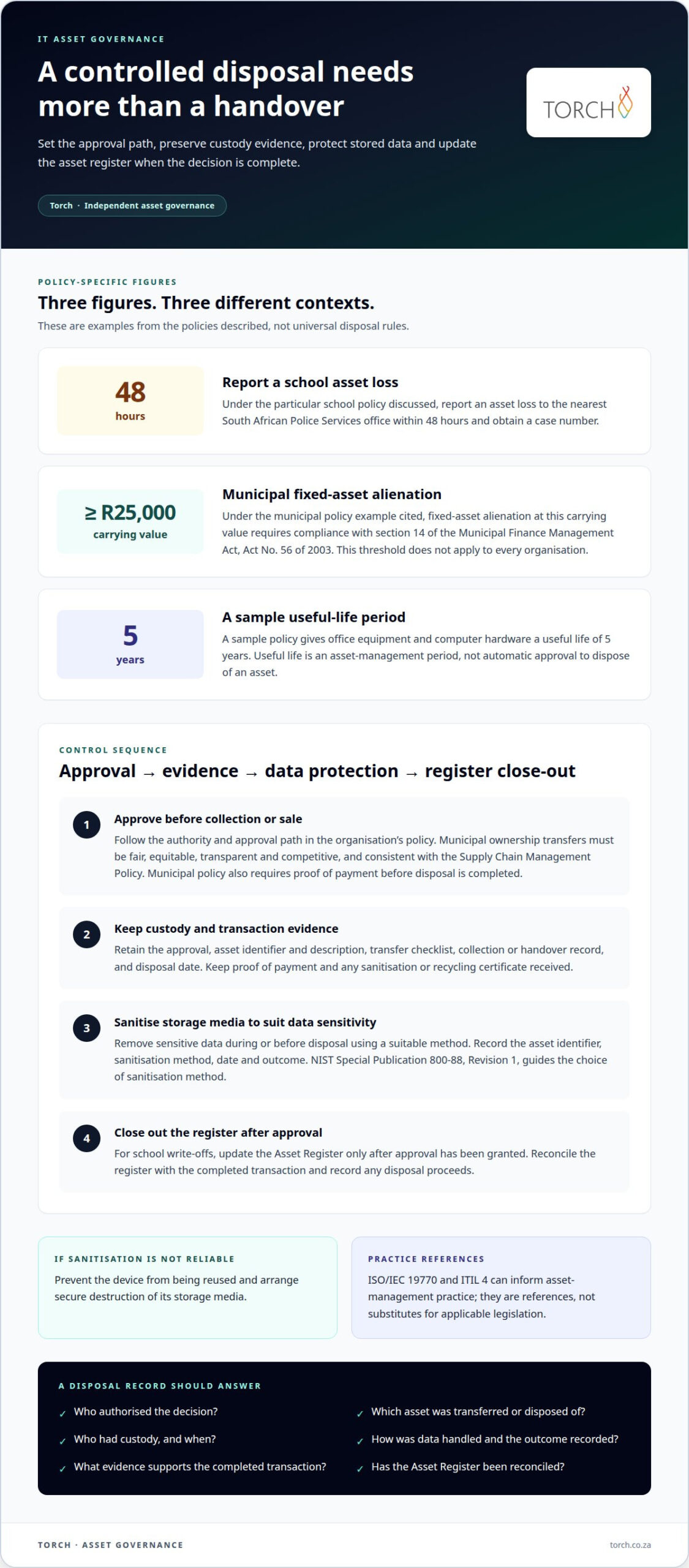
A disposal is not complete when equipment leaves the building. An IT asset disposal policy in South Africa should set out who approves the decision, how the asset register is updated and how the disposal is recorded. The applicable framework depends on the organisation: municipal policies identify the Municipal Finance Management Act, Act No. 56 of 2003, while a school policy may list the Public Finance Management Act and National Treasury Regulations. Under the particular school policy discussed, an asset loss must be reported to the nearest South African Police Services office within 48 hours, and a case number obtained.
When developing an IT asset disposal policy in South Africa, define who approves disposal, which records to retain and what happens when an asset is missing. Clear responsibilities and records help maintain oversight of equipment, data and disposal proceeds. This guide outlines South African legislation and policy references, the approval and transfer process, how to report losses, and the responsibilities of asset officers and management committees. It also explains how requirements can vary between organisations, so you can apply controls that fit your context.
Key Takeaways
- Identify the legislation and asset-management references that apply to your organisation, including the municipal threshold that can affect fixed-asset alienation.
- Set a clear approval path for disposals, transfers and write-offs, and keep the supporting records aligned with each decision.
- Establish a consistent response to loss, theft or damage so reporting, case records and register updates are handled in the right order.
- Define the asset officer’s and management committee’s responsibilities to strengthen oversight across the asset lifecycle.
- See how an asset-management service can connect each asset to an owner and cost centre, with lifecycle tracking from procurement to decommission.
Applicable legislation and regulations
A statutory framework is the set of laws and references guiding asset decisions. An IT asset disposal policy in South Africa should reflect the organisation’s context. Municipal policies list the Constitution of the Republic of South Africa, 1996, and the Municipal Systems Act, 2000, as amended. School policies may instead reference public-sector financial rules and departmental asset-management guidance.
The Municipal Finance Management Act (MFMA) is identified as Act No. 56 of 2003. For municipal fixed-asset alienation with a carrying value of at least R25 000, the KZN 436 and Ingwe Municipality policy requires compliance with section 14 of the MFMA. This threshold concerns municipal fixed-asset alienation, not every organisation’s disposal decisions. The applicable policy should identify which rules govern its own approval process.
South Peninsula High School’s asset policy lists the Public Finance Management Act (PFMA), the National Treasury Regulations (NTR), the National Treasury Asset Management Reform Strategy and the Departmental Asset Management Policy. It also refers to Financial Regulations, Frameworks and the Standard Chart of Accounts for Public Schools. These documents provide the policy context for managing school assets.
GRAP 17 is the standard for Property, Plant and Equipment. A sample policy gives office equipment and computer hardware a useful life of 5 years. Useful life is an asset-management period, not automatic disposal approval. ISO/IEC 19770 and ITIL 4 can also inform asset-management practice by providing recognised references for managing IT assets and services. They should be treated as practice references, not as substitutes for applicable legislation.
Improper disposal can add electronic waste to the environment, expose stored information and weaken compliance records. NIST defines media sanitisation as making access to target data infeasible for a given level of effort. Its Special Publication 800-88, Revision 1, guides the selection of sanitisation methods.
Sample policies require data-storing assets to be tracked regardless of cost, assigned an asset ID and recorded in a database with the date of each change. They also require sensitive data to be removed during or before disposal using a method suited to its sensitivity. Together, these controls address environmental handling, information security and evidence of an asset’s final status.
Asset disposal approvals and procedures
A controlled disposal process connects approval, asset records, data handling and final transfer. The required steps depend on the organisation’s policy and the type of asset.
Disposal approval procedures
Disposal approval is documented authorisation to remove an asset from use or transfer its ownership. Schools may not dispose of assets without approval from the relevant authority. For municipalities, fixed-asset ownership transfers must be fair, equitable, transparent and competitive, and consistent with the Supply Chain Management Policy. Obtain approval before arranging collection or sale. Municipal policy also requires proof of payment before completing a disposal. For school write-offs, update the Asset Register only after approval has been granted.
Disposal records and custody evidence
Disposal records document what happened to an asset and who handled it. Retain the approval, asset identifier, description, transfer checklist, collection or handover record, and disposal date. A sample policy requires a transfer checklist when an asset changes location or trustee, or is disposed of. Keep proof of payment for municipal disposals and any sanitisation or recycling certificate issued. Together, these records help reconcile the asset register with the completed transaction.
Data wiping and destruction
Media sanitisation makes access to data on storage media infeasible for a given level of effort. NIST Special Publication 800-88, Revision 1, guides the choice of sanitisation method. Sample policy requirements state that sensitive data must be removed during or before disposal, with the method based on the data’s sensitivity. Record the asset identifier, sanitisation method, date and outcome. If a device cannot be reliably sanitised, prevent its reuse and arrange secure destruction of its storage media.
E-waste recyclers and disposition providers
An e-waste recycler processes discarded electronics, while an IT asset disposition provider may also manage collection, data sanitisation and resale. South African organisations can use either, depending on the asset’s condition and the chosen disposal route. Costs and resale values vary with equipment condition, age, completeness, transport, sanitisation and demand for reusable components. Require the selected provider to document collection, custody and final treatment. Record any certificates or transaction evidence received, then reconcile proceeds against the approved disposal.
Asset losses, theft and damage reporting
An asset-loss report records that equipment is missing, stolen or damaged. A clear process helps establish what happened, protect information and keep asset records accurate. Distinguish theft from accidental damage and unexplained absence. For example, a stolen laptop needs a different incident record from a cracked screen, even if both assets are unavailable.
For a school, an asset loss must be reported to the nearest South African Police Services office within 48 hours, and a case number must be obtained. Record that number with the asset details and incident date. This requirement is specific to the school policy described here; organisations should follow the reporting rules that apply to their own operating context.
Begin the internal response by promptly notifying the responsible manager or asset officer. Include the asset ID, make and model, assigned user, cost centre, last known location and a concise description. For a damaged device, record its visible condition and whether it remains in use. For a missing device, note when and where it was last seen, who had custody and any known witnesses.
If a device may contain sensitive information, notify the organisation’s information-security contact as part of the same incident process. The response can then address access risks, such as disabling accounts or credentials associated with the device. These are operational controls, not substitutes for a police report when the applicable policy requires one.
Keep incident evidence together: the internal report, photographs of damage, relevant correspondence, the police case number where applicable, and decisions about repair, replacement or write-off. Dated records of actions make the sequence easier to review. Do not present assumptions as facts: distinguish what is known, what remains unclear and who provided each account.
After assessing the incident, update the asset record to reflect the asset’s status and location. A school policy allows a lost asset to be removed from its Asset Register only after write-off approval. Until then, preserve the record and link it to the incident file. For damaged equipment, document whether it returns to service, goes for repair or enters an approved disposal process.
Reviewing incident patterns can reveal control weaknesses. Repeated losses from one location, for example, may point to gaps in storage or handover procedures. Use documented cases to improve access controls, custody records and staff guidance, while retaining the evidence and decision trail for each incident.
Asset officer and management committee responsibilities
An asset officer coordinates asset administration and maintains the school’s asset records. The school policy requires newly delivered assets to be entered in the Asset Register within seven days. This gives each item a formal record and makes it possible to assign follow-up responsibility. The officer connects delivery information with later checks, incident handling and approved changes to an asset’s status.
An Asset Management Committee provides a governance structure for asset-management decisions. The school policy requires at least five and no more than seven members. Defined membership clarifies who contributes to oversight and supports accountability for decisions. The committee’s work should complement the asset officer’s administrative role, rather than leaving one person responsible for every decision or verification activity.
Departmental verification means confirming that fixed assets remain under the relevant department’s control or use. The KZN 436 and Ingwe Municipality policy requires each department head to verify all fixed assets under that department’s control or use at least once in each financial year. This responsibility places verification with the manager closest to the assets’ daily use, rather than relying solely on central records.
A school asset verification team conducts physical checks against the school’s records. The school policy requires physical verification at least twice per school year and recommends counts in April and August. During a count, the team can identify discrepancies for investigation and record outcomes for follow-up. A missing item, for example, should be escalated through the organisation’s incident and approval processes, not treated as a routine register adjustment.
These roles work best as distinct parts of one control process. The asset officer records deliveries and administers approved changes; department heads verify assets under their control; and the verification team carries out physical checks. The committee provides oversight of asset management. Clear ownership helps ensure verification findings are resolved while keeping administration separate from review and decision-making.
Torch: One Partner, Six Integrated Service Lines
Torch Services supports organisations seeking a clearer connection between asset records, ownership and IT costs. Its asset-management service is relevant when fragmented records make it difficult to identify who is accountable for equipment, which cost centre carries it or where it is in its lifecycle.
The service maintains a full asset register that attributes every asset to an owner and a cost centre, with lifecycle tracking from procurement to decommission. ITAM, UEM and FinOps share one view, so asset ownership, endpoint management and cost information can be considered together. This gives decision-makers a consistent reference when assessing equipment status and its associated IT spend.
Torch’s proposition is One Partner, Six Integrated Service Lines: TEM, TLM, UEM, FinOps, ITAM and SecOps. For asset governance, the connected view across ITAM, UEM and FinOps is particularly relevant: it brings lifecycle information and cost allocation into the same management context. The appropriate capability depends on the organisation’s specific governance requirement.
Torch is independent, carrier-agnostic and vendor-neutral, with no commissions. This supports the organisation’s own asset and IT cost governance, rather than a carrier’s commercial interests. Torch’s services support internal decision-making but do not replace the organisation’s approval authority, disposal policy or responsibility for deciding how assets are handled.
A joined-up view of assets can make operational decisions more informed. Lifecycle information, for example, can help teams assess whether an asset remains in use or has reached decommissioning, while keeping its owner and cost centre visible. Connecting these details brings accountability and IT spend into the same discussion, rather than treating the asset record separately from its financial context.
Organisations may consider Torch’s asset-management service when they need stronger lifecycle visibility or a clearer connection between asset ownership and cost-centre information. The service supports asset management and operational efficiency, while internal approval processes remain the organisation’s responsibility.
Request a complimentary audit of a sample of your invoices.
Frequently Asked Questions
What should an IT asset disposal policy in South Africa include?
An IT asset disposal policy in South Africa should define decision rights, asset records, data handling and permitted disposal routes. It should explain how the organisation distinguishes reuse, donation, resale, recycling and destruction. A working laptop approved for redeployment, for example, needs a different outcome record from a damaged storage device. Assign each decision to a role so staff know who authorises the route and updates the records.
Which South African laws govern disposal of electronic waste and IT assets?
The applicable framework depends on the organisation and asset context. Municipal policies identify the Constitution of the Republic of South Africa, 1996, the Municipal Finance Management Act, Act No. 56 of 2003, and the Municipal Systems Act, 2000, as amended. School policies may list the Public Finance Management Act, National Treasury Regulations and asset-management references. GRAP 17 concerns Property, Plant and Equipment. Policies should distinguish these frameworks rather than treating them as identical rules for every organisation.
What does South Africa’s National Environmental Management: Waste Act require for e-waste disposal?
For each electronic item, document how it leaves the organisation’s control and where it goes next. Separate equipment for reuse from items sent for recycling or destruction, and retain transfer or treatment evidence. Choose the route according to the item’s condition and intended end use. Do not treat a handover as complete until the equipment reconciles with its disposal record.
Which data protection requirements under POPIA apply to disposing of computers and storage devices?
For computers and storage devices containing personal information, control access to the data before equipment is transferred, reused or discarded. Identify the device, record the sanitisation outcome and ensure the method suits the information’s sensitivity. A device intended for redeployment should not retain data from its previous user. Keep disposal evidence with the asset record so the organisation can trace the handling decision and final status.
How should organisations classify, inventory, approve, and document IT assets for disposal?
Classify each item by condition, data-bearing capability and proposed route, then match it to a unique asset record. Include make, model, serial number where available, assigned owner, cost centre and location. For example, distinguish equipment awaiting assessment from equipment approved for resale. Record the authorisation and final outcome against the same asset record. This gives finance, IT and operational teams a consistent reference when reviewing asset status.
What are the steps for disposing of, recycling, donating, or reselling IT equipment in South Africa?
Start by identifying the asset and confirming its condition, data status and intended route. Obtain the required organisational approval, prepare the device for transfer and record who receives it. For resale, retain transaction evidence; for donation, document the recipient and handover; for recycling or destruction, retain evidence of the provider’s treatment. Complete the process by updating the asset record with the actual outcome, not just the planned disposal.