
What if an IT budget variance is less a reporting problem than a sign that no one owns the next decision? In 2026, IT financial management best practices must do more than show where money went. They need to connect technology spend to accountable owners, clear actions and business priorities.
IT costs can be difficult to explain when telecom, software and endpoint expenditure sit across different teams, suppliers and processes. A report may surface a variance without showing who should investigate it, update the forecast or take corrective action. Fragmented oversight can also obscure security exposure alongside financial risk.
This article sets out a practical framework for governing IT budgets and expenditure, improving visibility and assigning responsibility for costs, forecasts and variances. It also explores how FinOps, telecom expense management and endpoint governance can support more informed commercial and operational decisions. The aim is lasting financial control and accountability, with security considered as part of sound technology investment.
Key Takeaways
- Use IT financial management best practices to link technology expenditure to ownership, allocation and business value.
- Classify costs and assign accountable owners before deciding whether showback or chargeback suits your organisation.
- Turn reporting into follow-through: validate variances, assign action owners and track agreed resolutions.
- Build a practical operating model by establishing a spend baseline, prioritising governance gaps and reviewing forecasts regularly.
- Assess where internal capacity is sufficient and where specialist support could strengthen financial control and accountability.
What IT financial management best practices are designed to control
A finance leader can see technology expenditure in the accounts and still lack the information needed to explain it. Which team owns the cost? What service or business need does it support? Is a variance temporary, or does it point to a decision that needs attention? Without clear answers, financial reporting records spend but offers limited control over it.
IT financial management (ITFM) is the ongoing discipline of planning, allocating, monitoring and governing technology spend so reliable cost information supports accountable business decisions. It goes beyond setting an annual budget. ITFM connects expenditure to the services and resources being funded, then uses that understanding to guide forecasts, reviews and corrective action. It sits within the broader practice of information technology management, where budgeting and resource management help organisations direct technology towards business needs.
For enterprises managing complex estates, independent governance can bring disconnected cost information and ownership into a clearer operating picture. For example, telecom expense management can help organisations examine telecom expenditure alongside their wider financial controls.
Which decisions should IT financial management support?
Useful ITFM gives decision-makers enough context to set budgets, refresh forecasts and assess procurement choices. It helps compare the cost of a service with its use and business purpose, so leaders can prioritise needs rather than make decisions from a line-item total alone.
There is a practical distinction between reporting an expense and explaining it. A useful account of a cost identifies its owner, purpose, expected level and reason for any variance. For example, a cost-centre report that shows an unexpected increase should also help teams check whether usage changed, a contract was amended or the original forecast assumptions no longer apply. That context helps finance and technology teams decide whether to investigate, adjust a forecast or review the underlying commitment.
Why does spend visibility need governance?
When ownership is fragmented across teams, suppliers and systems, costs can be difficult to challenge consistently or forecast with confidence. Visibility is the starting point, not the control itself. Governance establishes who reviews the information, how often they do so and what happens when a variance or gap needs attention.
That discipline also supports managed risk exposure. Endpoint costs and security oversight can intersect: devices that are poorly tracked may create uncertainty about both expenditure and operational exposure. Financial control and accountability therefore work best when cost reviews consider the resources being funded, their business purpose and relevant governance gaps. The IT financial management best practices that follow build on this foundation by linking cost information to clear ownership and action.
Build IT financial management around ownership, allocation and forecasting
Reliable control depends on more than collecting cost data. These IT financial management best practices connect each expenditure to an owner, a clear allocation method and a forecast that can be revised as business needs change.
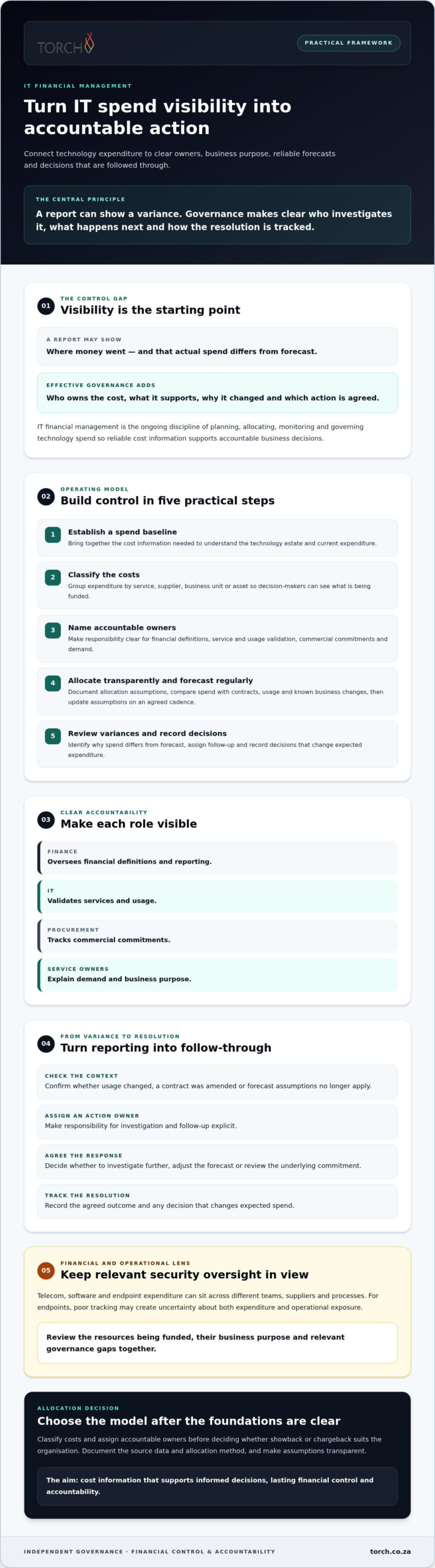
- Assign owners: Finance oversees financial definitions and reporting; IT validates services and usage; procurement tracks commercial commitments; service owners explain demand and business purpose.
- Classify costs: Group expenditure by service, supplier, business unit or asset, using categories that help decision-makers understand what is being funded.
- Allocate transparently: Set out the assumptions behind cost-centre allocations, such as measured usage or an agreed allocation basis.
- Forecast regularly: Compare actual expenditure with contracts, usage patterns and known business changes, then update assumptions on an agreed cadence.
- Review variances: Identify the reason for differences from forecast, assign follow-up and record any decision that changes expected spend.
Apply the same discipline to relevant parts of the enterprise estate. Telecom expenditure may involve services used across teams, while endpoint costs can include devices, support and management requirements. For each category, document the source data and allocation method. The rules should reflect how the organisation operates, rather than assume every cost can be divided in the same way.
Assign cost ownership and choose an allocation model
Showback reports costs to the teams that use or benefit from a service, helping them understand consumption without necessarily transferring the expense to their budgets. It can be a useful starting point where the priority is awareness or where allocation rules are still being refined. Chargeback assigns costs to business units or cost centres and may suit organisations with established, consistently applied allocation rules. Neither model is universal. The method matters less than clear assumptions that teams can understand and challenge.
Before choosing, check whether the underlying usage or allocation data is reliable enough to support the method. If two teams cannot understand how a shared service was split, the allocation is unlikely to encourage useful decisions. For organisations formalising these controls, an IT FinOps service model can help connect financial information with ownership and operational follow-through.
Make budgets and forecasts responsive to change
Build forecasts from actual expenditure, contract commitments, observed usage and known changes to services or business demand. Set a regular review cadence that gives finance, IT and service owners time to explain variances and adjust assumptions. Use scenarios to examine decisions, dependencies and consequences, such as how a planned service change may affect allocation. Scenarios should support judgement, not imply certainty where future demand is unclear.
Document the assumptions behind each forecast and note when they were last reviewed. When a forecast changes, record what changed and who approved the revised view. This gives teams a practical reference point for explaining expected spend and deciding whether another adjustment is needed.
Turn IT spend reporting into action, not another dashboard
A dashboard can flag a variance; it cannot decide whether the difference is justified, who must investigate it or what happens next. Effective IT financial management best practices pair reporting with independent governance and follow-through, so financial signals lead to informed decisions rather than another review with no clear outcome.
Create a useful review and remediation cycle
Set review frequency and escalation thresholds to suit your organisation’s spend, risk and operating needs. For each material variance, use a consistent four-step cycle:
- Detect: Identify where actual expenditure differs from the budget or latest forecast.
- Validate: Check the evidence, such as invoices, contract terms and relevant usage records.
- Assign: Name the person responsible for investigating the variance and agreeing a response.
- Track: Record the decision, owner, due date and outcome, then confirm the action is complete.
A variance is not automatically an error. For telecom expenditure, an invoice difference may reflect a contract change, usage fluctuation or an internal allocation issue. Compare the invoice with the relevant contract and usage evidence to establish what changed before taking action. This matters because billing errors are commonly estimated at 7–12% of invoices, so unvalidated variances can carry real cost. Telecom Expense Management can support a structured approach to reviewing these costs and strengthening financial control and accountability.
Connect financial control with operational and security governance
Endpoint expenditure also needs operational context. Device lifecycle information and policy oversight can help teams understand what assets are in use, which costs relate to them and whether those devices remain appropriately managed. A purchasing decision based on cost alone may overlook support needs or security exposure; Sophos 2025 puts the average ransomware recovery cost at R24M. Consider these alongside the financial case. Unified Endpoint Management can help connect endpoint oversight with cost visibility and security governance.
Keep the process proportionate: focus attention on material differences, document why they matter and escalate unresolved issues through agreed channels. That gives leaders a clearer basis for commercial optimisation without treating every fluctuation as a control failure. Over time, reviewing outcomes can also reveal recurring data gaps or unclear responsibilities that need to be addressed in the operating model.
Put IT financial management best practices into an accountable operating model
Strong IT financial management best practices become sustainable when they are built into clear roles and repeatable routines. Start with what the organisation can verify, then strengthen the controls that will improve decisions and financial accountability.
Start with a practical IT financial governance roadmap
Build the operating model in stages, rather than adding reporting requirements before you know what is missing:
- Baseline spend: List relevant cost categories, contracts, reporting sources, existing reviews and current owners.
- Agree ownership: Confirm who supplies, validates and acts on the information across finance, IT, procurement and service teams.
- Prioritise gaps: Focus first on material areas where unclear ownership, incomplete evidence or inconsistent review weakens control.
- Establish reviews: Set a suitable cadence for examining costs, forecasts, variances and open actions.
- Refine forecasts: Use review findings to update assumptions and improve the next planning cycle.
Measure progress by whether costs have named owners, forecasts are reviewed consistently, material issues reach resolution and reporting helps leaders make decisions. These measures keep the effort focused on useful control, not dashboard volume. If an issue remains open after a review, record the reason, next action and person responsible so it is not lost before the next cycle.
When independent governance support can help
Internal teams may have the knowledge to manage spend but lack the capacity, consistent data or cross-functional remit to review it across telecom, software and endpoints. Independent, carrier-agnostic governance can complement existing teams by bringing an objective review perspective without replacing internal decision-makers or treating supplier relationships as the problem.
Torch Services provides IT FinOps-as-a-Service, Telecom Expense Management and endpoint governance and security. Its work can support financial visibility alongside vendor accountability and managed risk exposure. Torch’s Telecom Expense Management includes billing validation, contract audits, benchmarking, usage optimisation and support for commercial decisions. Its FinOps service covers financial processes such as invoice reconciliation, variance analysis, budgeting and forecasting. The right scope depends on the gaps an organisation needs to address.
Assess specialist support against specific needs: which costs lack clear ownership, what evidence is difficult to reconcile, and which reviews are not leading to action? The answers can help determine whether to build capacity internally, add support or combine both approaches. Torch’s services can support organisations looking to strengthen those controls across telecom and IT expenditure.
Make financial control part of everyday IT decisions
Reliable IT financial management best practices connect technology costs to clear owners, business purpose and timely action. Start with a dependable view of expenditure, agree how costs are allocated, and use regular reviews to turn variances into decisions. Forecasts then become more useful, while cost oversight can account for operational needs and managed risk exposure.
Independent governance can complement internal teams when fragmented services or reporting make accountability harder to maintain. Torch Services’ offerings include Telecom Expense Management, IT FinOps-as-a-Service, Unified Endpoint Security and Management, and more, such as technology lifecycle management (TLM), IT asset management (ITAM) and SecOps. These services can help organisations examine technology spend, strengthen financial processes and connect endpoint oversight with security governance. The appropriate support depends on the organisation’s needs and the controls already in place.
With the right responsibilities and routines in place, technology spend can be easier to explain, govern and align with business priorities.
Frequently Asked Questions
What are the best practices for IT financial management?
IT financial management best practices include assigning owners to costs, classifying expenditure consistently, making allocation assumptions clear, and updating forecasts using actual spend and known changes. Review variances against budgets, contracts and usage evidence, then record who will resolve material issues and by when. This creates a repeatable link between technology costs and business decisions, rather than treating financial management as an annual budgeting exercise.
How can an organisation improve visibility of IT spending?
Start by bringing available financial, contract, invoice, asset and usage information into a consistent view. Categorise costs by service, supplier, team or cost centre where the data supports it, and identify who validates each source. For example, telecom invoices can be checked against contract terms and relevant usage records. Explain each material cost by its owner and purpose, so reporting helps teams investigate and decide rather than simply observe.
What is the difference between IT showback and chargeback?
Showback reports the cost of services or resources to the teams that use or benefit from them, helping those teams understand consumption without necessarily transferring the expense to their budgets. Chargeback allocates costs to a team or cost centre, typically under agreed rules. Showback can help build awareness while allocation assumptions are being developed; chargeback may suit an organisation with consistent, explainable rules. Neither model is essential for every organisation.
Is a dashboard enough for IT financial management?
No. A dashboard can highlight spending patterns or variances, but it cannot establish whether a difference is justified or ensure that someone acts. Effective governance adds validation, ownership and follow-through. Compare the signal with relevant evidence, such as a contract or usage record, assign an accountable owner, then track the decision, due date and outcome. Without those steps, visibility may improve while control and accountability remain unclear.
How often should IT budgets and forecasts be reviewed?
Set a review cadence that reflects your organisation’s spending patterns, commitments and decision-making needs. There is no single frequency that suits every enterprise. Reviews should be regular enough to identify material changes before they undermine a forecast, and timely enough for owners to respond. Compare actual expenditure with budget, forecast and relevant contract or usage information. Revisit assumptions when business demand, services or commitments change.
How can IT financial management include security considerations?
Include security by considering the assets and controls behind technology expenditure, not just the financial amount. For endpoint-related spend, review device ownership, lifecycle status and whether devices are governed under appropriate policies. This helps decision-makers weigh cost alongside operational requirements and managed risk exposure. A lower-cost option may not be suitable if it leaves devices or support needs outside the organisation’s oversight. Include relevant IT and security stakeholders in reviews.