
Addressing the Governance Gap: Why Manual IT Procurement Fails
In the realm of IT procurement, manual processes often fall short, leading to governance gaps and significant financial control deficiencies. IT procurement workflow automation integrates financial governance with operational efficiency, offering a seamless approach to managing IT expenses and procurement activities.
Dashboards can highlight issues within procurement processes, but they do not resolve them. It’s essential to have independent oversight to ensure that problems are not just identified but effectively addressed. Unmanaged IT estates often suffer from ‘silent leakage’—unnoticed financial losses due to unverified vendor billing and lack of comprehensive oversight.
The Cost of Control Deficiencies
- Manual invoice reconciliation frequently results in unrecovered billing errors, impacting an organisation’s financial health.
- Ghost assets, or unused and untracked resources, can significantly drain corporate finances if not properly managed.
- Internal audits may fail to capture the full scope of issues due to the absence of carrier-agnostic data, essential for an unbiased analysis.
Independent Governance vs. Software Dashboards
There is a fundamental difference between merely recognizing a problem and having the tools to execute a solution. Independent governance provides the necessary oversight to address issues effectively, especially in the African telecom landscape. Implementing IT FinOps can restore board-level confidence and ensure robust financial control.
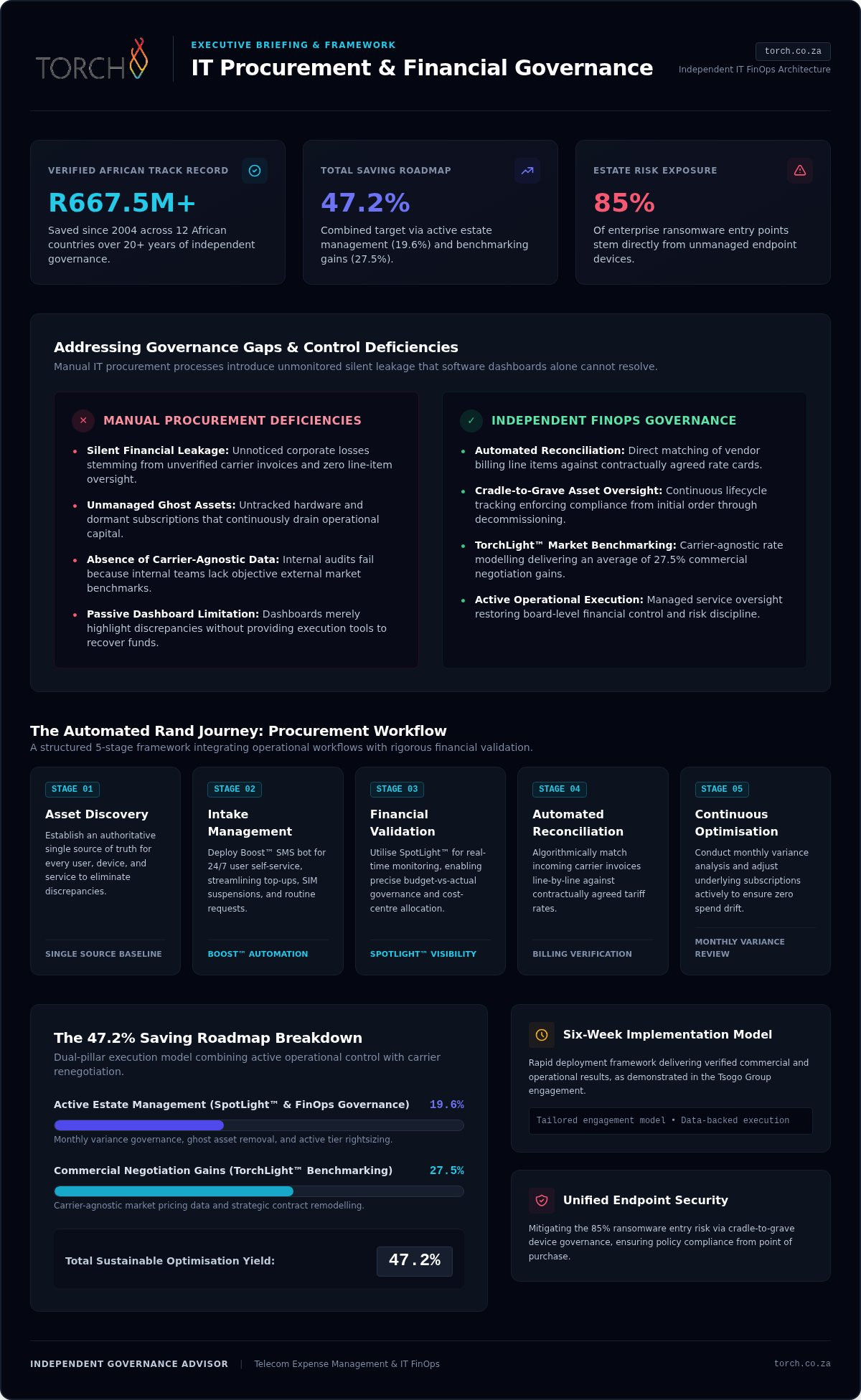
The Automated Rand Journey: Building an Efficient IT Procurement Workflow
Building an efficient IT procurement workflow involves a structured approach. Here’s how to automate the journey:
- Automated Asset Discovery – Establish a single source of truth for every user and device to eliminate discrepancies.
- Intake Management – Implement tools like the Boost™ SMS bot to facilitate user self-service and streamline requests.
- Financial Validation – Use real-time monitoring tools like SpotLight™ to ensure accurate budget-vs-actual oversight.
- Automated Reconciliation – Match carrier invoices against contractually agreed rates to ensure billing accuracy.
- Continuous Optimisation – Conduct monthly variance analysis and adjust subscriptions actively to maintain efficiency.
Simplifying the Request Process
Automation reduces the burden on internal IT teams by simplifying complex request paths. Tools like Boost™ handle 24/7 requests efficiently, ensuring processes such as top-ups and SIM suspensions are managed with minimal disruption.
Integrating Procurement with Asset Management
Managing the lifecycle of IT hardware and endpoints from ‘cradle-to-grave’ is crucial. Implementing Unified Endpoint Management ensures policy compliance from the moment of purchase, integrating procurement with asset management seamlessly.
Independent Oversight: Benchmarking and Silent Leakage Detection
Utilising tools like TorchLight™ for market benchmarking and contract modelling can significantly enhance procurement strategies. Carrier-agnostic benchmarking typically yields an average of 27.5% in negotiation gains, revealing financial benefits that internal teams might overlook.
Market Benchmarking in the African Context
- Local market data is indispensable for effective commercial renegotiation, enabling organisations to engage vendors with informed strategies.
- With over 20 years of experience, Torch Services has saved over R667.5M+ across 12 African countries, showcasing a profound understanding of the African market landscape.
Detecting Billing Errors with SpotLight™
Real-time governance visibility is crucial for cost-centre allocation. SpotLight™ helps identify hidden costs in enterprise telecom billing, serving as a core pillar of governance within Telecom Expense Management.
Delivering Sustainable Optimisation: The Torch Implementation Model
The Torch implementation model is designed to deliver results efficiently. While the six-week engagement model has shown significant results in case studies like Tsogo Group, each project is tailored to the client’s unique needs.
The 47.2% Saving Roadmap
- Savings breakdown: 19.6% from active management and 27.5% from negotiation gains are achieved through sustained embedded execution.
- The Tsogo Group case study exemplifies data-backed decisions that ensure long-term savings.
Securing the Estate through Procurement
With 85% of ransomware entry points originating from unmanaged devices, implementing Unified Endpoint Security Management is essential to protect both data and budgets. This proactive approach mitigates ransomware risks and fortifies financial governance.
For a comprehensive evaluation of your current control deficiencies, book a 30-minute governance review with Derek King.